
The most useful interpretation of a definite integral is total change. When a quantity changes at a known signed rate, integrating the rate over an interval gives the net change in that quantity. Area and volume are geometric examples, but the same structure describes displacement from velocity, work from force, charge from current, and inventory from net flow.
This lesson focuses on choosing the correct accumulated quantity. Signs and units decide whether an integral represents net change, total amount, displacement, distance, or work. A formula that is symbolically correct but interpreted as the wrong quantity is not a complete solution. We will use physical examples to reinforce the accumulated-rate model without assuming every rate is nonnegative.
By the end, you should write a work integral, distinguish displacement from distance, use an initial value plus integrated rate to obtain an endpoint amount, and check physical units. The final lesson synthesizes the complete Calculus I path and points toward Calculus II.
Work accumulates force along displacement
For a variable force component parallel to displacement, work from to is
A narrow displacement contributes approximately to the work. If force is measured in newtons and displacement in meters, the result has units , joules. A negative force component performs negative work relative to the chosen displacement direction.
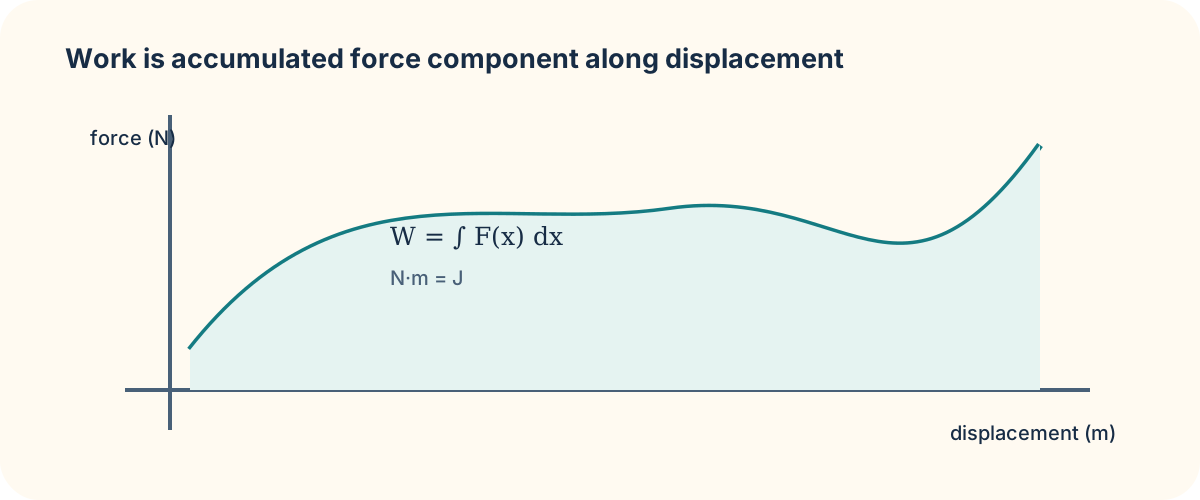
For a spring with force magnitude , where has units , stretching from zero to meters requires work . The integral captures that force changes with displacement. Replacing it with one force value times total displacement would be only an approximation unless the force were constant.
Velocity gives displacement or distance depending on signs
If is velocity, then
This signed integral gives final position minus initial position. If velocity changes sign, regions below the time axis subtract. Total distance counts motion in either direction, so it requires or a split at every velocity zero followed by positive magnitudes.
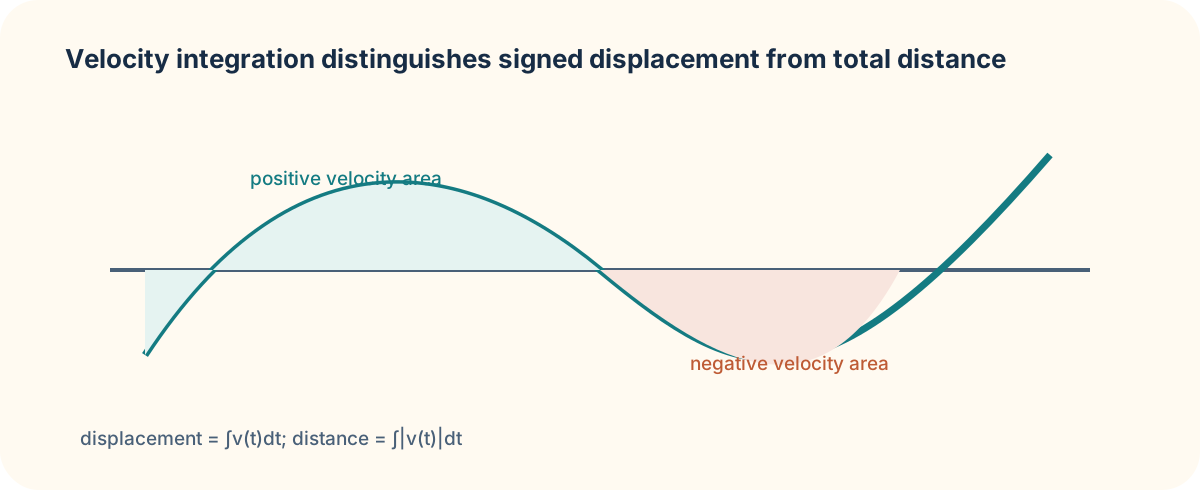
Suppose an object travels right for and then left for . Its displacement is , while its distance traveled is . A velocity integral gives the first quantity. To get the second, change negative contributions to positive magnitudes. State which question is being answered before choosing the integrand.
Total change combines rate and starting value
If is the signed rate of a quantity, then
This equation keeps the starting amount distinct from the accumulated change. A rate may alternate sign, but the integral correctly updates the quantity through all gains and losses. The endpoint units match , because rate units times time units produce quantity units.
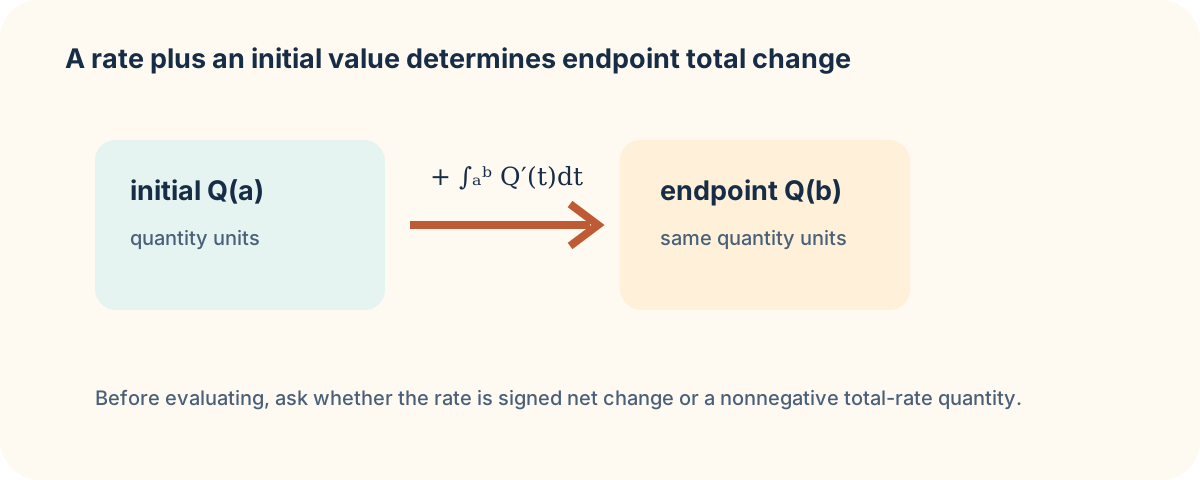
For an account balance measured in dollars with net rate in , the integral gives dollars of net change. It does not automatically give total deposits or total withdrawals, which would require separate nonnegative rate models. The context determines whether signed cancellation is desirable or whether absolute or component-wise accumulation is needed.
Use units and signs as final checks
Before evaluating an integral, label the integrand’s units, differential units, and expected result units. Then determine whether negative values should subtract from the final quantity. This check prevents common errors such as reporting velocity after integrating velocity, or calling signed displacement “total distance.”
Practice by finding the work done by from to . Then analyze a velocity function that changes sign and calculate both displacement and total distance. Finally, write a net-change model for a tank with initial volume and a signed flow rate. The course synthesis will connect these applications back to functions, limits, derivatives, and the progression toward more advanced calculus.