
Calculus often presents an expression in a form that hides the behavior we need to study. Direct substitution may produce , a difference quotient may contain a common displacement factor, or two radical terms may resist comparison. These obstacles are not invitations to ignore restrictions. They are signals that an equivalent form may reveal structure on the nearby domain. Algebraic restructuring is therefore part of calculus reasoning, not preliminary housekeeping.
This lesson organizes three high-value tools: factoring, combining rational expressions, and multiplying by conjugates. Each tool will be tied to a structural goal. We will distinguish equality of expressions on a restricted set from equality of functions on their full domains. We will also keep excluded inputs visible after cancellation. The guiding question is: what transformation reveals the behavior without changing the mathematical object under study?
By the end, you should choose an appropriate restructuring method, justify each step, and preserve original restrictions. You should explain why cancellation removes a factor rather than a point from the domain. You should rationalize radical differences without treating a conjugate as magic. You should combine nested fractions accurately. The next lesson completes Unit 1 preparation with radians, neighborhoods, and a cumulative readiness challenge.
Factoring reveals a hidden common factor
Consider . Substituting is illegal because the denominator is zero. Factoring gives
The cancellation is valid only where the cancelled factor is nonzero. The simpler expression reveals nearby behavior while the original input remains excluded.
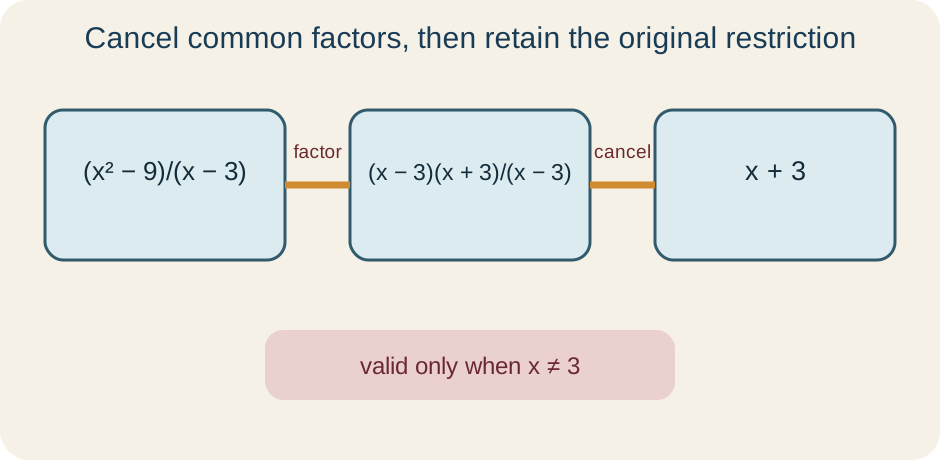
The original rational function and the line are not equal as functions on their natural domains. They agree for every , but exists and does not. This distinction will later allow a limit to exist at a missing point. Local agreement on a punctured neighborhood can be enough for a limit even when global function equality fails. Domain language makes that statement precise.
Difference quotients use the same structure. For , the numerator factors as . The factor cancels for . The resulting expression exposes how secant slopes behave for nonzero displacements. It does not define the original quotient at .
Choose the factorization that matches the obstacle
The difference of squares identity is especially useful when the denominator contains . The difference of cubes identity serves the same role for cubic expressions. Factoring by grouping may reveal a shared displacement in higher-degree differences. The useful factorization is the one that exposes a denominator factor. Expanding everything first can hide that structure.
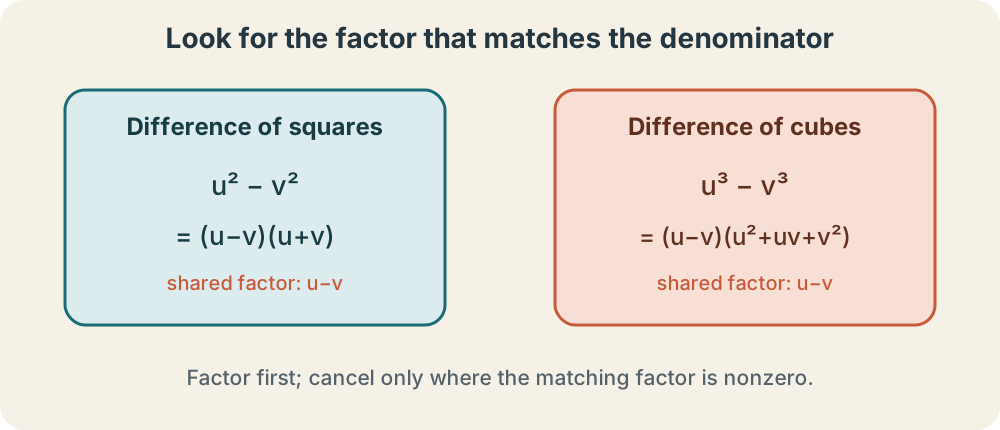
For , write and factor the numerator. The quotient becomes for . Evaluating the polynomial at two describes the nearby destination, not the original point value. Stating the restriction beside the simplified form prevents the two questions from being conflated. The algebra and domain should travel together.
Factoring is not always the correct first move. A sum of square roots does not usually contain a polynomial factor that matches its denominator. Nested rational terms are more naturally combined with a common denominator. Method selection depends on expression structure. A memorized command such as “always factor” is less useful than diagnosing what prevents comparison or cancellation.
Common denominators organize rational differences
For , the difference quotient contains
Combine the numerator fractions first:
Dividing by then gives , subject to , , and .
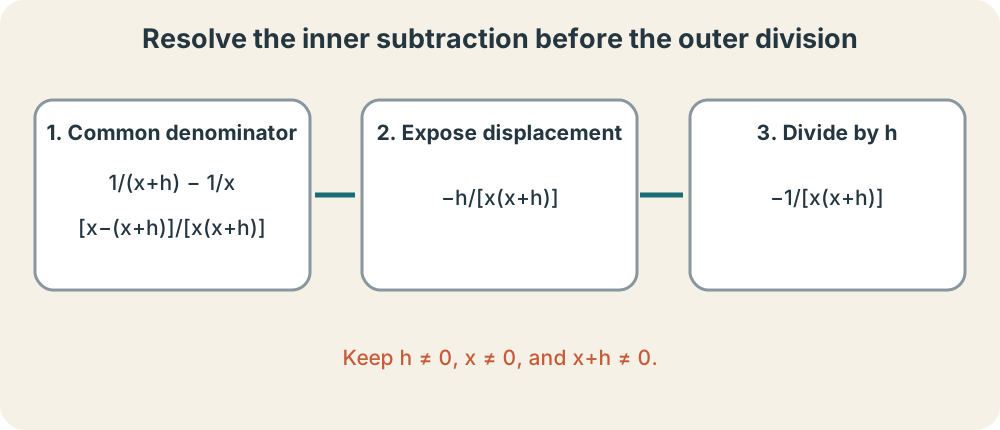
The subtraction sign must distribute across the entire second numerator. Writing instead of changes the result. Parentheses are therefore part of the reasoning rather than optional typography. After combining, the displacement factor appears because the two function values are close in structure. Cancelling that factor requires the already stated condition .
Restrictions arise from every denominator in the original expression. Simplification can make one restriction invisible, but it cannot make the excluded input legal retroactively. List restrictions before manipulating a complicated quotient. Then check that the final expression is asserted only on the original allowed domain. This habit prevents elegant but false equivalence claims.
Conjugates reveal radical structure
For a radical difference such as , multiply by the conjugate ratio
The ratio equals one wherever its denominator is nonzero, so it preserves the value. The numerator becomes through the difference-of-squares identity. A hidden displacement factor is now visible. Rationalization is therefore an application of factoring.
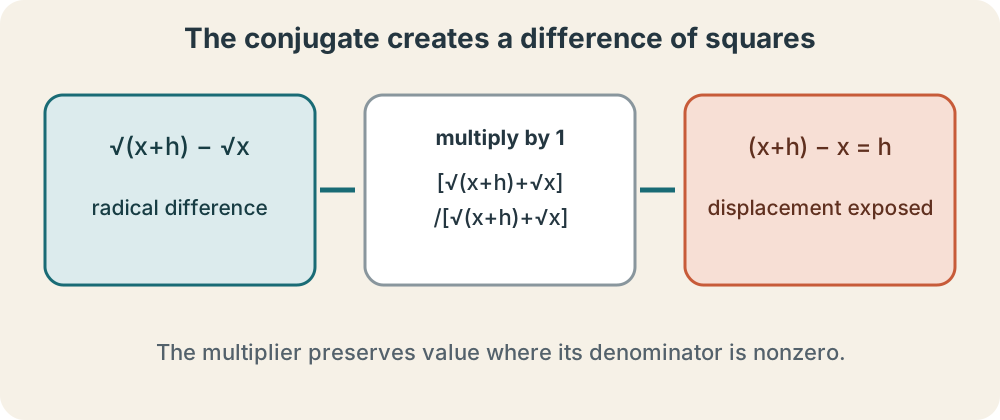
In a difference quotient, the exposed cancels with the outer denominator for . The simplified expression often has a sum of radicals in its denominator. Original square-root domain conditions remain in force. If the conjugate denominator could be zero, that condition must also be considered. Every transformation is justified by a nonzero multiplier equal to one.
For , multiply numerator and denominator by . The denominator factors as and cancellation produces for and . The original hole remains at four. The new form makes nearby behavior transparent without redefining the function.
Synthesis and transition
Simplify three expressions: , , and . For each, list restrictions before manipulating, name the chosen tool, and explain why the transformation is valid. Then state which restriction remains invisible in the final typography. Do not substitute into an excluded input as though simplification changed the original domain.
Create one incorrect solution that cancels terms across addition and one that loses a domain restriction. Annotate the first invalid line in each. Then repair the work using a valid factor or common denominator. Explaining an error demands deeper structural knowledge than merely producing a correct result. Use the repaired examples as a personal diagnostic checklist.
Algebraic restructuring reveals nearby equivalence while preserving the original mathematical question. Factoring, common denominators, and conjugates are selected because they expose a common displacement or remove an obstructive form. Cancellation relies on restrictions and never erases them. The next lesson adds radians, absolute-value neighborhoods, and exponent-logarithm discipline. Together, the two lessons form the readiness bridge from precalculus technique to limits.