
An antiderivative reconstructs a quantity from its rate in symbolic form. A definite integral constructs total accumulation directly by adding many small contributions. If a rate is nearly constant over a short interval, then rate times interval width estimates the amount accumulated there. A Riemann sum adds those estimates across a larger interval. Refining the partition makes the approximation approach a limiting exact value when the function is integrable.
This lesson develops the geometry and notation behind that idea. We will use rectangles to approximate area, sigma notation to record repeated addition, and signed area to interpret net change. The goal is not just to recognize an integral symbol; it is to see why a rate function multiplied by a small input width has the units and meaning of an accumulated quantity.
By the end, you should build a Riemann sum, explain every part of its sigma notation, distinguish net change from total amount, and connect a definite integral to a limit of increasingly refined approximations. The next lesson treats the upper endpoint as variable and turns accumulated area into a new function.
From rectangles to a limiting total
On an interval , divide the input range into subintervals of width . Choose a sample point in each subinterval. The rectangle height is , so its signed area estimate is . Adding all such estimates produces a Riemann sum. For equal-width partitions, .
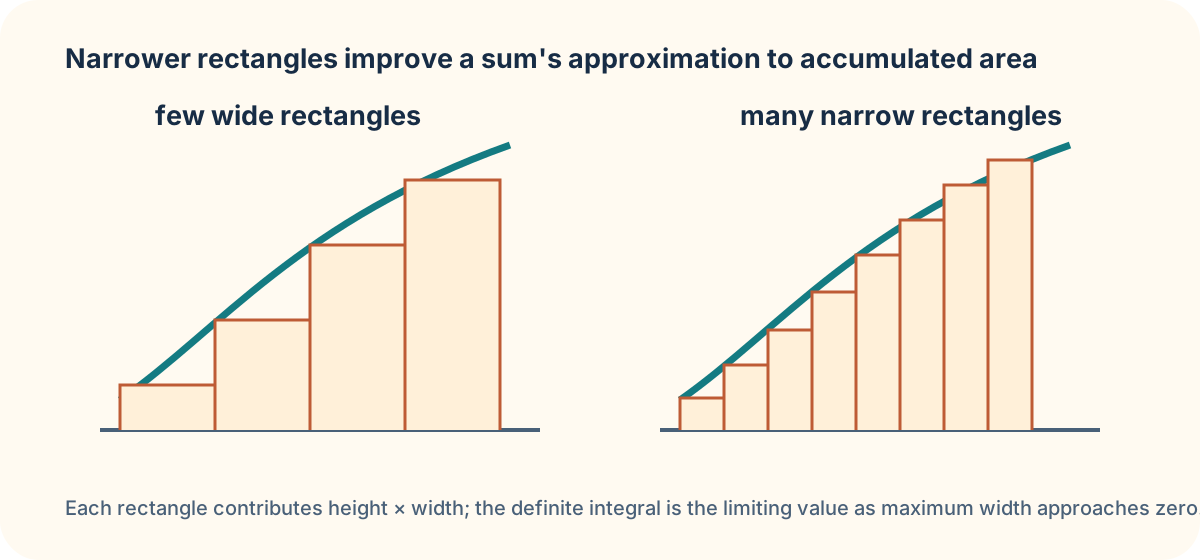
The definite integral is the limiting value:
The lower and upper bounds tell us which input interval is being accumulated. The integral symbol does not mean “multiply by a very small number.” It abbreviates a limit of ordinary finite sums. For continuous functions, choices such as left endpoints, right endpoints, or midpoints converge to the same integral as the largest subinterval width approaches zero.
Read sigma notation as repeated addition
The expression
means add one rectangle contribution for each index from one through . The star on marks a chosen sample point, not exponentiation. The product has the same units as area or accumulated change: output units multiplied by input units.
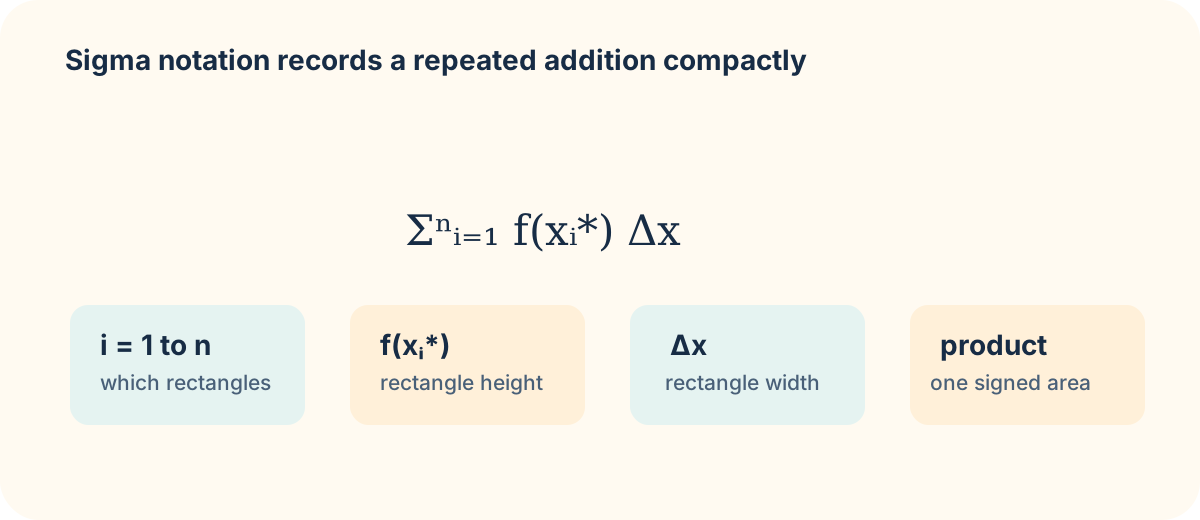
For velocity in , a contribution has units of meters. A sum of those contributions estimates displacement. For a flow rate in , multiplying by minutes yields liters. This unit conversion is not incidental; it reveals why integration recovers an accumulated quantity from a rate.
If on and we use two right-endpoint rectangles, then and sample points are one and two. The sum is . The exact integral is two, so this coarse right sum overestimates for an increasing function. More rectangles reduce the discrepancy. The limit, not a single chosen partition, defines the integral.
Signed area measures net change
When lies above the horizontal axis, its integral contribution is positive. When it lies below, the contribution is negative. Thus measures signed area, often called net change. A velocity graph below zero records motion in the negative coordinate direction, so its integral subtracts from displacement.
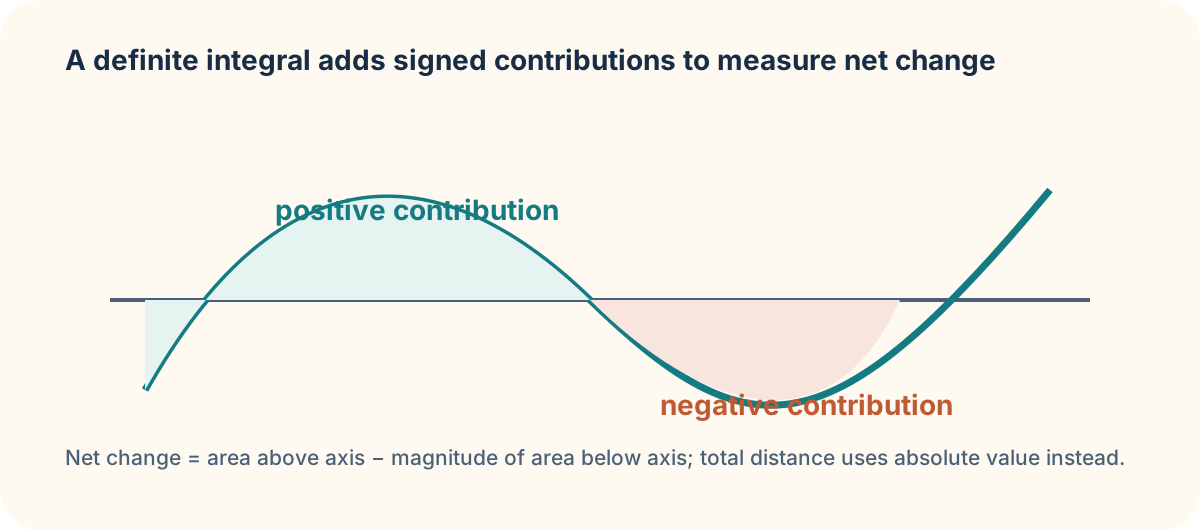
Total distance is different from displacement. If velocity is negative on part of an interval, total distance uses , which counts both directions positively. For example, an object that travels right and then left has displacement but total distance . State which quantity the context requests before interpreting an integral.
The same distinction appears in other models. A rate of inventory change below zero means inventory decreases. The integral gives net inventory change, while total throughput might require an absolute-value interpretation. Geometry language such as “area” is useful, but the units and model determine the accumulated quantity.
Prepare for accumulation functions
A definite integral has fixed bounds and produces a number. If the upper bound changes, the accumulated amount changes too, creating an accumulation function. That function will connect Riemann-sum construction to differentiation. Before moving on, approximate with a specified finite partition and label the resulting estimate. Then explain why the exact value is obtained only after a limiting process or an appropriate theorem.
Also practice reading a velocity table: multiply each sampled velocity by the corresponding time width, keep units in every contribution, and sum with signs. Ask whether the result estimates displacement or total distance. The Fundamental Theorem will soon provide an efficient endpoint method for exact integrals, but the Riemann-sum meaning remains the foundation for interpreting that method.