
Integration adds thin pieces. For volume, the pieces are thin cross sections rather than thin rectangles. If a solid has cross-sectional area perpendicular to the x-axis, then a slice of thickness contributes approximately to the volume. Summing and taking a limit gives the volume integral. The method is an extension of Riemann sums into three-dimensional geometry.
This lesson develops disks and washers, common cross sections produced by rotating a planar region around an axis. The crucial decisions are geometric: what is the slice direction, what is its outer radius, whether it has an inner hole, and which variable matches the slice thickness. Drawing one representative cross section before writing an integral prevents most setup errors.
By the end, you should construct a cross-sectional-area integral, distinguish a disk from a washer, choose slices perpendicular to the axis of rotation, and verify cubic units. The next lesson applies integration to work, motion, and other total-change contexts.
Volume is accumulated cross-sectional area
If the cross section perpendicular to the x-axis has area over , then
The integral’s units are cubic because has square-length units and has length units. The formula does not require a circular solid; any known cross-sectional area function can be integrated. A diagram should reveal how is determined from the original region.
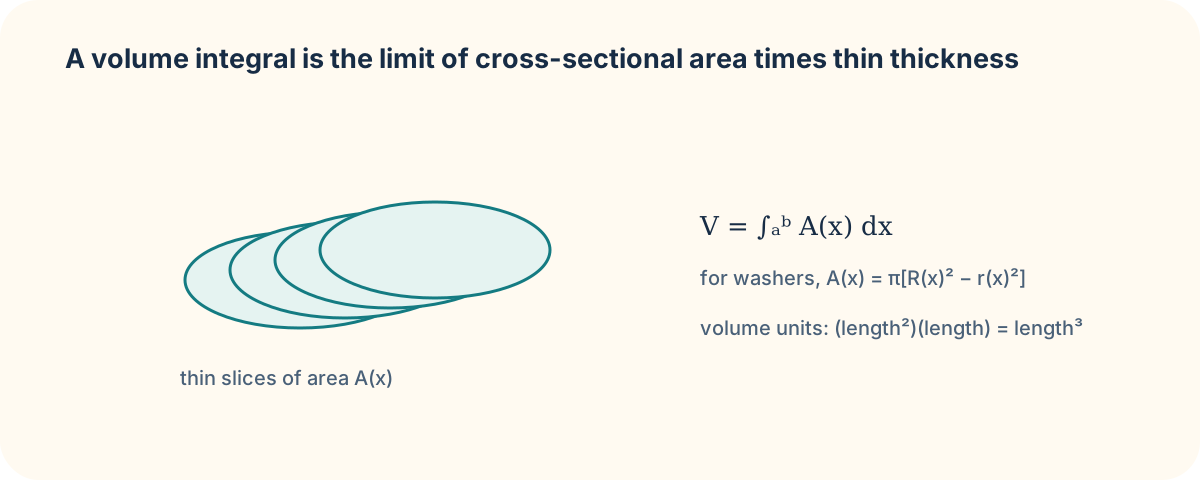
For a cylinder of radius and height , every cross section perpendicular to the height has area , so integration gives . The familiar formula is therefore a special case of the cross-section method. Calculus becomes valuable when cross-section area varies with position.
Disks and washers have different geometry
Rotating a region around an axis can create circular cross sections. A disk has no central hole, so its area is . A washer has an outer radius and inner radius , so its area is
The subtraction removes the hole’s cross-sectional area. The radii are distances from the axis of rotation, not simply y-values or x-values unless the axis is the relevant coordinate axis.
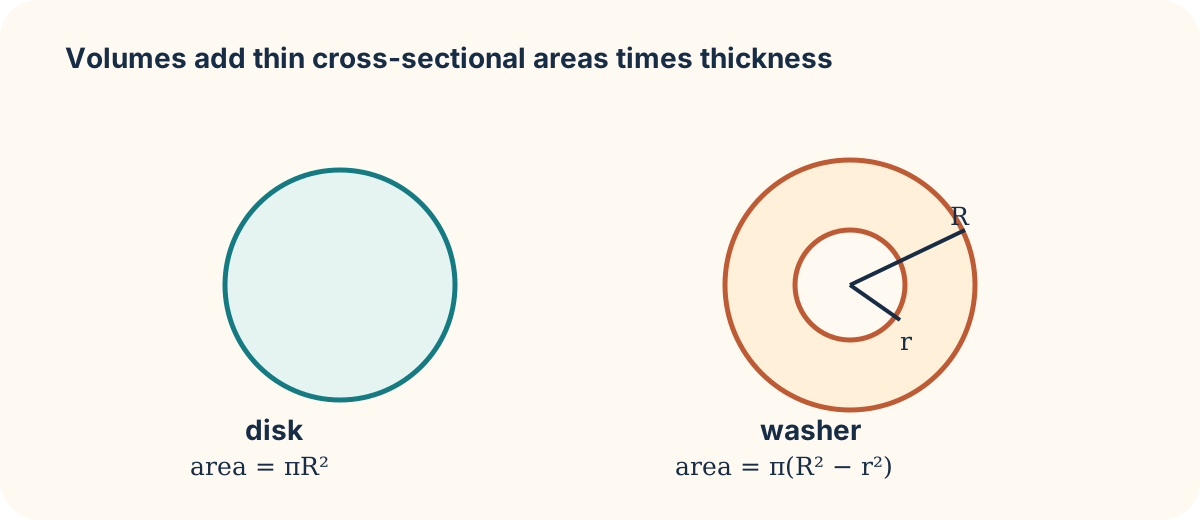
If the region under above the x-axis is rotated about the x-axis, vertical slices create disks of radius , so . If the region lies between two curves away from the axis, vertical slices create washers: outer radius minus inner radius must be identified from their distances to the axis. Sketch the line from the axis to each boundary before squaring anything.
Slice perpendicular to the rotation axis
For disks and washers, slices are perpendicular to the axis of rotation. A horizontal axis typically pairs with vertical slices and . A vertical axis typically pairs with horizontal slices and . This is a geometric rule, not a notation preference. If you use slices parallel to the axis, another method such as cylindrical shells may be more natural, but that is beyond this lesson’s scope.
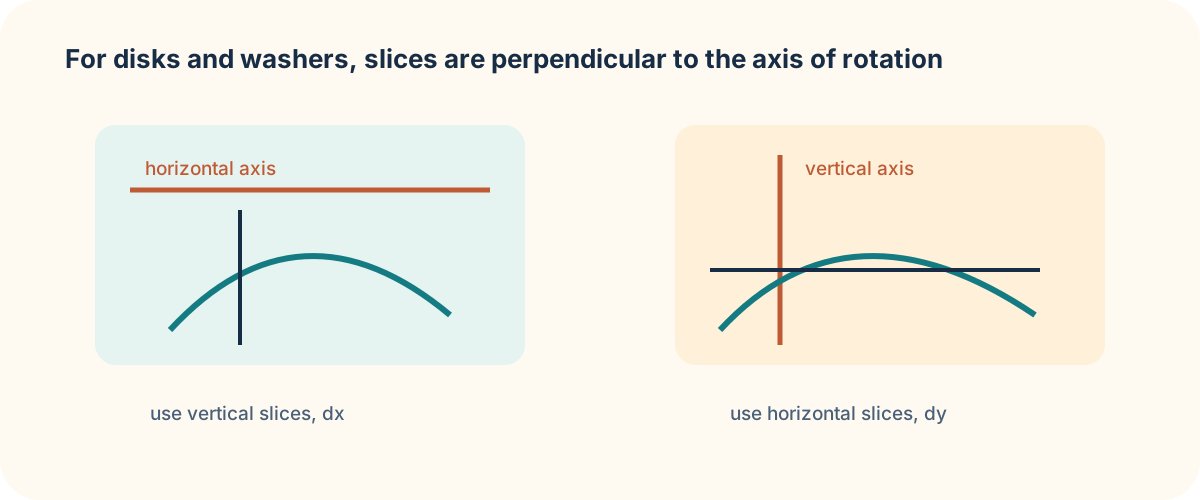
When an axis is shifted, measure radii as distances. Rotating about gives a radius such as , with the correct outer and inner distances determined by the region. Do not automatically square a signed difference without first deciding which boundary is farther from the axis. Squaring can hide a reversed-radius error.
Set up before evaluating
For a solid, state the bounds, variable, cross-sectional area, and units before evaluating. A final volume must be nonnegative with cubic units such as or . If an answer is negative, the integral setup likely has a reversed difference or a bound error. If it has square units, a thickness factor is missing.
Practice by rotating the region under from to about the x-axis. Sketch a vertical slice, name its radius, write the disk integral, and evaluate. Then consider a region between two curves rotated about a horizontal line and decide which is the outer radius. The next lesson turns from geometric accumulation to work, motion, and total change in physical models.