
The Fundamental Theorem of Calculus is the reason integration becomes computationally practical without losing its Riemann-sum meaning. It links two tasks that initially seem separate: accumulating a rate over an interval and finding a function whose derivative is that rate. The theorem has two complementary statements. One says an accumulation function differentiates back to its integrand. The other says a definite integral can be evaluated by an antiderivative at the endpoints.
This lesson keeps those statements distinct before using them together. The first part explains why local change and accumulated change reverse each other. The second part supplies the endpoint rule that replaces a long limiting sum with a short calculation. In every application, retain the units and signed-area interpretation built in the previous lessons.
By the end, you should state both parts of the theorem, evaluate a basic definite integral as an endpoint difference, and interpret the result as area or net change with correct units. The next lesson will recognize substitution as the reverse of the Chain Rule when an integrand contains an inner derivative.
Two statements, one connection
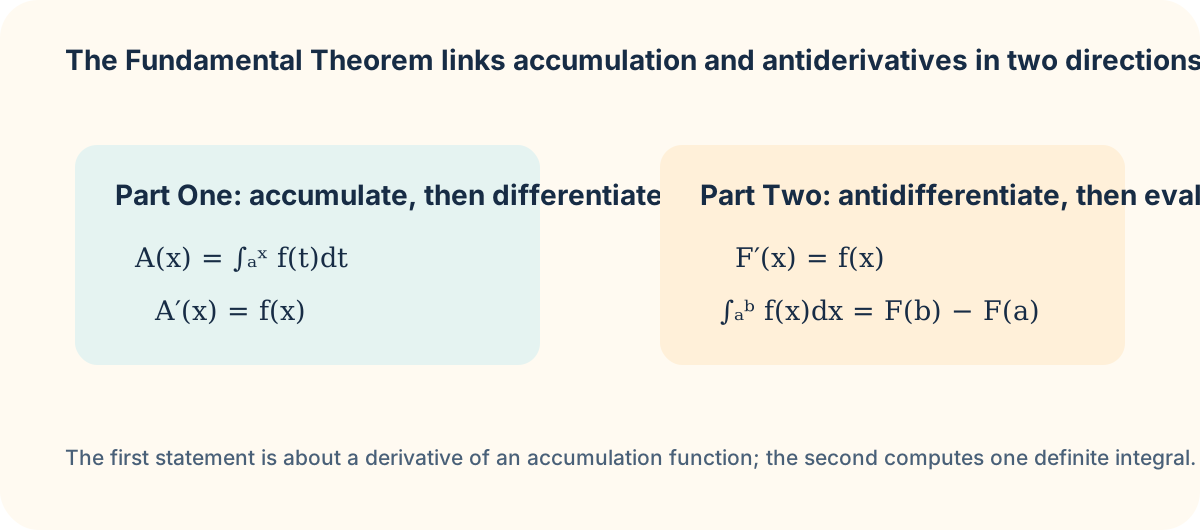
If is continuous and
then the first part says . The moving upper bound causes accumulated area to grow at the rate given by the current integrand height. The variable is a dummy variable inside the integral; is the input of the accumulation function. This distinction is essential when differentiating variable-bound integrals.
If , then the second part says
The notation is often written . Read it as “evaluate at the upper bound, then subtract the value at the lower bound.” It does not mean multiply the endpoints or treat the brackets as an interval.
Evaluate with an antiderivative
To compute , first find an antiderivative . Then evaluate:
The answer is a signed accumulated quantity over the interval. If the integrand represented a rate in and represented minutes, the answer would be liters. A bare number is incomplete in an applied problem.
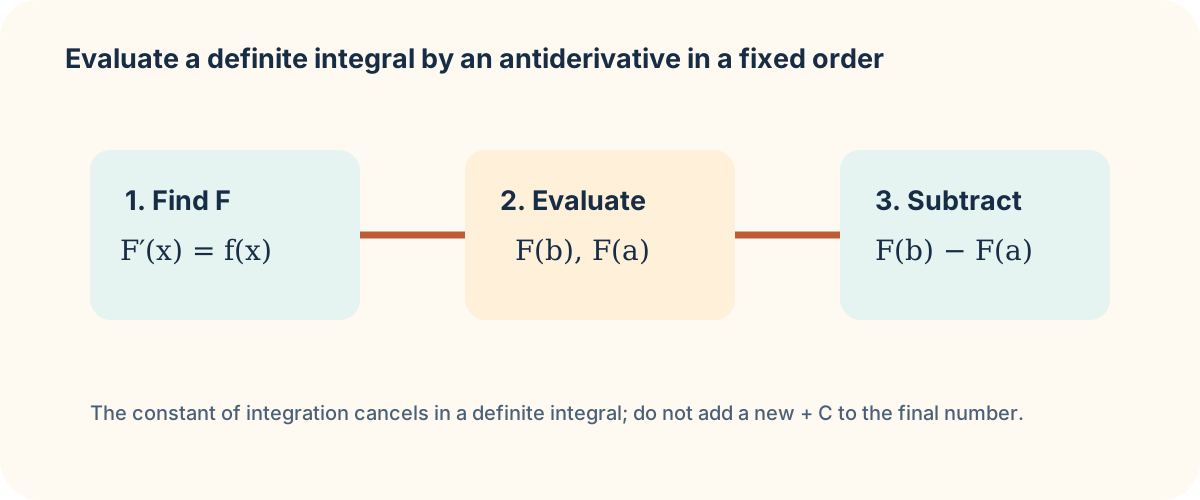
The constant of integration does not need to appear in a definite-integral calculation because . In contrast, an indefinite integral describes a family and must include . This difference follows from the task: a definite integral has fixed bounds and returns one number; an indefinite integral seeks all possible antiderivatives.
Preserve signed meaning and units
For velocity , the integral gives displacement. Negative velocity contributes negative displacement. To find total distance, first split at sign changes or integrate . The endpoint calculation is fast, but it does not change the interpretation established by Riemann sums.
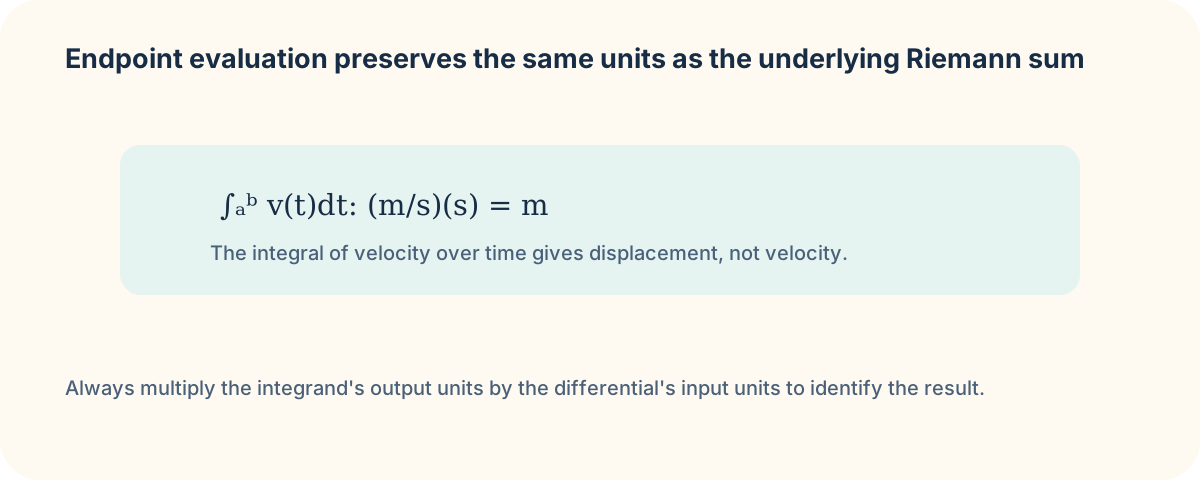
If for in seconds, then its antiderivative is interpreted carefully as a position change expression after evaluating times. From to , the displacement is . Write units through the calculation so the physical dimension of the answer remains visible.
Use the theorem as a conceptual check
When you differentiate an accumulation function, expect to recover the integrand at the moving bound. When you integrate a derivative over an interval, expect endpoint net change. These reciprocal checks catch common sign and bound-order errors. If reversing the bounds changes the sign, that is correct: .
Practice with and interpret the result as signed area. Then define and state without evaluating the integral first. The next lesson uses the same derivative structure to simplify integrals whose inner and outer functions are linked by composition.