
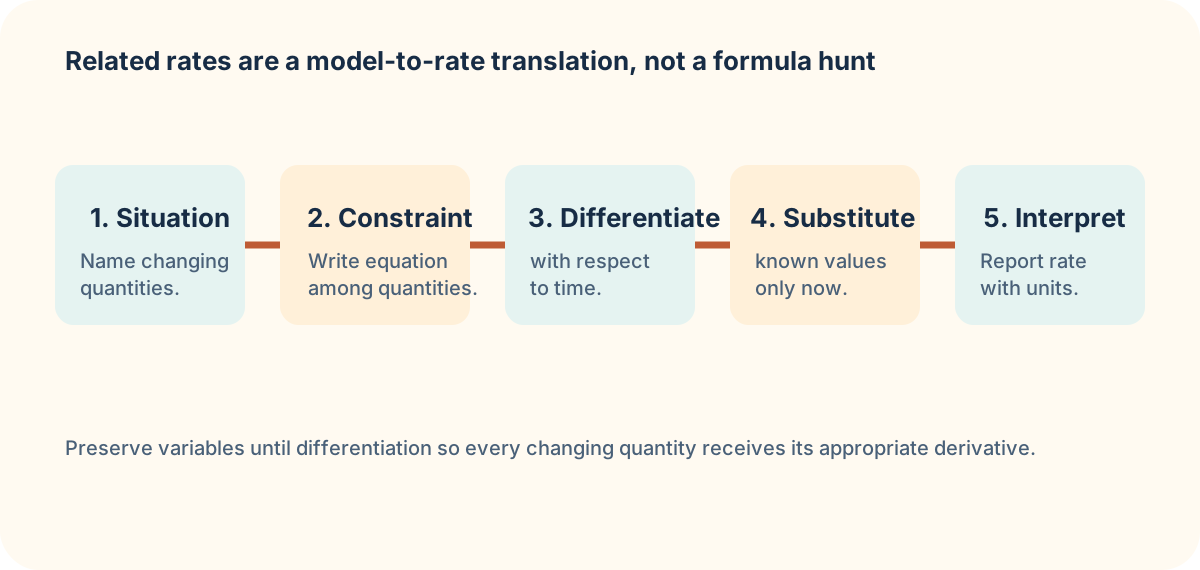
Related-rates problems describe quantities that change together. A circle’s radius and area, a tank’s water depth and volume, or a ladder’s height and horizontal distance are connected by a constraint. The derivative does not create that connection; it translates the constraint into a relationship among rates. The central challenge is modeling the situation accurately before doing any calculus.
The dependable workflow is: identify variables and units, write a relation among the variables, differentiate with respect to time, then substitute the particular values. The order matters. If you substitute a numerical value for a changing quantity too early, its derivative can disappear from the equation. Keeping the relation symbolic until after differentiation lets the Chain Rule record every active rate.
By the end, you should construct and differentiate a related-rates model, identify the requested derivative, and use units to check the result. You should also explain why a rate at an instant can depend on both a current value and another current rate. The next lesson uses tangent lines again, this time to iteratively approximate roots.
Translate the situation into a constraint
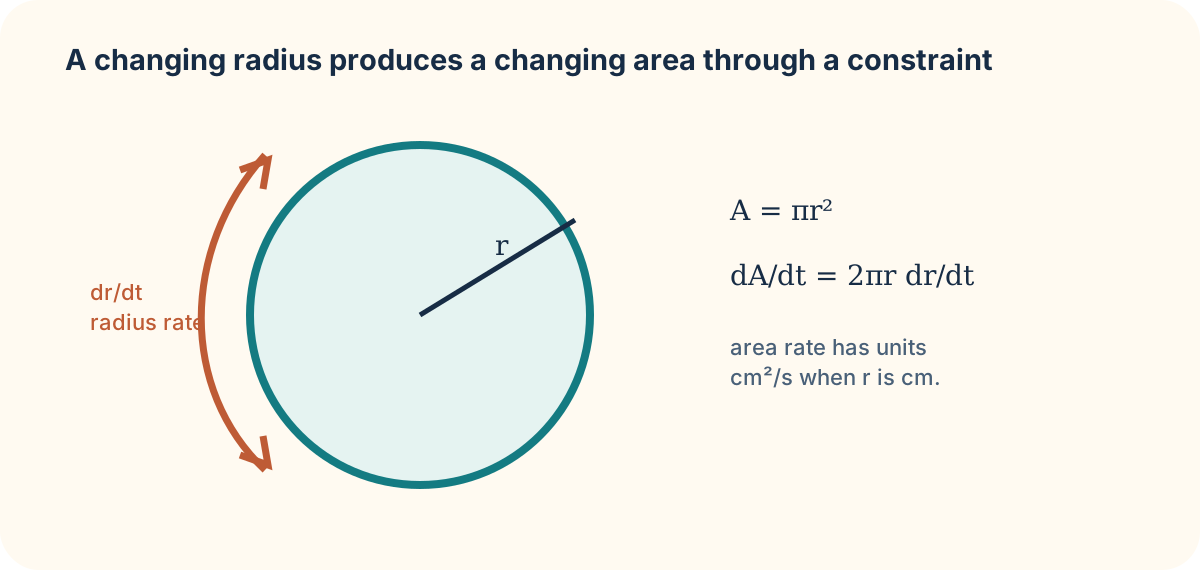
Choose symbols for quantities that change and state their units. Then write an equation that is true throughout the process, not just at the instant named in the question. For an expanding circular spill, let be radius in centimeters and be area in square centimeters. The geometric constraint is
This equation relates values, not rates. Its derivative will relate the rates.
Differentiate with respect to time:
The Chain Rule supplies because the radius depends on time. This result is a general rate equation. It says area changes faster for a given radial rate when the current radius is larger. That dependence is physical: adding a thin ring to a large circle adds more area than adding the same thickness to a small circle.
Substitute only after forming the rate equation
Suppose at one instant and . Substitute into the differentiated relation:
The answer is an area rate, not an area. The numerical factor includes the current radius and radial growth rate. If the radius were twice as large at the same radial rate, the area rate would also be twice as large. A related-rates answer should name the instant and the direction implied by its sign.
Notice that was not obtained by differentiating as though were an independent variable. The question asks about time, so every changing quantity is a function of time. The Chain Rule is the mathematical record of that dependency. This is the same reason implicit differentiation placed after each y-term.
Use units as a structural check
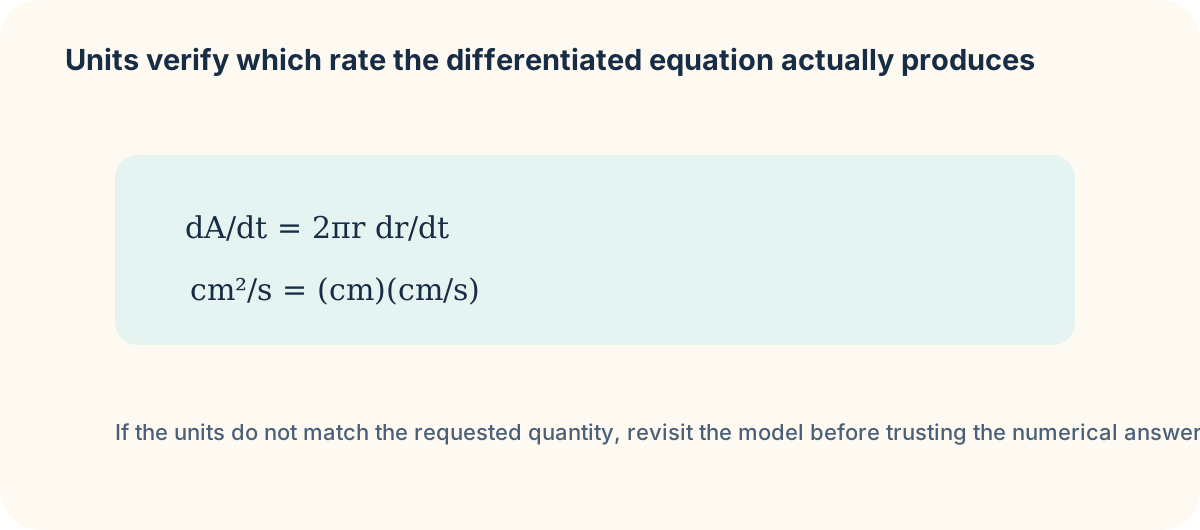
In the circle example, has units of centimeters and has units . Their product has units , exactly the expected units for . A mismatch is useful evidence that the wrong derivative was found or a factor has been omitted.
For a spherical balloon, , so differentiating with respect to time gives . The units are when radius is measured in centimeters. The surface-area factor explains why volume change depends on current size as well as radial rate.
A disciplined problem-solving routine
Draw a diagram when geometry is involved. Mark variables, known values, and the requested rate, keeping units visible. Write one relation connecting the quantities. Differentiate every term with respect to time before inserting the instant’s numerical data. Solve for the requested rate, then state its units and sign in a complete sentence.
Avoid importing unnecessary data. A problem may give a current height, radius, or distance because it belongs in the differentiated equation, while another quantity may be irrelevant. Conversely, do not use a formula merely because it contains a familiar word; the relation must model the particular geometry or physical constraint.
Practice with a right triangle whose hypotenuse length is fixed at . If one leg increases at , find the other leg’s rate at an instant when the legs are and . Start with the Pythagorean constraint and preserve both changing leg variables until after differentiating. The next lesson changes direction: rather than differentiating a known model, Newton’s Method uses a derivative to improve an unknown root estimate.