
The secant investigation watched slopes approach a destination without using the forbidden zero displacement. Limit notation generalizes that idea. It describes what function outputs approach as inputs move near a target, whether or not the target input is used. This distinction allows predictable surrounding behavior to coexist with a missing or reassigned point value. It is the conceptual foundation for continuity, derivatives, and approximation.
This lesson focuses on the meaning of one finite statement: . We will identify the moving and fixed quantities, translate the symbols into complete language, and compare the limit with . We will also study three functions that share identical nearby behavior but differ at one point. The guiding question is: what does a limit claim, and what does it deliberately leave undecided? The next lesson evaluates evidence and failure modes.
By the end, you should read and write finite limit notation, distinguish from , and explain why changing one isolated point does not change a limit. You should use punctured-neighborhood language without implying substitution. You should classify the relationship between limit and point value. You should also construct examples with holes and reassigned points. Precision in language is the main mathematical skill of this lesson.
Read every symbol as a role
The statement
is read “the limit of as approaches equals .” The variable is the moving input, is the fixed target input, and is the proposed output destination. The arrow describes approach rather than equality. During the investigation, may be arbitrarily close to without equaling it.
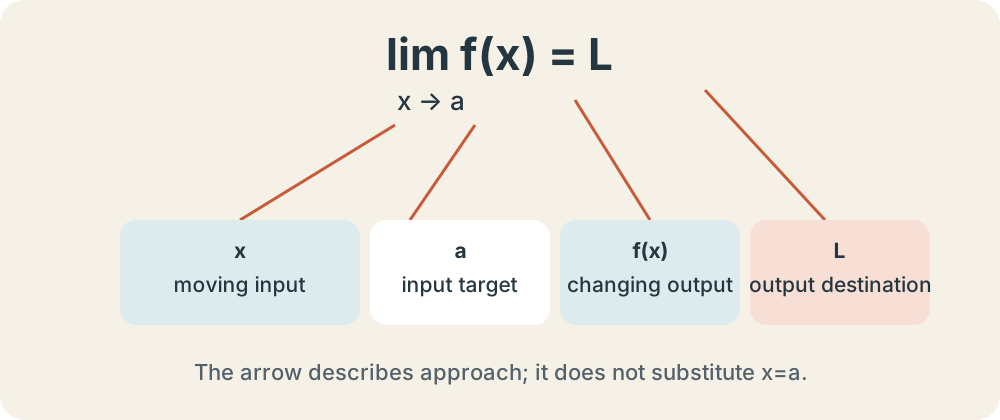
The phrase “the limit approaches ” reverses the roles. Inputs approach the target, and outputs approach the limiting value; the limit statement records the destination. Likewise, “ reaches ” is unnecessary. A limit can be meaningful where the function is undefined. Precise grammar mirrors precise mathematical structure.
The outputs need not ever equal . They may remain below it, remain above it, or alternate around it while becoming closer. Approach means that the output error can be made as small as required by choosing allowed inputs sufficiently close to the target. It is a controllable closeness claim, not an eventual-equality claim. Formal epsilon-delta language will later turn this idea into a guarantee.
Near a point is different from at a point
Consider
Factoring gives for every allowed input near two. As approaches two, the outputs approach four. Therefore even though is undefined. The missing point does not disturb the surrounding linear pattern.
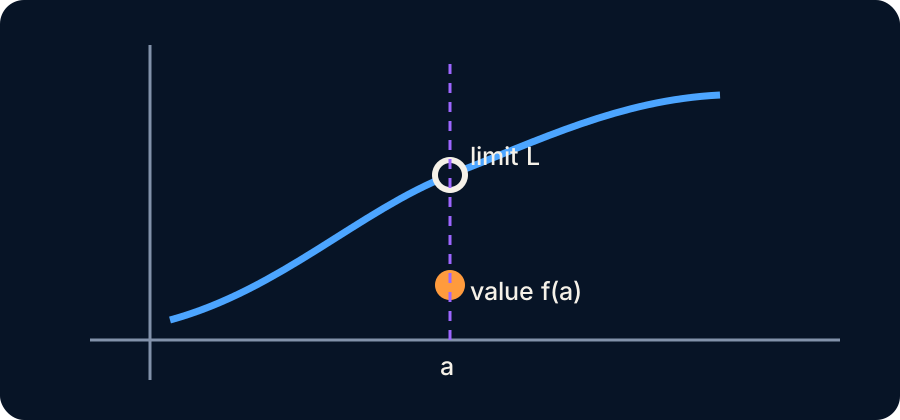
Now define a new function that agrees with for but has . The nearby outputs still approach four because only one isolated output changed. Thus while . The limit and point value answer different questions. Their disagreement is allowed.
Define a third function for every real . Then the limit and point value both equal four. The three functions have the same surrounding trace near two but different point assignments: missing, mismatched, and matched. Their limits are identical. Their continuity properties are not.
Punctured neighborhoods carry the evidence
A neighborhood of with radius is described by . A punctured neighborhood adds , excluding the center while retaining nearby inputs. Finite limits concern behavior on such punctured neighborhoods. This is why does not appear in the symbolic statement. The evidence comes from surrounding inputs.
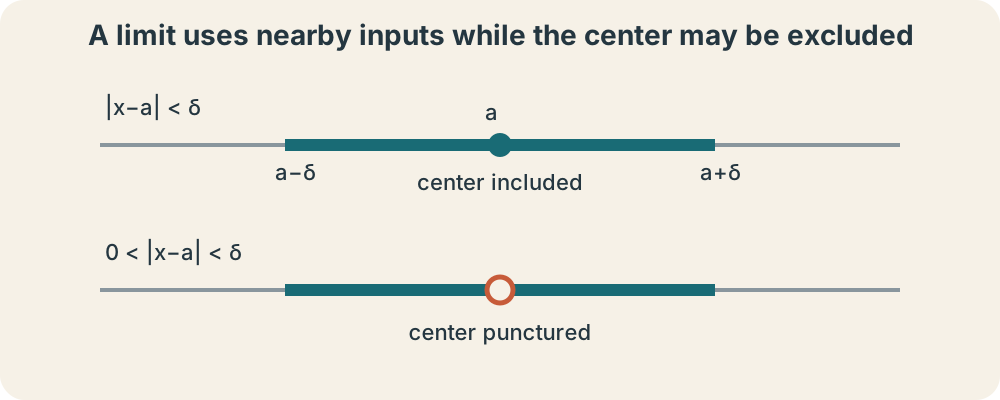
Removing one point does not create a gap in every scale around the target. No matter how small the chosen radius, allowed inputs can remain on either side unless the domain itself prevents one side. A formula may simplify on the punctured neighborhood even though the original remains undefined at the center. This local equivalence is enough to determine a limit. It is not enough to declare the functions globally equal.
The limiting value belongs to output space. If becomes small whenever is sufficiently small, the outputs are controlled near . The input and output distances play different roles. Input closeness is the condition we choose; output closeness is the result we seek. Keeping those spaces separate prevents the arrow from being misread.
Three point scenarios share one limit
The first scenario is a removable hole: is undefined, but nearby outputs approach . The second is a reassigned point: exists but differs from . The third is agreement: and nearby outputs approach the same value. In all three, the limit is . Only the third is continuous at the point.
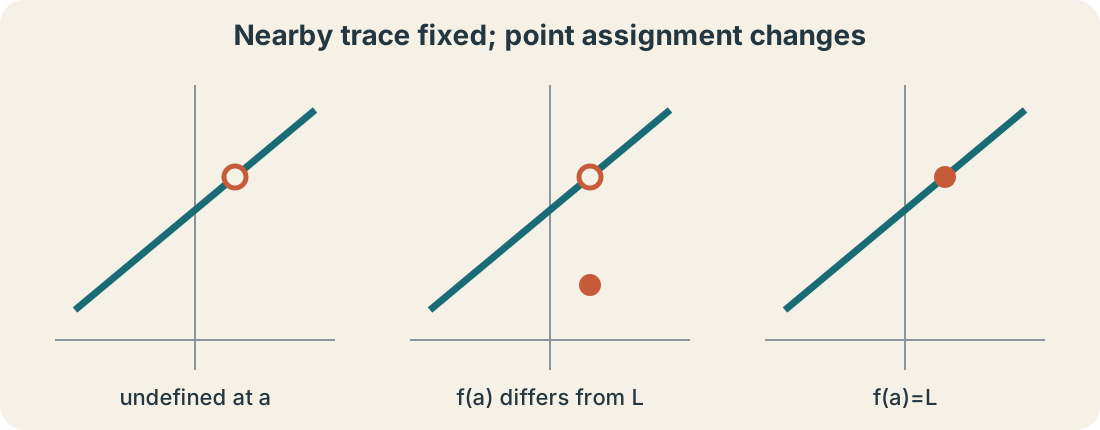
This classification refutes two common claims. An undefined point does not force a limit to fail, and an existing limit does not force equality with the point value. It also clarifies what a repair can do. Filling a removable hole with the limiting value creates continuity without changing surrounding behavior. Reassigning a mismatched point to does the same.
Continuity will later require three conditions: exists, exists, and the two values agree. Limit existence is only one component. Separating the components now makes the later definition understandable. A graph marker answers the point-value question, while the branches answer the nearby-behavior question. Both must be read.
Translate among words, symbols, and graphs
The sentence “outputs of can be made as close to five as desired by taking inputs sufficiently close to three, but not equal to three” corresponds to . The number three belongs to input space and five to output space. Reversing them changes the claim. Naming the function is also necessary when several relationships are present.
A graph supporting this claim should show branches approaching height five as the horizontal coordinate approaches three. An open circle at may mark the missing limiting point, but the circle alone does not establish approach. A filled point elsewhere records without changing the limit. The surrounding trace carries the limiting evidence.
A table should list inputs on both sides of three and outputs that move toward five. It should not include an invented row asserting unless that value is known. The closest sampled row is not “the limit.” It is one finite observation. The limit is the destination statement supported by the pattern and, eventually, by stronger reasoning.
Synthesis and transition
Sketch three functions that agree with for . Leave the first undefined at two, define the second to equal there, and define the third to equal three. State the limit and point value for each. Explain why the limit remains invariant while continuity changes. Label open and filled points clearly.
Then write in a complete sentence for a population model in which is years and is thousands of organisms. Identify the units of the target and destination. State what the expression does not tell you about . Describe a graph and a two-sided table that would support the claim without overstating them as proof.
A finite limit records the destination of nearby outputs as inputs approach a target. It neither substitutes the target nor automatically reports the assigned point value. Punctured neighborhoods explain why a hole or isolated mismatch can coexist with stable surrounding behavior. The next lesson asks how graphs, tables, formulas, and counterexamples support or defeat a proposed finite limit. Understanding the claim must come before judging its evidence.