
Not every curve arrives in the form . A circle, an energy constraint, or a relationship between two measured quantities may be written as one equation containing both and . Such a relation can still have a tangent slope at a point. Implicit differentiation finds that slope by treating as a function of even when we do not solve the equation explicitly for first.
The key idea is the Chain Rule. If changes when changes, then differentiating with respect to gives , not merely . The extra factor records the rate at which the dependent coordinate responds to the input. The same composition logic also explains derivatives of inverse functions: an inverse reverses a function’s input-output relationship, so its tangent slope is the reciprocal of the original nonzero slope.
By the end, you should be able to find a tangent slope from an implicit relation, identify the Chain Rule factor in every y-term, and use the inverse-function derivative formula with its conditions. You should also distinguish a relation’s local slope from an attempt to solve globally for all branches. This completes the derivative-construction unit and leads into derivative applications.
Differentiate y as a dependent quantity
Consider the circle
Although this equation does not isolate , it describes points on a circle of radius five. Differentiate both sides with respect to . The term becomes . The term is a composite expression because , so the Chain Rule gives . The derivative equation is
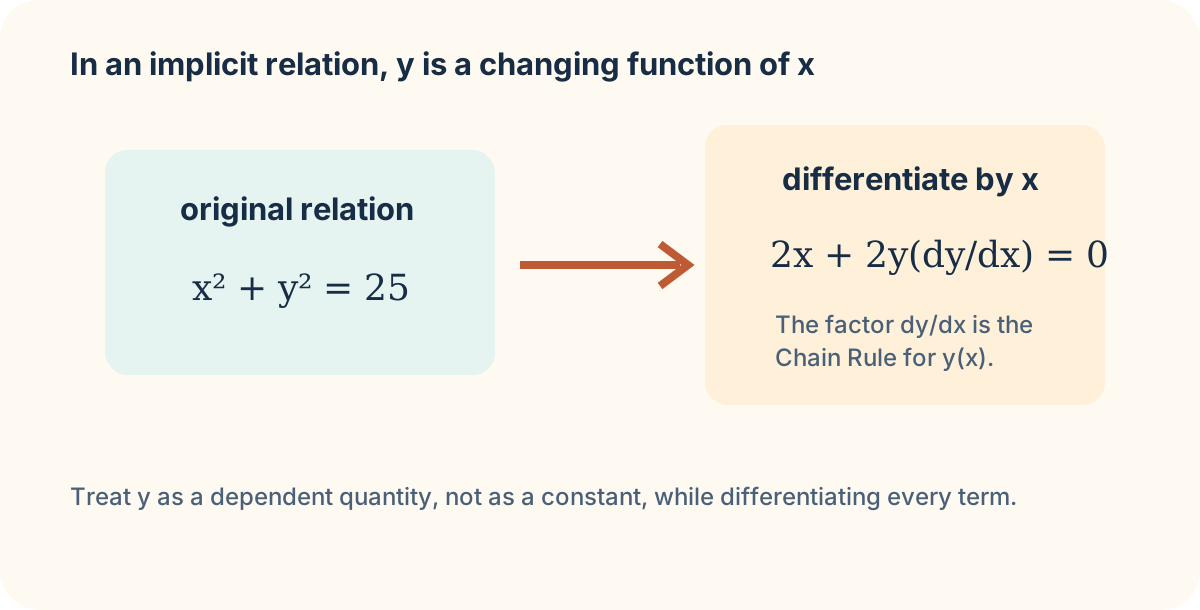
Now solve for the derivative:
At the point , the slope is . At , it is . Keeping and symbolic until after isolating creates a slope formula useful at every point with . At points where , the formula signals a vertical tangent rather than a finite slope.
Follow a stable workflow
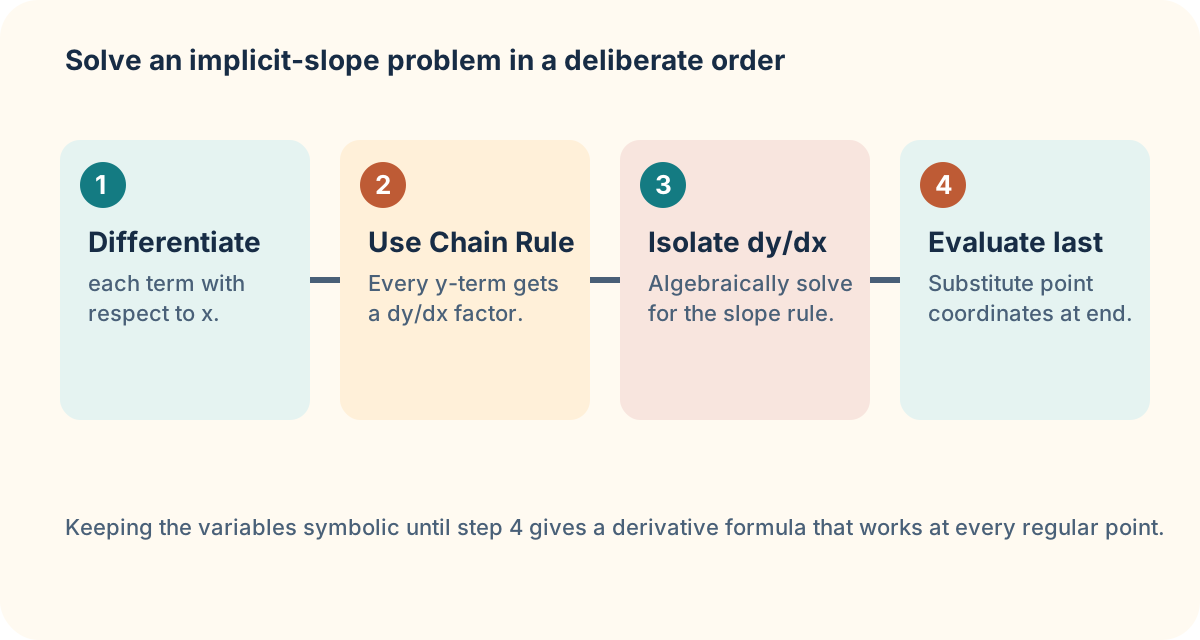
Implicit differentiation is not a special trick. First differentiate every term with respect to . Second, attach whenever differentiating an expression involving . Third, use algebra to collect and solve for . Only then substitute a point if the question asks for one particular tangent slope. This order reduces arithmetic clutter and makes the Chain Rule visible.
For , differentiate term by term:
The right side requires the Product Rule because both and change. Collect the terms containing on one side before solving. The goal is not to memorize a universal template but to recognize the ordinary product and chain structures already learned. Every factor has a reason.
Inverse functions reverse local slopes
If has an inverse, the composition returns each allowed input. Differentiate both sides using the Chain Rule:
Whenever , solve for the inverse derivative:
This formula is evaluated at matching points. If , then . The original input becomes the inverse’s output, and the original output becomes the inverse’s input.
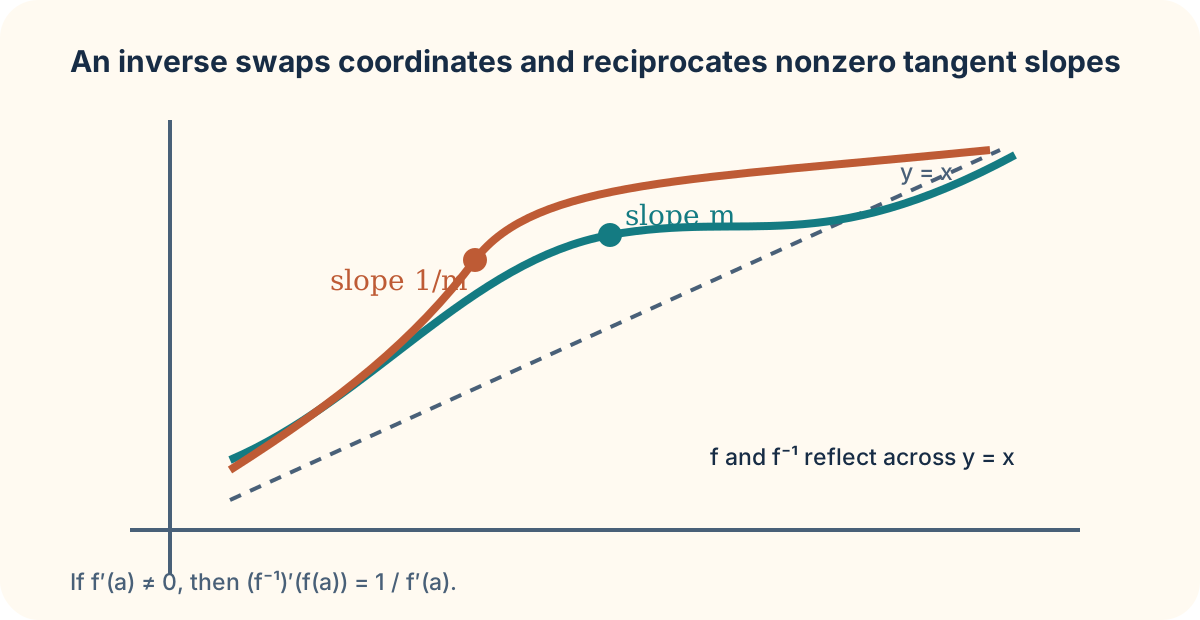
For , and . Therefore . The answer is not because the inverse derivative must be evaluated at the original function’s output. This input-output swap is the main bookkeeping challenge in inverse-function problems.
The reciprocal formula requires a nonzero original derivative. A horizontal tangent in would become a vertical tangent in an inverse relation, so a finite reciprocal slope would not exist. The formula also presumes a local inverse branch; a function must pass a one-to-one test on the relevant domain before an inverse function can be discussed globally.
Bridge to applications
Implicit slopes make visible a broad modeling idea: constraints link rates. If a quantity is confined to a circle, a fixed-volume container, or a conservation relation, changing one coordinate forces changes in another. Differentiation converts the relation among quantities into a relation among local rates. In the applications unit, this will become the engine behind related-rates problems.
Before moving on, find for and then evaluate it at any point you verify lies on the curve. Label the Product Rule term from differentiating and the Chain Rule term from differentiating . Finally, explain why at a point is not itself a point on the curve. It is a local slope, and that local linear behavior is the subject of the next lesson.
Unit 3 narrative challenge: the constrained camera arm
A camera mount traces the relation , with coordinates measured in centimeters. At one instant the camera is at , and its horizontal coordinate increases at . The design team needs the vertical-coordinate rate at that instant to check whether the camera clears a housing. Write the constraint-rate equation before using the point values. Which sign should the vertical rate have, and why?
Solution and reasoning
Differentiate with respect to time: . Thus . At the stated point, . The rate is negative because on the upper branch of the circle, moving right from requires the height to decrease to preserve the fixed radius.