
A definite integral with fixed bounds produces one number. If the upper bound moves, the accumulated signed area changes with it, creating a new function. This accumulation function is one of calculus’ central constructions because it turns a rate graph into an evolving total. Its derivative recovers the original rate under appropriate continuity conditions, which is the first part of the Fundamental Theorem of Calculus.
This lesson separates three linked ideas: accumulated area as a function, the rate at which that accumulation changes, and net change of a quantity with a known rate. The notation can look dense because an integral uses both a dummy variable and an upper-bound input. Careful reading keeps their jobs distinct and makes the theorem’s result intuitive rather than mysterious.
By the end, you should interpret , use when the conditions hold, and compute an ending quantity from a starting quantity plus integrated rate. The next lesson will formalize the endpoint-evaluation method that makes definite integrals efficient.
A moving upper bound creates a function
Define
The lower bound is fixed. The upper bound is the input of the new function . The symbol is a dummy variable used inside the sum-and-limit construction; it can be replaced by another unused symbol without changing the integral. Do not confuse the running variable with the upper-bound input .
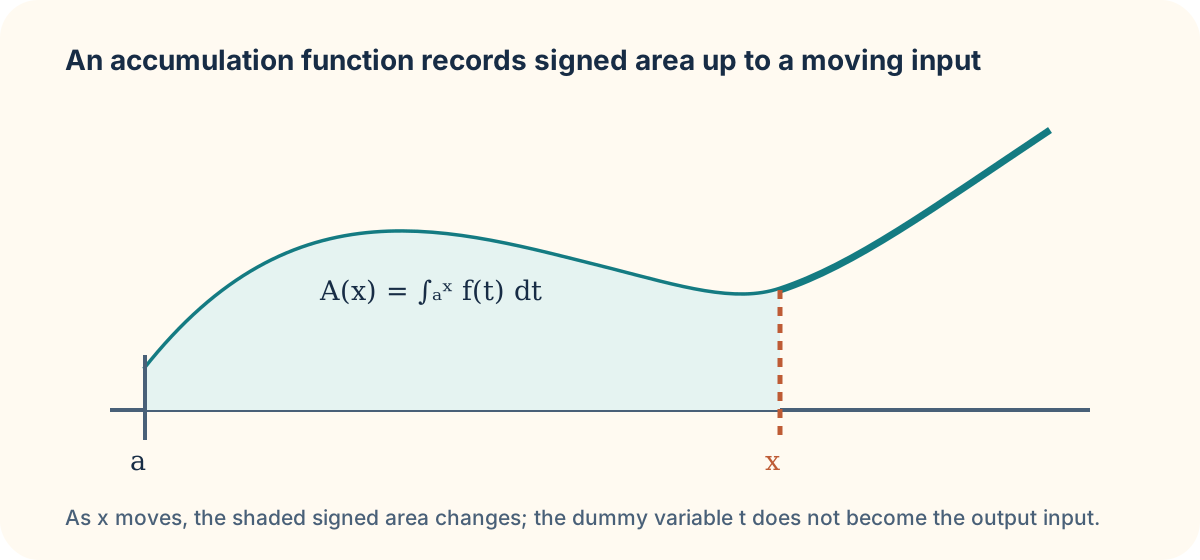
If is positive on an interval, increasing adds positive area, so increases. If is negative, increasing adds negative area, so decreases. If the upper bound moves left of the lower bound, the orientation reverses: . These sign conventions keep accumulation consistent across every input ordering.
At the base point, because the interval has zero width. This does not mean the rate must be zero. It means no accumulation occurs over an interval of zero length. Distinguish a quantity’s accumulated value from the current rate that generates its change.
Why the derivative returns the integrand
Move the upper bound from to . The new accumulation differs by the thin slice
Over a very narrow interval, the slice is approximately when is continuous. Divide by and take the limit. The rate of change of accumulated area is therefore the current height:
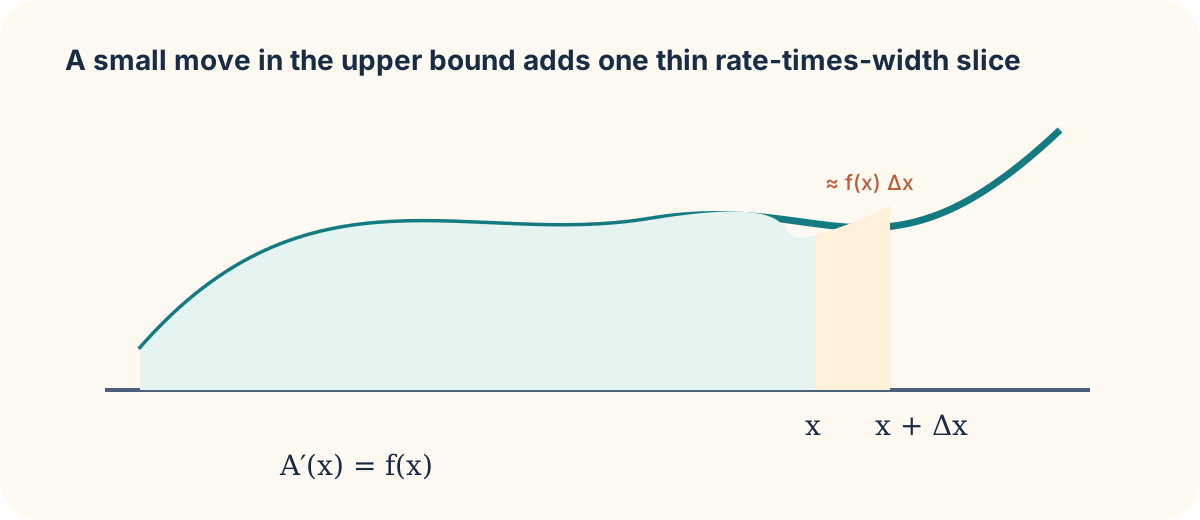
This is the Fundamental Theorem of Calculus, Part One. It reunites the two directions of calculus: a derivative measures local change, while an integral accumulates those local changes. When accumulation is built from a continuous rate, differentiating the accumulated function returns that rate.
For example, if , then . Do not substitute the upper bound into an antiderivative yet; the point here is that the variable-bound integral itself defines a function whose derivative is read directly from the integrand.
Net change combines a start with accumulated rate
If is the rate of a quantity , then over ,
Equivalently,
The first form emphasizes net change; the second form emphasizes an ending amount. Both use signed contributions. A negative rate over part of the interval reduces the final quantity.
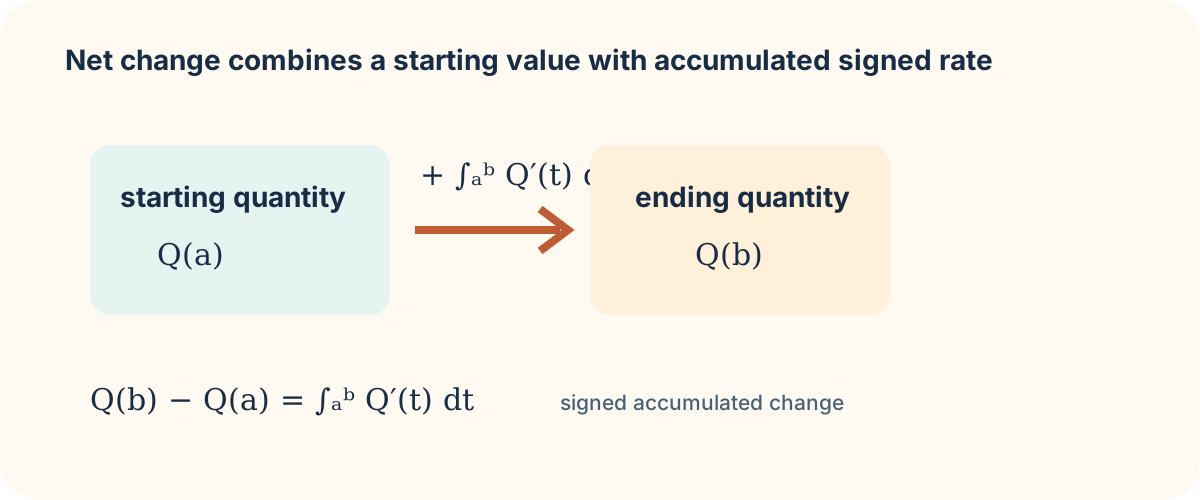
If a tank begins with and has rate , then its amount after minutes is . The integral has liters because rate units multiplied by minutes produce liters. The formula does not assume the rate stays positive; its signed area correctly includes inflow and outflow.
Prepare for endpoint evaluation
Riemann sums explain what definite integrals mean, and accumulation functions explain why integration and differentiation reverse each other. The next lesson will use an antiderivative to evaluate as . Before relying on that shortcut, keep the accumulation meaning in view: endpoint subtraction represents all the tiny signed contributions between the endpoints.
Practice by defining . State , find directly from the theorem, and determine whether increases or decreases where is positive or negative. Then formulate the net-change equation for a moving object with a known velocity and initial position. The next theorem will make exact integral calculations practical while preserving this same interpretation.
Unit 5 narrative challenge: tracking a reservoir balance
A reservoir starts with of water. Its measured net inflow rate is for the first . The operations team needs a model for the reservoir amount and an explanation of whether the water level initially rises or falls. Write the net-change expression before evaluating it. What information would distinguish net inflow from total volume that passes through the pipes?
Solution and reasoning
The amount is , where the integrand has units and is minutes. Initially , so the reservoir rises. The integral gives net change because a negative rate would subtract from the stored amount. Total throughput would require separately accumulating the magnitudes of inward and outward flows rather than only their signed difference.