
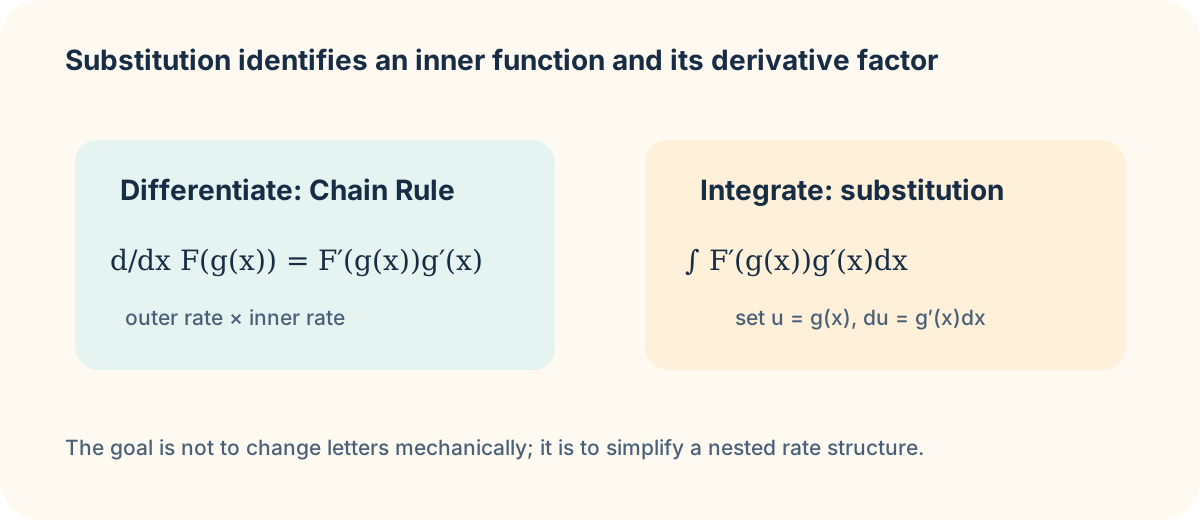
Substitution is integration’s response to function composition. The Chain Rule differentiates an outer function evaluated at an inner expression and multiplies by the inner derivative. When an integrand contains that same pattern, substitution reverses the process. It replaces the inner expression with a single temporary variable so the remaining integral has a simpler form.
The technique works because of structure, not because an integral contains a convenient-looking letter. A valid substitution identifies an inner expression and a matching derivative factor, possibly after adjusting by a nonzero constant. This lesson emphasizes that diagnostic step, the transformation of differentials and bounds, and a derivative check that confirms the result.
By the end, you should recognize a reverse-Chain-Rule pattern, carry out an indefinite or definite substitution, and avoid mixing variables after changing bounds. You should be able to explain why the method works before using it mechanically. The next lesson compares exact integration with numerical approximation and introduces average value.
Read the nested structure
The Chain Rule says
Reversing that pattern gives
Set , so . The substitution transforms the integral into . This is simpler because the nested expression has been treated as one whole quantity.
For , choose . Then , giving . Return to the original variable:
Differentiate the answer to check it. The Chain Rule produces , which is the original integrand.
Choose u for a reason
An effective choice of is usually the expression inside a power, root, exponential, logarithm, or trigonometric function. Then look for its derivative elsewhere in the integrand. If it is present up to a constant factor, solve for the needed differential factor. For example, in , set , so and .
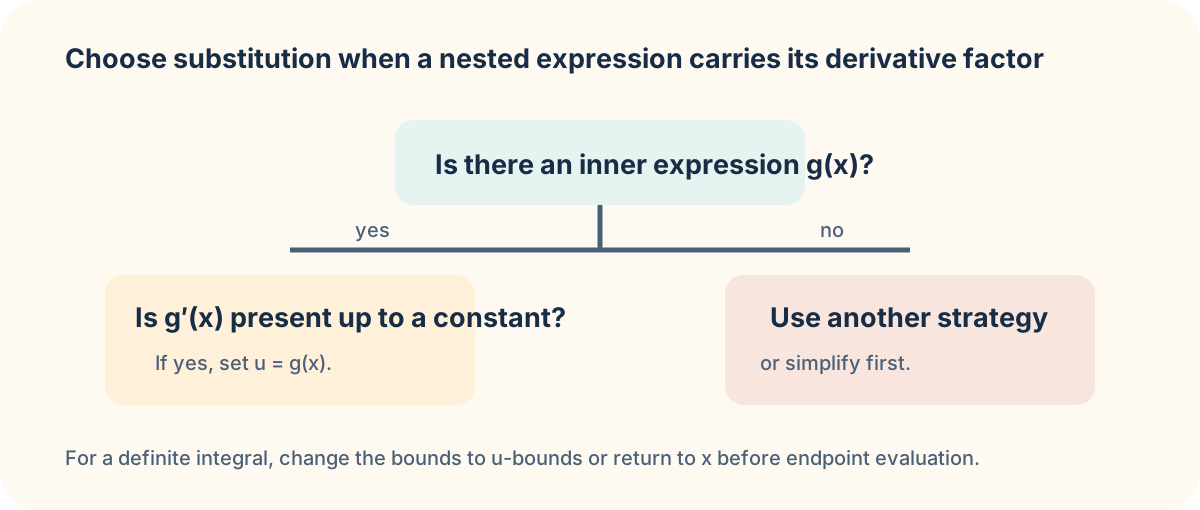
Not every integral is ready for substitution. The integrand has a product, but neither obvious inner expression carries its derivative factor. A later course may use integration by parts for that structure. Choosing here does not simplify the remaining factor. The test is whether the substitution converts the whole integrand into a function of times .
Definite integrals require consistent bounds
For a definite integral, either change the x-bounds into u-bounds and remain in , or substitute back to before applying the original bounds. Do not mix x-bounds with . If , then an x-bound of one becomes , and an x-bound of three becomes .
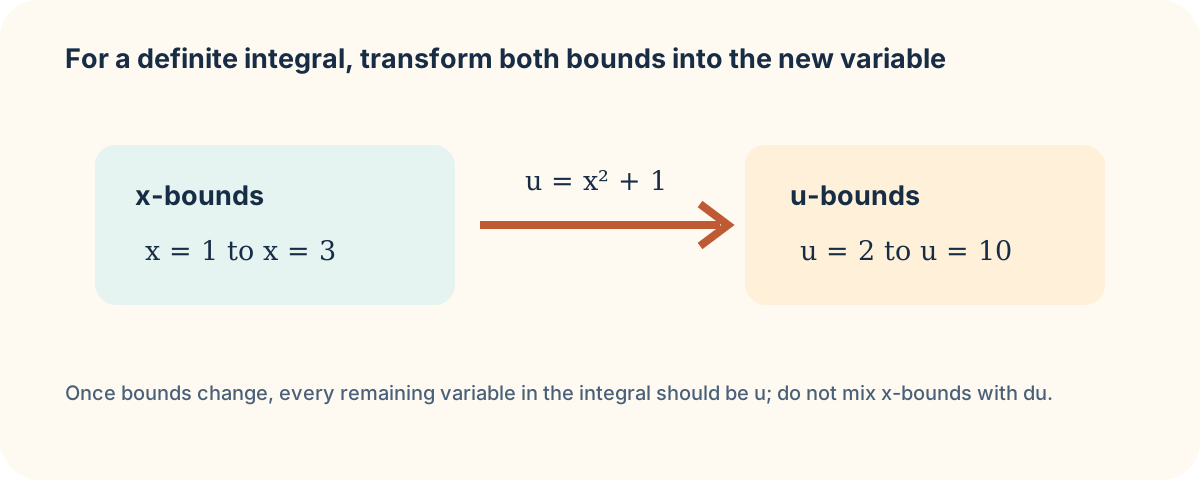
For example,
The final result has the same physical units as the original definite integral. Changing variables changes the symbolic description of the input, not the accumulated meaning. If the integral represents net change, retain its signed interpretation through every substitution step.
Use a reverse-derivative check
After integrating, differentiate your result in the original variable. A correct answer must recreate the original integrand, including the derivative of the inner expression. This check catches the most frequent error: writing an antiderivative of the outer pattern while omitting a factor that the Chain Rule requires.
Practice by evaluating and . In each case write the substitution, differential, transformed integral, and final check. State whether you changed bounds or returned to the original variable. The next lesson will examine numerical estimates and average values when an exact antiderivative is inconvenient or when the interpretation itself is central.