
Calculus studies change, but change cannot be discussed until the changing quantities have been organized as functions. A function connects each allowed input to exactly one output. It may be represented in words, a table, a graph, a formula, or a physical procedure. None of these appearances automatically tells the whole story. The function is the underlying assignment together with its domain and declared output setting.
This lesson develops that object-level view before any limits or derivatives are introduced. You will identify what must remain invariant when a function changes representation. You will distinguish domain, codomain, and range instead of treating them as interchangeable vocabulary. You will also use units and context to reject mathematically writable but scientifically meaningless inputs. The guiding question is: what information belongs to the function rather than to one picture of it?
By the end, you should be able to define a function precisely, translate among representations, and justify a domain. You should explain why two rules that agree almost everywhere may still define different functions. You should interpret notation such as without treating it as multiplication. You should attach units to model parameters and outputs. The closing investigation prepares you to read graphs, tables, and formulas critically in the next lesson.
One relationship can have several representations
Imagine a tank whose water depth is when a pump begins operating. During the next , its depth rises at . The input is elapsed time in minutes, and the output is depth in centimeters. The words already supply a starting value, rate, units, and physical interval. A relationship exists before a formula is written.
The rule compresses the same relationship on . A table samples selected inputs, while a graph shows the line segment across the full stated interval. The coefficient carries units of centimeters per minute, so multiplying it by time produces centimeters. Only quantities with compatible units may then be added. Dimensional consistency helps confirm that a translation has preserved meaning.
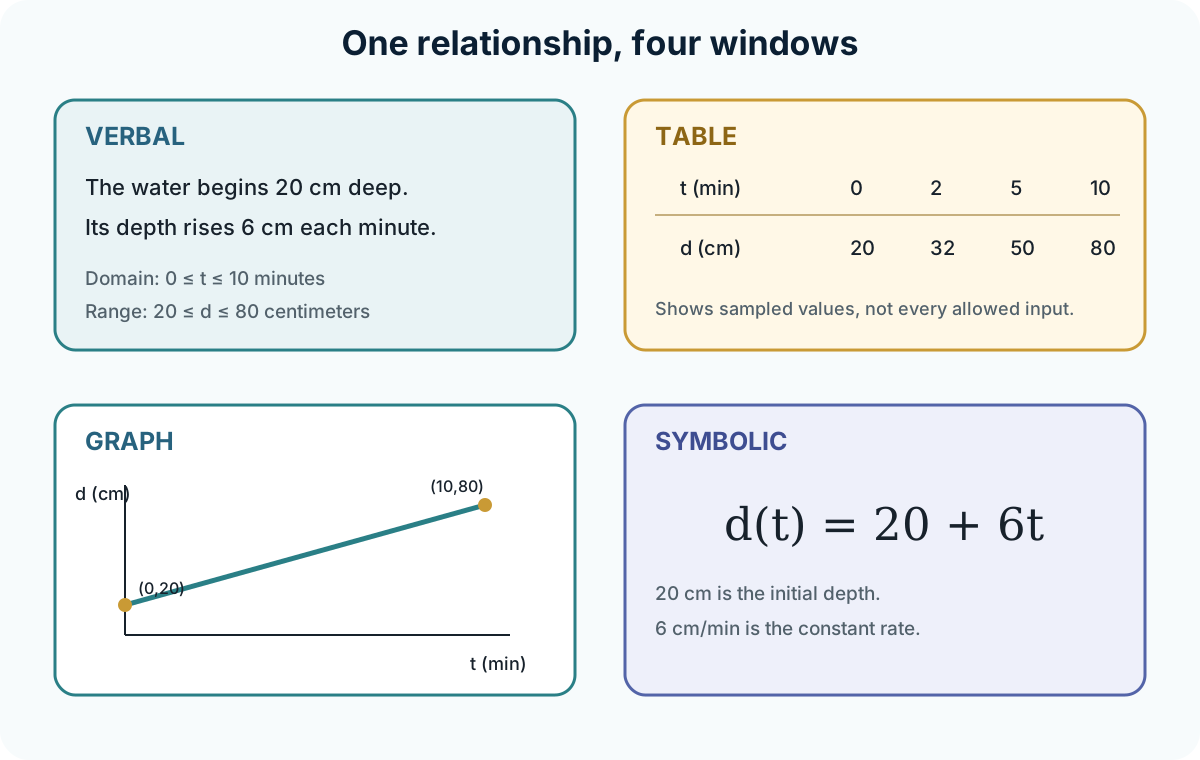
The four panels should be read as windows onto one object. If the pump rate changes, the verbal rate, table increments, graph slope, and coefficient must change together. If the tank becomes full after , the domain and graph endpoint must change even though the algebraic expression accepts larger inputs. Translation is therefore a coherence test. A mismatch reveals that the representations no longer describe the same function.
A function is an assignment
A function assigns exactly one output to each input in its domain. Different inputs may share an output, as for . The requirement forbids one input from receiving two outputs in the same function. The relation does not define as a function of positive until a branch is selected. The vertical-line test is a graphical version of the same requirement.
In , the letter names the function, is an input placeholder, and denotes the assigned output. Thus means that input is mapped to output . The notation does not mean multiplied by . Later, will describe the output at a nearby input and allow two outputs to be compared. Accurate notation now prevents confusion in difference quotients later.
An algebraic expression becomes a model only after variables, units, and domain are stated or reasonably inferred. The rule could describe temperature, money, or an abstract line. Those settings may share an algebraic shape without being interchangeable. A formula can therefore participate in many different functions. Treating the formula as the whole function erases information calculus will need.
Domain, codomain, and range
The domain is the set of allowed inputs. The codomain is the declared set in which outputs are permitted to live. The range is the set of outputs actually produced. For on domain with nonnegative integers as codomain, the range is . The codomain contains other permitted values, such as , that these five inputs never produce.
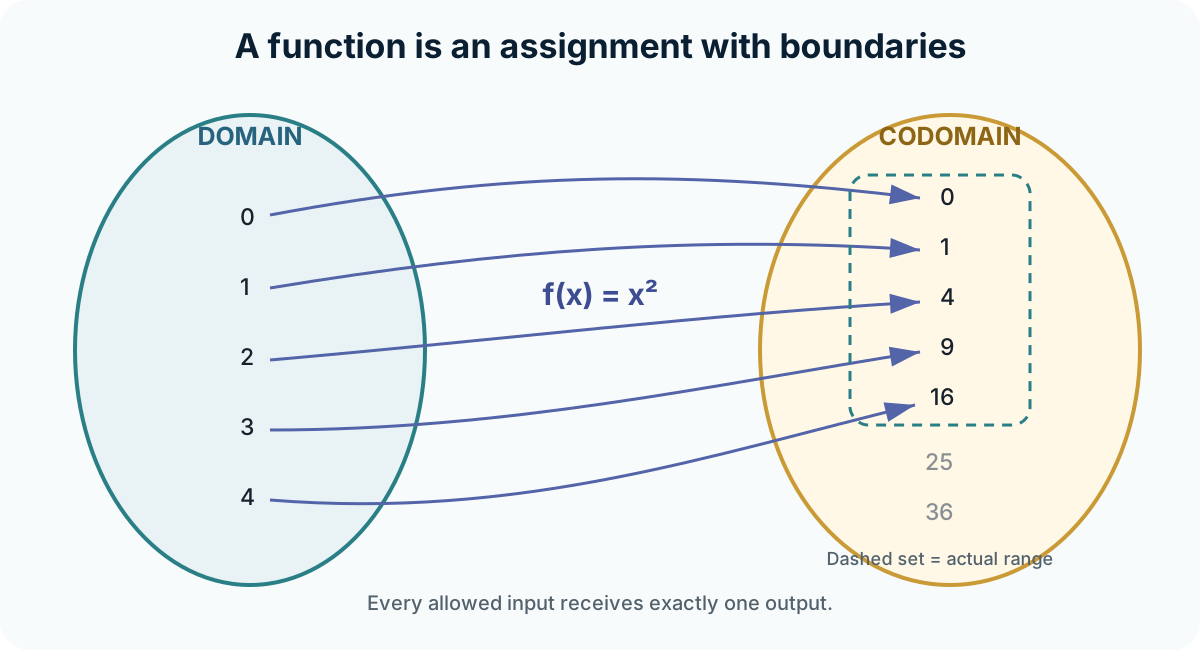
These distinctions matter when inverse functions are considered. A function is one-to-one if distinct domain inputs produce distinct outputs. It is onto its codomain if every codomain value is produced. Restricting to makes it one-to-one without changing its formula. Choosing the actual range as codomain can make it onto without changing any evaluations.
Domains arise from algebra, context, and measurement. Division by zero, an even root of a negative real number, and a logarithm of a nonpositive number impose algebraic restrictions. Negative elapsed time may be excluded by context. A data-based model may be trustworthy only over the interval that was observed. The effective domain is the intersection of every applicable restriction.
A formula does not determine the whole function
Consider . As an abstract real function, its graph may extend indefinitely in both directions. As a tank model, it may use only and produce depths from to . The formula is unchanged, but the function changes with the domain and interpretation. Claims about intercepts, extrema, and long-term behavior change with it.
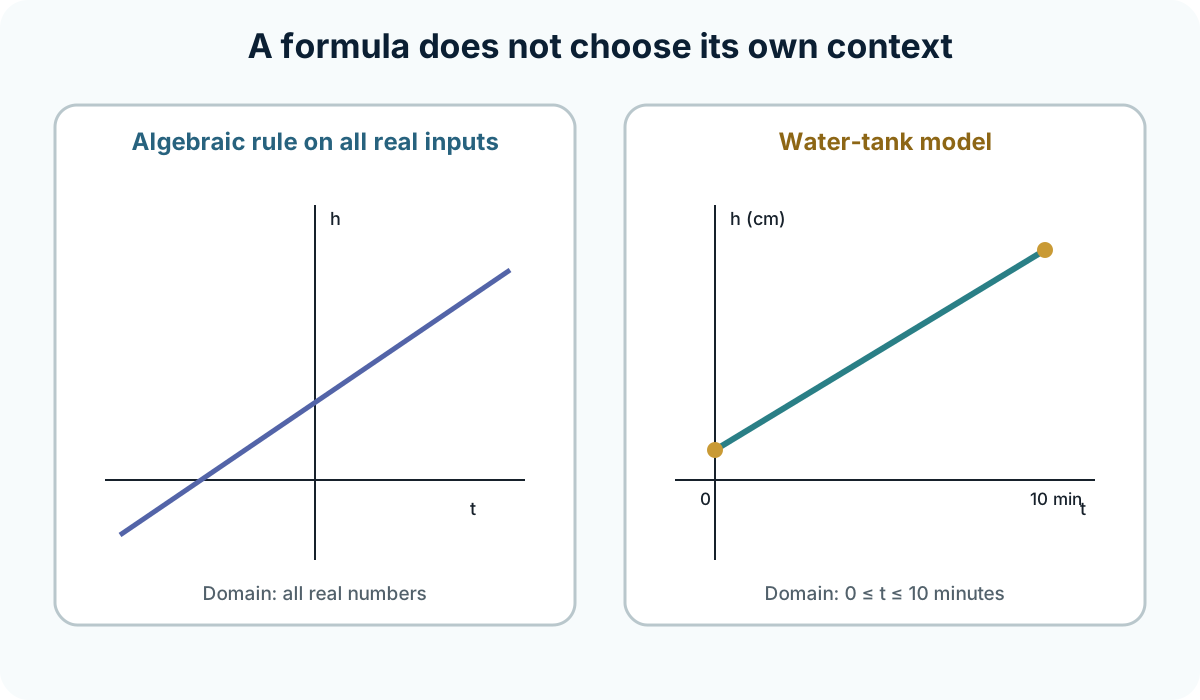
The unrestricted line has no maximum, while the restricted tank model reaches at . A negative-time intercept belongs to the abstract line but not the stated experiment. Extending the line may predict water above the tank walls. Such a value is algebraically computable yet physically invalid. A correct-looking graph can therefore make a false modeling claim if it omits endpoints.
Two functions are equal only when they have the same domain and agree at every input there. The rules and agree wherever is defined, but excludes while . Their graphs differ by one missing point. They are not equal functions even though they agree almost everywhere. Limits will later explain why nearby agreement can still be useful.
Synthesis and transition
Return to the tank model and change the pump rate to for only the first . Write a verbal description, symbolic rule, short table, and graph description. Label all units and justify the domain. Then identify the codomain you choose and the actual range. Check that every representation communicates one consistent assignment.
Next compare with . State both natural domains and explain why checking only and cannot prove equality. Describe the one graphical feature that distinguishes them. Explain which piece of the function object a formula-only comparison missed. Keep this example because it will reappear when limits separate nearby behavior from point values.
A function is more than its visible formula: it is an assignment operating on a specified domain, interpreted within an output setting. Representations are valuable because each reveals different structure, but each can also hide essential information. Domain, units, and context must survive every translation. With that foundation secure, the next lesson asks how to extract behavior responsibly from graphs, tables, and symbolic models. That skill will support transformations and rates of change without confusing evidence with proof.