
An algebraic expression is a structured description of a quantity. Its symbols record numbers, variables, operations, grouping, and sometimes restrictions on allowed inputs. Simplifying should reveal useful structure without changing the value the expression produces. That requirement makes algebraic manipulation an argument about equivalence rather than a race to write fewer symbols. This lesson develops the properties, reading habits, unit checks, and verification methods that make transformations dependable.
Learning objectives and structural reading
By the end of this lesson, you will identify terms, factors, coefficients, constants, powers, and outermost operations. You will apply commutative, associative, and distributive properties with explicit justification. You will combine like terms and move between expanded and factored forms. You will preserve domain restrictions during cancellation and substitution. You will also use units and numerical checks to diagnose incorrect transformations.
An expression is not an equation because it does not assert equality between two sides. The expression names a quantity that depends on . One can evaluate it, rewrite it, factor it, or compare it with another expression. Solving begins only when an equation or inequality asks which inputs make a relationship true. Keeping these tasks distinct prevents unsupported “moving” of terms.
Structure can be represented as a tree. The outermost operation combines large subexpressions, while inner operations build those pieces. In , subtraction is outermost. One branch contains , and the other contains . The tree below makes operation order and grouping visible.
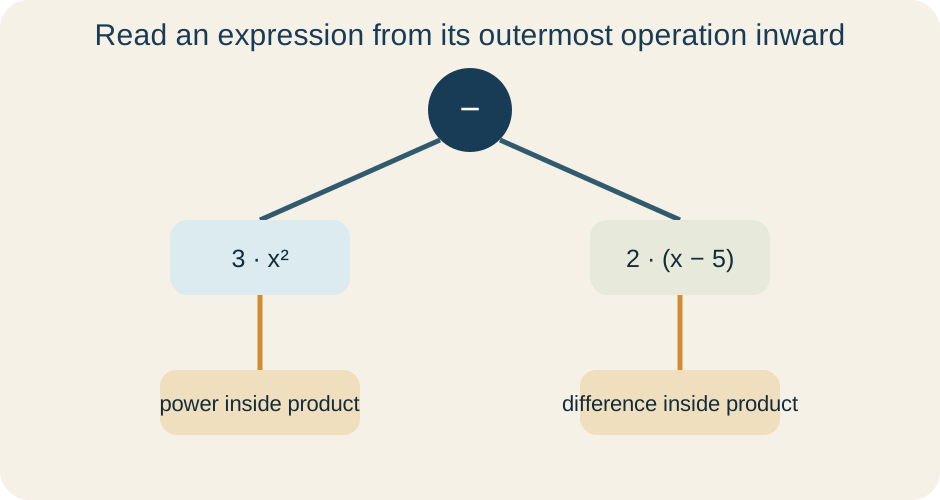
Name the parts of an expression
Terms are pieces joined by addition or subtraction at the outermost level. In , the terms are , , and . A sign belongs to the term that follows it. The number multiplying a variable expression is its coefficient. A term without a variable is called a constant term.
Factors are pieces multiplied within a term. In , the factors include seven, , and another . The exponent two means is multiplied by itself. It does not mean is multiplied by two. The base of the power is the expression directly controlled by the exponent.
Grouping symbols determine a base’s extent. The expression squares the entire product and equals . The expression squares only and then multiplies by three. Likewise, means , while . Careful identification of the base prevents sign and exponent errors.
Define equivalence for every allowed input
Two expressions are equivalent when they have the same value for every input in their common domain. The identity holds for every real . Distribution proves the equivalence. The equals sign here asserts that the two forms always represent the same quantity. It does not tell us to solve for one special input.
Testing selected values can disprove equivalence. If two expressions give different results at one permitted input, they are not equivalent. Agreement at several inputs does not prove universal agreement because untested values may differ. A property-based transformation proves equality across the domain. Numerical testing is therefore a check rather than the main proof.
The common-domain phrase matters. The expressions and agree whenever . The first expression is undefined at two, while the second is defined there. They are equivalent on the original expression’s domain but not identical as unrestricted functions. State the restriction with the simplified form.
Use commutative and associative properties
Addition is commutative: . Multiplication is also commutative: . These properties permit reordering terms or factors. Subtraction and division are not commutative. In general, and .
Addition is associative: . Multiplication is associative: . These properties permit regrouping without changing order. They justify dropping unnecessary parentheses in a pure sum or product. They do not justify regrouping across mixed operations without considering precedence.
Reordering and regrouping help collect like terms. In , treat subtraction as addition of opposites. Then reorder to . Combining within groups gives . Each step follows a named property rather than an unexplained symbol move.
Apply distribution in both directions
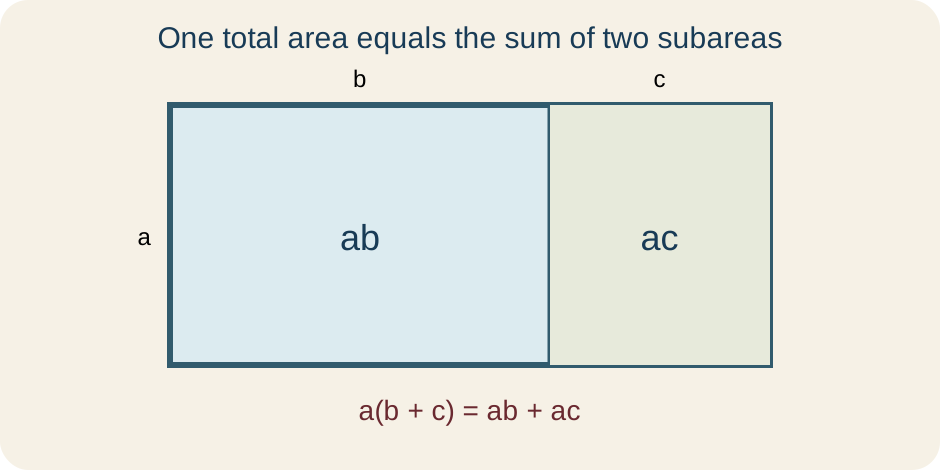
The distributive property is . The factor multiplies every term inside the parentheses. With subtraction, because subtraction is addition of an opposite. Distribution connects multiplication with addition. It is the main property behind expansion and factoring.
A negative sign before parentheses represents multiplication by negative one. Thus . Both signs change because both terms are multiplied. For , the result is . Distributing to only the first term changes the expression’s value.
Reading distribution backward factors out a common factor. The expression becomes . The coefficient six divides both terms. Multiplying the factored form restores the expanded form. The two directions emphasize different structure while preserving value.
Combine like terms through reverse distribution
Like terms have identical variable factors with identical exponents. The terms and are like because both contain . Reverse distribution gives . Only their coefficients combine. The variable factor remains unchanged.
The terms and are not like. Their outputs change differently as varies. At , their values are two and four, while at , they are three and nine. No constant coefficient can merge them into one shared variable factor. Combining them would erase meaningful dependence.
Units provide a parallel intuition. A length and an area cannot be added because meters and square meters measure different dimensions. Similarly, and represent different powers. Compatible terms can be added; incompatible terms must remain separate. This analogy supports, but does not replace, the algebraic definition.
Simplify multistep expressions
Begin with grouping symbols and distribution. Then combine like terms within the expanded result. Simplify numerical arithmetic carefully. Preserve any restrictions already identified. Choose the final form that best serves the question.
Simplify . Distribution gives . Group variable terms and constants as . Combining produces . Substitution at a convenient value can check the transformation.
At , the original expression is . The simplified expression gives . This agreement supports the work but does not prove it alone. Distribution and like-term properties provide the proof for all real inputs. A check is most useful when done in both forms independently.
Evaluate with careful substitution
Evaluation replaces every occurrence of a variable with its assigned value. Parentheses around negative or compound inputs preserve grouping. If , then becomes . Writing without grouping is interpreted as . The two expressions have different structures.
Evaluate when and . Substitution gives . The square gives four, and the bracket gives negative seven. Therefore the value is . Each grouping symbol prevents a sign from being lost.
Units should accompany contextual substitution. If and , then . Multiplication produces a squared unit. The result describes area rather than length. Reporting only the number six omits what the expression represents.
Compare expanded and factored forms
Equivalent forms answer different questions. Expanded form displays separate terms and is useful for combining like terms. Factored form displays repeated multipliers and is useful for identifying zeros or common structure. Neither form is universally simpler. Simplicity depends on the next task.
For , the expanded form displays three rectangular area contributions. Factoring the last two terms gives . This form groups all height-dependent contributions. The term remains separate because it contains no height factor. If and are fixed while varies, the grouped form makes that dependence easier to see.
For , expanded form shows the coefficients of two terms. Factored form reveals the common factor and the zero at if the expression is set equal to zero. Expanding verifies the factorization. Both forms produce the same value for every real input. Choose a form intentionally and explain what it exposes.
Preserve restrictions through simplification
Denominators create excluded inputs. Even-indexed radicals can require nonnegative radicands. Contexts can restrict counts, times, or lengths. Record restrictions before canceling or rewriting. A later simple formula does not automatically erase them.
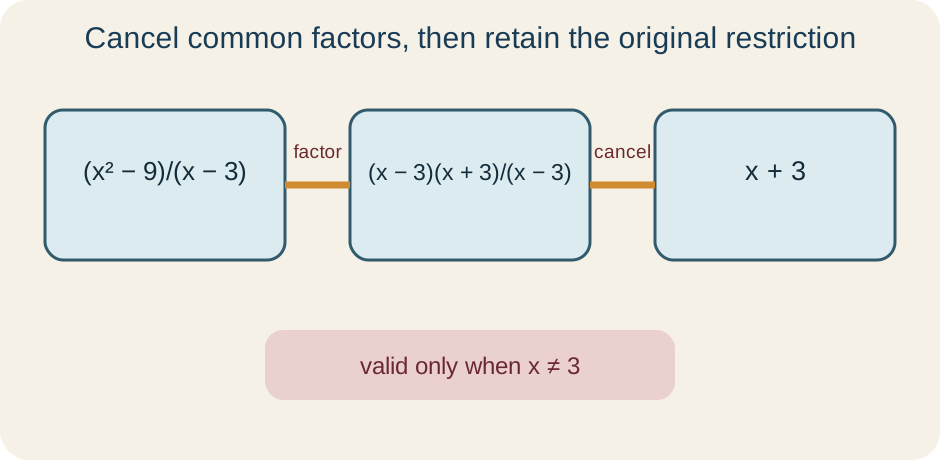
Consider . The original denominator requires . Factoring the numerator gives . Canceling the common nonzero factor produces for . The restricted statement is the correct simplification.
Cancellation applies to factors, not terms. One may cancel only after the numerator is written as a product containing that factor. One cannot cancel the in across addition. A numerical test quickly shows the invalid result would change values. The restriction-and-cancellation diagram below summarizes the logic.
Use identities and reject false patterns
An identity is an equality true for every allowed input. The distributive property generates . The middle term comes from two cross products. Writing omits those contributions. Substitution such as disproves the false pattern immediately.
The difference of squares identity is . Multiplication verifies it because the middle terms cancel. A sum of squares does not factor the same way over the real numbers. Pattern recognition must include signs and term structure. Similar appearance is not sufficient evidence.
Use identities as derived tools rather than unexplained magic. Expand the proposed factored form or factor the proposed expanded form. State the common domain. Test a simple input as an additional check. This combination produces both proof and error detection.
Translate words into expressions
Translation begins by defining variables. “Five more than twice a number” becomes , not . The phrase “more than” indicates addition after doubling. Parentheses are needed only when a complete sum is multiplied. Reading operation order from language prevents ambiguity.
“Three times the difference between a number and four” becomes . The word difference creates the grouped expression . Multiplication by three applies to the entire difference. Distribution would give the equivalent form . Both forms preserve the intended relationship.
Contextual expressions should include units where helpful. A fixed fee plus a per-kilometer rate times distance produces cost. The terms may be added because both have currency units. An expression with a fee plus a bare distance would be dimensionally inconsistent. Unit analysis checks the translation before any equation is solved.
Verify equivalence responsibly
A transformation chain provides the proof of equivalence. Each line should follow from a property, definition, or valid algebraic identity. Avoid replacing several uncertain steps with “simplify.” Name distribution, regrouping, combining like terms, factoring, or cancellation. Preserve restrictions alongside every affected step. Explanations make errors locatable.
Numerical checks should use allowed inputs. Choose values that exercise signs, zeros, and fractions when practical. If restrictions exclude an input, do not use it as a comparison point. One disagreement disproves equivalence. Many agreements still do not replace a general proof.
Computer algebra can confirm transformations but should not obscure domains or reasoning. A system may return a simplified formula without highlighting a removable hole. Inspect assumptions and restrictions. Different equivalent forms can also look unrelated until expanded or factored. Human interpretation remains necessary.
Diagnose common mistakes
Combining unlike terms destroys variable structure. Distributing to only one term changes value. Losing a negative sign before parentheses changes every affected term. Treating as omits cross terms. These errors can be traced to misreading the operation hierarchy.
Forgetting restrictions after cancellation changes the original domain. Canceling terms rather than factors misuses division. Treating subtraction or division as commutative reverses meaning. Applying an exponent to a coefficient that lies outside its base changes the quantity. Parentheses and named properties prevent these mistakes.
A dependable workflow records restrictions, identifies the outermost operation, applies exponents, distributes deliberately, and combines only like terms. It then selects an informative final form. A property chain proves equivalence. A numerical and unit check supplies independent evidence. This workflow scales to more advanced algebra.
Guided practice and connection forward
Simplify . Distribution gives . Combining like terms gives . At , both forms equal negative fourteen. The properties prove equivalence for every real input.
Decide whether and are equivalent. Expanding the first gives . The missing linear term shows the proposed expressions differ. At , their values are thirty-two and twenty. One counterexample confirms the failure.
For independent synthesis, simplify and justify each combination. Then factor using the greatest common factor and verify by distribution. Finally, simplify while preserving its restriction. Check each transformation with one permitted numerical input. Equation solving and polynomial operations will extend the same value-preserving structural reasoning developed here.