
A function organizes dependence by assigning exactly one output to every permitted input. That definition is simple, but it supports nearly every mathematical model in which one quantity depends on another. A function can be represented by a formula, table, graph, mapping diagram, verbal rule, or computational procedure. Each representation highlights different features while describing the same underlying relationship. Function notation makes the input–output structure precise enough to evaluate, compare, combine, and reverse rules.
The phrase “exactly one output” does not mean that different inputs must have different outputs. It means one permitted input cannot produce two conflicting outputs within the same function. Domain specifies which inputs are allowed, while range records outputs that actually occur. Context and algebra can both restrict those sets. This article develops those ideas through substitutions, visual tests, composition pipelines, inverse reasoning, units, and model interpretation.
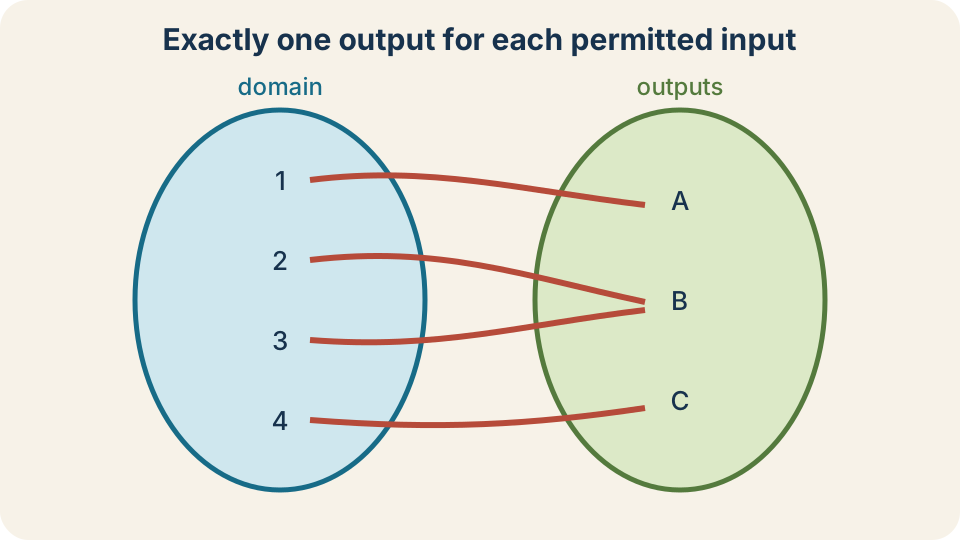
Every permitted input has exactly one outgoing arrow. Two inputs may point to the same output without violating the function definition. An input with two outgoing arrows would fail the definition. The left set represents the domain. The reached values in the right set form the range.
Separate relations from functions
A relation is any collection of ordered pairs. A function is a relation with the additional rule that each input coordinate appears with exactly one output. The ordered pairs , , and define a function because no input repeats with a different output. The repeated output is allowed. Outputs need not identify inputs uniquely unless an inverse is also required.
The pairs and do not define a function of the first coordinate because input has two outputs. A real-world device that reports two simultaneous temperatures for the same sensor state may be malfunctioning or missing another explanatory input. Adding a variable such as time could create a valid higher-dimensional function. Whether a relation is functional depends on what is chosen as the input. Modeling begins by declaring that choice.
Functions can be deterministic rules even when their formulas are unknown. A data table may define a function over measured inputs. An algorithm can define one through a sequence of operations. A graph can define one by coordinates. The function concept is broader than a single algebraic expression.
Name inputs, outputs, domain, and range
In , is the input and is the corresponding output. The letter names the function, while parentheses show evaluation at an input. The symbol is another name for the output value. It is not necessary to use and ; a temperature model may use , for example. Meaningful variable names often clarify context.
The domain is the set of permitted inputs. The range is the set of outputs actually produced from that domain. A formula alone may suggest a natural algebraic domain, while context can impose a smaller practical domain. A population model might be algebraically defined for negative time but physically interpreted only for . Always state whether a restriction comes from algebra or context.
The codomain is a declared target set that contains the range. In foundational algebra, range and codomain are sometimes spoken of loosely as if identical. They differ when not every permitted target value is actually reached. This distinction becomes important for inverse functions and more advanced mathematics. For current problems, identify at least the actual domain and range with careful endpoint notation.
Evaluate by replacing the complete input
For , the evaluated result is . The entire input replaces every occurrence of . Parentheses protect the negative sign before squaring. Writing would apply the exponent before the negative and produce a different value. Substitution should preserve the input as one grouped object.
For a compound input, use . This expression is not generally equal to . The expanded form is . The cross term appears from the square of the binomial. Function notation instructs substitution before simplification.
For , evaluation at is undefined because the denominator becomes zero. A formula does not override its domain. Evaluation at gives . Report undefined inputs rather than forcing a numerical answer. Domain checking belongs before arithmetic.
Determine natural algebraic domains
Polynomial expressions are defined for every real input. Rational expressions exclude inputs that make a denominator zero. Even-index radicals require nonnegative radicands when working over the real numbers. Logarithms require strictly positive arguments. These constraints can occur together and must all be satisfied.
Consider . The square root requires , which simplifies to . The denominator requires , so . Combining conditions gives domain . The union symbol joins two allowed intervals separated by one excluded input.
Endpoint notation communicates inclusion. A square bracket at means is allowed because the radicand can equal zero. Parentheses at show exclusion, and infinity always uses parentheses because it is not a reachable endpoint. Test values can verify each interval. A number greater than fails the radical condition, while fails the denominator condition.
Read tables and mapping diagrams
A table lists selected input–output pairs. To decide whether it represents a function, scan for repeated inputs. If one input row appears with different outputs, the relation fails. Repeated outputs are acceptable. A finite table’s domain and range can be listed directly from its distinct coordinates.
Tables are useful for exact lookup and finite data but may hide behavior between entries. A table of measured temperature every hour does not by itself state what occurred between measurements. A formula or interpolation rule adds assumptions. Never infer continuous behavior solely from discrete rows without justification. Representation limits are part of interpretation.
Mapping diagrams display arrows from a domain set to a target set. Every domain element must have one outgoing arrow for a total function on that displayed domain. Several arrows may converge on one output. An unused target value belongs to the codomain but not the range. The diagram makes function and one-to-one conditions visually distinct.
Use graphs and the vertical-line test
A graph of plots every ordered pair . A vertical line fixes one input coordinate. If any vertical line intersects the graph more than once, that input has multiple outputs. The relation is then not a function of . This criterion is called the vertical-line test.
A circle fails the vertical-line test because many horizontal positions meet both an upper and lower point. The upper semicircle alone can define a function over its horizontal domain. A sideways parabola also fails as a function of but may be a function of . The test depends on which axis is designated as input. Rotating a graph can change that designation rather than change the relation itself.
Graphs also reveal domain, range, zeros, intercepts, intervals of increase, and discontinuities. Read domain by projecting the graph onto the horizontal axis. Read range by projecting it onto the vertical axis. Open circles exclude endpoint values, while filled points include them. Arrows indicate continuation rather than a finite endpoint.
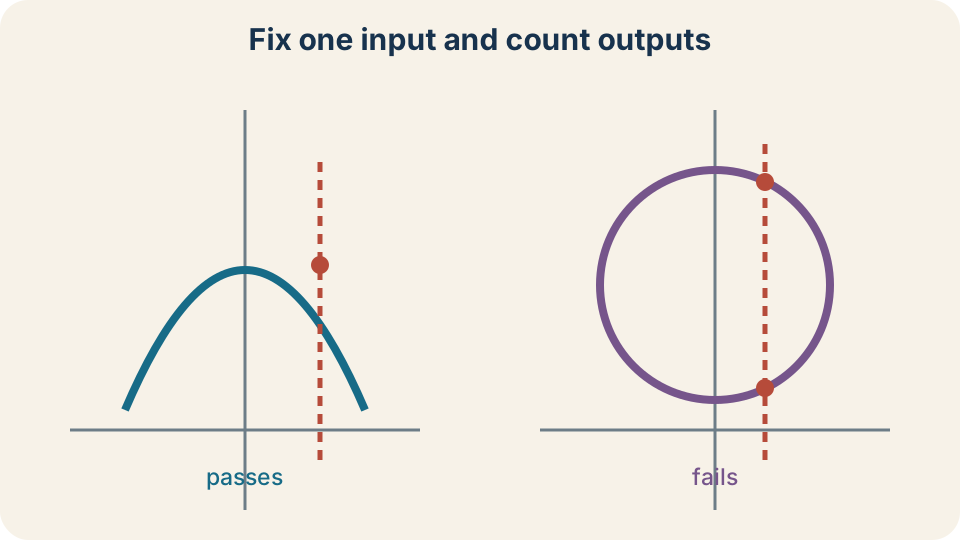
A vertical line represents one fixed input. The function graph meets every such line at most once. The circle meets some vertical lines twice and therefore assigns two outputs to one input. Restricting the circle to one semicircle can create a function. The test must be applied with respect to the chosen input axis. It does not test whether the relation has an inverse.
Translate among representations
A verbal rule can become a formula by identifying inputs, outputs, and operations. “Double the input and subtract three” becomes . A table is generated by evaluating that formula at selected inputs. A graph plots the resulting ordered pairs. Each translation should preserve the same input–output correspondence.
Different representations answer different questions efficiently. A formula exposes algebraic structure and supports exact manipulation. A table gives selected values without showing all behavior. A graph reveals global shape, intercepts, and trends. A verbal description supplies contextual meaning and units.
Consistency checks compare representations. If in a table, then the graph should contain and the formula should evaluate to at . A graph that rises while a table’s outputs fall may indicate mismatched axes or data. Translating is not decorative repetition. It tests whether a model tells one coherent story.
Interpret formulas with units
Suppose gives cost in dollars for quantity in items. The coefficient has units . Multiplying by items produces dollars. The constant is a fixed cost. Every term added in the output formula must have dollar units.
Function notation records dependence but not automatically units. Writing means ten items cost fifty-seven dollars under the model. The input represents items even if the unit is not repeated inside the parentheses. A statement such as would be meaningless for this model. Domain values carry contextual types as well as numerical values.
Unit analysis can reveal formula errors. If distance is in metres and time is in seconds, a linear coefficient multiplying requires units . Adding a bare value in seconds to a length term is invalid. Functions in applications map quantities with units, not abstract numbers alone. Dimensional consistency constrains both rule and domain.
Compose functions in process order
Composition sends an input through one function and then another. The expression names that operation. Apply first and feed its output into . The circle is read “composed with,” not multiplied. Process order is therefore read from inside outward.
Let convert Celsius temperature to Fahrenheit. Let convert Fahrenheit input to sensor voltage in volts. Their composition feeds the first output into the second rule. Degrees Fahrenheit cancel conceptually inside the sensor coefficient, leaving volts. The composition’s domain must produce values accepted by the sensor model.
Composition usually does not commute. If and , then . In the reverse order, . Equal ingredients do not imply equal pipelines. A process diagram helps preserve order before algebra begins.
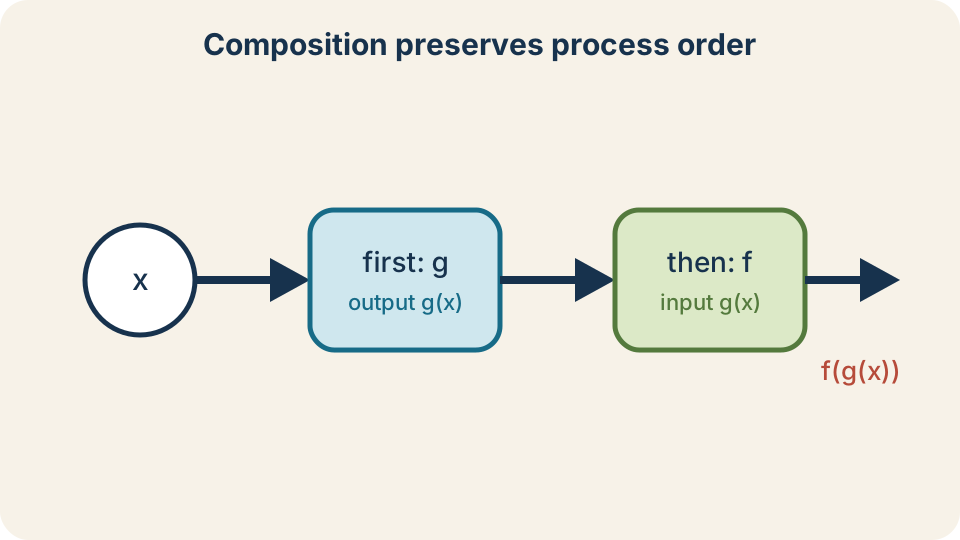
The input enters first. The output becomes the input of . The complete rule is written . Reversing the boxes generally changes the result. Units at the connection must be compatible between stages. The inside function is therefore evaluated before the outside function.
Track domains through composition
For to be defined, two conditions must hold. First, must belong to the domain of . Second, the produced value must belong to the domain of . The composition domain is therefore not always just the inner function’s domain. Output restrictions from the outer function can exclude additional inputs.
Let and . Then . Although accepts every real number, its output must be nonnegative for . Therefore the composition domain is . The temporary letter helps distinguish the outer function’s input slot from the original input.
The reverse order gives . This composition requires only . The formulas and domains differ. Composition order affects both outputs and permitted inputs. Domain analysis should follow the actual pipeline.
Define one-to-one behavior
A function is one-to-one if different inputs always produce different outputs. Equivalently, each output in the range comes from exactly one input. A graph passes the horizontal-line test when no horizontal line intersects it more than once. This test is about invertibility, not about being a function. A graph can pass the vertical-line test but fail the horizontal-line test.
The function on all real numbers is not one-to-one because . Its graph is a parabola intersected twice by many horizontal lines. Restricting the domain to removes the duplication. On that domain, every nonnegative output corresponds to one input. Domain restriction can therefore create an invertible version of a function.
Strictly increasing or strictly decreasing functions are one-to-one on their intervals. They never return to a previous output value. A function with turning points may still be one-to-one on selected pieces. Before seeking an inverse function, identify an appropriate domain. Invertibility is a property of a function together with its domain.
Build and verify inverse functions
An inverse function reverses the original input–output assignment. If , then . The notation names the inverse and does not mean reciprocal . A valid inverse satisfies for inputs in the original domain. It also satisfies for outputs in the original range.
For , write and solve for . Adding two gives , so . Exchange input and output letters to write . Composition verifies . The reverse composition also returns its input.
The graph of an inverse reflects the original graph across the line . Domain and range exchange roles. For restricted to , the inverse is with domain . Without the original restriction, writing would not define one inverse function because one input would have two outputs. Inverse construction must preserve the function rule.
Use piecewise functions
A piecewise function uses different rules on different parts of its domain. The conditions select which expression applies. For example, uses a linear rule for negative inputs and a quadratic rule otherwise. The semicolon or comma after each expression separates it from its condition. Only one rule should apply to a given input when conditions are written correctly.
To evaluate , use the first rule because , giving . To evaluate , use the second rule because , giving . At , the inclusive inequality chooses the quadratic value . One does not evaluate every piece and combine results. Conditions are part of the function definition.
Piecewise models describe taxes, shipping rates, material behavior, and control rules. Their graphs may have jumps or corners. Endpoint symbols show whether a piece includes a boundary. Domain and range must be assembled across all pieces. A function can remain valid even when its formula changes abruptly.
Repair common misconceptions
Function notation is not multiplication. The expression means the value of function at input , not times . Likewise, requires replacing every input occurrence by the entire expression . It does not mean . Parentheses communicate evaluation and grouping.
Repeated outputs do not violate the function definition. Repeated inputs with different outputs do. The vertical-line test checks whether a relation is a function of . The horizontal-line test checks whether an existing function is one-to-one. Confusing the tests mixes existence of outputs with reversibility.
An inverse is not a reciprocal, and composition order is not interchangeable. Domains also cannot be inferred only from visible formulas when context restricts inputs. A graph’s apparent shape is not proof if endpoints and scale are unclear. State definitions and conditions explicitly. Most function errors are failures to track what enters, what leaves, and which inputs are allowed.
Retrieve and connect forward
For , because the complete negative input is squared. For , the real domain is . The radical supplies an upper bound, while the denominator excludes one point. Both conditions must hold simultaneously. Interval notation records the combined result.
If and , then while . The comparison proves composition order matters in this example. If the original function is on all reals, it lacks an inverse function because two inputs share many outputs. Restricting to nonnegative inputs gives inverse . Domain is part of the mathematical object.
Functions organize algebra around dependence. Domain and range define the permitted exchange, representations reveal complementary features, composition builds processes, and inverses reverse one-to-one rules. Units give applied functions physical type and meaning. These ideas prepare graph transformations, polynomial models, exponential functions, calculus, and differential equations. A function is best understood as a structured mapping rather than merely a formula on a page.