
Factoring is the deliberate act of rewriting a polynomial sum as an equivalent product. The symbols change form, but the value of the expression does not change for any permitted input. Product form matters because it exposes zeros, repeated structure, and factors that may later cancel under stated restrictions. This lesson develops factoring as reasoned reverse multiplication rather than as a bag of unrelated tricks. Every method will therefore include a way to choose it, carry it out, and verify the result.
Learning objectives and the central idea
By the end of the lesson, you will extract a greatest common factor, recognize important identities, factor quadratic trinomials, and use grouping when four terms share a hidden binomial factor. You will also connect factors to zeros through the zero-product property. A symbol such as represents a number that may vary, while an exponent such as the in means that is multiplied by itself. A coefficient such as the in scales the power by five. These meanings let you read a polynomial as a multiplication structure waiting to be uncovered.
Factoring reverses the distributive property. Distribution says , where , , and may represent numbers or algebraic expressions. Reading the same equality from right to left gives , which removes the shared factor . The equals sign means that the two forms have the same value, not that one form is merely an instruction to compute the other. Consequently, multiplying the factors back together is a decisive check of every proposed factorization.
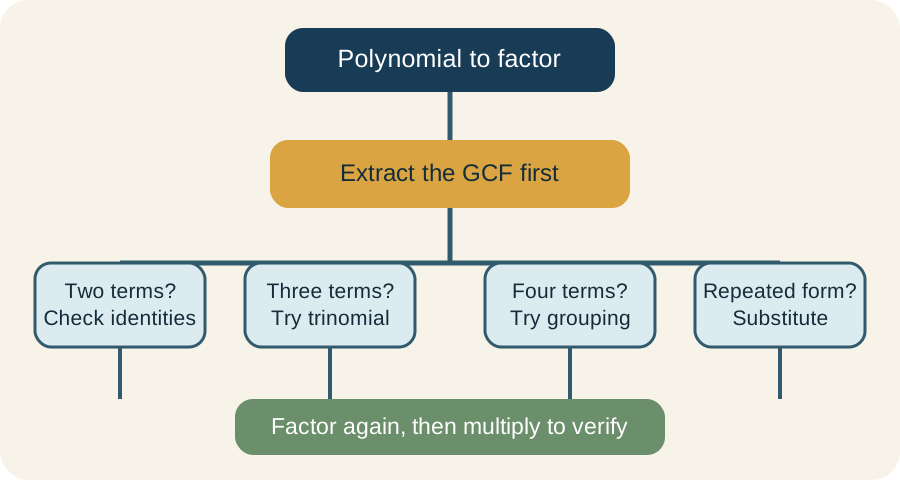
Your strategic question is always, “What multiplication could have produced these terms?” That question focuses attention on coefficients, powers, signs, and term count. A correct factorization is complete only when no factor can be decomposed further over the number system being used. In this lesson, “factor completely” means factor over the integers unless a problem states otherwise. Method selection should follow visible structure rather than trial-and-error alone. The roadmap below organizes the major decisions before we study each one in detail.
Begin with the greatest common factor
The greatest common factor, abbreviated GCF, is the largest expression that divides every term without a remainder. For numerical coefficients, find the greatest positive integer shared by all coefficients. For each variable, use the smallest exponent that appears in every term. Thus the terms and share the numerical factor and the variable factor . Factoring gives , and distribution immediately verifies the result.
Consider . The coefficients , , and have GCF . The smallest exponent of is , and the smallest exponent of is also , so the variable part is . Dividing each term by produces . Therefore the complete first step is .
A negative leading term sometimes makes a negative GCF useful. For , extracting gives , so the polynomial inside begins with a positive term. This sign choice is conventional rather than mandatory, because extracting would also preserve equality. In either version, divide every original term by the chosen GCF and preserve each sign. Checking by distribution catches the common error of changing only some signs.
Recognize identities as multiplication patterns
A polynomial identity is an equality that holds for every allowed value of its variables. The difference-of-squares identity is . The superscript means “square,” while the minus sign between the squares is essential. Multiplying the factors produces , and the opposite middle terms cancel. Therefore because .
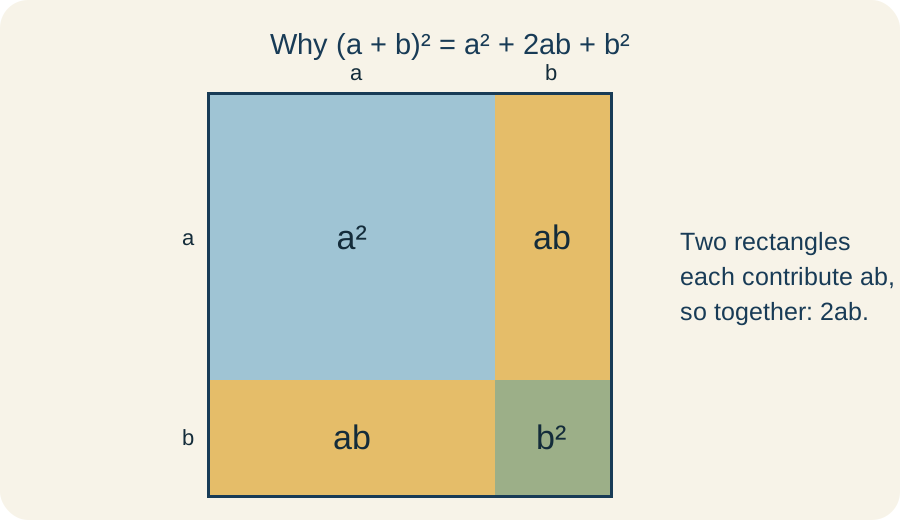
Perfect-square trinomials come from squaring binomials. The identities are and . The middle term must be twice the product of the square roots of the outside terms. For example, because , , and . Merely seeing square first and last terms is not sufficient; the middle-term test confirms the pattern.
The sum and difference of cubes provide two further patterns. They are and . The exponent means multiplication by the same base three times. A memory aid is that the short factor keeps the original sign, the middle term in the quadratic factor uses the opposite sign, and the final term is always positive. Thus , and multiplication should still be used as the final authority.
Factor monic quadratic trinomials
A monic quadratic has leading coefficient and can be written . The word “monic” means that the coefficient of the highest power is one. To factor it as , distribution shows that and . The letters and therefore need a product equal to the constant term and a sum equal to the linear coefficient. For , the numbers and work, so the factorization is .
Signs reduce the search. If is positive, then and have the same sign, and their shared sign is determined by . If is negative, then the numbers have opposite signs, and the sign of belongs to the number with greater absolute value. For , the factor pair and has product and sum . Hence .
An organized factor-pair table prevents guessing from becoming chaotic. List positive divisor pairs of , attach signs using the sign logic, and test sums. If no integer pair satisfies both conditions, the quadratic is irreducible over the integers. That conclusion does not mean the polynomial has no zeros; it means integer-coefficient linear factors are unavailable. Later methods such as the quadratic formula can determine whether real or complex factors exist.
Factor nonmonic quadratic trinomials
A nonmonic quadratic has the form with . The method begins by multiplying the leading coefficient and constant term . Find integers and whose product is and whose sum is . Then split into and factor the resulting four terms by grouping. This method works because the split reconstructs the cross products that appear when two binomials multiply.
Factor . Here , and the integers and multiply to and add to . Rewrite the polynomial as , then group it as . Extracting each group’s GCF gives . The repeated binomial is now a common factor, so the result is .
The grouping order can vary, but the two groups must reveal the same binomial factor. If they do not, first recheck the chosen pair and the signs. For , the product is , and the pair and has the required sum , not . The pair and has sum , so use . Grouping produces .
Use grouping beyond quadratics
Grouping is useful whenever subsets of terms can expose a repeated factor. For , group the first two and last two terms. This gives . The binomial is a factor of both grouped terms, so factor it out. The result is .
Sometimes a group must be factored with a negative sign to create matching binomials. Consider . Grouping gives , where the second group came from factoring out of . Both groups now contain . The complete factorization is over the integers.
Grouping is not guaranteed to succeed in the original order. Reordering terms is permitted because addition is commutative, but every term must remain present with its original sign. A useful diagnostic is to compare ratios of corresponding terms in the proposed groups. If the ratios suggest a common monomial multiplier, an appropriate shared binomial may emerge. If no arrangement works, the polynomial may require substitution, the Factor Theorem, or a method beyond this lesson.
Connect factors, zeros, and graphs
The zero-product property states that if a finite product equals zero, then at least one factor equals zero. In symbols, implies or . This property makes factored equations easy to solve because each factor creates a simpler equation. If , then or . The solutions are therefore and .
The Factor Theorem expresses the same connection for a polynomial . It says that is a factor of exactly when . The symbol represents a candidate zero, and means evaluate the polynomial at that input. For , evaluating gives . Therefore is a factor, and grouping confirms .
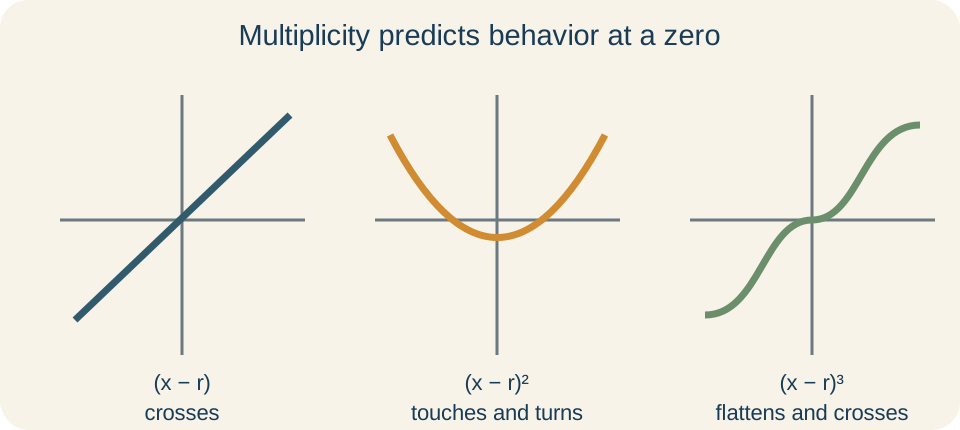
Zeros also describe graph intercepts. If , then the graph of contains the point on the horizontal axis. A factor has multiplicity , meaning it appears times in the product. Odd multiplicity usually makes the graph cross the axis, while even multiplicity makes it touch and turn. The factorization therefore predicts a touch at and a crossing at .
Factor by substitution and repeated structure
Some polynomials become familiar quadratics after a substitution. For , let . The expression becomes , which factors as . Replacing with gives . Factoring both differences of squares completes the result as .
The substitution is valid because every relevant power is built from the same repeated expression. In , use . Factoring gives . Substitution back produces . Expanding the final factors verifies both the substitution and the factoring.
Choose a substitution that lowers the apparent complexity without losing structure. For , the repeated quantity is , so set . The quadratic factors as . Returning to gives , after which the difference of cubes factors further. The sum does not factor over the integers because is not an integer cube.
Verify, diagnose, and state completeness
Verification by multiplication is part of the solution, not optional decoration. Multiply the proposed factors and combine like terms until the original polynomial reappears. You can also test several numerical inputs, but numerical agreement at a few points is weaker than symbolic expansion. A missing term, wrong sign, or misplaced coefficient becomes visible during expansion. For a long factorization, verify in stages rather than multiplying every factor at once.
Common errors have recognizable causes. Forgetting the GCF leaves an incomplete factorization, while using incorrectly changes a sum into a difference. Canceling terms across addition is invalid because cancellation applies to common factors, not isolated terms. Dividing by is legitimate only after writing , and the original expression still excludes when it appears in a denominator. Naming the structural reason for each step helps prevent these errors.
Completeness depends on the coefficient system. The polynomial is irreducible over the real numbers but factors as over the complex numbers, where . In a typical integer-factoring exercise, factors should have integer coefficients unless stated otherwise. Always report restrictions inherited from denominators and always distinguish an expression factorization from an equation solution. These habits make the final answer mathematically precise.
Guided practice and synthesis
First factor . The GCF is , leaving , which is a difference of squares. Thus . If the expression is set equal to zero, the zero-product property gives , , or . Each solution can be checked by substitution into the original polynomial.
Next factor . The product is , and the pair and has sum . Splitting the middle term gives . Grouping produces . Therefore the factorization is , with zeros and if the polynomial equals zero.
Finally, develop a repeatable narration for unfamiliar problems. State the GCF, identify the structural pattern, carry out the selected method, factor each remaining piece, and verify by multiplication. Explain every symbol that carries new meaning, especially exponents, candidate zeros, and multiplicities. When no integer method succeeds, say precisely that the polynomial is irreducible over the integers rather than claiming it cannot be factored at all. That complete reasoning process is the transferable skill this lesson is designed to build.
Further deductions
Factoring and expansion are complementary coordinate systems for polynomial information. Expanded form makes degree and coefficients immediately visible, whereas factored form makes zeros and multiplicities immediately visible. Moving between them is similar to changing viewpoints without changing the underlying object. This is why no single form should be labeled universally simplest. Simplicity depends on the question being asked.
Factoring also prepares you for rational expressions and calculus. A rational expression may contain a removable common factor, but cancellation is justified only after factoring and only with an explicit domain restriction. Limits often use this structure to compare nearby values even when direct substitution produces an indeterminate form. Derivative sign charts likewise use factors to locate critical numbers and determine intervals of increase or decrease. The algebra learned here therefore reappears across later mathematics.
The deepest habit is to treat symbolic manipulation as meaning-preserving transformation. Every equality should be justified by distribution, an identity, or another established property. Every excluded value should remain visible even if its factor later cancels. Every proposed answer should survive reverse multiplication. With those habits, factoring becomes a coherent method for revealing structure rather than a sequence of guesses.