
A linear equation states that two first-degree expressions have equal value. Solving does not mean moving symbols until an answer appears; it means constructing equivalent statements that preserve exactly the same solution set. The equals sign expresses a relationship between two complete expressions. Operations are valid because they preserve that relationship and can be justified. This lesson builds a transparent solving process, classifies every possible outcome, and connects symbolic work to graphs, formulas, units, and contextual models.
Learning objectives and the meaning of equality
By the end of this lesson, you will solve linear equations with variables on one or both sides. You will clear fractions, distribute correctly, combine like terms, and classify equations with one, no, or infinitely many solutions. You will rearrange literal formulas and construct equations from verbal relationships. You will verify solutions in the original equation. You will also explain why each operation preserves the solution set.
The equals sign means that the expression on its left and the expression on its right represent the same value. It is not merely a signal that an answer follows. In , both sides are complete expressions. A solution is a value of that makes the equality true. Substituting any other value produces a false numerical statement.
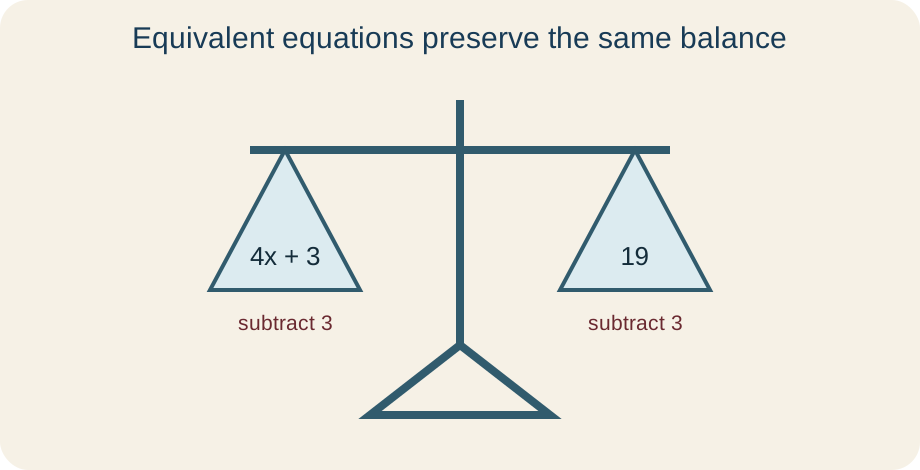
An equation can be imagined as a balance, but the analogy must be used carefully. Whatever change is applied to one side must also be applied to the other side. This shared operation creates a new equation with the same solutions when the operation is reversible. The balance map below links visual balance to the algebraic idea of equivalence. The real justification comes from properties of equality, not from the picture alone.
Define solutions and equivalent equations
The solution set is the collection of all allowed values that make an equation true. Two equations are equivalent when they have exactly the same solution set. For example, , , and are equivalent over the real numbers. Their appearances differ, but each is true only when . Solving aims to replace a complicated equation with a simpler equivalent one.
Adding the same expression to both sides preserves equality. If , then . Subtracting is included because subtracting is adding . Multiplying both sides by the same nonzero number also preserves and reflects equality. Division by a nonzero number is the inverse operation.
Multiplication by zero is not reversible. The distinct equations and both become after multiplying by zero, so their original information disappears. Dividing by an expression involving the variable can also lose a solution when that expression might equal zero. Record restrictions before dividing. Reliable algebra preserves information rather than merely producing a shorter line.
Solve one-step and two-step equations
For , undo the addition before undoing multiplication. Subtracting three from both sides gives . Dividing both sides by four gives . Substitution checks . Each line is an equivalent equation.
The reverse order is guided by expression structure. In , the outer subtraction by seven is undone by adding seven. This gives . Multiplying both sides by five gives . The horizontal fraction bar means the entire numerator is divided by five.
One can sometimes choose another valid route, but clarity matters. Adding, subtracting, multiplying, or dividing should be applied to both complete sides. Writing “the three moves over and changes sign” hides the actual operation. Naming “subtract three from both sides” makes sign changes predictable. It also prepares you for equations where terms cannot be moved by a memorized shortcut.
Distribute and combine like terms
Distribution multiplies every term inside parentheses. The expression becomes because five multiplies both and . A negative multiplier changes each enclosed sign. For example, . Missing one term changes the equation rather than simplifying it.
Like terms have identical variable parts. The terms and combine to , while and do not combine because their exponents differ. Constants combine with constants. Simplify each side before deciding which inverse operation is helpful. Organized simplification reduces the number of operations performed across equality.
Solve . Distribution gives . Subtracting from both sides gives , and adding five gives . Dividing by seven gives . Substitution makes both original sides equal twenty-five.
Manage variables on both sides
When the variable appears on both sides, collect variable terms on one side and constants on the other. Either side can hold the variable, but choosing a positive final coefficient often simplifies arithmetic. In , subtracting gives . Subtracting five gives . Therefore .
Avoid saying a term crossed the equals sign. The term did not travel and become negative by itself. The operation was subtraction of from both sides. On the right, ; on the left, . Showing that shared operation preserves the logic.
If coefficients are negative, choose operations that keep reasoning visible. For , subtracting gives . Adding six yields , so . The reversed-looking final equation is equivalent to because equality is symmetric. Neither side is inherently the answer side.
Classify one, none, or infinitely many solutions
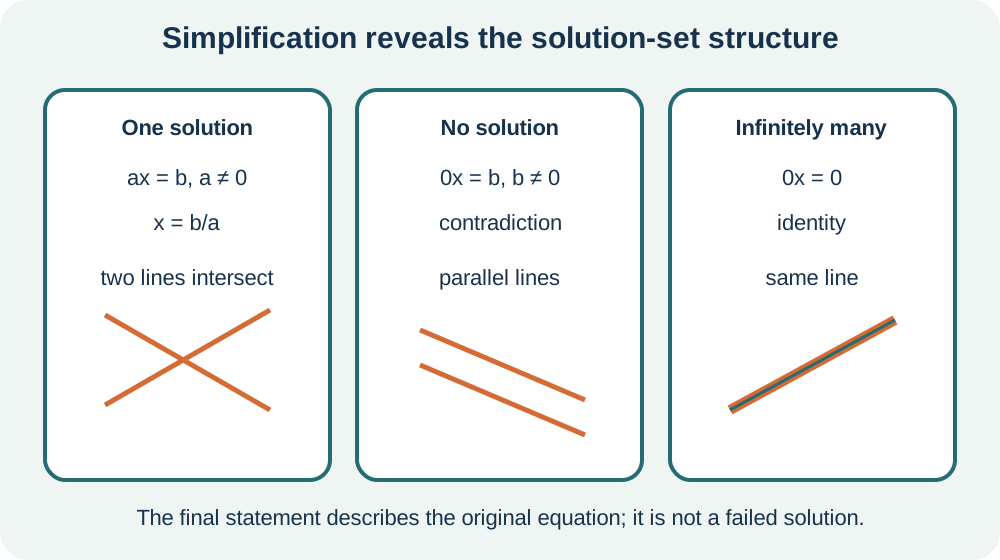
Some linear equations simplify until the variable disappears. If the remaining statement is true, every value in the domain is a solution. For , distribution gives . Subtracting gives . The equation is an identity over its domain.
If elimination produces a false numerical statement, no value can satisfy the original equation. For , distribution gives . Subtracting gives , which is false. The equation is inconsistent. Continuing to divide or isolate a variable after reaching a contradiction has no meaning.
A nonzero variable coefficient eventually produces one solution. A zero coefficient paired with a true constant statement produces infinitely many solutions. A zero coefficient paired with a false constant statement produces no solution. These outcomes are structural and can be predicted from slopes and intercepts of related lines. The classification diagram below connects algebraic outcomes with graph intersections.
Clear fractions across the whole equation
Fractional coefficients are valid, but clearing denominators can make structure easier to see. Multiply every term on both sides by a common denominator. The least common denominator keeps numbers relatively small. Parentheses help show that the multiplier applies to an entire numerator. Skipping even one term changes the equation.
Solve . The least common denominator is six. Multiplying every term by six gives . Distribution and combination produce . Thus and .
Check the fraction solution in the original equation rather than only the cleared version. Substitution verifies that denominator handling and arithmetic were correct. In linear equations with numerical denominators, multiplying by their nonzero common denominator is reversible. If a denominator contains a variable, first exclude values that make it zero. Clearing such denominators can create candidates that require extra checking.
Rearrange literal equations
A literal equation contains several variables and often represents a general relationship. Solving for one variable uses the same equality properties as solving for . Treat other variables as known quantities during the rearrangement. State restrictions created by division. Preserve grouped expressions with parentheses and horizontal fraction bars.
From , isolate . Multiply both sides by two to get . Divide by the entire factor . The result is , provided . The restriction explains when the rearrangement is valid.
Inspect the target variable’s powers before calling an equation linear. The formula is not linear in when because it contains . If , it reduces to . Then for . Technique selection must follow structure, not the number of letters.
Translate contexts into equations
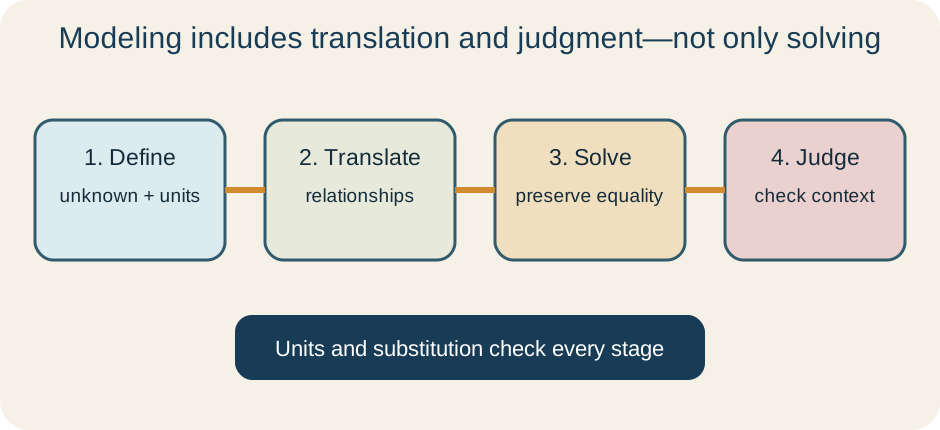
Modeling begins before algebra. Define the unknown with units, identify the fixed quantity and the per-unit quantity, and translate the relationship. A cost model often has form total cost equals fixed charge plus rate times usage. The multiplication of rate by usage should produce cost units. Dimensional consistency checks the translation.
A rental costs plus for each kilometer. If the bill is and is distance in kilometers, write . Subtracting eighteen dollars gives a variable charge of twenty-five dollars. Dividing by the rate gives . Units cancel correctly through the horizontal fractional relationship.
Interpretation is part of the answer. The solution should have an allowed sign and a plausible magnitude. A negative distance would signal that the model or data need reconsideration. Currency rounding should occur at a stage consistent with the billing rule. State assumptions such as constant rate and no taxes rather than hiding them.
Use graphs to interpret equations
An equation asks where two expressions have equal outputs. Graphing and turns solutions into horizontal coordinates of intersections. If two nonparallel lines intersect once, the equation has one solution. If distinct parallel lines never intersect, it has no solution. If the lines coincide, every input is a solution.
Graphing supports interpretation but does not replace exact reasoning when precision matters. A displayed intersection may be difficult to read if it lies between grid lines. Algebra can provide the exact fractional value. The graph can then check sign and approximate size. Using both representations gives stronger evidence than relying on either carelessly.
Slope explains the three classifications. Different slopes produce one intersection. Equal slopes with different vertical intercepts produce parallel lines. Equal slopes and equal intercepts represent the same line. Simplification that eliminates the variable is the algebraic counterpart of comparing these line structures.
Verify and diagnose solutions
Substitute a candidate into the original equation. Evaluate the left and right sides independently. If they become the same numerical value, the candidate passes the check. If not, retrace distribution, signs, denominator clearing, and arithmetic. Checking only the final simplified equation may miss an error that changed the original.
Common errors have recognizable signatures. Applying an operation to one side only breaks equality. Clearing some but not all denominators changes coefficients. Dividing by a possibly zero expression can discard a solution. Assuming every equation has one answer ignores identities and contradictions.
A complete written solution forms a chain of equivalent equations with brief reasons. It states the final solution set, not just a bare number. For one solution, notation such as is clear. For no solution, say the solution set is empty. For an identity over the real numbers, say every real number is a solution.
Guided practice and synthesis
Solve . Subtract from both sides to get . Add seven to obtain . Divide by two to get . Substitution makes both original sides equal twenty-five.
Solve . Multiply every term by twelve to get . Distribution gives . Thus and . Substitute into the original fractional equation to verify.
For independent synthesis, a taxi charges plus . Write and solve an equation for the distance possible with . Explain every term and its units. Check the result in the original cost equation. Then state one real billing rule that could make the continuous linear model approximate rather than exact.
Connection forward
Solving a linear equation means preserving a solution set while simplifying its description. Equality properties justify every reversible operation. Distribution, like-term combination, denominator clearing, and formula rearrangement are tools within that logic. Graphs interpret solutions as intersections. Context and units determine whether the mathematical answer makes sense.
The most durable habit is to narrate operations rather than describe terms as moving. Apply one operation to both complete sides, preserve restrictions, and check the original statement. When the variable disappears, classify the remaining numerical statement. When a model is involved, define the unknown and interpret the result. These habits make later algebra more reliable.
Linear inequalities use many of the same transformations, with one crucial addition: multiplying or dividing by a negative number reverses order. Systems of linear equations extend the intersection idea to several equations. Functions turn each side into an input-output rule. Algebraic modeling repeatedly uses the same sequence of translation, solution, verification, and interpretation developed here. Mastery of equality therefore provides a foundation for nearly every later algebraic method.