
An equation identifies values that make two expressions equal. An inequality identifies values for which one expression is ordered above or below another. Its solution is usually a region rather than one isolated number. Algebraic operations must preserve that order, and negative scaling reverses it for a geometric reason. This lesson develops solution methods, representations, verification, and real constraints as one connected framework.
Interpret the four inequality symbols
The symbol represents a less-than comparison. The symbol represents a greater-than comparison. Both of these strict inequalities exclude equality. The symbol includes values that are less than or equal to the boundary. The symbol includes values that are greater than or equal to the boundary. Reading each symbol as a complete comparison helps preserve its meaning during algebra.
The statement describes every real number to the left of five on a standard number line. The statement includes the same region and the boundary value five. An open circle marks an excluded finite boundary. A filled circle marks an included boundary. Arrows show that the solution continues without end.
The two expressions being compared can be complicated. In , the left expression depends on and the right expression is constant. A solution value makes the comparison true. A nonsolution makes it false. Solving means describing the complete set of values that satisfy the comparison.
View solutions as sets
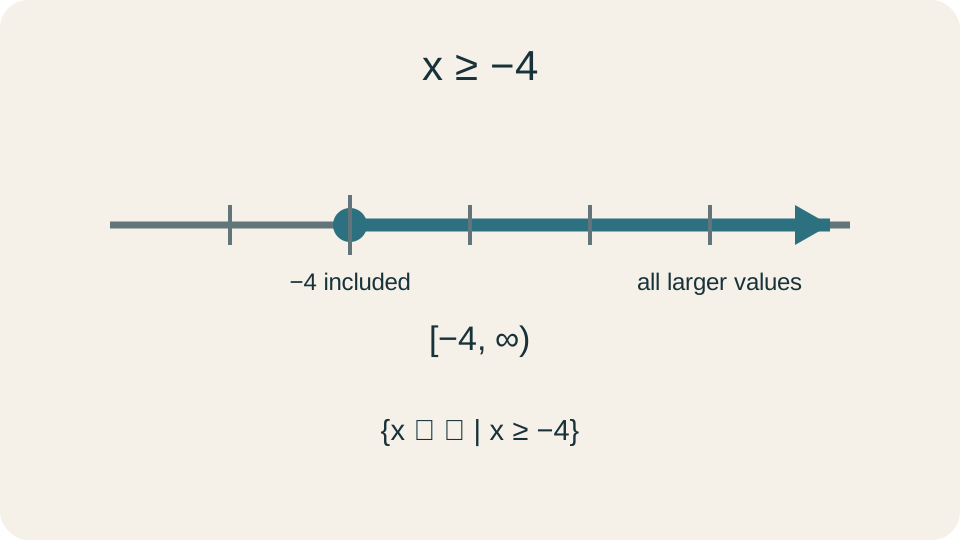
An inequality generally has infinitely many real solutions. The answer names a set rather than a calculation step. Set-builder notation writes this as . The symbol denotes the real numbers. The vertical bar means “such that.” Every value named by the notation must make the original inequality true.
A number-line graph displays this set geometrically. Place a filled point at negative four because equality is included. Shade or draw an arrow to the right because larger numbers satisfy . The arrow does not point toward the variable. It points toward included coordinate values.
Interval notation writes the same set as . A square bracket includes a finite endpoint. A parenthesis excludes a finite endpoint. Infinity always receives a parenthesis because it is not an attainable number. The three representations should translate consistently.
Preserve order under addition and subtraction
If , adding the same number to both sides gives . Both points shift equally along the number line. Their left-right order does not change. Subtraction is addition of a negative number, so it also preserves order. The inequality symbol therefore stays oriented the same way.
For example, start with . Subtracting seven from both sides gives . The subtraction removes the same horizontal translation from each expression. A value such as satisfies both forms. A value such as satisfies neither.
Adding different quantities to the two sides would not preserve equivalence automatically. Every algebraic transformation must apply the same operation to both sides. This balance principle is shared with equations. The difference is that order, not equality alone, must remain true. Writing one transformation per line makes the logic visible.
Preserve order under positive scaling
If and , then . Multiplying both coordinates by a positive number stretches or compresses the number line without reversing its orientation. Division by a positive number behaves the same way. The inequality symbol does not reverse. Positive scale factors preserve order.
Consider . Dividing both sides by positive three gives . The boundary value four makes the original comparison an equality. A smaller value such as zero satisfies both forms. A larger value such as five fails both.
The sign of the divisor matters more than the operation’s name. Multiplying by is equivalent to dividing by three, and both preserve order because the factor is positive. A symbolic coefficient must have known sign before division is performed. If its sign is unknown, cases may be required. Mechanical symbol movement can conceal this condition.
Explain why negative scaling reverses order
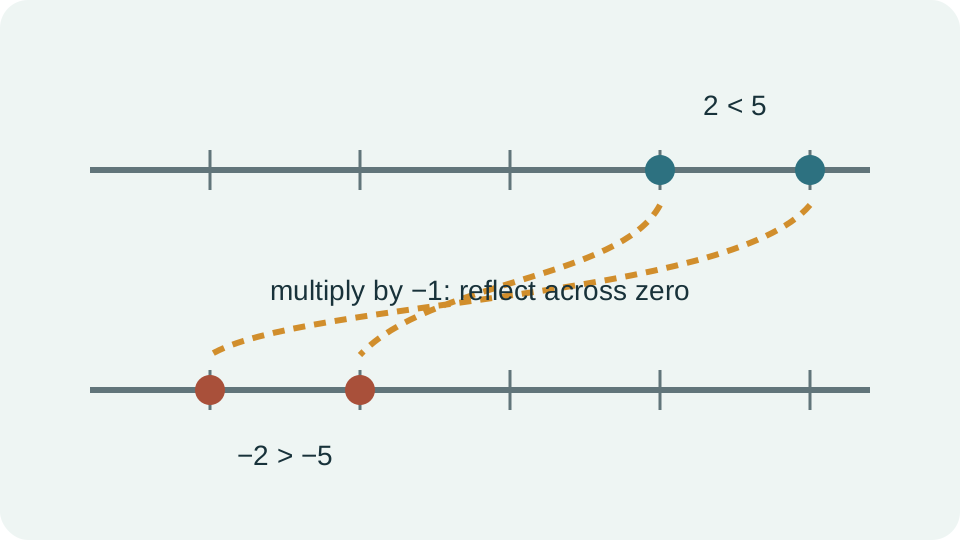
If , multiplying by negative one gives . Reflection across zero reverses every point’s left-right position. A number originally farther left becomes farther right after reflection. Multiplication by any negative number combines a positive scaling with this reflection. The inequality symbol must reverse to describe the same ordered relationship.
For a numerical example, is true. Multiplication by negative three gives and . On the number line, . Writing would be false. The reversal is a consequence of order, not a punctuation trick.
Division by a negative number also reverses the inequality because it is multiplication by a negative reciprocal. The reversal occurs once for each negative scaling of the complete comparison. Addition or subtraction of a negative number does not trigger it. The controlling question is whether both sides were multiplied or divided by a negative quantity. Naming that operation explicitly is more reliable than reacting to every visible minus sign.
Solve a one-step inequality
Consider . Add six to both sides to obtain . The symbol stays oriented because addition preserves order. The boundary comes from the associated equation . Because the original inequality is strict, sixteen is excluded.
Now consider . Dividing both sides by negative four gives . The symbol reverses from greater-than-or-equal to less-than-or-equal. The boundary negative five is included. Testing zero fails the original, while testing negative six succeeds.
One-step examples isolate the order rule from other algebra. Every solution should still be interpreted as a set. Boundary testing checks inclusion. A second point from the proposed shaded side checks direction. These checks reveal many sign reversals that were missed or applied unnecessarily.
Solve a multistep linear inequality
Solve . Subtract five from both sides to get . Divide by negative three and reverse the comparison. The result is . In interval notation, the solution is .
The boundary check uses . The left side becomes , so the inclusive comparison is true. Test from the proposed solution region. It gives , which is true. Test outside the region, and is false.
Testing does not replace algebraic proof, but it checks the boundary and shaded direction. A single successful point cannot prove an entire interval. The reversible algebraic transformations establish equivalence. The tests detect likely implementation errors. Explanation and verification serve complementary roles.
Handle variables on both sides
Consider . Subtract from both sides to obtain . Add two to get . Divide by positive three to conclude . The variable terms were collected without changing order.
Sometimes variable terms cancel completely. For , subtracting gives , which is always true. Every real number is a solution. For , subtraction gives , which is always false. The solution set is empty.
The symbols for these cases are for all real numbers and for the empty set. The empty-set symbol does not mean zero. Zero is a number and could be a solution. Cancellation exposes whether the original comparison was universally true or impossible. A number-line graph is fully shaded for and has no shaded points for .
Solve compound inequalities with and
A compound “and” inequality requires both comparisons to hold. The statement places the same expression between two bounds. Subtract one from all three parts to obtain . Divide all parts by positive three. The result is .
The solution is the intersection of two sets. It must satisfy and simultaneously. Interval notation is . The left boundary is open because negative one is excluded. The right boundary is closed because three is included.
An operation on a three-part inequality must be applied to every part. If dividing all parts by a negative number, both comparison directions reverse and the numerical order should be rewritten clearly. For example, divided by negative two gives . Reordering from smaller bound to larger bound makes the interval readable. Each transformation preserves the combined condition.
Solve compound inequalities with or
An “or” statement accepts values satisfying at least one branch. The inequality or describes two separated rays. Interval notation is . The union symbol combines the two sets. The gap between negative two and four is excluded.
Overlapping “or” branches may simplify. The statement or covers every real number because every number satisfies at least one branch. Its union is . By contrast, and has no solution because the branches do not overlap. Words and set operations must agree.
Compound inequalities can arise from factored or absolute-value conditions. Solve each branch carefully and then combine according to “and” or “or.” A number-line sketch reveals overlap and gaps. Symbols alone can hide a union that actually covers everything. Visual set reasoning is a reliable simplification tool. Substituting one point from each resulting region provides an additional check.
Use interval notation accurately
An interval lists values from left to right. The interval means . The interval means . Mixed brackets include one endpoint and exclude the other. Endpoint symbols encode the exact comparison.
Unbounded intervals use infinity symbols. The set is . The set is . Infinity and negative infinity always use parentheses. They describe unbounded direction rather than values that can be substituted.
Union combines regions, while intersection keeps only overlap. The notation means elements in or or both. The notation means elements common to both. Compound inequalities translate directly into these operations. A graph can verify whether the selected operation matches the words.
Model an upper-bound budget
A delivery service charges plus for each package. A customer can spend at most . Let be the number of packages. The phrase “at most” means less than or equal to. The constraint is .
Subtracting gives . Dividing produces . Algebra over real numbers permits fractional values. Context does not because individual packages are counted. The feasible counts are .
Rounding to thirteen would violate the budget. The context requires taking the greatest integer not exceeding the bound. Check twelve packages: total cost is . Thirteen packages cost and fail. Contextual verification completes the model.
Model lower bounds and strict language
Phrases encode inequality symbols. “At least” means greater than or equal to. “More than” means strictly greater than. “No more than” means less than or equal to. “Fewer than” means strictly less than for countable items.
Suppose a storage tank must contain at least . If it currently contains and fills at , elapsed time must satisfy . Solving gives . The inclusive boundary matches “at least.” Units reduce to minutes. Substitution at produces exactly .
If time is measured only in complete minutes before inspection, the first feasible recorded time is fourteen minutes. If fractional minutes are allowed, is the exact boundary. Context determines the domain. Inequality modeling requires translating both language and allowable values. Rounding direction must preserve the requirement rather than merely follow the nearest-number rule.
Express tolerances with absolute value
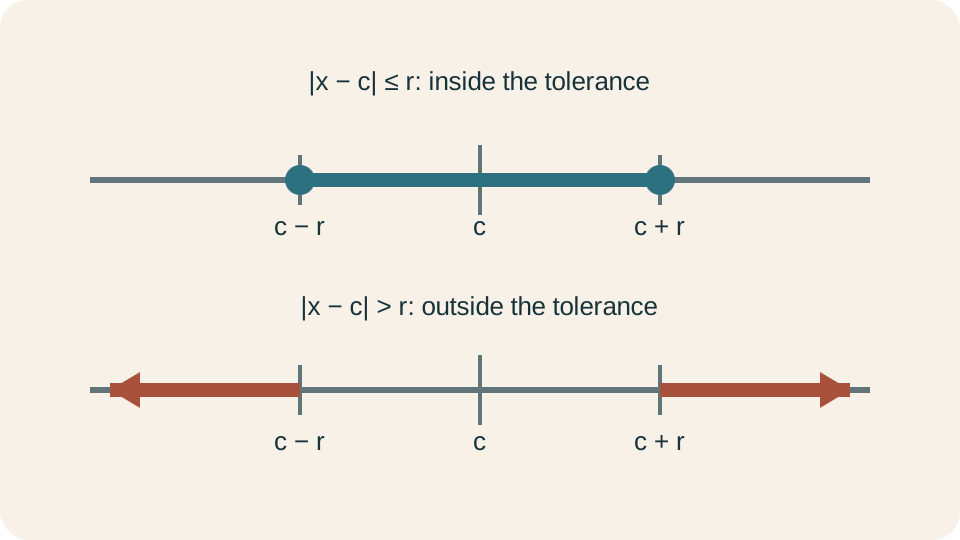
Absolute value measures distance from zero. Therefore measures the distance between and center . The condition means that distance is at most radius . For , it becomes . The solution lies inside a central interval.
The condition means distance from exceeds . Its solutions lie outside the central interval. The equivalent branches are or . Strictness is preserved at both boundaries. A number-line distance picture explains why “inside” uses and while “outside” uses or.
A pin should have diameter with tolerance . The condition is . It becomes . Both endpoints are acceptable because the tolerance is inclusive. Every term has length units.
Graph inequalities in two variables
A linear inequality such as describes a region in the coordinate plane. The associated equation forms the boundary line. Because equality is included, the boundary is drawn solid. A strict inequality would use a dashed line. Line style records boundary inclusion.
To choose the shaded side, test a point not on the boundary. The origin gives , which is true. Therefore the side containing the origin is shaded. Every point in that half-plane satisfies the inequality. The boundary divides the plane into two candidate regions.
Systems of inequalities require intersection of several shaded regions. Their common region is called a feasible region in optimization contexts. Boundary intersections can become vertices of that region. A test point should be applied to each inequality separately. Graphing extends one-dimensional rays and intervals into two-dimensional half-planes.
Divide by expressions only after sign analysis
From , one cannot automatically write unless the sign of is known. If , the direction is preserved. If , the direction reverses. If , division is undefined and the original statement reduces to . Symbolic parameters require cases.
Variable expressions create the same issue. Dividing both sides by without knowing its sign can reverse the comparison for some values and be undefined at . Rational inequalities are usually solved by moving terms to one side and making a sign chart. Critical points divide the number line into intervals of constant sign. Test points then identify valid intervals.
This warning explains why equation habits cannot be copied mechanically. Equality is unaffected by multiplying both sides by any nonzero quantity. Order depends on sign. A correct inequality solution preserves all cases and excluded values. Unknown sign is information that must be resolved, not ignored.
Verify boundaries and regions
The associated equality usually identifies finite boundary candidates. Substituting a boundary determines whether an inclusive symbol allows it. A strict symbol excludes it even if both expressions would be equal. Denominator restrictions can also exclude a boundary independently. Verification begins with the original inequality.
Choose a test point from each proposed region. Substitute into the original comparison rather than only the final simplified form. One point represents an interval only when algebra has shown that truth cannot change inside it. Linear inequalities have one boundary and constant truth on each side. More complicated inequalities require all critical points.
Graphical and contextual checks add evidence. Does a positive cost rate create an upper bound under a fixed budget? Does a minimum requirement shade upward? Does an included tolerance use filled endpoints? A solution should agree across algebra, graph, language, and units.
Diagnose common inequality errors
One error is reversing the symbol after adding or subtracting a negative number. Order reverses only when multiplying or dividing both sides by a negative quantity. Another error is failing to reverse after negative division. A number-line reflection explains both cases. Rules remembered without reasons are easier to misapply.
Endpoint errors are also common. Strict and use open circles and parentheses. Inclusive and use filled circles and square brackets at finite boundaries. Infinity always uses parentheses. These choices are part of the answer, not decorative notation.
Modeling errors include ignoring domain restrictions. Counts are usually nonnegative integers. Time may be nonnegative and continuous or recorded discretely. Automatic rounding can violate a strict or upper-bound constraint. The final set must respect both algebra and context.
Practice a complete solution routine
First state the domain and translate language into a comparison. Second simplify both sides and collect variable terms. Third use order-preserving operations, reversing only after negative scaling. Fourth represent the solution as inequality, interval, or graph. Fifth check boundary, direction, units, and contextual restrictions.
Solve . Subtract seven to get . Divide by negative two and reverse the symbol, giving . The interval is . Testing succeeds, while the excluded boundary produces equality rather than strict inequality.
For a load model, a platform of mass must keep total mass below . Each crate has mass . The constraint gives . Since is a nonnegative integer, at most eleven crates are allowed. Twelve crates would produce exactly and violate the strict requirement.
Consolidate inequality reasoning
Inequalities describe ordered solution sets. Addition and subtraction preserve order, as does positive scaling. Negative scaling reverses order because it reflects the number line. Solutions can be written symbolically, graphed, or expressed with interval and set notation. Each representation must encode the same endpoints and direction.
Compound “and” statements use intersection, while “or” statements use union. Absolute value converts distance constraints into central or outer regions. Two-variable inequalities produce half-planes. Context can restrict continuous algebraic solutions to integers, nonnegative values, or physically meaningful units. Modeling completes rather than follows the mathematics.
A reliable solution explains every transformation and checks the original comparison. It never divides by an expression of unknown sign without cases. It treats boundary inclusion as mathematical information. It interprets infinity as unbounded direction rather than an endpoint. Inequality reasoning is the algebra of feasible regions and limits.