
An equation is a statement that two expressions represent the same value. Solving an equation means finding every allowed value that makes that statement true. The work is not a game of moving symbols across an equals sign. Each step applies a valid operation to both sides so that equality is preserved while the unknown is isolated. This lesson makes that balance principle visible and uses it to solve, check, and model one-step relationships.
Establish the learning goals
By the end of this lesson, you should be able to interpret the equals sign as a relation between two complete expressions. You will identify the operation acting on an unknown and choose an inverse operation that reverses it. You will solve additive, subtractive, multiplicative, divisive, fractional, and decimal one-step equations. You will preserve units in applied equations and verify solutions in the original statement. You will also recognize equations having no solution or every value as a solution.
One-step equations are simple enough to expose the logic that governs much harder equations. A correct step transforms an equation into an equivalent equation with the same solution set. The inverse operation does not magically transport a term from one side to the other. It creates an identity element, such as zero or one, on the variable side. The same operation on the other side preserves equality.
Use three questions at every step. What operation is currently applied to the variable? Which operation undoes it? How can the proposed solution be checked? These questions replace brittle memorized slogans with a reusable method. They remain useful in linear equations, formula rearrangement, functions, and calculus.
Read equality as a relation
In , the equals sign says that the expression on the left and the expression on the right share the value twelve. It does not mean “perform the calculation on the left and write an answer next.” Either side can be rewritten with an equivalent expression. For example, remains true because equality is symmetric. Reading both sides as complete expressions prevents many notation errors. The relation remains true regardless of which equal expression is written first.
Equality is also transitive. If and , then . This property allows a chain of correct equations to connect an original statement with a solved form. Every equals sign in that chain must be true, not merely indicate the next thought. A line such as is invalid because does not equal the expression before the solution has been established.
An equation may be true for one value, several values, every allowed value, or no value. The solution set contains all values that make it true. For , the solution set is . For , every allowed value works. Solving means determining the complete solution set rather than producing an unexplained number.
Preserve equality with equivalent operations
The addition property of equality says that if , then . Subtracting the same quantity from both sides is included because subtraction means adding an opposite. The multiplication property says that when . The division property says when . These are the legal foundations of elementary equation solving.
The restriction matters because division by zero is undefined. Multiplying both sides by zero can also destroy information by making distinct expressions both equal zero. Reversible operations preserve equivalence most transparently. Later algebra sometimes uses operations that introduce extra candidates, such as squaring both sides. Those candidates then require careful checking.
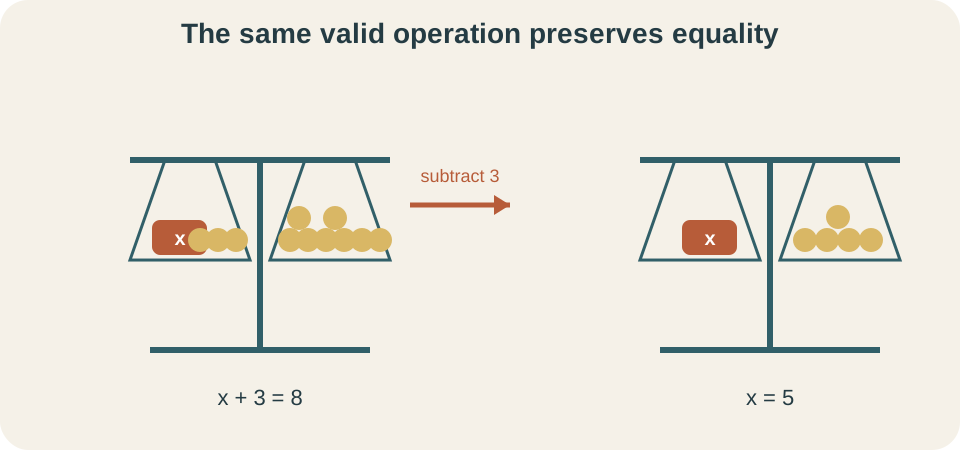
A balance scale provides a useful analogy. If two pans have equal weight, adding the same mass to both keeps the scale balanced. Removing the same mass from both also preserves balance when the removal is physically possible. The analogy illustrates equality preservation but does not replace algebraic justification. Equations can involve negative numbers, abstractions, and operations that a literal scale cannot display.
Identify an operation and its inverse
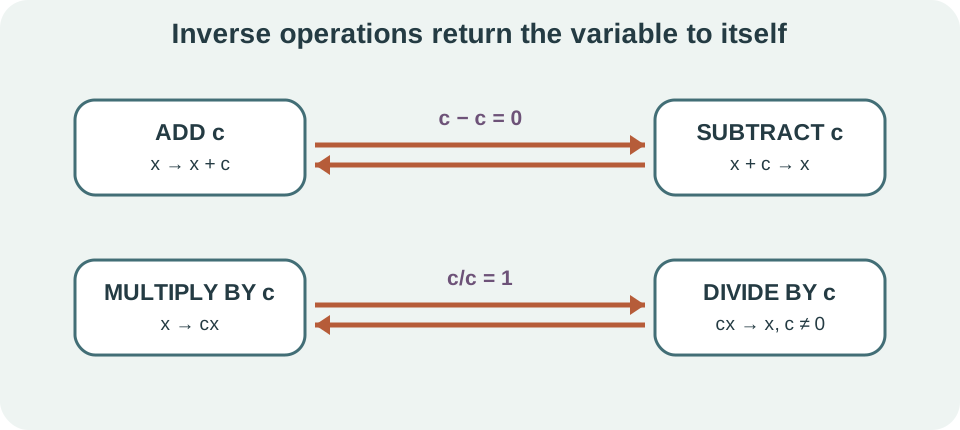
Inverse operations compose to produce an identity effect. Addition by is undone by subtraction of because , and adding zero leaves a value unchanged. Multiplication by nonzero is undone by division by because , and multiplying by one leaves a value unchanged. Division by nonzero is undone by multiplication by . These inverse pairs guide the isolation step.
The outermost operation acting on the variable determines what to undo first. In the one-step equation , addition by nine acts on . In , multiplication by negative four acts on . In , division by eight acts on . Naming the operation before acting reduces sign and reciprocal errors.
The phrase “do the opposite” is incomplete unless the operation and both equation sides are specified. Subtracting nine only on the left of produces a false transformation. Subtracting nine from both sides gives . The left simplifies to , and the right simplifies to five. The reasoning, not the visual motion of symbols, produces .
Solve addition equations
Consider . Subtract nine from both sides to obtain . Because , the left side becomes . The right side becomes five. Therefore .
The check substitutes five into the original equation. The left side becomes , which equals the original right side. This true numerical statement verifies the solution. Checking the solved form against itself would provide no independent evidence. Always return to the original equation.
Units follow the same equality principle. If an initial temperature increases by to become , then . Subtracting from both sides gives . The unit stays attached because all terms represent temperature differences or readings in the stated scale. Substitution confirms that adding the stated change to the initial reading produces the final reading.
Solve subtraction equations
In , subtraction by thirteen is undone by adding thirteen. Applying the same operation to both sides gives . The opposite terms combine to zero, leaving . Substitution checks that . The negative right side does not require a special rule.
Equations of the form need additional attention because the variable is being subtracted. For , subtract eight from both sides to get , then multiply both sides by negative one to obtain . This is technically a two-step equation, but it exposes why “move and change the sign” can obscure structure. The check confirms the result. Writing the intermediate equation keeps the negative coefficient visible.
One may alternatively add to both sides of , producing , and then subtract three. Both routes preserve equality. Different valid sequences can reach the same solution set. A good route keeps signs clear and makes each equality easy to verify. Algebra rewards transparent reasoning more than fewest written marks.
Solve multiplication equations
For , the coefficient negative four multiplies . Divide both sides by to get . The left coefficient becomes one because . The right side becomes negative seven. Therefore .
The sign can be predicted before calculation. A negative number times produces positive twenty-eight, so must be negative. Substituting yields . The product of two negative numbers is positive, so the check succeeds. Sign prediction is a useful reasonableness test.
When a coefficient has units, dividing by it transforms the unit as well. If , with density and mass , then . Dividing gives . Grams cancel, and the reciprocal cubic-centimeter denominator moves to the numerator. The surviving cubic-centimeter unit matches the meaning of volume.
Solve division equations
For , division by eight is undone by multiplication by eight. Multiplying both sides gives . The factor leaves on the left. The right side becomes twenty-eight. Thus .
The divisor must be nonzero. In , the original equation is defined only when . Multiplication by then preserves the relationship and gives . Domain restrictions should be recorded before simplifying. Ignoring them can turn an undefined statement into an apparently ordinary equation.
Applied division equations often represent unit rates. If , then multiply both sides by . The result is . Hour units cancel and kilometers remain. This unit cancellation confirms that distance was isolated.
Solve equations with fractional coefficients
To solve , multiply both sides by the reciprocal . This gives . The coefficient product equals one, so the left side becomes . The right side becomes twenty. Therefore .
The reciprocal method is division by the coefficient written as multiplication. Because , dividing both sides by is valid. The reciprocal is chosen because the two fractions multiply to one. Inverting the variable or the wrong side has no justification. State which factor is being undone.
Check the result in the original equation: . A magnitude estimate also helps because three fifths of the unknown equals twelve, so the whole unknown must exceed twelve. The result twenty satisfies that expectation. Fraction equations become easier when the coefficient is understood as a scale factor. Solving reverses that scaling.
Solve equations with decimals and signed values
Decimal coefficients follow the same multiplication principle. For , divide both sides by to obtain . Equivalently, recognize and multiply both sides by four. The fraction interpretation makes the result easy to estimate. One fourth of twenty-four is six.
Negative constants require careful parentheses during substitution. For , add three to both sides and obtain . The check is . Writing the signed values explicitly clarifies that addition of a negative is subtraction. The same balance law governs every sign combination.
Measurement values should retain both unit and sensible precision. Suppose a sample’s mass satisfies . Subtracting gives . The subtraction is permitted because both terms have the same dimension. A bare answer of would not state what was measured.
Recognize zero-coefficient special cases
The equation has no solution because the left side equals zero for every real . No real value can make zero equal five. Dividing both sides by zero is not a permitted attempt to solve it. The solution set is empty, written . This conclusion follows by evaluating the equation’s meaning.
The equation is true for every real because zero times any real number is zero. Its solution set is all real numbers. Dividing both sides by zero would again be undefined and could not reveal this result. The two equations look similar but make completely different claims. Evaluate the identity before applying a routine.
These special cases appear naturally after simplifying more complicated linear equations. If all variable terms cancel and a false statement such as remains, the original equation has no solution. If a true statement such as remains, every allowed value is a solution. The remaining statement classifies the solution set. This reasoning will matter in the later linear-equations lesson.
Model measurements with one-step equations
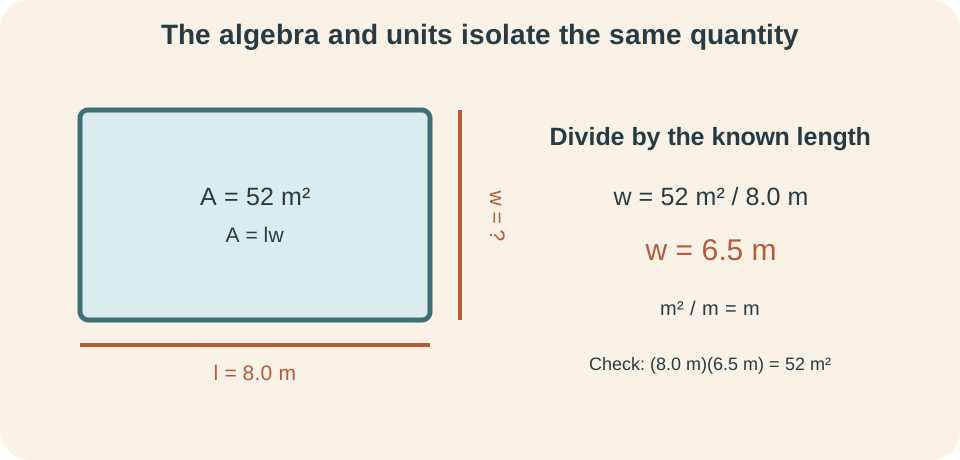
A rectangular garden has area , where is length and is width. Suppose and . Substitution gives . Dividing both sides by gives . Square meters divided by meters leaves meters.
The equation is built from a geometric relationship rather than from keywords alone. The known area, known length, and unknown width are assigned to their roles in . A sketch can verify which dimension is missing. Because width times length must reproduce area, the unit calculation is part of the solution. The check confirms both value and dimension.
Models also contain assumptions. This calculation treats the garden as a rectangle with exact stated measurements. If uncertainty in area or length matters, the width would also carry uncertainty. Algebra isolates the requested quantity under the chosen model. It does not by itself validate the shape or measurements.
Verify solutions in the original equation
A solution is valid only if it makes the original equation true. The most reliable check substitutes the candidate for the variable before any transformations. Evaluate the entire left side and right side separately. Confirm that their values and units agree. A correct-looking isolation step is not a substitute for this test.
Checking catches arithmetic and sign errors. If someone solves as , substitution produces , which does not equal forty-two. The failed equality points directly to a sign mistake. The correct candidate gives . A short check can prevent a wrong result from propagating.
Later operations can introduce extraneous candidates or lose domain restrictions. One-step inverse operations are usually reversible when their restrictions are respected, but developing the check now builds a durable habit. State the check as an equality rather than saying only “it works.” Include the original units in an applied problem. Verification should be visible to a reader. Visible verification also makes mistakes easier to diagnose and correct.
Diagnose common misconceptions
Operating on only one side changes the relationship and generally changes the solution set. Symbols do not jump across the equals sign and change sign on their own. That shortcut is a compressed description of applying an inverse operation to both sides. When a sign error occurs, write the full balanced step again. The underlying equality property resolves the ambiguity.
Another mistake confuses an expression with an equation. The expression has no solution until it is related to another expression by a condition. An equation such as can be solved because it asks which makes equality true. Likewise, the equals sign should not be used between unequal intermediate calculations. Mathematical notation must state true relationships.
Dividing by zero, dropping units, and checking only the final line are additional failures. Zero coefficients require logical classification rather than division. Units must undergo the same multiplication or division as their numerical values. The candidate belongs in the original equation during verification. Each correction returns attention to meaning rather than memorized motion.
Practice balanced equation solving
Solve and check , , , and . For every equation, name the operation currently acting on . Write the same inverse operation on both sides. Simplify only after the balanced step is visible. Substitute the result into the original equation.
A distance satisfies . Solve for with units retained. A rectangle has area and length . Solve for its width. Check each result using the defining relationship.
Classify and as having one solution, no solution, or all real solutions. Explain why division is not allowed in either case. Then write a one-step equation whose solution is . Solve your equation using a balance step. Exchange the equation with a reader who can verify your construction.
Solutions and reasoning
Adding thirteen gives , and . Dividing by negative six gives , and . Multiplying by eight gives , and . Multiplying by gives , and . Each inverse operation creates zero or one on the variable side.
Multiplying the distance equation by gives . Dividing area by length gives . Substitution reproduces the original rate and area. Hour and centimeter factors cancel appropriately. The remaining units match the requested quantities.
The equation is true for every real , whereas is true for none. Division by zero is undefined and would erase the distinction. One possible constructed equation is . Subtracting six from both sides gives . Substitution verifies that .
Carry the balance principle forward
Multi-step linear equations repeat the same balance process. The outermost operation is undone, the equation is simplified, and another inverse operation is selected. Variables may appear on both sides, but every legal step still preserves the solution set. Formula rearrangement uses the same logic with several named quantities. Nothing fundamentally new replaces equality.
The language you use shapes the reasoning you remember. Say “subtract nine from both sides,” not “send nine across.” Say “divide both sides by the nonzero coefficient,” not “drop the coefficient.” Identify restrictions before simplifying. These statements record why the transformation is valid. They also remain accurate when equations become too complicated for a visual shortcut. Precise language supports precise algebra.
Keep the full workflow: define the unknown, build or read the equation, identify the operation, apply its inverse to both sides, simplify, and check. Retain units wherever quantities are measured. Predict sign and approximate size before calculating. A one-step equation is small, but solving it rigorously establishes the habits used throughout algebra and applied mathematics. Those habits turn later procedures into understandable extensions rather than unrelated rules.