
Algebra begins when a symbol stands for a quantity whose value may be unknown, changing, or deliberately general. That small change from numbers alone to numbers and symbols makes it possible to describe an entire family of situations at once. An expression is therefore more than a string of marks: it is a compact record of quantities, operations, and relationships. Learning to read that record structurally is the foundation for equations, functions, formulas, and mathematical models. This lesson develops that reading habit carefully and connects every symbolic move to meaning.
Establish the learning goals
By the end of this lesson, you should be able to distinguish a variable, a constant, an expression, an equation, and an identity. You should also be able to identify terms, factors, coefficients, bases, and exponents without relying on visual guesswork. These distinctions matter because different structures permit different operations. For example, terms may sometimes be combined by addition, while factors may sometimes be reorganized by multiplication. Accurate vocabulary gives you a reliable way to explain why a step is valid.
You will translate verbal and physical relationships into expressions while preserving order, grouping, and units. You will evaluate expressions by substitution, including substitutions involving negative numbers, fractions, and quantities with units. You will also use the commutative, associative, and distributive properties to produce equivalent forms. The goal is not to memorize isolated manipulation rules. The goal is to understand how the form of an expression communicates its mathematical meaning.
As you work, ask three recurring questions. First, what does each symbol represent in this context? Second, what operations does the expression instruct, and in what order must they occur? Third, do the resulting units and values make sense? These questions turn symbol manipulation into reasoned analysis. They also catch many errors before calculation begins.
Understand what a variable represents
A variable is a symbol assigned to a quantity or a possible value. In the equation , the symbol represents one presently unknown number. In the formula , the symbol may take many positive values as the radius of a circle changes. In the rule , the symbol denotes an input selected from a stated domain. The same letter can therefore play different roles in different contexts.
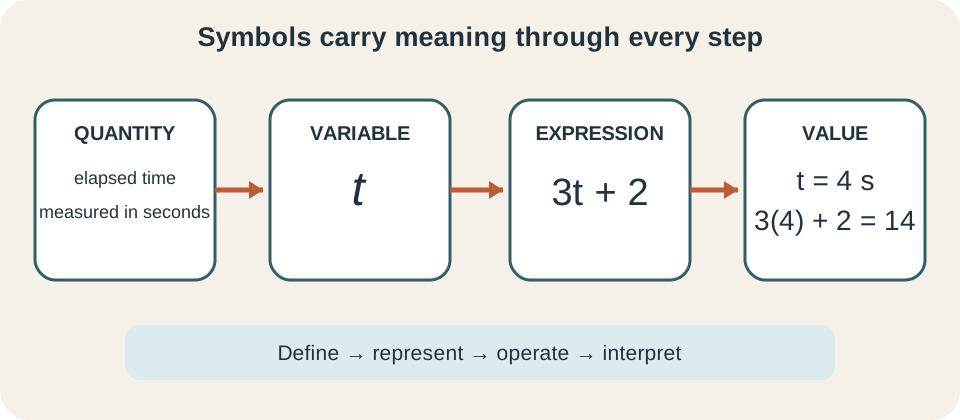
A variable can also represent a measured physical quantity rather than a bare number. If represents elapsed time, then writing communicates both magnitude and unit. If represents speed, then has dimensions of length divided by time. A symbol’s definition should state this meaning explicitly. Without that definition, a formula can be algebraically readable but scientifically ambiguous.
Letters do not possess permanent universal meanings. The symbol might represent mass in mechanics, slope in coordinate geometry, or an integer index in number theory. Context supplies the definition, allowed values, and units. A well-written solution therefore defines variables before using them. Treating every symbol as a named quantity prevents algebra from becoming an exercise in moving unexplained letters.
Separate constants, parameters, and variables
A constant has a fixed value within the problem under consideration. Numerical constants such as and state their values directly. Named constants such as also have fixed mathematical values, with representing the ratio of a circle’s circumference to its diameter. A physical constant may carry units, such as an acceleration magnitude expressed in . Constants can participate in operations without changing their fixed status.
A parameter is held fixed during one analysis but may change when comparing cases. In , the input variables may be and , while and specify which line is being studied. Choosing and selects one member of the larger family of lines. In another investigation, itself may vary and become the primary variable. The distinction therefore depends on the purpose of the model.
Recognizing roles clarifies dependence. In the expression , the item count varies while the fixed charge and unit price are treated as constants. If a store changes its price, the unit price becomes a parameter across pricing scenarios. Naming those roles helps the reader know what may change. It also prepares you to interpret functions and multivariable models later.
Distinguish expressions, equations, and identities
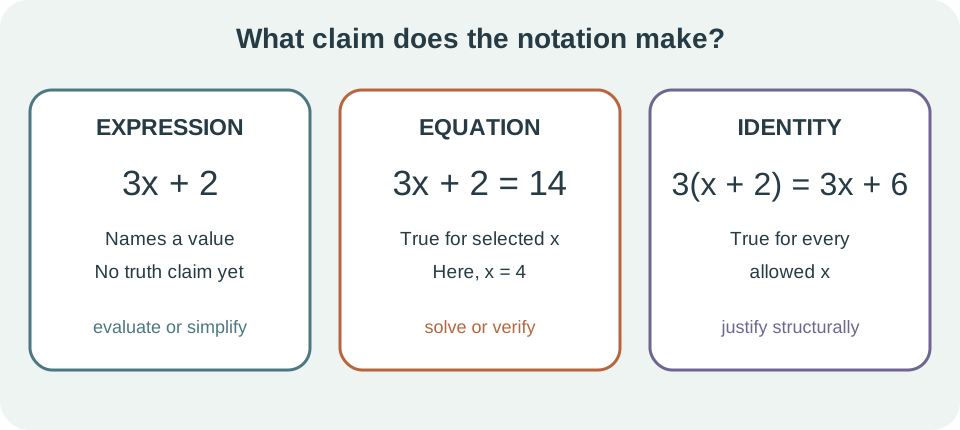
An expression names or computes a value but does not assert equality by itself. The symbolic object is an expression containing three terms. The symbol means multiplied by itself, and the coefficient multiplies that power. Because no condition has been imposed, the expression cannot be “solved.” It may instead be evaluated, simplified, expanded, or factored. The requested action must therefore match the kind of mathematical object being examined.
An equation states that two expressions have the same value under specified conditions. The equation asks which values of make the assertion true. The equals sign means that the entire expression on the left and the entire expression on the right represent one common value. It does not mean “calculate next,” nor does it indicate an approximate relationship. Solving an equation means finding values that preserve this equality.
An identity is an equation true for every allowed value of its variables. For example, is true for every real because of the distributive property. By contrast, is true only when , so it is a conditional equation rather than an identity. Testing a few values can provide evidence but does not prove an identity. Structural reasoning explains why two forms agree throughout their domain.
Read the hierarchy of an expression
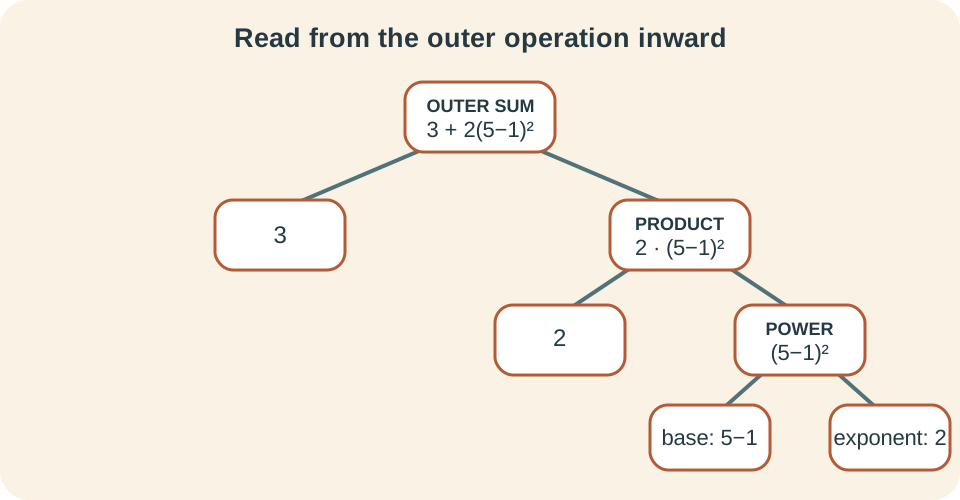
An expression has a nested structure, much like a sentence has phrases inside clauses. Addition and subtraction at the outermost level separate an expression into terms. Multiplication and division within a term connect factors. In , the terms are , , and . Reading from the outermost operation inward reveals what can legitimately be combined.
In the term , the factors are and . The number is the numerical coefficient, is the base, and is the exponent. The exponent states how many copies of the base participate in repeated multiplication, so . In the term , the coefficient is , and the variable factors are and . The constant term has no visible variable factor.
Grouping symbols create subexpressions that must be treated as single units. In , the factor is an entire difference multiplied by . In , the horizontal fraction bar groups the numerator and divides that complete sum by . Removing the grouping changes the operation and usually changes the value. A structural reading therefore precedes any attempt to simplify.
Translate language into mathematical structure
Translation should preserve relationships rather than match isolated keywords. The phrase “five more than ” becomes , while “five less than ” becomes . The phrase “five less than twice ” becomes because doubling occurs before subtracting five. The word “than” often reverses the order in a subtraction phrase. Careful reading matters because subtraction is not commutative.
Grouping is equally important. “Half the sum of and ” means because the entire sum is divided by two. The expression means half of , followed by adding six, which is a different relationship. “The square of the difference between and ” becomes , not . Parentheses record which operation acts on the whole phrase.
Units can guide translation in applied settings. Suppose a service charges plus for each of hours. The total cost is . Multiplying the hourly rate by time cancels hours and leaves dollars. Both addends then share the same unit, confirming that the expression is dimensionally meaningful.
Evaluate an expression by substitution
To evaluate an expression, replace each variable with its given value and perform the resulting arithmetic. Parentheses should surround every substituted value, especially when the value is negative or fractional. For and , write . The square applies to the complete negative number because the parentheses define the base. The result is .
Substitution must occur everywhere the variable appears. If represents the area of a rectangle, with and , then . The exponent on the unit indicates that two length factors were multiplied. Replacing only one occurrence or discarding units would lose information. A complete substitution line makes the reasoning visible.
Estimate before calculating so that the final value can be judged. If is approximately , then should be slightly greater than . A calculator result of would therefore signal an entry or interpretation error. Estimation is not a competing method but a diagnostic companion to exact work. Strong algebra combines symbolic structure, numerical computation, and reasonableness checks.
Apply the order of operations structurally
The order of operations is a consequence of how notation groups operations. Parentheses and other grouping symbols identify computations that act as units. Exponents apply to their stated bases before surrounding multiplication or addition. Multiplication and division are then handled at the same level from left to right, followed by addition and subtraction at the same level. This convention lets one written expression have one shared interpretation.
Consider . The parenthetical difference gives , the exponent gives , and multiplication gives . Adding the remaining produces . The exponent does not apply to the coefficient because its base is only the grouped quantity . Naming each structure explains the order more reliably than recalling a slogan.
A fraction bar is also a grouping symbol. In , the numerator is the complete sum and the denominator is the complete product , giving . Writing the same relationship with an ungrouped slash can obscure which terms belong above or below the division. Theory Commons therefore uses horizontal fraction bars for mathematical fractions. The notation visually preserves the hierarchy that the calculation must follow.
Use properties to create equivalent expressions
The commutative property states that the order of addends or factors may be reversed. Thus and for ordinary real numbers. It does not apply to subtraction or division, because usually differs from . The associative property allows regrouping of repeated addition or repeated multiplication. These properties help reorganize an expression without changing its value.
The distributive property connects multiplication with addition: . The symbol multiplies every term inside the grouped sum. For example, because and . Reading distribution as multiplication of the complete grouped expression prevents omitted terms. Reversing the property factors a common factor from several terms.
Equivalent expressions can emphasize different information. The form makes a common factor and repeated group visible. The form makes separate terms visible and may be easier to combine with other terms. Neither form is universally “more simplified”; usefulness depends on the task. Algebraic fluency includes choosing a form that exposes the needed structure.
Combine like terms with meaning
Like terms have identical variable factors raised to identical powers. The terms and are like because each contains one factor of . Their sum is , which follows from the distributive property. This resembles adding three meters and five meters to obtain eight meters. Only the numerical coefficients combine because the common quantity remains unchanged.
The terms and are not like terms. The first contains , while the second contains , so they represent different variable factors. Likewise, and are unlike because one includes a factor of . Adding unlike terms is valid, but it does not collapse into one term. Their sum already represents the combined quantity.
Units provide an applied analogy for like terms. A length of can be added to because both measure the same kind of quantity. A length cannot be directly added to an area of because their dimensions differ. Variable factors behave similarly in symbolic combination. Dimensional thinking therefore reinforces the algebraic rule.
Preserve units and dimensions in expressions
Every term in a physically meaningful sum must have compatible dimensions. In , the quantities and are lengths. Speed has units such as , while time has units of seconds. Their product therefore has units of meters. The equation adds length to length and is dimensionally consistent.
Coefficients may carry units even when they look like ordinary numbers. In , the value is part of a rate. If , then the variable cost is and the total is . Writing “” without its unit would hide what the coefficient means. Units belong in numerical examples because they help define the quantities.
Dimensional consistency is necessary but does not guarantee that a model is correct. Two different physical models may both use compatible units. Nevertheless, incompatible terms prove that an expression cannot represent the stated relationship as written. Unit analysis is therefore a powerful error detector. It should accompany substitution and simplification rather than appear only at the final answer.
Model a complete situation with an expression
Suppose a rectangular garden has width meters and length meters. Its perimeter is meters because a rectangle has two widths and two lengths. Distributing gives meters. The original form displays the geometric sources of the terms. The equivalent form makes evaluation and comparison easier.
If , then the length is . Substitution into the structural form gives . Substitution into produces the same result when the constant term is interpreted with its unit. Agreement between equivalent forms is a useful verification. A sketch provides a third representation of the same relationship.
Models always rest on assumptions. This garden model assumes straight sides, right angles, and measurements represented accurately by the variables. If a gate requires an un-fenced interval, another term must modify the expression. Algebra does not decide which features matter; the modeler does. The expression then makes those modeling decisions explicit and testable.
Diagnose common misconceptions
One common error treats adjacent variable symbols as separate terms. In , adjacency means multiplication, so is one term rather than a sum. Another error combines unlike terms, such as changing into . Testing exposes the problem because the original gives while the incorrect form gives . A counterexample can quickly disprove a proposed equivalence.
Negative substitution creates another frequent difficulty. For , the expression becomes , while becomes . The exponent acts before the leading negation when no parentheses make the negative sign part of the base. Writing every substitution with parentheses reduces ambiguity. Reading the expression’s tree clarifies which operation is outermost.
Students sometimes use the equals sign to connect steps that are not actually equal. Writing is valid only after explicitly stating that . Writing is invalid because removing two changes the value. Every equals sign asserts identical value on both sides. Maintaining that meaning prepares you for equation solving and proofs.
Practice deliberate symbolic reading
For , identify the terms, coefficients, constant term, base, and exponent. Then translate “half the sum of and ” using a horizontal fraction bar. Evaluate at with visible substitution parentheses. Simplify using distribution and like terms. For each task, explain one structural feature that controls the work.
Create an expression for a taxi fare consisting of plus for kilometers. Evaluate it for and show the unit cancellation. Explain why the fixed fee and distance charge may be added. Identify which symbol is variable and which quantities act as constants. Finally, state one assumption built into the model.
Decide whether each statement is always true, sometimes true, or never true: , , and . Support each decision with a property, solution condition, or counterexample. Do not rely only on trying one convenient number. Distinguish an identity from an equation true for selected values. This classification tests whether you understand equivalence rather than merely calculation.
Solutions and reasoning
The terms are , , and . Their numerical coefficients are and , while is the constant term. In , the base is and the exponent is . Half the sum is because the complete sum occupies the numerator. Substitution gives , and simplification gives .
The fare is . At , the distance charge is because kilometers cancel. The total is . The variable is , while the fixed fee and rate are constants for this pricing plan. The model assumes one constant per-kilometer rate with no waiting charge or surcharge.
The statement is never true over ordinary real arithmetic because distribution produces , and equating the two forms would require . The statement is always true by the distributive property. The statement is sometimes true because only for or . The first claim is a false proposed identity, the second is a true identity, and the third is a conditional equation. These conclusions describe all real values rather than a few tested examples.
Connect expressions to equations and functions
An expression becomes part of an equation when it is constrained to equal another expression. If represents a perimeter and the perimeter is , then states the condition to be solved. Solving will require operations that preserve equality. The expression’s structure tells you which inverse operations can expose the variable. Structural reading therefore directly supports equation solving.
An expression also defines a function when it assigns an output to each permitted input. The notation names the function and identifies as its input variable. The expression on the right specifies how to calculate the output. Evaluating is substitution, while solving is equation solving. The same expression can therefore participate in several different mathematical tasks.
Keep the central habit as you move forward: symbols must remain attached to meanings. Identify quantities and units, read the operation hierarchy, and justify equivalent transformations with properties. Use substitution and estimation to verify your interpretation. These practices make later algebra less about memorized moves and more about relationships. They are the foundation on which equations, graphs, functions, and models are built.