
Long additions often hide the rule that generated them. Writing communicates some pattern, but the reader must infer where the pattern starts, how it changes, and exactly where it ends. Summation notation states each of those choices explicitly. Its large Greek letter sigma is not decorative shorthand; it is an instruction that can be expanded, transformed, checked, and executed. Learning to read that instruction prepares you for sequences, probability, statistics, numerical methods, and integral calculus.
Learning objectives and the central reading habit
By the end of this article, you will be able to name every component of a finite sum and translate reliably between sigma notation and expanded addition. You will determine term counts, evaluate sums by substitution, and explain why the summation index is a temporary label. You will use linearity to separate expressions, derive common identities rather than merely quote them, and shift indices without changing the terms. You will also interpret nested sums and recognize summation structures inside averages, least squares, and Riemann sums. Each skill rests on one central habit: read a sum as a complete set of instructions before performing arithmetic.
Consider . The symbol is the index, the number below sigma is the lower bound, and the number above sigma is the upper bound. The expression is the summand, meaning the formula that generates each term. The notation says to substitute each integer value into the entire summand and then add the results. Expanding produces .
The notation therefore coordinates two processes. The index advances through an inclusive list of integers, while the summand converts each index value into a term. Sigma then accumulates those terms through addition. If any one component changes, the resulting sum may change. A careful reader identifies the index, bounds, and summand before calculating.
Anatomy of a finite sum
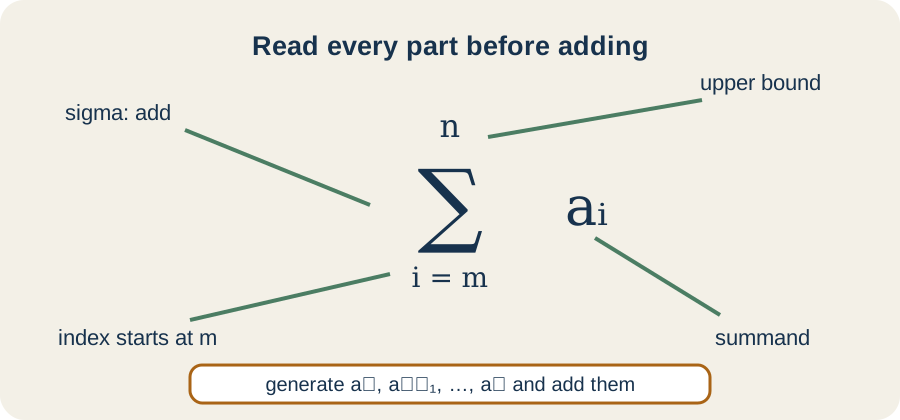
The general finite sum expands as . Here is the index, is the lower bound, is the upper bound, and is the summand. The ellipsis indicates that the same indexing rule continues through all intermediate integers. Both endpoint terms are included, which is why the bounds are called inclusive. The notation is defined when the intended index set and all generated terms are meaningful.
The figure below separates the four jobs performed by the notation. Sigma commands addition, the lower statement initializes the index, the upper value supplies the last index, and the expression to the right generates a term. Reading from the index declaration outward helps prevent partial substitution. For example, in , both occurrences of must receive the same current value. Parentheses protect the full summand and make that scope visible.
Some authors omit bounds when the intended range has already been defined, as in . That abbreviation is useful only when the reader can identify exactly which values of are included. In foundational work, explicit bounds are usually clearer. A finite sum also differs from an infinite series, whose upper limit may be written as infinity and whose value requires a convergence argument. This article focuses first on finite sums, where expansion always produces a finite list.
Count terms before evaluating them
An inclusive integer sum from through contains terms when . The subtraction counts the number of steps between the bounds, and the added one counts the starting position itself. Thus has terms. Expanding confirms the count as . The value seven is an endpoint, not the number of terms.
Term counting exposes many off-by-one errors before they spread. For , the count is , not . For , the count is . Computer science often uses the second convention because an array of length may be indexed from zero through . Both conventions are valid when their endpoints are read literally.
Empty-sum conventions are useful in more advanced algebra and programming. When the upper bound precedes the lower bound, the sum is commonly assigned the value zero. This choice makes identities behave consistently because zero is the additive identity. For example, a recurrence can use the same formula at an endpoint without creating a special case. Beginning readers should still check whether their course or software adopts this convention.
Expand a sum as a substitution process
To expand a sum, start at the lower bound and substitute that index value into every occurrence of the index in the summand. Increase the index by one, repeat the substitution, and stop after using the upper bound. Keep parentheses around generated terms until signs and powers have been simplified. Only then perform the addition. This sequence separates structural reasoning from arithmetic and makes errors easier to locate.
For , the index values are zero, one, two, and three. Expansion gives . The exponent applies to the base two, while supplies the exponent at each step. Starting at zero matters because contributes a real term. There are terms, which agrees with the expansion.
Now consider . The five index values are , and each must replace both occurrences of . Using parentheses gives . Simplification yields . Parentheses around negative substituted values prevent the common error of reading as though it meant .
Understand the index as a bound variable
The summation index is a bound variable, meaning its role is confined to the sum that declares it. After the addition is completed, the index does not remain in the result. Consequently, and represent the same terms. Renaming a bound index is like renaming a temporary counter in a loop. The name changes, but the generated sequence does not.
An index must not collide carelessly with a variable that has meaning outside the sum. In , the first is free while the index inside the sum is bound. Reusing the same symbol makes the expression legal in some formal settings but unnecessarily confusing. Renaming the bound index produces , which clearly preserves the external . Good notation reduces the reader’s memory burden.
Nested sums require distinct indices because each level controls a different repetition. In , the outer index is held fixed while the inner index completes its run. For , the inner sum is , and for , it is . Adding the outer results gives . The scope of each index is visible in the bounds attached to its sigma.
Use linearity to reorganize finite sums
Summation is linear, so addition and constant multiplication can pass through a finite sum. In symbols, . The letters and must be constant with respect to the index . The rule follows from distributing and regrouping a finite addition. It does not allow nonlinear operations such as squaring to pass through unchanged.
For example, evaluate by separating its structure. Linearity gives . The first inner sum is , while the second adds the constant one five times and equals five. Therefore the result is . The second term illustrates the identity .
Linearity does not imply . The left side adds individual squares, while the right side creates additional cross-products when expanded. With and , the left side is , but the right side is . This counterexample is enough to disprove the claimed identity. Always identify the operation being moved across sigma and verify that a valid rule permits it.
Derive the arithmetic finite-sum formula
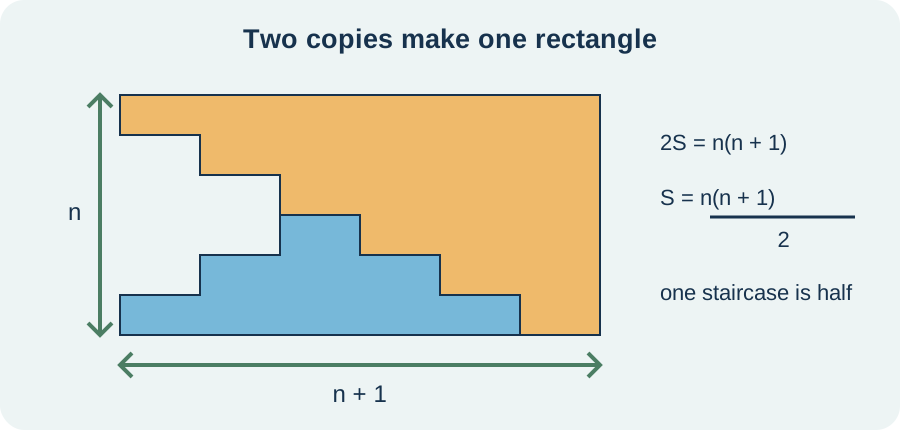
The sum of the first positive integers is . Write it forward as and backward as . Adding the aligned equations gives . There are identical pairs, so . Dividing by two yields .
The horizontal fraction bar groups the entire numerator before division by two. Geometrically, two copies of a staircase containing objects form a rectangle with side lengths and . One staircase therefore occupies half of the rectangle. This model explains both factors and the division by two. A formula remembered with its derivation is easier to reconstruct and harder to misuse.
An arithmetic sequence has a constant difference between consecutive terms. If its first term is , last term is , and number of terms is , pairing gives . The parentheses show that the endpoint terms are added before multiplication by . For an indexed range not beginning at one, count terms separately and identify its actual first and last values. The formula depends on term count, not merely the upper index.
Use standard power-sum identities with meaning
Three frequently used identities are , , and . The first counts terms, the second sums a linear pattern, and the third sums squared indices. Each formula assumes an index beginning at one and ending at the positive integer . Different bounds require adjusting the range or subtracting partial sums. State those assumptions whenever the formula is applied.
Suppose the goal is . Rather than treating ten as the term count, subtract the unwanted initial portion from the sum through ten. This gives . Using the identity produces . The subtraction removes precisely the terms .
Power-sum formulas later make polynomial Riemann sums computable. A term such as can be factored into . Substituting the square-sum identity turns a long addition into an algebraic expression in . A limit can then describe what happens as the partition is refined. Summation notation is therefore a bridge between finite algebra and continuous accumulation.
Shift an index without changing the terms
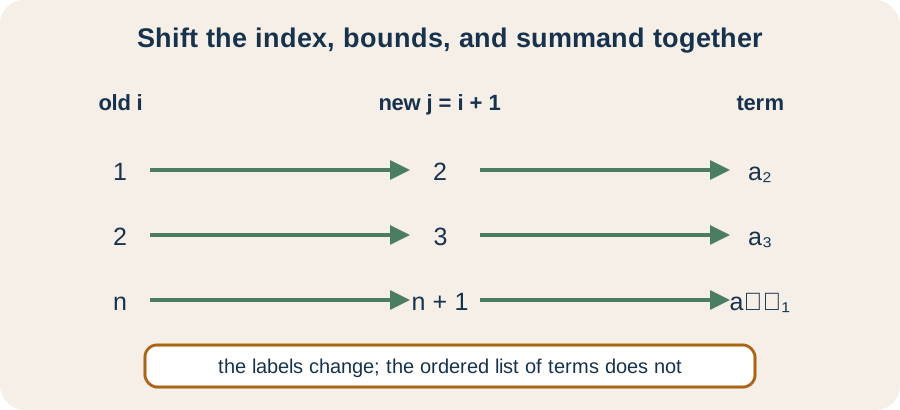
An index shift renames the counter and adjusts the bounds and summand so the generated terms remain identical. Consider , which expands as . Let , so the old lower value corresponds to . The old upper value corresponds to . Therefore .
The safest procedure has four parts. Write the substitution connecting the old and new indices, transform each bound using that substitution, rewrite the summand in the new index, and expand a few terms to compare. Changing only the letter is a rename, while changing the letter and bounds may be a shift. Changing the bounds without compensating in the summand changes the actual terms. Every part must move together.
Index shifts are valuable when adding, comparing, or solving recurrence relations. Two sums can combine term by term only after their indices describe matching ranges and corresponding terms. For example, shifting can align with . Both expand as . The expansion test proves the equivalence without relying on visual similarity.
Interpret nested and multi-index sums
A nested sum repeats one complete summation for every value of another index. In , the inner -sum runs from one through while is temporarily fixed. The outer sum then advances and repeats the inner process. If all index pairs are valid, the expression adds terms. This structure naturally represents a rectangular table or grid.
Finite rectangular sums can often be reversed: . Both sides add the same finite collection of entries, merely in a different order. The equality relies on the associative and commutative properties of finite addition. For infinite series or conditionally convergent objects, changing order may require additional justification. Finite notation should not be generalized without checking its assumptions.
Dependent bounds describe nonrectangular regions. The sum includes one term when , two when , and so on. Its index pairs form a triangular region rather than a rectangle. Reversing the order requires describing that same triangle with new bounds. Drawing the allowed pairs on an index grid makes the boundary relationships visible.
Recognize summation in data and models
The arithmetic mean of observations is . The bar over denotes the sample mean, and is the number of observations. Sigma adds the data values, while the horizontal fraction divides the total by the count. Units are preserved because adding like measurements retains their unit and division by a dimensionless count does not change it. If the observations are measured in meters, the mean is also measured in meters.
Least-squares fitting uses . The symbol is an observed response, while is the fitted response for the same indexed case. Their difference is a residual, and squaring makes every contribution nonnegative before addition. Sigma accumulates disagreement across all cases into one objective value. The formula is meaningful only because the index aligns each observation with its own prediction.
Probability and calculus use the same accumulation pattern for different kinds of contributions. Expected value may appear as , where each possible value is weighted by its probability. A Riemann sum appears as , where a sampled height is multiplied by a small width. In each setting, the summand represents one local contribution. Sigma coordinates the repeated addition that produces a global quantity.
Debug summation errors systematically
When a sum seems wrong, first expand the first two and last two terms. This small sample reveals whether the index begins correctly, advances correctly, and stops at the intended endpoint. Next, count the terms using upper minus lower plus one. Then inspect whether every occurrence of the index was substituted. Structural checks should precede calculator checks.
Watch especially for constants and signs. The sum equals , not merely , because the constant is included once for every index value. The sum equals by linearity. However, is not generally the square of the sum. Parentheses and a one-line expansion make these distinctions visible.
Finally, estimate magnitude before accepting a result. If five positive terms all lie between ten and twenty, their sum must lie between fifty and one hundred. A negative answer or a result of five cannot be correct regardless of elegant algebra. Units can supply another check because only compatible quantities may be added. Estimation, units, and expansion form a strong three-part verification routine.
Practice through expansion, transformation, and explanation
Expand and evaluate , showing each substituted term. Then state the number of terms and explain why the lower bound contributes a term even though it is zero. Rewrite the same sum using a new index . Confirm the shifted form by comparing its first and last generated terms. Keep the summand parenthesized until substitution is complete.
Evaluate in two ways. First, subtract the sum from one through four from the sum from one through twenty. Second, use the arithmetic-sequence formula with the correct endpoint terms and term count. Explain why the count is sixteen rather than fifteen or twenty. Both methods should produce the same value.
Analyze the claim . Expand the square inside the left-hand summand and identify the missing contribution. Give a two-term numerical counterexample. Then write the correct identity using sigma notation. Explain which valid properties of addition and constant multiplication justify each step.
Solutions and reasoning
For the first task, expansion gives . There are terms because zero is an included index value rather than an absence of a term. With , the bounds become two through six and , so the shifted sum is . Its first and last terms remain negative one and eleven. The expanded sequence is unchanged.
For the second task, . The arithmetic formula gives . The term count is . The two methods use different decompositions of the same finite addition. Agreement provides a useful verification.
For the third task, . Therefore the correct identity is . Taking , , and makes the claimed left side four while its claimed right side is two. The missing cross-term causes the failure. Linearity distributes the addition and permits the constant two to move outside sigma.
Carry the notation forward
Mastery of sigma notation means more than evaluating a few sums. You should be able to predict a sum’s terms, explain its bounds, transform it without changing its meaning, and recognize when a proposed rule fails. Those actions turn notation into a reasoning tool. They also make later formulas less intimidating because the large sigma can be mentally unpacked into a controlled process. Fluency grows through repeated movement between compact and expanded forms.
The next useful connection is sequences and indexing, where a formula or recurrence defines the terms being accumulated. In statistics, sigma organizes deviations, weights, and moments. In calculus, a sequence of finite sums approaches a limit and defines an integral. Each subject adds new meaning to the summand while preserving the same basic accumulation instruction. The notation remains stable even as its applications become more sophisticated.
Whenever you encounter sigma, ask four questions before calculating. Which symbol changes, which values does it take, what complete expression is generated, and how many terms result? Then expand a few terms and check that the algebra respects linearity and scope. This routine prevents nearly every foundational summation error. Precise reading is the real power of compact notation.