
An algebraic expression is a structured recipe for producing a value. Its symbols record operations, grouping, constants, variables, and relationships among quantities. Reading that structure correctly is more important than manipulating symbols quickly. Equivalent forms can emphasize different information while producing the same outputs on a shared domain. This article develops expressions as mathematical objects that can be parsed, interpreted, and transformed deliberately.
Distinguish expressions from equations
An expression names a quantity but does not assert equality by itself. The string is an expression. The statement is an equation because it claims that two expressions have equal values. An expression can be evaluated or rewritten. An equation can additionally be solved for values that make the claim true.
This distinction affects mathematical language. One simplifies to because the two expressions are equivalent. One solves to find . Saying “solve the expression” confuses the object with a statement. Precise verbs help reveal the intended task.
Expressions also appear inside larger statements. An inequality compares two expressions, and a function rule assigns an expression to each allowed input. A formula such as is an equation relating quantities. The right side remains an expression with its own internal structure. Recognizing nesting prevents a learner from treating every line of symbols as the same kind of object.
Parse structure before calculating
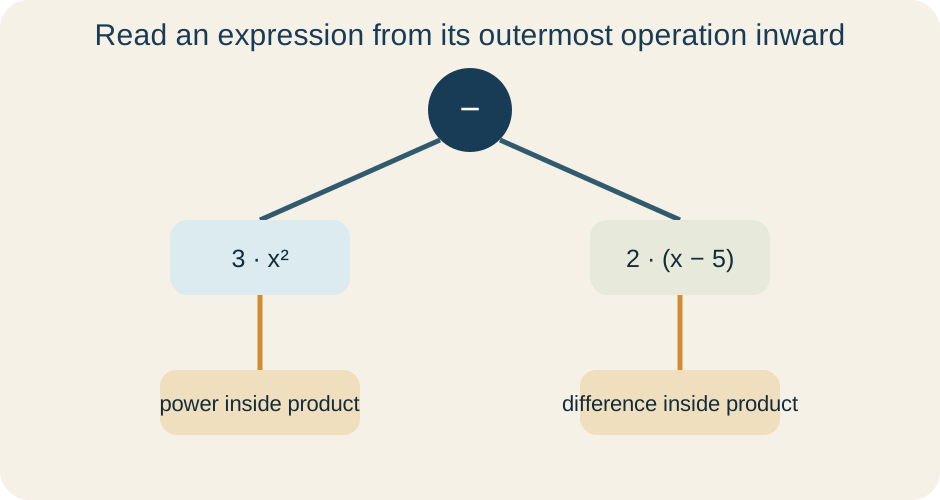
An expression tree identifies the outermost operation and its inputs. In , subtraction of five is the final operation. Before that, the grouped sum is squared and then multiplied by three. Parentheses make one input to the exponent. The visible string encodes a hierarchy rather than a flat sequence.
Order-of-operations conventions resolve structure when parentheses are absent. Exponents act before multiplication, and multiplication acts before addition or subtraction. Operations of equal priority are processed according to their associativity conventions. A horizontal fraction bar groups the entire numerator and denominator. It should never be read as an ungrouped slash through surrounding terms.
Parsing can be checked by describing the recipe in words. For , first form and , then divide the first result by the second. This narration exposes the denominator restriction . It also prevents the false reading . Words and an expression tree are complementary representations.
Identify terms, factors, coefficients, and constants
Terms are pieces separated by addition or subtraction at the outermost level. In , the terms are , , and seven. The signs belong to their terms. Parenthesized additions inside a product do not create outer terms. Structure determines where the separation occurs.
Factors are quantities multiplied within a term. In , the factors include negative three, , and . A coefficient is the numerical factor multiplying a variable part. The coefficient of in is four. A constant term contains no variable and therefore remains unchanged as variables vary.
These labels support valid operations. Like terms have identical variable parts with identical exponents. Thus and combine, but and do not. Coefficients add while the shared variable factor remains. Naming the parts explains why a proposed combination is legal or illegal.
Evaluate through substitution with grouping
Evaluation assigns specific values to variables and follows the expression’s structure. For at , substitute with parentheses: . The square applies to the entire negative input. The result is eight plus six plus one, or fifteen. Parentheses protect the sign during substitution.
Units belong in contextual evaluation. If is time in seconds and represents meters, coefficients must carry units that make every term a length. Terms can be added only when their dimensions match. A numerical value without its resulting unit is incomplete. Dimensional analysis can expose a mistranscribed power or coefficient.
Estimation provides another check. Before exact evaluation, predict the sign and rough magnitude. For a large negative input, a positive squared term may dominate a linear term. Compare the exact answer with that expectation. A surprising result deserves structural review rather than immediate acceptance.
Use distribution as a structural law
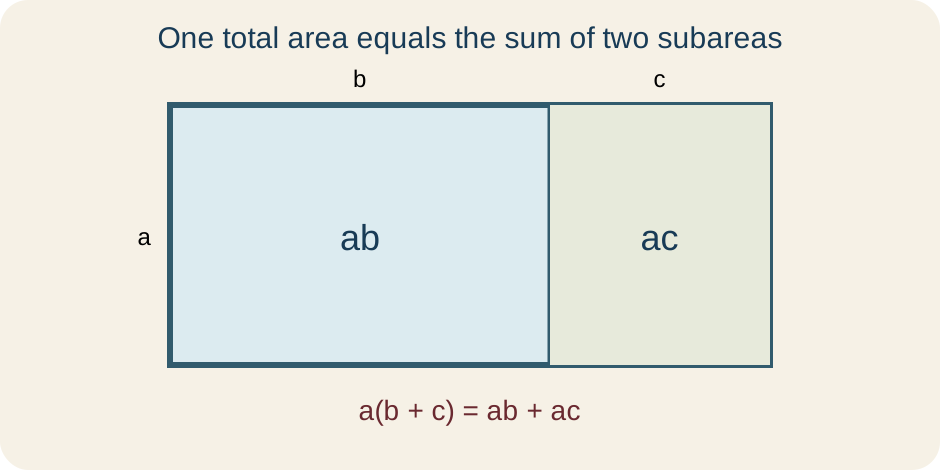
The distributive property states . It connects a product form with an expanded sum form. The factor multiplies every term inside the grouped sum. For , distribution gives . Omitting the second product changes the expression.
An area model gives the identity geometric meaning. A rectangle of height and total width has area . Splitting it into widths and produces areas and . Their sum equals the original area. The algebraic law preserves one geometric quantity in two decompositions.
Distribution through subtraction includes the sign. The expression means and becomes . Subtracting an entire grouped expression changes every term inside when parentheses are removed. Writing the factor negative one explicitly can prevent sign errors. Verification by redistributing confirms the result.
Combine like terms without changing structure
Combining like terms uses distribution in reverse. The expression becomes . The common factor remains while its coefficients combine. This is not possible for because the variable factors differ. Their outputs change differently as varies.
Multiple variables require exact matches. The terms and combine to . The term is not like either one because the exponents attach to different variables. Reordering factors does not change a product, so and do match. A canonical variable order makes matches easier to see.
Combine only after distribution has exposed outer terms when appropriate. In , the inside parentheses is not yet an outer additive term. Distribution gives , followed by . Each transformation should name the law used. This narration turns simplification into a justified sequence.
Understand equivalence and domain together
Two expressions are equivalent on a domain when they produce the same output for every input in that domain. The forms and are equivalent for all real . A numerical spot check can detect some errors but cannot prove universal equivalence. Algebraic laws provide the proof. The domain statement completes it.
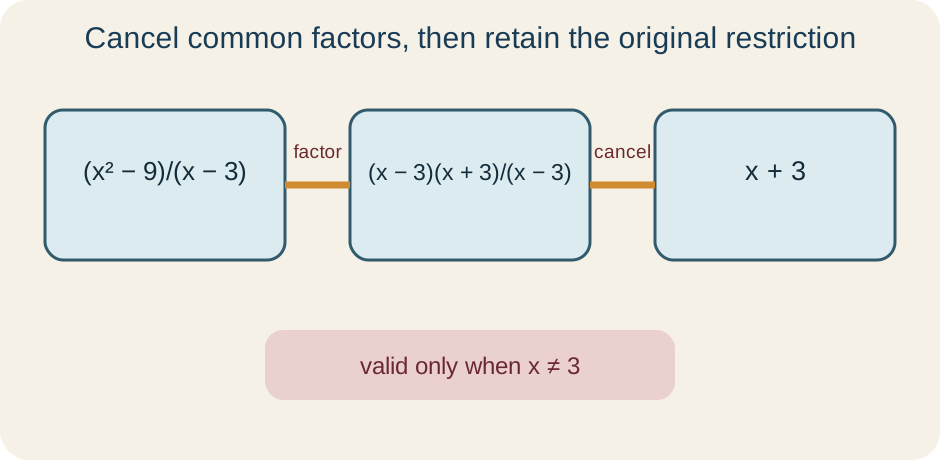
Domain matters when transformations involve denominators or radicals. The expression simplifies to only for . The original expression is undefined at one, while the simplified polynomial is defined there. The forms agree on the original domain but are not identical as functions with unrestricted real domains. Cancellation must preserve the excluded input.
An equivalent rewrite can change what is visible. Expanded form emphasizes individual terms and polynomial degree. Factored form emphasizes zeros and common multiplicative structure. A rationalized form may support limit evaluation. Choose a form according to the question while retaining domain information from the original expression.
Cancel factors rather than terms
Cancellation is division of a numerator and denominator by a common nonzero factor. In , the common factor cancels for , leaving . The restriction remains because division by zero was never allowed. The entire numerator has a factor of . This multiplicative structure makes cancellation legal.
In , the denominator is not a factor of the whole numerator. It is only one term inside a sum. Canceling it from the term would leave the other term unscaled and change the value. One may split the fraction as for , but the three-over- term remains. Addition blocks factor cancellation until a common factor is actually present.
Factoring can reveal a cancelable structure. In , factor the numerator as . Then cancel the common factor for . The result is on the restricted domain. Recording the restriction before cancellation prevents the hole from disappearing from the analysis.
Treat powers as repeated multiplicative structure
An exponent records repeated multiplication. The expression means , not . When multiplying equal bases, exponents add because the factor counts combine. Thus . This rule assumes multiplication rather than addition.
The power of a product distributes to every factor: for integer . A power does not generally distribute across addition. The expression equals , not . The missing cross term records interaction between the summands. Expanding once is a reliable reminder.
Negative exponents encode reciprocals: for . A zero exponent gives for nonzero . These restrictions arise from division. Rewriting negative exponents can make domain structure more visible. An appendix on exponent laws can support quick reference without replacing structural reasoning in the main lesson.
Interpret expressions as models
An expression can represent a measured or predicted quantity. In , the first term is a fixed cost. The second term is a per-item rate multiplied by item count. Their sum has currency units. Every symbol has a contextual role.
The variable’s domain comes from the model. If counts purchased items, nonnegative integers are appropriate even though the algebraic expression accepts all real numbers. A negative or fractional count may be algebraically evaluable but contextually meaningless. Stating the feasible domain prevents false interpretations. Model assumptions narrow mathematical possibility.
Equivalent forms can answer different model questions. The expression emphasizes initial position and constant velocity. Solving or factoring a transformed expression may emphasize a target time. Unit consistency must survive every rewrite. A model is not only symbolic equality; it is a claim about quantities, dimensions, and scope.
Use simplification as a goal-dependent decision
“Simplify” does not always mean “make shorter.” A useful form may reduce operation count, reveal factors, expose asymptotic behavior, or match a later theorem. The expanded expression is convenient for reading coefficients. The factored form is convenient for reading zeros. Both are already meaningful forms. The purpose of the next operation determines which one is more useful.
Premature expansion can destroy helpful structure. The expression clearly displays a composition for differentiation. Expanding it creates many terms and hides the chain-rule layers. Conversely, expansion may be useful for combining polynomial terms. The task determines which structure should remain visible.
State the purpose of a rewrite. Say that factoring is used to locate zeros or that distribution is used to combine like terms. This metacognitive sentence makes strategy explicit. It also provides a stopping criterion. Once the needed information is visible, further manipulation may add risk without adding insight.
Diagnose ambiguous notation and common errors
Notation should minimize avoidable ambiguity. Write multiplication with parentheses or a centered dot when adjacent symbols could be misread. Use a horizontal fraction bar for ratios so numerator and denominator grouping remain clear. Use parentheses around negative substituted values. These choices support both desktop and narrow mobile displays.
A common error combines unlike terms because both contain the same variable somewhere. Compare full variable parts, including exponents. Another error distributes an exponent across a sum. A third cancels additive terms across a fraction bar. Each error treats a structured object as if it were a flat list of symbols.
Verification should use a method independent of the original manipulation. Expand a factorization, substitute several safe inputs, or compare graphs over a representative domain. Preserve excluded inputs during numerical tests. Check units in models. Multiple forms of evidence make structural errors easier to locate.
Practice a complete expression analysis
Analyze . Identify two outer terms and the shared factor . Factoring gives . Expanding the result reproduces . State which form better reveals zeros and which better reveals coefficients.
Next analyze . Factor the numerator as . Cancel only for , obtaining on the original domain. Evaluate both forms at a safe input to verify agreement. Explain why the simplified form does not restore the missing input.
For independent work, translate a constant-rate scenario into an expression with units. State the variable domain, fixed term, and rate term. Rewrite the expression in another equivalent form if that reveals useful information. Check dimensional consistency and evaluate one contextual input. The companion lessons on equations and functions will use these same structured objects inside larger relationships.
Sources and further study
OpenStax Elementary Algebra 2e develops expression vocabulary, evaluation, distribution, and like terms. Its exercises support fluency across symbolic forms. Before simplifying, mark outer terms and factors. After simplifying, verify by substitution. This routine connects procedural work with structural reading.
OpenStax Intermediate Algebra 2e extends these ideas to rational and radical expressions. Use its examples to practice preserving domains through transformation. Compare forms according to their purpose rather than visual length. Track every denominator restriction before cancellation. These habits prepare expressions for later functions and calculus.
Further study should connect expressions to syntax trees in programming and symbolic algebra systems. Both environments must parse grouping before evaluation. Computer algebra can transform forms quickly but still requires domain-aware interpretation. Test how a system reports a canceled rational factor. Human structural reasoning remains necessary to explain what the output means.