
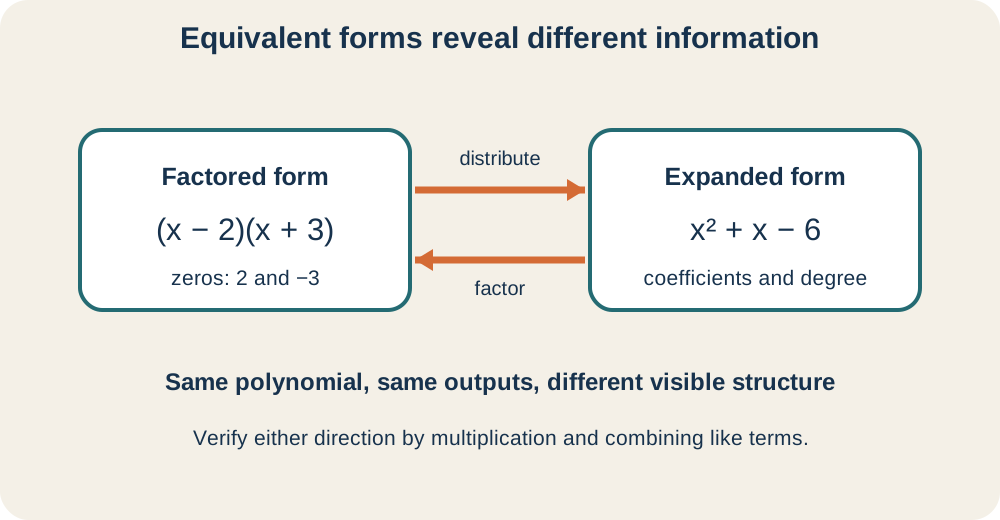
Factoring rewrites a polynomial as a product of simpler expressions. It reverses distribution and preserves every polynomial output. Expanded form displays degree and coefficients clearly, while factored form exposes zeros and repeated factors. Neither representation is universally better. Algebraic fluency means choosing the form that makes the current question visible.
Moving deliberately between these equivalent forms is a reasoning skill, not merely a symbolic exercise.
Understand factoring as reverse distribution
Distribution multiplies factors to create a sum of terms. For example, expands to . Factoring begins with and reconstructs the product. The two expressions are equal for every real or complex input. They are different forms of one polynomial function.
Factoring is not removing terms or changing their values. It identifies a shared multiplicative structure already present in the expanded expression. Multiplying the proposed factors must reproduce every original coefficient. This reverse check is decisive. If expansion fails, the factorization is wrong regardless of how plausible it looks. Writing both forms side by side also helps connect each factor product with the coefficient it creates.
The chosen number system matters. The polynomial does not factor into real linear factors. Over the complex numbers, it becomes , where . A statement that a polynomial is fully factored must therefore specify or imply a coefficient system. Foundational algebra usually works over integers or real numbers unless stated otherwise.
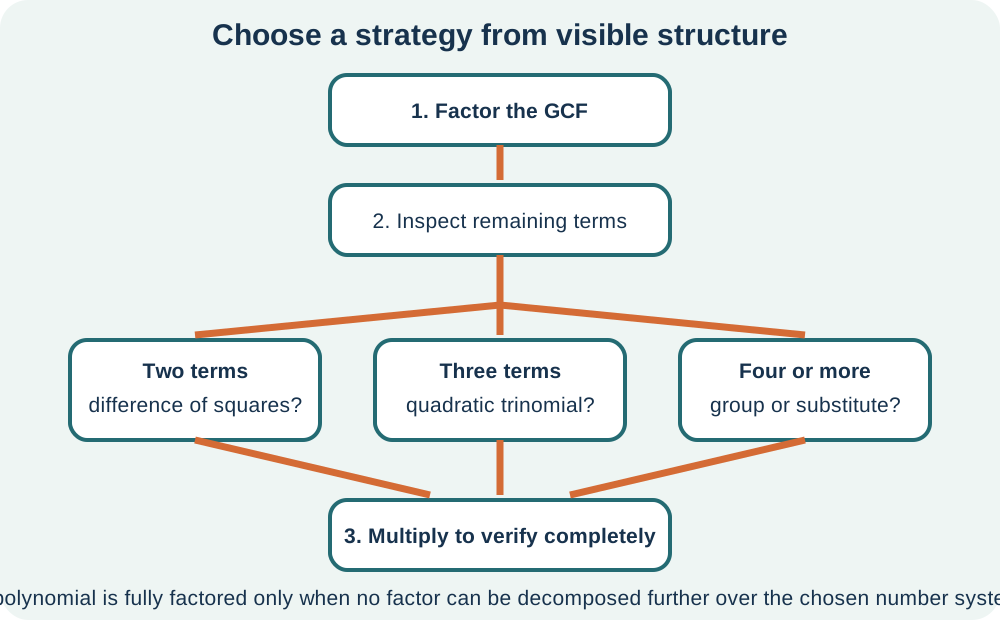
Begin every strategy with the greatest common factor
The greatest common factor, or GCF, is the largest factor shared by every term. For , the numerical coefficients share six and the variable terms share . Factoring gives . Distribution verifies both terms. Ignoring the GCF leaves an incomplete factorization.
A negative GCF can make the remaining polynomial easier to read. For , factor to obtain . The quadratic then factors as . The complete result is . Choosing a negative factor makes the leading term inside positive.
Factoring out a common expression uses the same idea. In , both terms contain . The result is . Treating the parenthesized expression as one object reveals the structure. Substitution with a temporary symbol can help when the repeated factor is visually complicated.
Use term count to select a pattern
After removing the GCF, inspect the number and shape of remaining terms. Two terms may form a difference of squares, difference of cubes, or sum of cubes. Three terms may form a quadratic trinomial or perfect square. Four terms often invite grouping. Higher-degree expressions may become quadratic after a substitution.
The difference of squares identity is . It works because the outer and inner cross terms cancel during multiplication. Thus . A sum of squares does not use this real-number identity. Writing always produces a difference, never a sum.
Perfect-square trinomials follow and . Both outer terms must be squares, and the middle term must be twice their product with the correct sign. For , the square roots are and five. The middle term is , so the factorization is . Checking the middle coefficient prevents two square terms from being mistaken for this pattern.
Factor monic quadratic trinomials
A monic quadratic has leading coefficient one. To factor , find numbers and whose sum is and whose product is . Then . The sum produces the middle coefficient. The product produces the constant term.
For , seek two integers with product negative six and sum one. The numbers three and negative two satisfy both conditions. Therefore . Multiplication gives . Combining the middle terms verifies the original expression.
Sign reasoning narrows the search. A negative constant requires factors with opposite signs. A positive constant requires matching signs, and the middle coefficient determines whether both are positive or negative. List factor pairs systematically rather than guessing randomly. If no integer pair works, the quadratic may require the quadratic formula or may factor over noninteger numbers.
Factor nonmonic quadratic trinomials
For with , the product-sum method searches for numbers whose product is and whose sum is . Split the middle term using those numbers. Group the resulting four terms. Factor each group so a common binomial appears. Then factor that binomial.
Consider . The product is eighteen, and nine plus two equals eleven. Rewrite the middle term to obtain . Grouping gives . Therefore the factorization is .
Multiplication verifies the result. The first terms produce , the outer and inner products produce and , and the last terms produce three. The middle products combine to eleven . This check also explains why the product-sum conditions work. They reconstruct the coefficient relationships created by binomial multiplication.
Factor by grouping and substitution
Grouping searches for a shared binomial after smaller common factors are removed. For , pair the first two and last two terms. Factoring gives . The common binomial is . The result is .
Grouping choices are not always unique. A useful grouping produces the same remaining factor from each group. If the factors differ only by sign, factor a negative quantity from one group. Rearranging terms can reveal a better pairing because addition is commutative. Every rearrangement should preserve all original terms and signs.
Substitution helps when powers repeat a pattern. In , let . The expression becomes . Restoring gives . Factoring differences of squares completes the result as .
Solve polynomial equations with the zero-product property
Factoring becomes an equation-solving tool when one side equals zero. The zero-product property states that if , then or . At least one factor must be zero because nonzero real numbers have a nonzero product. The property does not apply directly when the product equals another number. Move all terms to one side first.
For , factor to obtain . Set each factor equal to zero. The equations and give and . Substitution verifies both values in the original polynomial equation. The solution set contains both roots.
Do not divide by a variable factor before using the property. From , dividing by would discard the valid solution . Case splitting preserves it: either or . Division by an expression is safe only after establishing that expression is nonzero. The zero-product property handles precisely the case where a factor may be zero.
Read zeros and multiplicity from factors
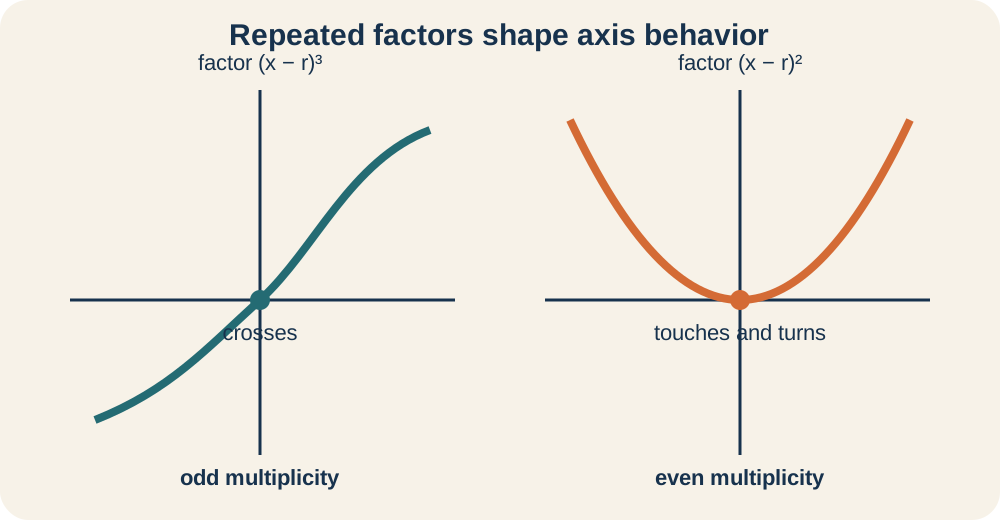
A factor reveals a zero at . If the factor appears times, then has multiplicity . For , the zero negative two has multiplicity three. The zero one has multiplicity two. Multiplicities add to the polynomial’s degree when the factorization is complete into linear factors.
Odd multiplicity usually produces an axis crossing. The polynomial changes sign through the zero because an odd power changes sign. Even multiplicity usually produces a touch and turn. The corresponding even-power factor stays nonnegative on both sides. Greater multiplicity also flattens the graph near the intercept.
Multiplicity is algebraic information with geometric consequences. A graph can suggest whether a zero is repeated, but visual resolution may hide exact flattening. The factored formula provides exact multiplicity. A sign chart confirms crossing or touching behavior. Combining algebra and graph interpretation gives stronger evidence.
Preserve restrictions when canceling factors
Factoring often simplifies rational expressions. For , factoring gives . For , the common factor cancels and the expression equals . The original denominator still excludes . Simplification does not fill the original hole.
Cancellation removes common multiplicative factors, not terms connected by addition. In , the is not a factor of the complete numerator. Nothing cancels. In , cancellation is valid for . Parentheses reveal whether a candidate is a factor of the whole numerator.
Restrictions should be written before cancellation. This ordering preserves information that the simplified expression no longer displays. It also matters when solving rational equations because excluded values can appear as algebraic candidates. Verification in the original expression rejects them. Domain bookkeeping is part of factoring-based simplification.
Connect factors, intercepts, and sign intervals
Factored form makes polynomial sign analysis systematic. Zeros divide the number line into intervals. On each interval, every factor has a stable sign. Multiplying those signs determines the polynomial’s sign. Testing one input per interval is sufficient when no other zeros intervene.
Consider . The zeros negative one and two create three intervals. For , both factors are negative and the product is positive. Between the zeros, the factors have opposite signs and the product is negative. For , both are positive and the product is positive.
This sign chart solves inequalities such as . Include the zeros because the inequality allows equality. The solution is . If the symbol were strictly less than, the endpoints would be excluded. Factoring transforms a difficult polynomial comparison into factor-sign bookkeeping.
Know when integer factoring stops
Not every polynomial factors over the integers. For a quadratic , the discriminant is . If is a nonnegative perfect square and coefficients are integers, rational linear factors are available after accounting for the leading coefficient. If , there are no real roots. If is positive but not a perfect square, real irrational factors exist.
For , the discriminant is . The quadratic has no real zeros and no real linear factorization. Over complex numbers, its roots are and . The factorization becomes . Stopping over the reals is correct when the coefficient system is stated.
The Rational Root Theorem can provide candidates for higher-degree integer polynomials. A candidate must still be tested. Synthetic division then removes a verified linear factor. Remaining factors may require another strategy. Factoring is a decision process, not a guarantee that every expression has a simple integer product.
Verify completeness and diagnose errors
Always expand the final product. Check the leading term, constant term, and every middle coefficient. A correct first step can still leave a factorable component. For example, is not fully factored over the reals because factors again. The complete real factorization is .
Common sign errors appear in trinomial factor pairs. Product and sum conditions must both hold. Difference-of-squares errors appear when a sum is incorrectly factored. Grouping errors appear when the common binomials differ. Multiplication exposes all of these failures.
Use degree as another check. Degrees of nonconstant factors should add to the degree of the original polynomial. Leading coefficients should multiply correctly. Constant terms should also multiply correctly. These fast invariants do not replace full expansion, but they catch many structural errors early.
Practice a complete factoring workflow
Factor completely over the integers. Begin with the GCF to obtain . Recognize a difference of squares. The final factorization is . Expanding verifies the original two terms.
Next solve . Factor the GCF , then factor as . The zero-product property gives , , and . Substitute each solution into the original equation. Record multiplicity and expected graph behavior if any factor repeats.
For independent work, simplify a rational expression with a removable factor and state its excluded input. Factor a quartic using substitution. Build a sign chart for a factored cubic inequality. For each task, name the number system and verify by multiplication. These habits turn factoring from pattern guessing into controlled structural reasoning.
Sources and further study
OpenStax Elementary Algebra 2e develops GCF, trinomial, grouping, and special-product methods. Its exercise sets support deliberate strategy selection. Before each example, predict the method from visible structure. Afterward, multiply the factors without viewing the text’s verification. This retrieval cycle strengthens both recognition and checking.
OpenStax Intermediate Algebra 2e connects factoring to rational expressions and polynomial equations. Use its domain examples to practice recording restrictions before cancellation. Compare integer, real, and complex factorizations. Track multiplicity when solving equations. These extensions show why coefficient systems and domains belong in the explanation.
Further study should connect factoring to the Factor Theorem and polynomial division. The Factor Theorem states that is a factor exactly when . Division turns a known zero into a lower-degree polynomial. Graphs then connect roots and multiplicity to intercept behavior. Together these ideas make factored form a bridge among algebra, functions, and calculus.