
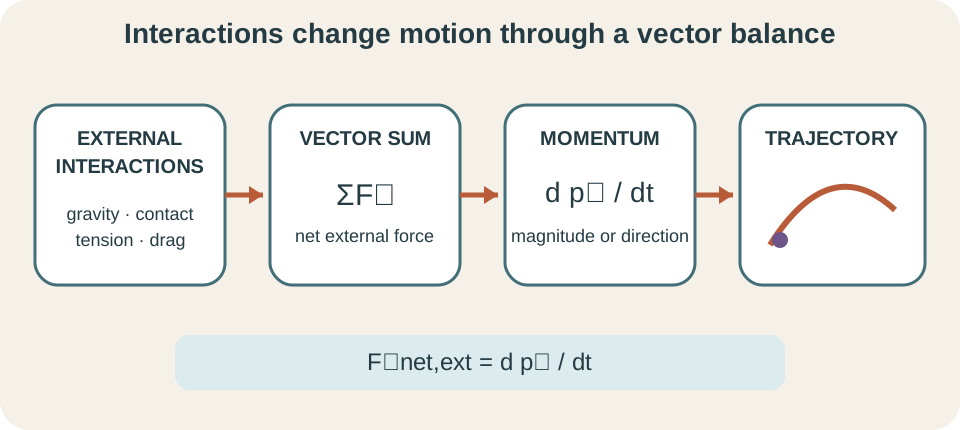
Motion does not require a net force, but changing momentum does. Newton’s second law identifies the net external force on a chosen system with the time rate of change of that system’s momentum. For constant mass, this statement becomes the familiar vector equation relating net force, mass, and acceleration. The law is predictive only when forces, system boundaries, coordinates, signs, and units are defined consistently. This lesson develops that full reasoning process rather than treating as a number-substitution slogan.
Establish the learning goals
By the end of this lesson, you should be able to state Newton’s second law in momentum and constant-mass forms. You will identify the chosen system and include only external forces acting on it. You will construct vector and component equations from a free-body diagram. You will distinguish velocity direction from acceleration and net-force direction. You will also retain units, verify signs, and test limiting cases in numerical models.
You will apply the law to horizontal motion, inclined planes, elevators, circular motion, and time-varying forces. Each setting uses the same structure even though the force models differ. You will connect force-time accumulation with impulse and momentum change. You will also see why solving for a complete trajectory requires initial position and velocity. These connections place one algebraic equation inside a broader mechanics framework.
Use a consistent workflow throughout. Choose the system, inventory external interactions, draw and label a free-body diagram, choose axes, resolve vectors, sum components, and then apply the law. Solve symbolically before substituting numerical values when possible. Check dimensions, direction, magnitude, and behavior in simple limits. This workflow makes assumptions and mistakes visible.
Start with momentum, not a slogan
Momentum is the vector . The bold symbol indicates a vector, is mass, and is velocity. Momentum has SI units . Its direction is the velocity direction when mass is positive. Momentum describes the translational state of motion of the chosen system.
Newton’s second law states . The left side is the vector sum of external forces acting on the system. The derivative on the right is the instantaneous time rate of change of momentum. A force can change momentum magnitude, direction, or both. The equation concerns the complete vector rather than speed alone.
The subscript “net, ext” carries important meaning. Net instructs us to add all relevant forces as vectors before relating them to motion change. External means the interactions cross the chosen system boundary. Forces internal to a multi-object system occur in third-law pairs and cancel from the total momentum balance under the ordinary particle model. Changing the boundary changes which forces appear explicitly.
Derive the constant-mass form
Differentiate momentum with the product rule: . The first term reflects velocity change, while the second reflects changing mass within the chosen description. If mass is constant, then . The remaining derivative is . Acceleration is defined as .
Therefore, for a constant-mass system, . This is a special case of the momentum statement, not a separate law. Because mass is a positive scalar, acceleration points in the same direction as net external force. Its magnitude is when force and acceleration are collinear. The inverse dependence on mass describes inertia quantitatively.
Variable-mass problems require careful system accounting. Simply retaining the product-rule term can be insufficient when mass crosses a boundary carrying momentum, as in a rocket. A control-volume momentum balance or a carefully defined closed system is needed. The constant-mass form remains correct for many introductory objects such as blocks, carts, and projectiles. State the assumption rather than applying it silently.
Interpret the newton as a derived unit
The SI unit of force is the newton, symbol . From , one newton is defined as . Force is therefore not measured in kilograms. Kilogram measures mass, while newton measures interaction strength through the acceleration it produces. The derived unit encodes the second law.
Unit analysis checks numerical equations. Dividing by gives . Replacing newtons with their base units makes the cancellation explicit. Kilograms cancel, leaving length divided by time squared. That is the unit of acceleration.
Other force units must be converted before mixing them with SI quantities. A pound-force is not a pound-mass, and neither is numerically interchangeable with a newton without a conversion. Weight is a force measured in newtons when SI mass and acceleration are used. Always distinguish a physical quantity from the unit system used to express it. Dimensional consistency cannot repair an incorrect force model, but inconsistency proves something is wrong.
Choose the system before drawing forces
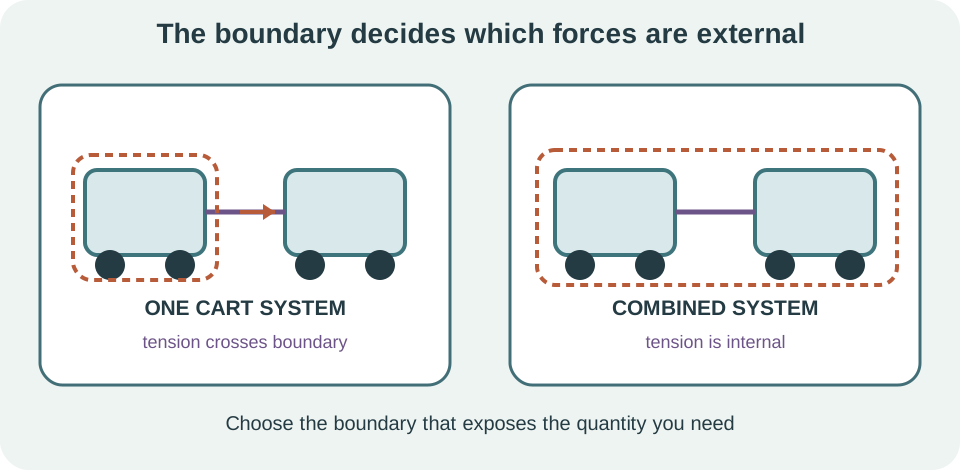
The system is the object or collection of objects whose motion is being analyzed. Draw an imagined boundary around it. Every force arrow on its free-body diagram must represent an external agent acting across that boundary. If the system is one crate, Earth’s gravity, the floor’s normal interaction, a rope, and friction may be external. Forces the crate exerts on those agents do not act on the crate.
If two connected carts form one system, the tension between them is internal. It should not appear in the external-force sum for the combined system. If one cart alone is selected, tension crosses that smaller boundary and must appear. Both choices are valid, but they answer different equations. Strategic boundary choice can eliminate an unknown internal force from an initial calculation.
Never draw “” as a force. It is the product equal to the net force after actual interactions are summed. Likewise, motion direction is not a force arrow. Label each force by the agent and interaction, such as “Earth on block” or “floor on block.” Agent-based labels help distinguish third-law partners from forces sharing one free-body diagram. A complete label makes the physical source of every arrow auditable.
Add forces as vectors before solving
Forces do not take turns controlling motion. Their vector sum determines the instantaneous momentum change. Suppose a crate is pushed right with while kinetic friction acts left with . Choose right as positive. The horizontal net force is .
The acceleration is . The positive sign means acceleration points right under the chosen convention. It does not state the crate’s current velocity direction. Initial motion requires separate information. The component result must always be translated back into that coordinate convention.
If the crate is moving left while acceleration points right, its leftward speed initially decreases. It may stop momentarily and then move right if the force persists. If it is already moving right, its rightward speed increases. The same force state can accompany different velocities. Newton’s law connects force to acceleration, not directly to velocity.
Resolve the vector law into components
In Cartesian coordinates, the vector equation becomes separate scalar equations: , , and, when needed, . The sigma symbol means add the signed components of all external forces along that axis. A force may contribute to more than one component. Signs come from axis directions, not from whether a force is “good” or “bad.” Each component equation must use one consistent coordinate choice. Together, the scalar equations contain the same information as the original vector law.
Suppose a force of magnitude makes angle above the positive horizontal axis. Its components are and . The cosine component is adjacent to the referenced angle, while sine is opposite. If the vector points into a negative axis direction, the corresponding component carries a negative sign. A component is not an additional force; it is one coordinate description of the same vector.
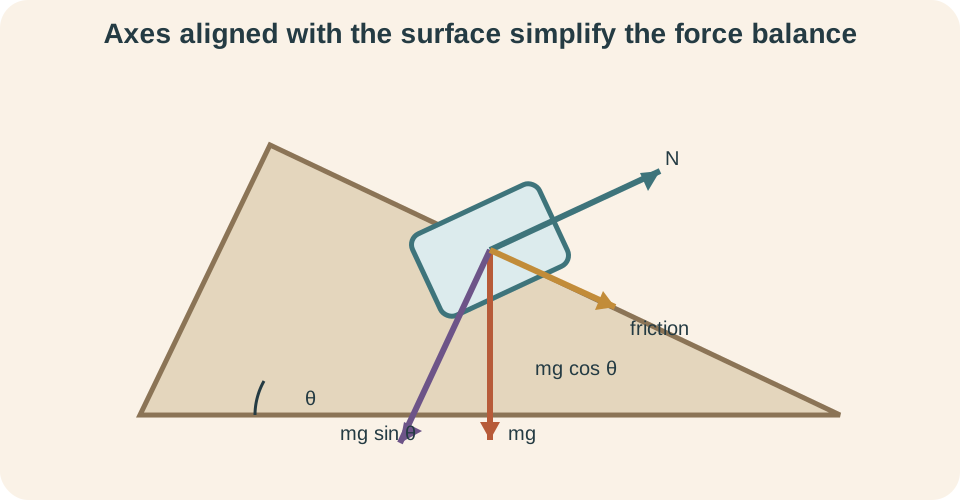
Choose axes to simplify the geometry. On an incline, axes parallel and perpendicular to the surface often reduce the number of split vectors. In circular motion, radial and tangential directions may clarify acceleration. The law is coordinate-independent, but its scalar representation depends on the chosen basis. State the axes before writing signed equations.
Analyze vertical equilibrium and normal force
A crate sliding horizontally on a level floor may have zero vertical acceleration. The vertical forces are upward normal force from the floor and downward weight from Earth. With upward positive, . Therefore in this particular situation. The equality follows from the motion constraint and force inventory.
Normal force is not universally equal to weight. If an additional upward force component acts, the floor may exert less normal force. If a person pushes downward, normal force increases. On an incline, the perpendicular component of weight is , not generally the full weight. In an accelerating elevator, apparent weight can differ from .
The normal force is a contact response that prevents interpenetration under the model. Its magnitude adjusts to satisfy the perpendicular motion constraint until contact is lost. It is not automatically , nor is it the third-law partner of weight. Both normal force and weight act on the same object. Their third-law partners act on the floor and Earth, respectively.
Build the inclined-plane equations
Consider a block of mass on an incline angle above horizontal. Choose positive down the slope and positive perpendicular outward. Weight splits into down the slope and into the surface. The normal force points outward perpendicular to the surface. Kinetic friction opposes sliding along the surface.
If the block slides downward, friction has magnitude and points upward. Perpendicular acceleration is zero while contact remains, so . Thus . The parallel equation is . The sign of each term follows from the selected downhill-positive axis.
Dividing by nonzero mass gives . Mass cancels because both gravity and the modeled kinetic friction scale with mass. If , the result becomes , the frictionless limit. If , gravity has no downhill component. These limits support the algebra and sign choices.
Distinguish static and kinetic friction in the law
Static friction is not automatically . Its magnitude adjusts from zero up to the maximum required to prevent relative slipping. Newton’s second law determines the needed static friction from the other forces and the motion constraint. Only when impending slip occurs does the magnitude reach the usual maximum model. Treating every static case as equality can produce false accelerations.
Kinetic friction is commonly modeled as while surfaces slide. This is an empirical approximation with limited dependence on speed and contact conditions in its intended regime. Its direction opposes relative sliding, not necessarily the object’s net force or acceleration. Determine direction from the actual or impending relative motion. Then assign the coordinate sign.
Suppose a horizontal applied force is smaller than the maximum available static friction. The object can remain at rest with , and static friction matches the applied magnitude oppositely. The net force is zero even though two individual forces are nonzero. If the applied force exceeds the static maximum, slipping begins and the kinetic model becomes relevant. The force law and second law must be solved together consistently.
Interpret apparent weight in an elevator
A scale reading is usually a normal force rather than gravitational force itself. Consider a person of mass standing on a scale in an elevator. Choose upward as positive. The forces on the person are upward scale force and downward weight . Newton’s second law gives .
Solving gives . If the elevator accelerates upward, and the scale reads more than . If it accelerates downward, and the reading is less. Constant upward or downward velocity has , so the scale reads . Velocity direction alone does not determine apparent weight.
In free fall, and the ideal scale reading becomes zero. Gravity still acts and the person still has weight . The zero reading means there is no supporting contact force. This example separates gravitational force from the everyday sensation of support. It also reinforces the importance of coordinate signs.
Apply the law to circular motion
An object moving in a circle has inward radial acceleration even when its speed is constant. Its magnitude is , where is speed and is radius. The acceleration points toward the circle’s center because the velocity direction changes. Newton’s second law requires an inward net-force component . “Centripetal force” names this net inward requirement, not a new interaction.
Actual forces supply the radial sum. Tension may pull a ball on a string, gravity may hold a satellite in orbit, or friction may turn a car. Draw those actual interactions. Do not add a separate centripetal-force arrow on top of them in an inertial frame. Doing so would double-count the inward cause.
For a car on a flat curve, static friction can provide the needed inward force. The condition must also respect and . Therefore , giving . Mass cancels, and the square-root units reduce to meters per second. This inequality gives a model-dependent speed limit before slipping begins.
Connect force with impulse
Starting from , multiply by the small time interval and integrate. The result is . The left side is impulse, written . The right side is momentum change . The equality is the impulse-momentum theorem.
Impulse is the signed vector area under a force-versus-time graph. A large force acting briefly can produce the same impulse as a smaller force acting longer. Its units are , equivalent to . This equivalence follows from the definition of the newton. It provides a dimensional check.
For constant net force, . If a force acts east for , the impulse is east. Momentum increases by that vector amount. The velocity change still depends on mass for a constant-mass object. Dividing the momentum change by mass produces the corresponding velocity change.
Turn force laws into a trajectory
Acceleration is the second derivative of position: . For constant mass, Newton’s law becomes . The force may depend on time, position, or velocity. This equation is a second-order differential equation. A force model therefore becomes a rule for trajectory curvature.
Solving a second-order motion equation generally requires initial position and initial velocity . Force alone does not specify where the object begins or how it is already moving. Different initial conditions produce different paths under the same law. This explains why force direction does not determine instantaneous velocity direction. State information and interaction law play separate roles.
For a constant net force, acceleration is constant and familiar kinematic formulas follow by integration. If force varies, analytic or numerical differential-equation methods may be required. A spring produces position-dependent force, while drag produces velocity-dependent force. Newton’s second law supplies the structure shared by all these models. The force law supplies the particular dynamics.
Use multi-object systems strategically
Suppose two carts of masses and are connected and pulled by external force on a frictionless track. Choose both carts as one system. The internal tension cancels from the combined balance. Newton’s law gives . Therefore .
To find tension, switch to one cart as the system after determining acceleration. If tension is the only horizontal force on cart one, then . The same acceleration applies while the connector remains taut and ideal. Substitution yields . Changing the boundary reveals the desired internal interaction.
This two-stage method illustrates why “list all forces” is incomplete advice. List all external forces on the chosen system. A force can be internal in one equation and external in another. Both equations must use the mass and acceleration of their respective systems. Clear boundaries prevent missing or double-counted forces.
Check signs, dimensions, and limiting cases
A sign check begins before calculation. Predict the acceleration direction from the vector sum. If the computed sign contradicts that prediction, inspect force directions and coordinate choices. Negative acceleration is not automatically deceleration; it means acceleration points along the negative axis. Whether speed increases depends on the velocity sign as well.
A dimensional check replaces quantities with units. Force divided by mass must yield length per time squared. A friction coefficient and trigonometric functions are dimensionless. Terms added in one component equation must share force units. An equation that adds newtons to kilograms is invalid.
Limiting cases test model structure. Set friction to zero, incline angle to zero, applied force to zero, or mass very large. The expression should approach physically understandable behavior. At , a gravity component along a level surface should vanish. As mass increases under fixed force, acceleration should decrease toward zero.
Diagnose common misconceptions
Net force does not point with velocity in general. It points with acceleration for positive constant mass. An object can move upward while gravity accelerates it downward. It can move around a circle with acceleration perpendicular to velocity. Motion history and present interaction are distinct.
Balanced forces do not mean no forces act. They mean the vector sum is zero, giving constant momentum for a closed constant-mass object. A resting book has weight downward and normal force upward. Those two are not a third-law pair because both act on the book. Their partners act on Earth and the table.
Normal force is not always , static friction is not always , and “centripetal force” is not an extra arrow. Force diagrams must name interactions, not derived motion quantities. Units must accompany every numerical value. The correct law cannot rescue an incorrect inventory of forces. A careful system definition prevents most of these errors before calculation begins.
Practice complete force analysis
A cart experiences a net force of east. Find its acceleration with units and direction. Then suppose its initial velocity is west. Explain whether it initially speeds up or slows down. State what additional information is needed to find when it reverses. Verify the force unit using base SI units.
A block slides down a incline with . Use . Find normal force, kinetic friction magnitude, and downhill acceleration. Keep units in every numerical line. Check the zero-friction limit qualitatively.
A person rides an elevator accelerating downward at . Find the scale force using upward positive and . Compare it with gravitational weight. Explain what happens at constant downward velocity. Distinguish apparent weight from gravitational force.
Solutions and reasoning
The acceleration is east. If velocity points west while acceleration points east, the cart initially slows. Reversal time requires the initial velocity magnitude and how force varies with time. One newton equals one kilogram-meter per second squared. Dividing by kilograms leaves acceleration units.
The normal force is . Kinetic friction is . The acceleration is downhill. If friction vanishes, the result becomes . The smaller frictional result is reasonable.
With upward positive, . The scale force is . Gravitational weight is . The lower normal force produces reduced apparent weight. At constant downward velocity, acceleration is zero and the scale returns to .
Carry the second law forward
Newton’s second law is a momentum balance for a chosen system. The constant-mass form connects external-force sum with acceleration. Component equations translate the vector statement into calculable scalar relationships. Force models describe gravity, contact, springs, drag, and other interactions. Initial conditions turn acceleration rules into motion histories.
Newton’s third law will organize the paired forces created by one interaction across two objects. Friction lessons will refine static and kinetic contact models. Momentum and impulse lessons will emphasize time accumulation. Energy methods will provide a complementary scalar accounting approach. Each topic preserves the need for a clear boundary and consistent units.
Keep the reasoning order stable even as problems become complex. Define the system, draw external interactions, choose coordinates, sum vector components, apply the appropriate momentum balance, and verify the result. Do not infer forces merely from current motion. Do not let a compact formula hide assumptions. The second law becomes powerful when every symbol remains connected to a physical role.