
Newton’s first law rejects a persistent misconception: a net force is not required to maintain motion. A nonzero net external force is required to change velocity. Objects at rest and objects moving with constant velocity therefore belong to the same dynamical condition. The law also defines the inertial reference frames in which Newtonian mechanics takes its standard form. This lesson develops the law through interactions, vectors, equilibrium, frames, observations, and carefully interpreted examples.
State the law precisely
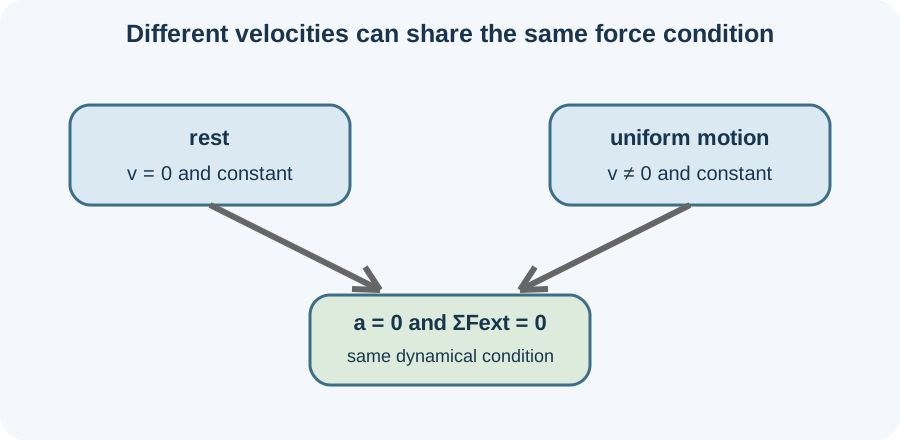
In an inertial reference frame, an object at rest remains at rest and an object in motion continues with constant velocity unless a nonzero net external force acts on it. Constant velocity includes both constant speed and constant direction. Rest is the special constant velocity . The bold symbol indicates that velocity is a vector. The statement applies to a chosen object or system.
Mathematically, implies . The sigma symbol means vector addition of all external forces. The subscript “ext” restricts the sum to interactions crossing the chosen system boundary. The acceleration vector is the rate of change of velocity. Zero acceleration means velocity remains constant.
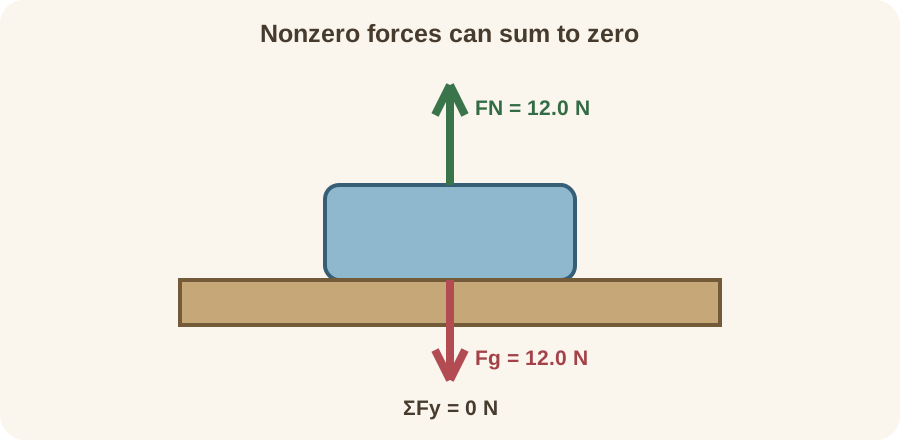
The law does not say that no forces act. Multiple nonzero forces may cancel vectorially. A book resting on a table experiences gravitational and normal forces. Their sum can be zero even though each force is measurable. Distinguishing “no force” from “zero net force” is foundational.
Separate velocity from acceleration
Velocity describes how position changes. Acceleration describes how velocity changes. An object can have nonzero velocity and zero acceleration. It then moves equal displacements in equal time intervals along a straight line. Its motion does not require a continuing net force in the ideal model.
An object can also have zero velocity at one instant and nonzero acceleration. At the top of a vertical toss, instantaneous velocity is zero while gravitational acceleration remains approximately downward. The object does not remain there. One instantaneous velocity value does not determine acceleration. Force analysis explains the subsequent change.
Constant speed does not guarantee zero acceleration. A car turning at constant speed changes velocity direction. It therefore accelerates toward the inside of the curve. A nonzero net force is required for that directional change. Newton’s first law concerns constant velocity, not merely an unchanging speedometer reading.
Understand inertia without inventing a force
Inertia is the tendency of an object to resist changes in velocity. It is a property of matter rather than an additional interaction. An object does not move because an “inertia force” pushes it forward. It continues with constant velocity when no net external force changes that motion. Language should not turn persistence into a fictional force.
Mass measures translational inertia in Newtonian mechanics. Greater mass requires greater net force to produce the same acceleration. Equivalently, under the same net force, greater mass accelerates less. Mass is measured in kilograms. It should not be confused with weight, which is a gravitational force measured in newtons.
Inertia also explains why changes feel resisted inside vehicles. When a car accelerates forward, a passenger’s body tends to retain its previous ground-frame velocity. The seat exerts a forward force to change that velocity. When the car stops, a seat belt exerts the force needed to slow the passenger. The body’s apparent continuation is inertia, while the seat and belt supply real interactions.
Identify all external interactions
Applying the law requires a clearly chosen system. If a book is the system, Earth’s gravity and a table’s contact force are external. Forces between particles inside the book are internal. Changing the system changes which interactions cross its boundary. The net-force statement must match that choice.
An interaction inventory asks what touches the system and what acts at a distance. Contact interactions include normal force, friction, tension, drag, and applied pushes. Long-range interactions include gravity and electromagnetic forces. Motion itself is not an interaction. Velocity should never appear as a force arrow.
Once interactions are identified, represent forces as vectors. Choose coordinate axes and resolve components when necessary. Add components separately. A zero vector sum requires every coordinate component to sum to zero. Cancellation in one direction does not imply cancellation in another.
Analyze a book on a horizontal table
Consider a book resting on a horizontal table. Near Earth’s surface, gravitational force magnitude is . It points downward. The table supplies a normal force of upward in equilibrium. The newton unit equals .
Choose upward as positive. The vertical net force is . The book’s vertical acceleration is therefore . Neither force vanishes. Their equal magnitudes and opposite directions create balance.
The normal force is not automatically equal to weight in every situation. An additional vertical push, an accelerating elevator, or an inclined surface changes the balance. Equality follows from the stated equilibrium and interaction set. It should be derived rather than memorized. This distinction prepares for more complex free-body diagrams.
Explain motion on a constant-velocity train
Suppose the same book rests on a table in a train moving east at constant . Relative to the train, the book is at rest. Relative to the ground, it moves east at . Both descriptions can be correct. Velocity depends on reference frame.
In either frame moving uniformly relative to the other, the book has zero acceleration. Its vertical forces balance. If no horizontal force is required to overcome drag or other effects in the idealized interior, horizontal net force is zero. The book shares the train’s constant velocity without a forward force continually pushing it. The train previously accelerated the book to that velocity.
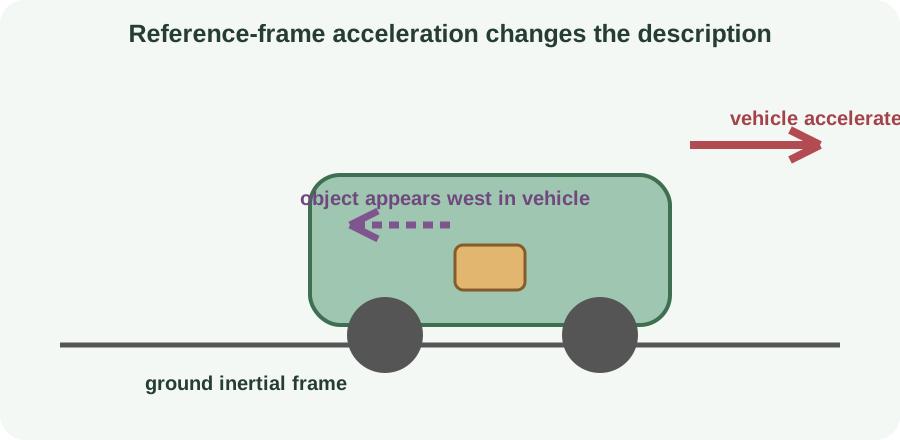
If the train suddenly accelerates east, the book tends to retain its earlier ground-frame velocity. Relative to the accelerating train, it appears to slide west. A real eastward friction force may then accelerate the book with the train. The apparent backward motion is not caused by a mysterious westward interaction in the ground inertial frame. Reference-frame choice separates observation from force cause.
Define inertial reference frames
An inertial frame is one in which a force-free object moves with constant velocity. Newton’s first law identifies this class of frames. A frame moving at constant velocity relative to an inertial frame is also inertial within classical mechanics. No mechanical experiment inside a sealed uniformly moving laboratory can identify an absolute constant velocity. Relative motion is what can be measured.
Earth’s surface is often treated as approximately inertial for short, ordinary experiments. Earth actually rotates and orbits, so this approximation has limits. Coriolis effects matter for weather, long-range projectiles, and large-scale motion. A suitable frame depends on the required precision and scale. Modeling assumptions should be stated when frame acceleration is neglected.
A frame accelerating or rotating relative to an inertial frame is noninertial. In such a frame, objects can appear to accelerate without ordinary external forces explaining that motion. Apparent or inertial forces may be introduced to retain a force-balance form. Their origin in frame acceleration must be identified. They are not new physical interactions with another object.
Distinguish static and dynamic equilibrium
Equilibrium means zero acceleration and therefore constant velocity in an inertial frame. Static equilibrium is the special case of constant zero velocity. Dynamic equilibrium means constant nonzero velocity. Both satisfy . The difference lies in velocity, not force balance.
A hockey puck gliding straight at constant speed on nearly frictionless ice approximates dynamic equilibrium. Its vertical gravity and normal forces balance. Horizontal resistance is small enough to neglect for the model. The puck does not need a forward force to keep moving. Residual drag would eventually make the approximation fail.
A hanging sign at rest illustrates static equilibrium. Tension and weight combine to zero. If two angled cables support it, their horizontal components must cancel and their vertical components must balance gravity. Zero motion alone does not establish equilibrium at every instant. A ball momentarily stopped at the top of a toss is not in equilibrium because gravity remains unbalanced.
Explain why ordinary objects seem to stop
Everyday experience often suggests that motion naturally dies away. Sliding objects encounter friction, rolling resistance, air drag, and deformation. These interactions create net forces opposite motion. The resulting acceleration changes velocity. The stopping is evidence of interactions, not evidence that force is needed to sustain ideal motion.
Galileo’s inclined-plane reasoning helped reveal this distinction. A ball rolling down one slope gains speed and climbs an opposite slope. Reducing resistance lets it travel farther before reaching comparable height. As the second slope becomes gentler, the required distance increases. The limiting horizontal case suggests continuing motion when resistance vanishes.
Air tracks, ice, vacuum systems, and spacecraft provide closer approximations to low-resistance motion. None is perfectly force-free. The first law idealizes what happens as unbalanced interactions become negligible. Idealization extracts a general principle from imperfect observations. Its value lies in explaining deviations through identifiable forces.
Use the law as a diagnostic rule
If an object’s velocity changes, the net external force is not zero in an inertial frame. This includes speeding up, slowing down, or turning. The observation does not immediately identify which force acts. It tells the analyst to look for an unbalanced interaction. The first law therefore guides investigation.
If velocity is constant, the net force is zero. Again, individual forces may exist. A skydiver at terminal velocity has downward gravity balanced by upward drag. The motion is dynamic equilibrium. Before terminal speed, the imbalance produces downward acceleration.
These implications assume an inertial frame and a suitable system. In an accelerating elevator, apparent behavior can confuse a quick diagnosis. State the frame before inferring force balance from motion. State the system before listing external interactions. Careful setup makes the law operational.
Connect first-law reasoning to free-body diagrams
A free-body diagram represents one chosen system as a simple object and shows external force vectors. It omits velocity arrows unless they are separately labeled as motion information. Arrow direction represents force direction. Arrow length may represent magnitude when drawn to scale. Labels identify the interacting agent or force type.
For equilibrium, the vector arrows must add to zero. Opposite equal arrows cancel when they lie on the same axis. Three or more forces can cancel through component sums. Visual symmetry can suggest balance but algebra verifies it. A diagram should be followed by equations such as and .
Free-body diagrams prevent hidden forces from entering equations. They also prevent real interactions from being omitted. The first law supplies the zero-net-force condition after motion establishes equilibrium. The diagram supplies the force inventory. The next lesson develops that workflow in detail.
Avoid treating balanced forces as action–reaction pairs
The upward normal force and downward weight on a book balance, but they are not a Newton’s third-law pair. Both forces act on the book. Third-law partners act on different objects. Earth pulls the book downward, and the book pulls Earth upward. The table pushes the book upward, and the book pushes the table downward.
Balance and interaction pairing answer different questions. Balance concerns the vector sum on one system. Third-law pairing concerns mutual forces between two systems. Equal magnitude and opposite direction occur in both ideas, which creates confusion. The object on which each force acts resolves it.
When drawing a free-body diagram for the book, include only forces acting on the book. Do not include the book’s forces on Earth or table. Those belong on diagrams of the other objects. The two book forces can cancel without being partners. This distinction becomes essential in multi-object mechanics.
Analyze motion in one and two dimensions
In one dimension, equilibrium requires the signed force sum to be zero. A rightward pull and leftward resistance cancel. The object may remain at rest or move at any constant velocity. Force balance alone does not determine which constant velocity. Initial conditions supply that information.
In two dimensions, each component must balance. An object can have while . It then has no horizontal acceleration but does accelerate vertically. Projectile motion without air resistance provides an example: horizontal velocity remains constant while vertical velocity changes under gravity. Separate component equations reveal this structure.
Vector notation prevents scalar cancellation across perpendicular directions. A east force does not cancel a north force. Their vector sum has magnitude . Direction is northeast. Equal magnitudes cancel only when directions are opposite.
Distinguish mass, weight, and normal force
Mass is an intrinsic measure of inertia in classical mechanics. Weight is the gravitational force on that mass. Near Earth’s surface, weight magnitude is . Normal force is a contact force perpendicular to a surface. These three quantities should not be used interchangeably.
A object has mass everywhere in the model. Near Earth, its weight is . On the Moon, weight is smaller because gravitational acceleration is smaller. Mass and inertia remain the same. The kilogram and newton units make the distinction visible.
Normal force adjusts to contact conditions. On a horizontal table in equilibrium with no other vertical forces, it equals weight magnitude. On an incline, it is usually smaller than weight. In an accelerating elevator, it can be larger or smaller. Newton’s laws determine it from the full force balance.
Diagnose common first-law misconceptions
The first misconception is that motion requires force. Constant velocity requires zero net force, not a forward net force. The second is that zero net force means zero velocity. It means zero acceleration. Initial velocity persists.
The third misconception is that inertia is a force. Inertia is a property quantified by mass. The fourth is that an object momentarily at rest must be in equilibrium. Acceleration may remain nonzero. The fifth is that constant speed guarantees balance despite possible turning.
A reliable correction asks three questions. Is velocity changing in magnitude or direction? What system is being analyzed? Is the selected frame inertial? Answers determine whether the zero-net-force conclusion applies.
Practice complete first-law reasoning
A puck glides north at constant on nearly frictionless ice. Its acceleration is approximately . Its net external force is approximately . It can continue north without a northward net force. Vertical forces still balance.
A car moves around a level curve at constant . Its speed is constant, but velocity direction changes. The car accelerates inward and is not in equilibrium. Tire-road friction contributes the required inward net force. Removing that force would make the car continue approximately tangent to the curve.
A passenger stands in a bus that accelerates forward. Describe the event first from the ground inertial frame and then from the bus frame. Identify the real contact force changing the passenger’s velocity. Explain the apparent backward motion without inventing a backward ground-frame force. This comparison tests both inertia and reference-frame understanding.
Connect forward to Newton’s second law
Newton’s first law identifies the zero-net-force case and defines inertial frames. Newton’s second law quantifies what happens when the net force is nonzero. In constant-mass form, . Setting the net force to zero recovers zero acceleration. The laws form a connected framework.
Free-body diagrams make the framework usable. They identify external interactions before vector addition. Component equations connect arrows to measured acceleration. Initial conditions then determine velocity and position changes. Each stage answers a different question.
You are ready to continue when you can distinguish velocity from acceleration, inertia from force, and balance from absence of forces. You should identify inertial frames, attach units, and recognize both static and dynamic equilibrium. You should also explain everyday stopping through resistance rather than a natural loss of motion. These habits establish the conceptual base for force calculations. Newton’s second and third laws can then add quantitative response and interaction pairing.