
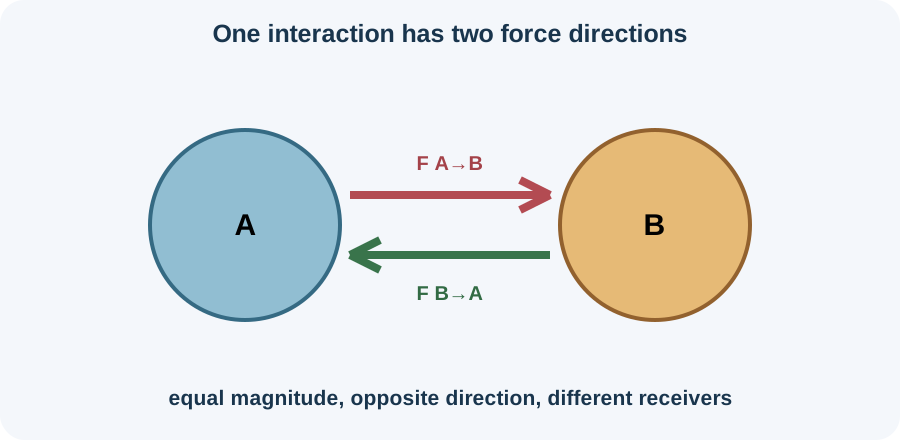
Forces arise from interactions between objects. Newton’s third law states that each interaction has two simultaneous force directions of equal magnitude and opposite direction. The partner forces act on different objects, which is why they do not cancel on either object’s individual free-body diagram. Balanced forces are a separate idea involving several forces that act on the same system. This lesson develops a reliable agent-based method for identifying pairs and connects internal-force cancellation to propulsion and momentum conservation.
State the law with object labels
If object A exerts a force on object B, then B simultaneously exerts a force on A. Vector notation is . The arrow in the subscript names the agent first and the receiving object second. The negative sign means opposite vector directions. Equality of vector magnitudes follows automatically.
The two forces share one interaction type. A gravitational force pairs with another gravitational force. A normal contact force pairs with the opposite normal contact force. A tension interaction pairs through the same rope-object contact. Mixing interaction types cannot create a valid third-law pair.
The forces exist at the same time. One does not occur first and cause the partner later. Their magnitudes remain equal even when the objects have unequal masses or different accelerations. The law describes interaction symmetry. Motion response requires Newton’s second law applied separately to each object.
Use an agent-receiver naming template
Name a force as “force exerted by A on B.” Object A is the agent. Object B is the receiver. The third-law partner swaps those roles. This sentence template removes ambiguity before shorthand symbols are introduced. It also determines which free-body diagram receives the arrow.
Suppose a rope pulls upward on a box. One force is rope on box. Its partner is box on rope, directed downward on the rope. The partner is not Earth’s gravitational force on the box. Agent swapping identifies the unique match.
For a book resting on a table, table on book is an upward normal force. Its partner is book on table, directed downward on the table. Earth on book is the book’s weight. Its partner is book on Earth through gravity. Two distinct interactions therefore produce two distinct pairs.
Recognize the four defining pair tests
A third-law pair has equal magnitude. The vectors point in opposite directions. They belong to the same interaction. They act on different objects. All four conditions must hold.
Equal and opposite alone is insufficient. A book’s weight and normal force may have equal magnitudes and opposite directions. They are different interaction types and both act on the book. Therefore they are not partners. Their equality arises from equilibrium, not from the third law.
A useful checklist asks whether swapping agent and receiver transforms one force label into the other. If it does, the pair is likely correct. If both arrows appear on the same single-object free-body diagram, they cannot be a third-law pair. If their interaction names differ, they cannot be partners. These checks make identification mechanical and reliable.
Keep partners on different free-body diagrams
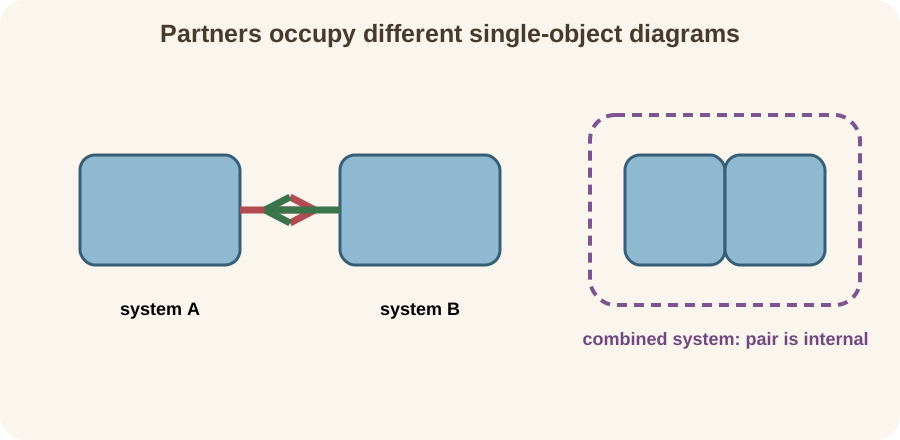
A free-body diagram contains forces acting on one chosen system. For a single object, only arrows with that object as receiver belong. The third-law partners have another receiver. They belong on diagrams for other systems. This ownership rule prevents inappropriate cancellation.
Draw separate diagrams for a person and wall. On the person’s diagram, include wall on person. On the wall’s diagram, include person on wall. Their arrows have equal magnitude and opposite direction. Neither diagram contains both arrows.
When the person and wall are combined as one system, their mutual contact forces become internal. They need not appear in the combined external-force sum. Their vector contributions cancel when equations for all included parts are added. This cancellation follows because both partner forces are now inside the same chosen boundary. External interactions with the surroundings remain in the combined diagram.
Distinguish third-law pairs from force balance
Force balance concerns the vector sum of all external forces on one system. If that sum is zero, acceleration is zero in an inertial frame. The contributing forces may come from several unrelated interactions. Their magnitudes depend on the motion constraints. Balance can occur or fail.
Third-law pairing concerns the two directions of one interaction across two systems. The pair always exists within the Newtonian interaction model. It does not depend on equilibrium. A rapidly accelerating object still exerts a partner force. The equal pair does not imply either object has zero net force.
For a resting book, Earth on book and table on book balance. Their third-law partners are book on Earth and book on table. The balancing forces act on the same receiver. The paired forces act on different receivers. Writing full labels separates the two relationships.
Explain unequal accelerations under equal pair forces
Consider two interacting objects with masses and . Their interaction forces have equal magnitude . If other forces are negligible, their acceleration magnitudes are and . Different masses produce different accelerations. Equal forces do not require equal motion changes.
A truck colliding with a small car exerts the same magnitude force on the car as the car exerts on the truck at each instant. The car’s smaller mass can produce greater acceleration magnitude. Structural design and occupant constraints also affect damage. Greater damage does not prove a greater interaction force on that vehicle. Force equality and response inequality coexist.
Suppose the collision force magnitude is . A car would have acceleration magnitude from that force alone. A truck would have . Units follow from newtons divided by kilograms. The numerical comparison makes the mass dependence explicit.
Analyze a person pushing a wall
Suppose a person pushes a wall eastward with . The wall pushes the person westward with . These two forces form a third-law pair. They remain equal even when the wall does not visibly move. Motion is not required for the interaction symmetry.
The person’s acceleration depends on every force acting on the person. The wall’s westward force may be balanced by an eastward static-friction force from the floor. Vertical forces may also balance. If the total vector sum is zero, the person remains in equilibrium. The wall-person pair alone does not determine that result.
The wall’s acceleration depends on forces acting on the wall and its attached structure. Building supports and Earth interactions can balance the person’s push. The wall’s large effective mass and constraints also limit response. Comparing only the paired contact forces omits the rest of each force inventory. Separate free-body diagrams supply the missing context.
Understand contact forces microscopically
Contact forces arise from electromagnetic interactions between atoms and molecules. When surfaces press together, their electron clouds resist overlap. Each surface deforms slightly. The forces across the interface are mutual. The third law summarizes this interaction at the macroscopic scale.
The normal force is therefore not a one-way support gift. A table pushes a book upward while the book pushes the table downward. The magnitudes are equal at the interface. The table’s own motion depends on all forces acting on it. Its connection to the floor and Earth can prevent noticeable acceleration.
Friction is also paired. If a floor exerts eastward static friction on a walker, the walker exerts westward static friction on the floor. The two forces act on different bodies. The floor-Earth system can absorb tiny momentum changes. Ground propulsion is an interaction rather than a one-sided push.
Explain walking and swimming propulsion
When walking forward, a foot pushes the ground backward. The ground exerts forward static friction on the foot. That forward force can accelerate the person. The person is not pulled forward by their own internal muscles directly as an external net force. Muscles position the body so the ground interaction supplies propulsion.
A swimmer pushes water backward. Water pushes the swimmer forward. The displaced water gains backward momentum. The swimmer gains forward momentum. No solid ground is required because the fluid is the interaction partner.
Propulsion performance depends on the medium and contact conditions. On nearly frictionless ice, a person cannot easily push the ground backward. Their foot slips because available static friction is small. The third-law pair still exists, but its magnitude is limited by the contact. Equal partner forces do not guarantee a desired acceleration.
Explain rocket propulsion without air
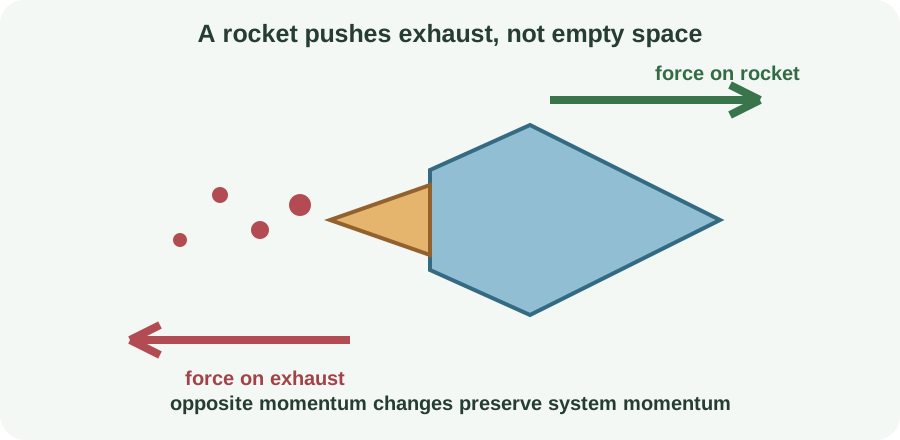
A rocket carries propellant and accelerates exhaust backward. The rocket exerts a force on the exhaust. The exhaust exerts an equal and opposite force on the rocket. This interaction accelerates the rocket forward. Air is not required.
The rocket and exhaust can be treated as parts of a larger isolated system. Their internal forces cancel in the total momentum equation. Backward exhaust momentum is balanced by forward rocket momentum. The changing-mass dynamics require care beyond the simplest constant-mass form . Momentum flow provides the appropriate quantitative framework.
Spaceflight demonstrates that propulsion does not require pushing against Earth or atmosphere. The rocket pushes on its own exhaust. Chemical energy enables the exhaust separation and speed. Newton’s third law identifies the mutual force directions. Conservation of momentum describes the system-level result.
Analyze rope and tension interactions
A taut rope pulls on an attached box. The box pulls back on the rope with equal magnitude. These are third-law partners at their contact. If the rope is ideal and massless, the tension magnitude may be uniform. That uniformity is an additional rope-model result, not the third law by itself.
For a massive accelerating rope, tension can vary along its length. Neighboring rope segments exchange third-law forces locally. Each segment may need a net force to accelerate its mass. Equal forces at one interface do not imply equality between forces at different interfaces. Location labels prevent those forces from being conflated.
A pulley can redirect a rope tension. The rope pulls on the pulley along each contacting segment. The pulley pulls oppositely on the rope at those contacts. A support force balances or accelerates the pulley assembly. A complete diagram identifies every receiving object. The third law pairs each contact separately.
Analyze gravitational interaction pairs
Earth pulls a falling apple downward. The apple pulls Earth upward with equal force magnitude. The pair follows the same gravitational interaction. Their accelerations differ dramatically because Earth’s mass is enormous. Both objects move relative to their common center of mass.
For apple mass near Earth, gravitational force magnitude is approximately . Earth experiences an upward force from the apple. Earth’s acceleration is tiny because its mass is about . The equal-force statement remains exact within the model. The unequal accelerations arise from the drastically different masses.
The apple’s weight and an upward drag force are not third-law partners. Both act on the apple. Drag’s partner is the apple’s force on the air. Weight’s partner is the apple’s gravitational force on Earth. Agent labels again resolve the classification.
Connect internal pair cancellation to momentum
For two interacting particles, write and a corresponding equation for B. Adding the equations brings the internal pair into one sum. By the third law, those pair forces cancel. Only external forces remain in the total momentum rate. This is the system-level importance of interaction symmetry.
If the external-force sum is zero, total system momentum remains constant. Internal collisions can redistribute momentum between parts. One object can gain exactly what another loses along the interaction direction. Their individual momenta change. The total vector stays fixed.
This cancellation does not mean internal forces are physically irrelevant. They determine stresses, deformations, and individual accelerations. They disappear only from the total external-force balance for the combined system. Changing the boundary can make the same force external again. System choice controls the accounting.
Examine collisions over time
During a collision, contact force usually changes rapidly with time. At every instant, the force on A from B equals the negative force on B from A. Therefore the impulses are equal and opposite over the same contact interval. Impulse is the time integral of force. It equals momentum change.
If car and truck remain in contact for with average force magnitude , impulse magnitude is . One vehicle receives that impulse in one direction. The other receives the opposite impulse. The unit newton-second equals kilogram-metres per second. Equal contact duration makes the opposite momentum changes equal in magnitude.
Safety systems alter force-time profiles. Extending stopping time can reduce peak and average force for a given momentum change. The third-law force equality between colliding partners remains. Occupant forces can differ because the occupant interacts with belts, airbags, and vehicle structures. Define which interaction is being compared.
Treat distributed and delayed interactions carefully
Introductory mechanics often models interactions as instantaneous action at a distance or ideal contact. In electromagnetism, fields carry momentum and changes propagate at finite speed. A simple two-particle force statement may require inclusion of field momentum for exact system accounting. Newton’s third-law form is a classical approximation in some contexts. Momentum conservation is the more general principle.
Extended deformable objects can also transmit forces through waves. Pushing one end of a long spring does not make every part respond simultaneously. Local material interactions still exchange forces. Internal stress propagation takes time. A rigid-body model suppresses that detail.
These limitations do not make the third law useless. It remains highly accurate for ordinary mechanics under appropriate approximations. They show why laws have domains of applicability. Stating the model scale prevents overextension. Foundational reasoning becomes stronger when its assumptions are visible.
Diagnose common third-law errors
One error is pairing forces that act on the same object. Those may balance but cannot be partners. Another is assuming the larger object exerts a larger interaction force. Pair magnitudes are equal. Different accelerations follow from mass and other forces.
Another error is saying the forces cancel without naming a system. On either individual object, only one partner appears. They cancel only after the objects are combined and equations are added. A fourth error is treating the response as delayed. The forces are simultaneous within the Newtonian model.
Vague “action and reaction” language can hide ownership. Use agent-on-receiver names. Verify same interaction type. Verify opposite directions and different receivers. This procedure replaces slogans with a testable structure.
Practice interaction-pair identification
A rope exerts an upward force on a box. The box exerts a downward force on the rope. Name the agent and receiver for each. Place them on separate diagrams. Explain why the box’s weight is not the partner.
A swimmer accelerates forward. Identify swimmer on water and water on swimmer. Draw the pair and then draw all forces on the swimmer. Explain why the swimmer can accelerate even though the pair magnitudes are equal. The partner force does not appear on the swimmer’s diagram.
A small car and truck collide. State the force equality at an instant. Use to compare their accelerations under the interaction force alone. Then list other factors that influence damage. Separate the third-law claim from conclusions it does not support.
Connect forward to system mechanics
Newton’s third law organizes interactions across boundaries. Free-body diagrams use one direction of each relevant pair. Combined-system equations cancel internal pairs. Momentum conservation follows when external impulse is zero. These are different views of the same interaction structure.
Energy accounts use system boundaries too, but internal forces can transfer energy between parts even when they cancel from the net force. Torque accounts also depend on force application points. Continuum mechanics replaces discrete contact arrows with stresses distributed across surfaces. Agent and receiver reasoning remains useful. The boundary still determines which interactions appear externally.
You are ready to continue when you can name both forces in a pair, place them on the correct diagrams, and distinguish them from balanced forces. You should explain equal forces with unequal accelerations and identify propulsion partners without requiring ground. You should also state when internal pairs cancel in a combined momentum account. These skills turn the third law from a slogan into a system-analysis tool. Momentum and collision lessons can then build on a stable interaction framework.