
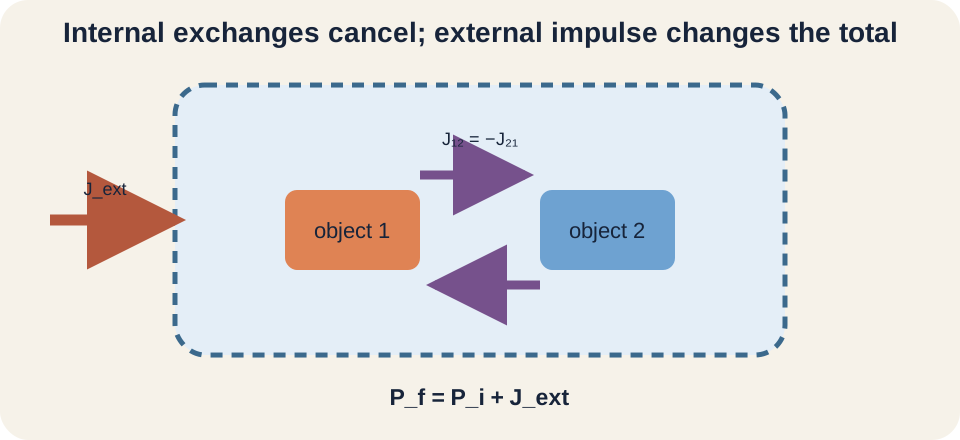
Momentum conservation is not a special rule that begins when objects collide. It follows from a system momentum balance when net external impulse is zero or negligible. Internal interactions can be extremely large and still leave total momentum unchanged. They exchange momentum among system members in equal and opposite amounts. The system boundary determines which forces count as internal.
Collision problems often tempt students to insert unsigned speeds into one equation. That approach loses direction, hides assumptions, and confuses momentum with kinetic energy. A reliable solution starts with a coordinate axis, lists every initial and final velocity, and states the selected system. It then evaluates external impulse over the interaction interval. Conservation is a conclusion from that evaluation.
This lesson derives the conservation statement, treats sticking, recoil, and elastic constraints, and extends the method to two dimensions. Energy accounting will distinguish elastic from inelastic events. Center-of-mass motion will provide an independent check. Worked examples will retain units and signs. Experimental sections will explain why measured totals rarely match exactly.
Learning objectives and an opening prediction
After this lesson, you should identify a system for which momentum is approximately conserved. You should write and solve signed one-dimensional momentum balances. You should analyze recoil and explosions from an initially stationary state. You should conserve vector components in two-dimensional events. You should also distinguish momentum conservation from kinetic-energy conservation and evaluate experimental evidence.
Imagine two carts colliding on a low-friction track. During contact, each cart exerts a large force on the other. Predict whether those forces change the two-cart total momentum. They change individual momenta but are internal to the pair and cancel in the system sum. Small horizontal external impulse makes total horizontal momentum approximately constant.
Now select only cart A as the system. Cart B’s contact force becomes external to that boundary. Cart A’s momentum is not conserved during the collision. The physical interaction did not change, but the accounting category did. Conservation statements belong to a defined system.
Derive the system momentum balance
For particle , Newton’s law is . The first term contains forces from outside the selected system. The second contains forces on from other members . Sum over all particles. Internal force pairs appear twice with opposite directions.
Under Newton’s third law in the ordinary mechanical model, . Their sum cancels. Therefore , where . Integrating from initial to final time gives . The external impulse controls total momentum change.
If , then . If external impulse is small compared with internal momentum exchanges or measurement precision, use approximate equality. Internal forces need not be small. Their cancellation in the total is what matters. This derivation establishes the conditions behind the conservation equation.
Select the system and time interval
A useful collision system often includes all colliding objects. Their contact forces then become internal. The time interval begins just before interaction and ends just after it. A short interval reduces the impulse from modest external forces. This does not make those forces cease to exist.
Gravity can be external while horizontal momentum remains conserved. Momentum components obey separate balances. On a level track, gravity and normal forces cancel vertically while horizontal friction is small. The horizontal external impulse is then negligible. Vertical momentum need not be analyzed with the same approximation. State “horizontal momentum is approximately conserved,” not simply “momentum is conserved.”
A bullet-block problem may select bullet and block together during embedding. The support or floor can provide external impulse depending on duration and mounting. After embedding, later sliding friction changes the combined momentum. Conservation may apply during the short impact but not during the long slide. Time interval is as important as boundary.
Write a momentum inventory
For a two-object one-dimensional system, conservation is . Subscripts one and two label objects, while and label initial and final states. Masses are positive. Velocity signs encode direction. Every term has units .
Draw a table with rows for objects and columns for initial and final momentum. Fill signs before doing arithmetic. Sum each column to form and . Unknowns remain symbolic. The table makes missing objects and reversed directions easier to catch.
If mass leaves or enters the chosen system, the simple fixed-members equation requires modification. Select a larger closed system or include momentum flux. Ordinary collision exercises keep member masses fixed. Explosions split one initial object into multiple final members but conserve total mass within a closed classical model. List every fragment.
A perfectly inelastic collision
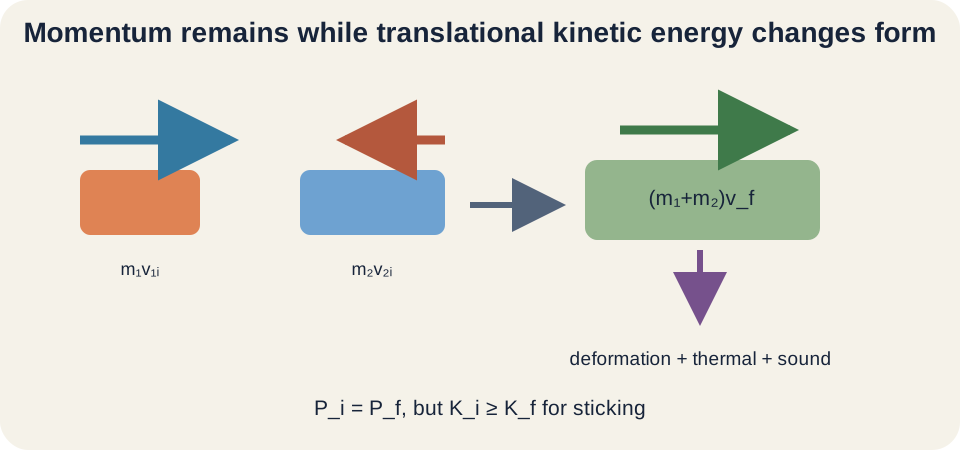
In a perfectly inelastic collision, objects stick and share one final velocity . Momentum can be conserved while translational kinetic energy decreases. The balance is . Solve as . The numerator is initial total momentum.
Suppose a cart moves right at and sticks to a stationary cart. Choose right positive. Initial momentum is . Final mass is . Thus right.
The final velocity lies between the initial velocities because the formula is a mass-weighted average when masses are positive. If objects approach from opposite directions, the result can be zero or point either way. “They stick, so add speeds” is incorrect. Masses weight their corresponding signed velocities. Add signed momenta, then divide by total mass.
Kinetic energy changes in sticking
Initial kinetic energy in the example is . Final translational kinetic energy is . The decrease is . Energy has not disappeared. It moved into deformation, thermal, acoustic, and other internal accounts.
Momentum is vector-linear in velocity, while kinetic energy is scalar-quadratic. One conservation statement cannot replace the other. A perfectly inelastic event produces the maximum translational kinetic-energy decrease compatible with the given initial momentum when all members share one velocity. The remaining translational energy is center-of-mass motion. Internal relative motion has been removed.
One can calculate a kinetic-energy ratio after solving momentum. Do not impose for a sticking collision. That would generally overconstrain the system and produce contradiction. The collision label supplies the extra relation: common final velocity. Energy accounting then diagnoses transformation.
Recoil from an initially stationary system
If a system begins at rest, initial total momentum is zero. After two pieces push apart, . Therefore . Final momenta are equal in magnitude and opposite in direction. Speeds are inversely proportional to masses.
A skater pushes a skater, who moves right at . Choose right positive. Conservation gives . Thus . The heavier skater moves left more slowly.
Internal chemical, elastic, or biological energy can create kinetic energy while total momentum remains zero. The source provides energy, not net system momentum. Rockets recoil by exchanging momentum with exhaust, though an open vehicle-only system needs momentum-flux treatment. Guns, balloons, and fireworks illustrate related principles. External forces can modify the ideal result over longer intervals.
Explosion with a moving center of mass
An object need not begin at rest before fragmenting. Suppose mass moves at velocity and splits into masses and . With negligible external impulse, . The center-of-mass velocity remains . Fragments move relative to that translating center.
Let a object move right at and split into and pieces. If the first moves right at , then . Thus right. Their separation grows because their velocities differ. Both fragments can move right while separating because one is faster.
“Opposite directions after an explosion” applies only in the zero-momentum frame for a two-piece split. In the laboratory frame, both may travel the same direction. Transforming to the center frame subtracts . The piece velocities become and . Their center-frame momenta cancel.
Elastic collision adds a kinetic-energy constraint
An elastic collision conserves total momentum and total translational kinetic energy under the model. These provide two independent scalar constraints for two unknown final velocities in one dimension. In one dimension, write both equations: and . The first retains direction; the second uses squared speeds. Together they determine two unknown final velocities.
For a one-dimensional elastic collision, relative speed of separation equals relative speed of approach: for a consistent ordering. This relation follows from combining momentum and kinetic-energy conservation. It is not a third independent law. It often simplifies calculation. Signs remain essential.
If equal masses collide elastically in one dimension and one begins at rest, they exchange velocities. The incoming object stops and the target departs with the incoming velocity in the ideal case. Real carts may deviate through rotation, sound, deformation, and friction. Equality is a testable limiting prediction. Momentum alone would not force velocity exchange.
General one-dimensional elastic formulas
For known initial velocities, the final velocities are given by the following paired expressions. The first solves for object one: The second solves for object two: . Every coefficient is dimensionless. The formulas assume one-dimensional elasticity and fixed masses. They should not be used for sticking collisions.
If is much larger and initially at rest, the first object approximately reverses with similar speed. If is much larger, it continues with only a small speed change while the light target can depart quickly. If masses are equal, velocities exchange. These limiting cases check the formulas. Physical intuition grows from examining ratios.
Memorizing the formulas is less important than knowing the two conservation equations. Derivation can be reconstructed. Formula signs are easy to copy incorrectly. A momentum and energy check after calculation is mandatory. Both totals should match within rounding.
Two-dimensional momentum conservation
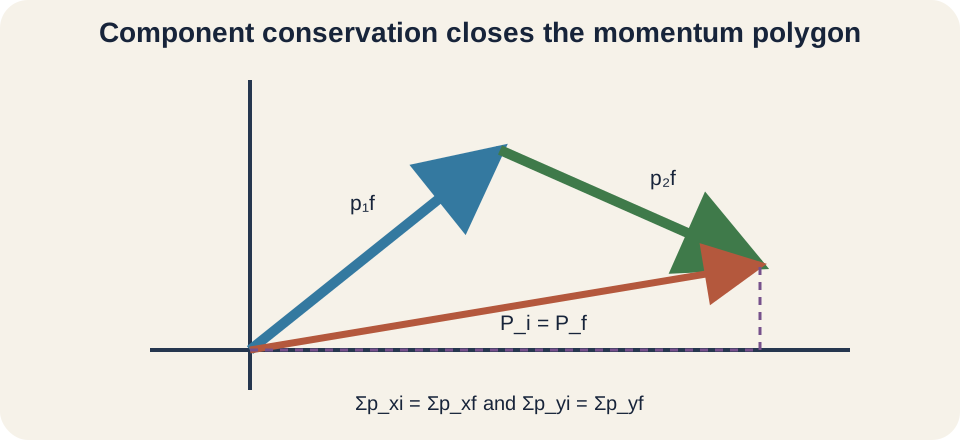
Momentum is conserved component by component when external impulse is negligible. Write and . Choose axes before resolving vectors. Momentum conservation supplies two scalar equations in a plane. Additional collision information may still be required.
Suppose an initially stationary object explodes into three pieces. Their vector momenta must form a closed polygon because their sum is zero. If two final momentum vectors are known, the third is their negative vector sum. Components often simplify the geometry. A scale drawing provides a reasonableness check.
Angles require stated reference directions and quadrants. A vector at north of west has negative and positive components. Use cosine for the component adjacent to the stated reference axis and sine for the perpendicular component. Do not assign signs from calculator outputs alone. The diagram determines signs.
Worked two-dimensional recoil example
A system initially at rest ejects a fragment east at and a fragment north at . A third fragment has mass . The first momenta are and . Their sum is . The third momentum must be .
Divide by to obtain . Its speed is . Direction is southwest at south of west. Both components oppose the known total. The final vector sum is zero.
Kinetic energy after the explosion is positive and came from an internal source. Momentum conservation alone does not determine how much energy was released. If fragment speeds were not fully given, an energy value could supply another constraint. Vector equations and scalar energy equations complement each other. Count unknowns before solving.
Center-of-mass motion provides a global check
For constant total mass, . If external impulse is zero, total momentum and center-of-mass velocity remain constant. A collision can rearrange relative motion without changing center translation. This is true for elastic, inelastic, and explosive internal events. The center path ignores internal complexity.
In a zero-momentum frame, the center of mass is stationary. Before and after a two-object collision, momenta are equal and opposite there. Elastic collisions preserve the magnitudes of relative velocities in that frame, while inelastic collisions reduce relative kinetic energy. Sticking leaves both objects stationary relative to the center. This view unifies collision types.
In the laboratory frame, center velocity may be nonzero. The final shared velocity of a perfectly inelastic collision equals initial center-of-mass velocity. This follows from . A result outside the range of same-direction initial velocities signals a sign or arithmetic error. Center motion is an efficient plausibility check.
Coefficient of restitution describes rebound
Some collision problems use coefficient of restitution . In one dimension, . Under a consistent sign arrangement, . Ordinary ideal values range from zero to one. A perfectly inelastic sticking event has , and a perfectly elastic collision has .
Momentum conservation plus a specified can determine final velocities. Restitution is an empirical collision relation, not a replacement for momentum balance. It summarizes rebound behavior for the contacting materials and conditions. It can depend on speed, temperature, shape, and deformation. A constant value is an approximation.
A value above one can occur in superelastic events where internal energy is released during collision. Ordinary passive-contact assumptions then fail. A spring-loaded or chemically active object can separate faster than it approached. Energy accounting must include the internal source. Momentum conservation can still hold for the isolated system.
External impulse correction
If external impulse is not negligible, use . This is the general statement. Conservation is the special case . A measured momentum difference can estimate external impulse. Its direction should match the external-force history.
Suppose a two-cart system begins with and experiences frictional impulse during the chosen interval. Final total momentum should be . Demanding equality with would ignore evidence. The correction is small but explicit. Whether it is negligible depends on tolerance.
Longer intervals accumulate more impulse from a persistent small force. A friction force that is negligible during a collision may matter during a coast. Choose endpoints close to the interaction when testing collision conservation. Sensor timing influences the result. Interval design is part of experimental reasoning.
Experimental conservation tests
Measure masses, initial velocities, and final velocities with uncertainties. Compute total momentum for each trial. Compare with the propagated uncertainty and an external-impulse estimate. Exact equality is not expected from rounded measurements. Consistency means the difference is small enough relative to evidence.
Video tracking can introduce scale, perspective, and frame-timing error. Motion sensors can misidentify overlapping carts during collision. Track tilt and friction provide external impulse. Rotating wheels carry angular momentum and energy, though translational system momentum remains based on center velocities. Apparatus details matter.
Plot final total momentum against initial total momentum over many trials. Ideal conservation predicts slope one and intercept zero. Error bars and residuals show systematic bias. A slope below one may signal calibration rather than physical momentum loss. Momentum cannot vanish into heat; untracked objects or external impulses explain discrepancies.
Common misconceptions and repairs
One misconception says momentum is conserved for each object. Interaction forces change individual momenta. The total for a suitable system is conserved when external impulse is negligible. List members and add their vectors. Use individual changes to see the exchange.
Another misconception conserves kinetic energy in every collision. Momentum and total energy follow conservation laws, but translational kinetic energy can transform into internal forms. Only elastic collision models conserve that specific kinetic account. Sticking collisions do not. Name the collision relation before adding an energy equation.
A third misconception uses speed magnitudes without signs. Opposite directions can cancel momentum. Choose an axis, convert directions to signed velocities, and keep signs through algebra. Report the final direction in words. Vector bookkeeping prevents impossible results.
Practice with guided feedback
First, a cart at sticks to a cart at ; find final velocity. Second, calculate initial and final kinetic energies. Third, identify the transformed energy. Fourth, state the external-impulse condition. Use right as positive.
Initial momentum is . Combined mass is , so . Initial kinetic energy is . Final kinetic energy is . About transfers into internal, thermal, deformation, and sound accounts.
For a check, final direction follows positive initial total momentum. The shared final speed lies between the signed initial velocities. Momentum before and after agrees within rounding. Kinetic energy decreases as expected for sticking. Conservation is justified only if external impulse during collision is negligible.
Retrieval and connection forward
Without looking back, derive from particle momentum balances. State the condition for conservation. Solve one sticking and one recoil problem with signs. Explain why kinetic energy can change while momentum does not. Finish by drawing a closed two-dimensional momentum polygon.
Collision lessons will combine momentum with elasticity, restitution, or energy transformation. Center-of-mass analysis will separate translation from internal motion. Rotational mechanics will introduce angular momentum and external torque impulse. Fluid and rocket systems will include momentum transported across boundaries. The same system-first conservation habit remains essential.
Keep one organizing statement: total momentum changes only through net external impulse for the selected system. Internal forces exchange momentum but cancel in the total. Conservation is therefore conditional on boundary, direction, and interval. Collision type supplies additional relations, while energy accounting identifies transformations. Every result should pass sign, unit, center-of-mass, and original-balance checks.