
A complicated object can translate, rotate, bend, break, and rearrange. Yet one special point summarizes the translational motion of all its mass. That point is the center of mass. It is a mass-weighted average position rather than necessarily a material particle. Its motion separates whole-system behavior from internal motion.
The center of mass is valuable because internal forces cannot change the total momentum of an isolated system. A firework may explode into many fragments, but their shared center of mass continues along the path determined by external forces. Two skaters can push apart, yet their center of mass remains fixed if external horizontal force is negligible. This principle does not ignore internal motion. It organizes that motion around a system-level reference.
This lesson builds the idea from weighted averages and extends it to vectors, velocity, momentum, force, symmetry, and continuous bodies. Numerical examples include units and explicit coordinate choices. Diagrams distinguish the center of mass from the geometric center and from the center of gravity. You will learn to predict location before calculating. The final goal is a transferable system-analysis method.
Learning goals and an opening prediction
You should calculate center-of-mass position for discrete masses. You should extend the calculation to two and three dimensions. You should connect center-of-mass velocity with total momentum. You should explain why only net external force changes center-of-mass motion. You should also reason about continuous bodies, symmetry, and stability.
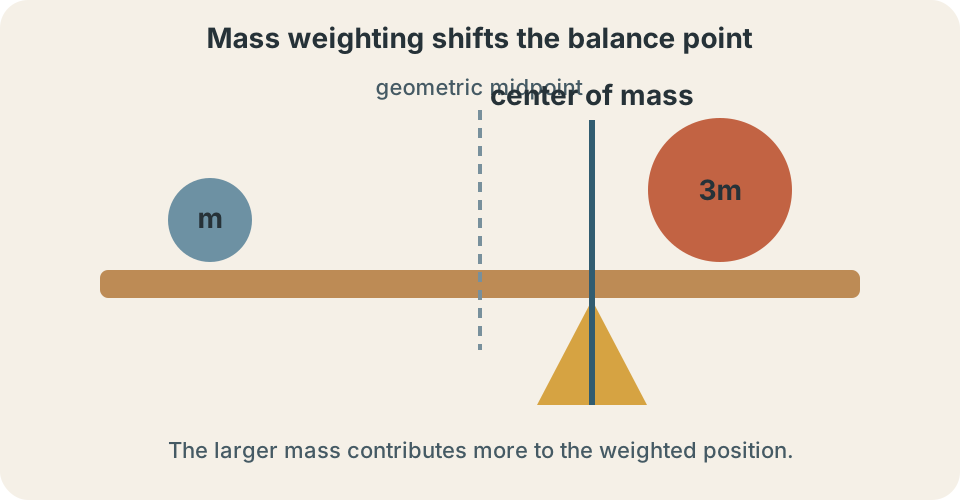
Place a small mass and a large mass at opposite ends of a light rod. Predict where their center of mass lies. It must lie between the masses and closer to the larger one. The larger mass contributes more strongly to the weighted average. Equal masses would place it at the midpoint.
Now imagine adding equal mass far to the right. The center of mass shifts rightward because the new term has a large positive position. Moving the coordinate origin changes every coordinate but does not change the physical point. Predictions about direction and bounds should come before arithmetic. They provide independent checks on a calculated answer.
A weighted average, not an ordinary midpoint
An ordinary average gives every listed value equal weight. Center of mass weights each position by the mass located there. For point masses on one axis, . The numerator adds mass-position products. The denominator is total mass.
The index labels each particle. Symbol means add the expression for all included particles. Each product has units of . Dividing by total mass in kilograms leaves metres. Dimensional cancellation confirms that the result is a position.
For positive masses, the one-dimensional center of mass lies between the smallest and largest occupied coordinates. It shifts toward greater mass. A result outside those bounds signals an arithmetic or sign error for a discrete set of positive point masses. The origin may lie anywhere, so the coordinate itself can be negative. The physical location remains within the span.
Choosing coordinates and defining the system
The system boundary determines which masses appear in the sum. A person alone and a person-plus-boat have different centers of mass. Include every mass named as part of the system. Exclude external objects unless the question expands the boundary. State that boundary before writing equations.
Choose an origin and positive direction convenient for the geometry. Placing the origin at one mass can eliminate a product because its coordinate is zero. Negative coordinates are valid for objects on the opposite side. Distances and coordinates are not interchangeable. A coordinate carries sign and location relative to the origin.
Changing the origin shifts the numerical center-of-mass coordinate by the same amount as every particle coordinate. It does not move the physical center of mass. Rotating axes changes components but not the point. A labeled sketch keeps these transformations clear. Consistency matters more than a particular coordinate choice.
Worked example with two masses
A mass is at and a mass is at . Total mass is . The center is . Evaluation gives . The result lies closer to the larger mass.
The numerator is . Its two terms represent weighted position contributions rather than separate torques in this context. Dividing by produces . The answer lies between and . Both units and bounds pass.
Measure instead from the second mass and choose rightward as positive. Then the first mass is at and the second at . The calculation gives . This coordinate describes the same physical point. It is one metre left of the larger mass.
Solving for an unknown mass or position
The weighted-average equation can be rearranged. If one position is unknown, multiply by total mass before isolating its term. This avoids manipulating a nested fraction prematurely. Retain signed coordinates throughout. Check whether the inferred position fits the physical diagram.
Suppose sits at and an unknown mass sits at . The center of mass is measured at . Write with consistent kilogram and metre units understood in each term. Solving gives , so . The larger inferred mass explains why the center lies near .
The inferred mass is larger than , as expected because the center lies close to it. Substitution returns . A negative mass would be unphysical in this classical mechanics setting. Prediction, solution, and substitution agree. The reverse problem strengthens understanding of weighting.
Extending the definition to vectors
In space, position is a vector. The definition becomes , where . Bold includes all coordinate components. The same scalar mass weights each component. One vector equation is equivalent to separate coordinate equations.
In two dimensions, and . Calculate the two ledgers independently. A point can lie inside the coordinate rectangle even where no particle exists. Reconstructing a magnitude is usually unnecessary because center of mass is a location. Report its coordinates with units.
Three dimensions add . The method does not change. A table with columns for , , , , and weighted products prevents omissions. Every row should represent one included subsystem. Column totals provide the final numerator and denominator.
Worked two-dimensional system
Three particles occupy , , and . Their masses are , , and . Total mass is . The coordinate calculations can be performed separately. A sketch predicts a location nearer the particle.
Horizontal position is . Vertical position is . Units reduce from divided by . The point is . It lies inside the triangle formed by positive point masses.
An equal-mass average would give . The actual vertical coordinate is higher because the upper particle is the heaviest. This comparison reveals what mass weighting changes. Neither answer must coincide with a particle. The center describes the distribution collectively.
Velocity and total momentum
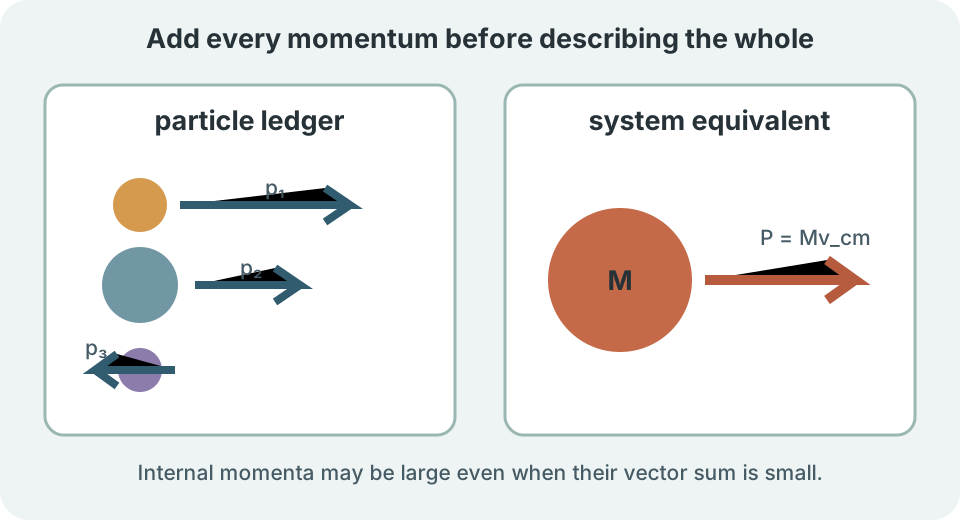
Differentiate center-of-mass position with respect to time when masses are constant. The result is . Each particle velocity receives the same mass weighting as position. Multiplying by total mass gives . The right side is total momentum .
Therefore . This compact equation says a many-particle system has the same total momentum as one imaginary particle of mass moving with the center-of-mass velocity. It does not erase internal kinetic energy. Particles can move rapidly relative to the center while total momentum is zero. Translation and internal motion remain distinct.
Two equal skaters moving oppositely at equal speeds have zero total momentum. Their center-of-mass velocity is therefore zero. Each skater still has nonzero momentum, but the vector sum cancels. If one skater is heavier, equal and opposite velocities no longer cancel. Mass weighting sets the collective velocity.
External force controls center-of-mass motion
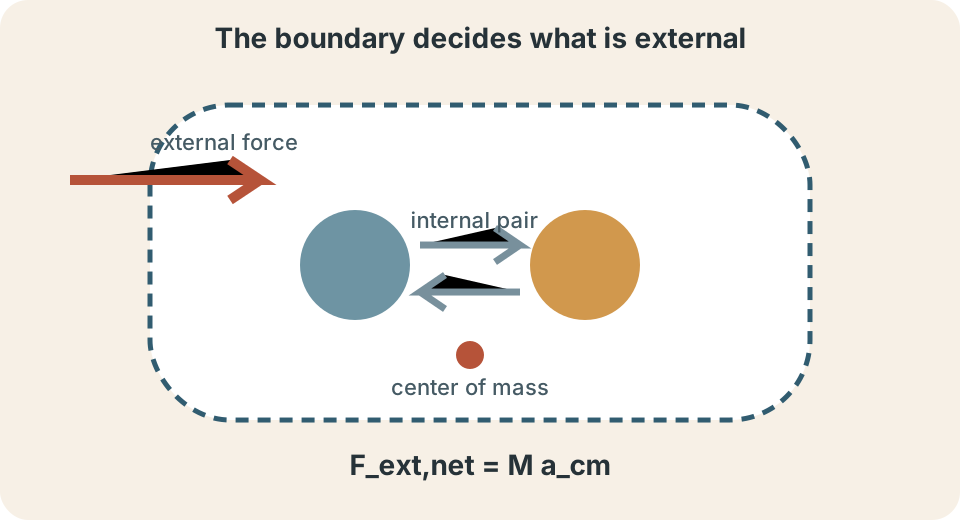
Differentiate total momentum with respect to time. Newton’s second law for a system gives . With constant total mass, , so . The subscript “ext” identifies forces crossing the system boundary. Internal forces cancel in action–reaction pairs under the ordinary particle model.
This cancellation is why an explosion cannot change an isolated system’s center-of-mass motion. Fragment forces are internal. They redistribute momentum among fragments while preserving the total. Gravity, drag, or a support can change the motion because those forces are external to the chosen fragment system. System choice determines classification.
If net external force is zero, center-of-mass velocity is constant. It may be zero or nonzero. If net external force is constant, center-of-mass acceleration is constant. Internal complexity does not alter this system-level rule. The rule becomes a powerful check on collision and recoil problems.
Explosion and collision reasoning
Imagine a projectile moving through the air when an internal charge separates it into pieces. If air resistance is neglected, gravity is the only external force. The fragments’ center of mass follows the same parabolic path the intact projectile would have followed. Individual fragments take different paths. Their mass-weighted positions reproduce the system path.
During a short collision, internal contact forces can be enormous. They occur in opposite pairs within the chosen two-object system. External impulse may be negligible over the brief interval. Total momentum and center-of-mass velocity are then approximately constant. Kinetic energy may still change.
Choosing only one colliding object changes the analysis. The contact force from the other object becomes external. That one-object momentum changes. Conservation applies to the larger isolated system, not automatically to each member. Drawing a boundary makes the logic explicit.
Continuous mass distributions
A continuous body can be imagined as many tiny mass elements . The discrete sum becomes an integral: . The integral adds weighted contributions across the body. Total mass is . The differential represents an infinitesimal mass element.
Mass density connects geometry to . For a thin rod with linear density , . For a sheet with surface density , . For a volume with density , . Each density has units that make a mass.
For a uniform rod from to , use . Then . Constant density cancels. The result matches symmetry. Nonuniform density would remain inside the integral and shift the center.
Symmetry can replace calculation
Uniform mass distributions inherit geometric symmetries. A uniform disk has its center of mass at its geometric center. A uniform rectangular plate has it at the intersection of symmetry lines. A uniform sphere has it at its geometric center. Symmetry can identify coordinates without integration.
The argument must include both shape and density. A symmetric outline with uneven density need not have its center of mass at the geometric center. Added components can also break symmetry. State the reflection or rotation that leaves the entire mass distribution unchanged. The center of mass must remain fixed under every such symmetry.
Symmetry can determine one coordinate without determining all of them. A body symmetric about the axis must have in axes centered on that line. Its vertical coordinate may require integration. Use symmetry first, then calculate only what remains. This ordering reduces work and error.
The center can lie where there is no matter
The center of mass need not lie inside material. A uniform ring has its center at the empty center of the ring. A hollow sphere has its center in empty space. A boomerang-shaped object can have a center outside its material boundary. The point represents an average, not a marked atom.
For a composite body, missing material can be treated as negative contribution in a bookkeeping method. Start with a complete simple shape and subtract the removed region’s mass moments. Negative mass is not physically created. It is an algebraic device for exclusion. The final total mass must remain the actual positive mass.
Suspending an object freely allows its center of mass to settle vertically below the support point. Repeating from another support gives intersecting vertical lines through the center. This provides an experimental location method for flat irregular objects. Friction and string alignment affect precision. The method connects torque balance with mass distribution.
Center of mass and center of gravity
Center of mass depends only on mass distribution. Center of gravity is the effective point where gravitational force acts for torque calculations. In a uniform gravitational field, they coincide. Near Earth over ordinary object dimensions, this approximation is usually excellent. The terms are often used interchangeably in introductory problems.
In a strongly nonuniform gravitational field, different parts experience different gravitational force per unit mass. The center of gravity can then differ from the center of mass. Large astronomical bodies or extended structures may require this distinction. State the uniform-field approximation when relevant. Do not define center of mass through gravity.
Weight is an external force on the chosen object system. In a uniform field, total weight is applied effectively at the center of mass. This simplification supports torque and stability analysis. It does not mean all microscopic gravity acts at one atom. It preserves the net force and torque behavior.
Stability and support
For an object resting under gravity, stability depends on the vertical projection of its center of mass relative to the support region. If the projection lies inside the base of support, a restoring tendency can exist. If it moves outside, gravity produces a tipping torque. A wider base generally increases the allowed range. A lower center of mass generally reduces tipping tendency.
Leaning changes the projection without necessarily changing the body-fixed mass distribution. Moving an arm or load changes the distribution and therefore the center itself. People adjust posture to keep the combined person-object center over their feet. Vehicles place heavy components low for similar reasons. Static stability is a system question.
The edge of the support region is a threshold in an ideal rigid model. Real materials deform, feet grip, and active control matters. A center-of-mass diagram is still a useful first model. Label the gravitational line of action and pivot edge. Then evaluate torque direction.
Common misconceptions and repairs
One misconception identifies center of mass with geometric center in every case. That is true only for suitable symmetry and uniform density. Unequal masses shift the weighted average. Predict the shift toward greater mass. Use the full distribution rather than outline alone.
Another misconception says internal motion can propel an isolated center of mass. Internal forces redistribute momentum but cannot change total momentum. A person walking inside a freely floating craft moves the craft oppositely. Their combined center remains in uniform motion. External interaction is required to change that motion.
A third misconception assumes the center must lie inside matter. Rings and hollow objects disprove that idea. A fourth confuses coordinate sign with physical impossibility. Negative coordinates simply lie on the negative side of the chosen origin. Sketches and bounds repair both misunderstandings.
A reliable solution routine
Define the system and coordinate axes. Sketch every mass location with units. Predict the center’s region and its shift toward larger masses. Create a table of masses, coordinates, and mass-coordinate products. Sum each coordinate ledger independently.
Compute total mass and divide the weighted sums by it. Carry kilograms and metres so units visibly reduce to position. Check bounds and symmetry. Substitute the result when solving an inverse problem. Report coordinate values rather than an unnecessary distance from the origin.
For motion, calculate total momentum and use . Classify forces as internal or external relative to the same boundary. Apply . Separate internal motion from collective translation. Finish with a physical interpretation.
Practice and connection forward
Masses and lie at and . The weighted numerator is . Total mass is . Thus . It lies between the masses and closer to the heavier one.
Two particles of and move at and . Total momentum is . Total mass is . Center-of-mass velocity is . The positive sign points along the chosen positive axis.
Without looking back, explain mass weighting, the possibility of an empty center, and the role of external force. Derive from the position definition. Predict the center for two unequal masses before calculating. Collision lessons will use center-of-mass motion to organize impact. Rotational dynamics will connect mass distribution to torque and inertia.