
A moving object carries a state quantity called linear momentum. Momentum combines how much matter participates with how that matter moves. A light object moving quickly and a heavy object moving slowly can have equal momentum. Direction matters because velocity is a vector. Momentum therefore supports a different kind of accounting from scalar kinetic energy.
Momentum becomes most powerful when a system contains several interacting objects. Internal forces can redistribute momentum among members while external force changes the total. During a short collision, the external impulse may be small enough that total system momentum remains nearly constant. Recoil and explosion problems follow the same structure. Selecting the system boundary is the key modeling decision.
This lesson begins with the definition and builds units, signs, and components. It then develops total momentum, relates external force to momentum-change rate, and compares momentum with kinetic energy. Worked examples will preserve directions and units explicitly. The lesson prepares for impulse and conservation without assuming them as unexplained rules.
Learning objectives and an opening prediction
After this lesson, you should calculate momentum in one and several dimensions. You should add individual momenta to obtain total system momentum. You should use and explain its constant-mass form. You should distinguish momentum from kinetic energy. You should also analyze recoil, reference frames, and system boundaries.
Imagine a cart moving right at and a cart moving left at . Choose right as positive. Their momenta are and . Their vector contributions have equal magnitude and opposite sign. Total momentum is zero even though both carts move.
Zero total momentum does not mean zero total kinetic energy. Each cart has positive kinetic energy because speed is squared. The system can therefore contain substantial motion while vector momenta cancel. Vector and scalar accounts answer different questions. This contrast will recur in collisions.
Define momentum with mass and velocity
Linear momentum is . The bold symbol denotes momentum as a vector, is mass in kilograms, and is velocity in meters per second. Since mass is a positive scalar, momentum points in the same direction as velocity. Its magnitude is . A stationary object has zero momentum in the chosen frame.
The SI unit is . Momentum can also be written in newton-seconds because . The newton-second form becomes natural when discussing impulse. These units are equivalent but emphasize different relationships. Momentum is not measured in joules.
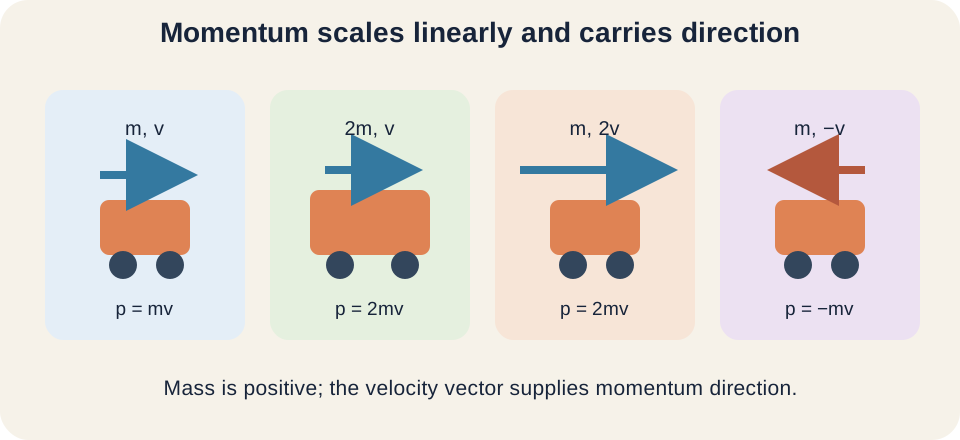
Doubling mass at fixed velocity doubles momentum. Doubling velocity at fixed mass also doubles momentum, including its direction sign. Reversing velocity reverses momentum. Momentum depends linearly on both mass and velocity. Kinetic energy will show a quadratic velocity dependence instead.
One-dimensional signs encode direction
Choose a positive axis before assigning numbers. If right is positive, a object moving left at has . Its momentum is . The negative sign means left. Its momentum magnitude is .
A negative momentum is not less physical than a positive one. Signs are coordinate labels. Choosing left as positive would reverse every horizontal velocity and momentum sign while leaving physical predictions unchanged. Consistency matters more than which direction is selected. Write the axis on the page.
Momentum change is . Reversing direction makes this subtraction especially important. If the object changes from to , then . The change is not merely the difference of magnitudes . Signed states must be subtracted.
Momentum components add independently
In two dimensions, write . The unit vectors and point along chosen and axes. Components are and . Each component carries sign. Vector magnitude is .
Suppose a puck moves at at above positive . Its speed components are and . Momentum components are and . Both components are positive because the vector lies in the first quadrant. The magnitude is .
Angles require a named reference axis. “Thirty degrees” alone is incomplete. A quadrant determines component signs. If the puck moves thirty degrees above negative , its component is negative while its component remains positive. Draw the vector before using sine or cosine.
Total momentum is a vector sum
For a system of particles, total momentum is . The capital distinguishes system total from one particle’s momentum. The sigma means add contributions for all included members. Momentum components add separately. Opposite contributions can cancel.
For two carts, . Masses are never subtracted simply because objects move oppositely. Direction resides in velocity signs. If at and at , then . Both objects remain members despite cancellation.
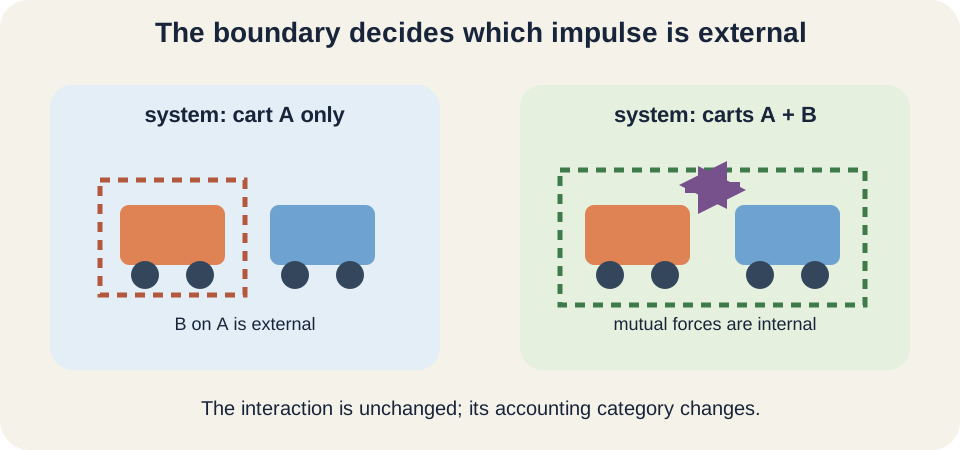
System selection determines the sum. A cart-only system excludes a colliding bumper, while a two-cart system includes both carts. An interaction can be external for one boundary and internal for another. Momentum accounting must name the boundary before classifying forces. Otherwise “conserved” lacks a defined subject.
Newton’s second law in momentum form
Newton’s second law is fundamentally . Net external force on an object equals its momentum-change rate. The derivative describes instantaneous change per time. Force and momentum direction are connected through the derivative, not necessarily through momentum itself. A force can oppose momentum and reduce its magnitude.
For constant mass, . This recovers the familiar . The constant-mass assumption is essential for that simplification. Momentum form remains more general. Variable-mass systems require careful treatment of mass flow and system boundaries.
If a constant net force acts right for a momentum change, then . Momentum increases by each second under that model. This statement can mean a negative momentum becomes less negative before turning positive. Force sign describes rate of change, not current motion direction. A positive force can act while an object still moves left.
Impulse accumulates force over time
Integrate Newton’s law from to : . Define the left side as impulse . Then . The integral accumulates changing force through time. Impulse bridges an interaction interval to momentum states.
For constant net force, . A large force acting briefly and a smaller force acting longer can provide equal impulse. On a force–time graph, signed area is impulse. Peak force alone cannot determine momentum change. Duration and curve shape matter.
A ball moving right at is stopped. Its momentum changes from to . Therefore impulse is , pointing left. The separate impulse lesson develops average force and collision timing. Here the relationship establishes how momentum changes.
System momentum changes through external impulse
For a multi-object system, . Internal force pairs exchange momentum among members but cancel from the total rate under the ordinary Newtonian model. Integrating gives . External impulse changes total system momentum. Internal impulse redistributes it.
During a short collision, gravity or friction may act but provide small impulse compared with contact forces. Total momentum can then be approximately conserved in a selected direction. “Approximately” reflects a comparison, not a claim that external forces vanish exactly. Estimate external impulse when precision matters. Short duration often makes a modest external force negligible.
For two carts colliding on a level track, vertical gravity and normal forces cancel in the vertical momentum balance. Horizontal friction may be small. Choosing both carts as the system makes their mutual collision forces internal. The system’s horizontal momentum then changes little. Choosing one cart would make the other cart’s contact force external.
Center-of-mass velocity links to total momentum
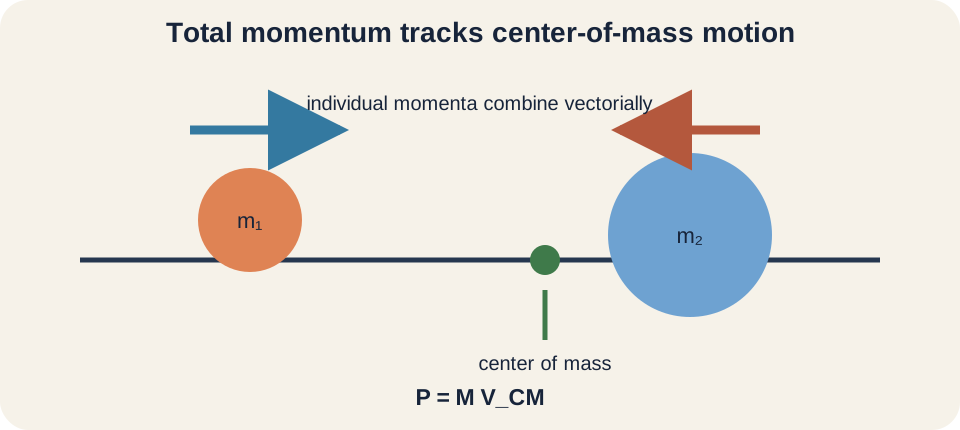
The center-of-mass position is , where total mass is . Differentiate for a fixed-mass system. The center-of-mass velocity is . Therefore . Total momentum tracks the motion of the system’s mass-weighted center.
If total momentum is zero, the center of mass is at rest in that frame. Individual members can still move around it. The opening two-cart example has zero total momentum, so its center-of-mass velocity is zero. This frame is called the center-of-momentum or center-of-mass frame for fixed total mass. Collision symmetry often becomes clearer there.
External net force determines center-of-mass acceleration: for constant total mass. Internal forces can produce explosions, vibrations, or rotations without accelerating the center of mass. A firework can fragment while its center of mass follows the trajectory set by external gravity. Its pieces spread around that continuing center path. System motion separates from internal motion.
Worked example: total momentum and center speed
A cart moves right at , while a cart moves right at . Total momentum is right. Total mass is . Center-of-mass velocity is right. Momentum units divided by mass reduce to velocity units.
The center speed lies between the two cart speeds because both move in the same direction. It is closer to the heavier cart’s speed because the average is mass-weighted. A simple arithmetic mean would give and would be incorrect. The total-momentum relation supplies the proper weighting. Units reduce to meters per second.
If the second cart instead moves left at , total momentum becomes . Center velocity becomes right. Changing one direction changes the vector sum. The total remains rightward because the first contribution is larger. Masses remain positive.
Recoil follows internal momentum exchange
Suppose two initially stationary carts push apart using a compressed spring. Initial total momentum is zero. If external impulse is negligible, final total momentum remains zero: . Therefore . The negative sign requires opposite directions.
If a cart moves right at after release and the other mass is , then . Their momenta are and . The lighter cart moves faster. The heavier cart needs less speed to carry the same momentum magnitude. Equal and opposite momentum does not imply equal speed.
The spring releases stored energy while internal forces exchange momentum. Momentum conservation does not determine the final speeds without at least one more piece of information. Energy, spring compression, or one measured speed can provide it. Momentum sets a vector constraint. Energy accounting answers a different scalar question.
Momentum and kinetic energy are not interchangeable
Momentum magnitude is , while translational kinetic energy is . For a fixed mass, kinetic energy can be written . The square removes momentum direction from energy. Two objects with opposite equal momentum have equal positive kinetic energies. Their total momentum can cancel while energies add.
For fixed momentum magnitude, a smaller mass has greater kinetic energy because . For fixed speed, a larger mass has both greater momentum and greater kinetic energy. For fixed kinetic energy, momentum magnitude is and increases with square root of mass. Every comparison must state what is held fixed. Vague “more momentum means more energy” claims can fail across different masses.
Momentum is conserved in isolated collisions regardless of whether mechanical kinetic energy is conserved. Kinetic energy can transform into deformation, thermal energy, sound, or internal energy. Elastic collisions conserve translational kinetic energy under their model, while inelastic ones do not. Momentum and energy conservation are both valid but track different accounts. Their simultaneous use constrains collision outcomes.
Reference frames change momentum values
Velocity depends on reference frame, so momentum does too. If a frame moves at constant velocity relative to the original, each particle velocity transforms as . Total momentum becomes for fixed total mass. The same physical system therefore has different total momentum in different inertial frames. Momentum conservation still holds within each consistent frame.
Choose . Then . This defines the center-of-momentum frame. Collision participants approach and separate around a stationary center of mass. Laboratory and center-of-mass descriptions can look different while predicting the same measurable event. Never mix initial values from one frame with final values from another.
At speeds near light speed, classical momentum must be replaced by relativistic momentum . The factor depends on speed relative to light. Newtonian momentum is an excellent approximation at ordinary speeds. Stating the regime keeps the model honest. Relativity preserves momentum conservation with the corrected definition.
Variable-mass cautions
A rocket changes mass as exhaust leaves the chosen vehicle boundary. Writing without accounting for momentum flux can be misleading. The full momentum balance must include material crossing the system boundary. One can choose a larger closed system containing rocket and expelled exhaust, or use a control-volume formulation. System choice determines the terms.
Rain accumulating in a moving cart is another variable-mass example. Incoming drops bring momentum before joining. The cart’s speed change depends on that incoming momentum and external forces. Mass change alone does not create or destroy momentum. Flowing mass transports it across the boundary.
Introductory problems often assume constant mass. That assumption should be stated when deriving . The momentum definition itself remains useful for each included material element. More advanced mechanics treats open-system momentum systematically. Avoid using rocket examples as if mass simply disappears.
Measuring momentum and uncertainty
Momentum measurement requires mass and velocity estimates. A balance supplies mass, while motion sensors, timing gates, or video provide velocity. In one dimension, preserve sign during data processing. In two dimensions, estimate components separately. Calibration and frame rate affect uncertainty.
For , fractional uncertainties combine approximately according to the measurement model. If independent small uncertainties are treated statistically, . The symbol denotes a standard uncertainty estimate. Near zero velocity, relative uncertainty becomes unhelpful and absolute uncertainty should be used. Report precision consistent with evidence.
In a collision lab, compare total momentum before and after with uncertainty intervals. A small nonzero difference may be consistent with measurement uncertainty or external impulse. Do not force rounded totals to match exactly. Examine friction, track tilt, sensor alignment, and sampling times. Conservation is tested quantitatively, not declared by expectation.
Common misconceptions and repairs
One misconception says a stationary system has no momentum-related motion. Zero total momentum can result from nonzero opposing momenta. The center of mass is stationary while members move. Kinetic energy can remain positive. Add vectors before interpreting the system.
Another misconception says equal and opposite forces guarantee each object’s momentum stays unchanged. Internal forces change individual momenta by equal and opposite amounts. Their sum remains unchanged for the pair if external impulse is negligible. Individual momentum is not conserved during interaction. System total is the relevant conserved quantity.
A third misconception treats momentum as a force. Momentum is a state quantity in , while force is its rate of change in newtons. Impulse has momentum units and accumulates force through time. Units expose the distinction. Name whether a problem asks for state, rate, or accumulated interaction.
Practice with guided feedback
First, find momentum of a car moving west at with east positive. Second, combine it with a car moving east at . Third, find system center-of-mass velocity. Fourth, explain why total kinetic energy is not zero. Draw the axis before calculating.
The first momentum is . The second is . Total is , and total mass is . Center velocity is . Kinetic energies are positive scalars and add despite opposing directions.
For a conceptual check, reverse every coordinate sign. Each momentum and center velocity sign reverses, while speeds and kinetic energies remain unchanged. The physical conclusion still points west in ordinary language. For a system check, identify external forces. For an impulse check, compare their effect over the selected interval.
Retrieval and connection forward
Without looking back, define momentum with symbols, direction, and units. Explain how to obtain total momentum and center-of-mass velocity. Derive the constant-mass Newton’s-law form from . Contrast zero total momentum with zero kinetic energy. Finish by explaining recoil through internal momentum exchange.
Impulse will quantify force accumulated through time. Conservation of momentum will formalize external-impulse conditions for collisions and explosions. Collision lessons will combine momentum with energy or restitution. Center-of-mass motion will separate system translation from internal motion. Momentum provides the vector ledger connecting all of them.
Keep one organizing statement: momentum is mass times velocity and therefore a frame-dependent vector state. Individual momenta add to a system total, which equals total mass times center-of-mass velocity. External force changes total momentum, while internal forces redistribute it. Momentum and kinetic energy are distinct accounts. A conservation claim is meaningful only after the system, interval, and external impulse are identified.