
A collision is a short interaction during which objects exert large forces on one another. The visible result may be a bounce, a rebound, a deflection, or objects joining together. Momentum provides the organizing principle because internal collision forces transfer momentum within a chosen system. Kinetic energy requires a separate account because some of it may become deformation, thermal energy, sound, rotation, or vibration. This lesson develops a disciplined way to decide what is conserved, choose signs, solve the equations, and interpret what the mathematics means physically.
Define the event and the system
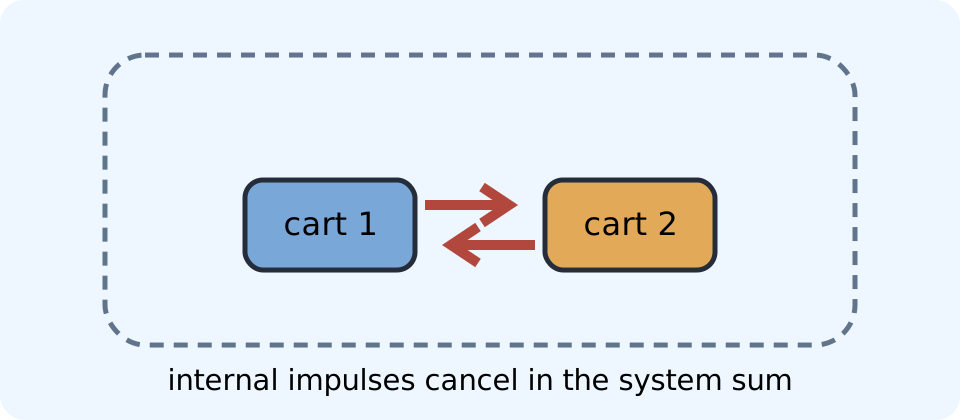
A collision analysis begins before any equation is written. Identify which objects belong to the system and specify an interval beginning just before contact and ending just after contact. The words “before” and “after” refer to states outside the brief interaction, not to arbitrary clock readings. Momentum conservation applies to the system only when the net external impulse over that interval is zero or negligible. A statement such as “momentum is always conserved” is incomplete unless the system boundary has been named.
Internal forces occur between members of the chosen system. During a two-cart collision, cart 1 pushes cart 2 while cart 2 pushes cart 1 with an equal and opposite force at each instant. Their impulses are also equal and opposite because they act through the same time interval. These internal momentum changes cancel when the momenta of both carts are added. Each cart’s momentum can change dramatically even while the total remains constant.
External forces come from agents outside the system, such as a track, Earth, air, or a person. A nonzero external force does not automatically invalidate momentum conservation because impulse depends on both force and duration. During a very short horizontal collision, friction may deliver much less impulse than the much larger contact forces, so horizontal momentum is approximately conserved. Vertically, normal force and weight may balance or provide external impulse, so each direction must be evaluated separately. State the approximation explicitly rather than hiding it inside an equation.
Represent momentum as a vector
Linear momentum is . The symbol is mass in kilograms, is velocity in , and momentum has units . Bold symbols indicate vectors, so direction is part of the quantity. In one dimension, direction is represented with an algebraic sign after choosing a positive axis. A negative momentum means motion opposite the chosen positive direction, not a negative amount of motion.
For several objects, total momentum is the vector sum . The capital Greek sigma means to add the contribution from every object labeled by the index . If external impulse is negligible, , where the subscripts identify initial and final system states. In one dimension this becomes . The velocity subscripts identify object number first and time state second.
Momentum conservation is one vector equation, which means one scalar equation per spatial dimension. A one-dimensional two-object collision therefore gives one momentum equation. If both final velocities are unknown, momentum alone cannot determine both values. Additional physical information might be that the objects stick, that the collision is elastic, or that one final speed is measured. Counting unknowns and independent equations prevents a solver from assuming information the problem never supplied.
Connect force, impulse, and momentum transfer
Impulse is the accumulated effect of force over a time interval. For a constant force, , while for a changing force, . The integral represents the signed area under a force-versus-time graph. The impulse-momentum theorem is . Impulse has units , equivalent to .
During contact, the force on each object can vary rapidly and reach a large peak. Newton’s third law says at every instant, so integrating gives . One object’s momentum gain is the other object’s momentum loss. This mechanism explains conservation rather than merely asserting it. The cancellation is exact for the internal pair even when the force-time curve is complicated.
Increasing collision duration can reduce average force for the same momentum change because . Airbags, crumple zones, helmets, and padded surfaces exploit this relationship by extending stopping time and distance. They do not eliminate impulse when the same initial and final momenta remain. Instead, they reduce typical and peak forces while channeling deformation away from vulnerable structures. The vertical bars around indicate the magnitude of the momentum change. A safety explanation should distinguish impulse, force, time, and energy rather than saying padding “absorbs momentum.”
Classify collision outcomes
An elastic collision conserves both total momentum and total kinetic energy of the selected system. An inelastic collision conserves momentum under the external-impulse condition but has less final translational kinetic energy. A perfectly inelastic collision is the special inelastic case in which the colliding objects stick and share one final velocity. These categories describe idealized before-and-after accounts. The word elastic does not mean that no object deforms during contact, because temporary deformation can occur and reverse.
Total energy remains conserved for a closed system even when translational kinetic energy decreases. The missing translational kinetic energy appears in other accounts, including internal deformation, thermal energy, sound, vibration, fracture, or rotation not included in a simplified model. It is better to say that kinetic energy was transformed than that energy was lost. Momentum and kinetic energy are different quantities with different conservation conditions. One must test them separately rather than assuming that conservation of one implies conservation of the other.
An explosion or recoil is mathematically related to a collision run in the opposite time direction. Internal stored energy becomes kinetic energy, so system kinetic energy can increase while momentum remains conserved. A firework initially at rest can fragment into pieces whose vector momenta sum to zero. The energy increase comes from chemical or other internal energy, not from momentum. This comparison reinforces that momentum conservation places a vector constraint but does not fix the kinetic-energy account.
Solve perfectly inelastic collisions
When two objects stick, their final velocities are equal by the physical constraint. Momentum conservation becomes . Solving gives . The numerator is initial total momentum, and the denominator is combined mass. This result resembles a mass-weighted average of initial velocities, so the final velocity lies between them when no unusual sign configuration is present.
Consider a cart moving east at that strikes and sticks to a stationary cart. Taking east as positive gives . The kilogram units cancel while the velocity unit remains. The positive sign means the combined carts move east. The result is closer to the initially stationary cart’s velocity because that cart has greater mass.
Initial kinetic energy is . Final kinetic energy is . Thus . The negative change means left the translational kinetic-energy account and entered other forms. Momentum conservation determined , while the energy calculation diagnosed the collision rather than supplying the sticking equation.
Analyze one-dimensional elastic collisions
An elastic collision satisfies both and . The first equation conserves signed vector momentum in one dimension. The second conserves scalar kinetic energy, so velocities are squared and their signs disappear inside each term. Solving the pair directly is possible but algebraically cumbersome. Factoring the energy equation together with momentum leads to a useful relative-speed statement.
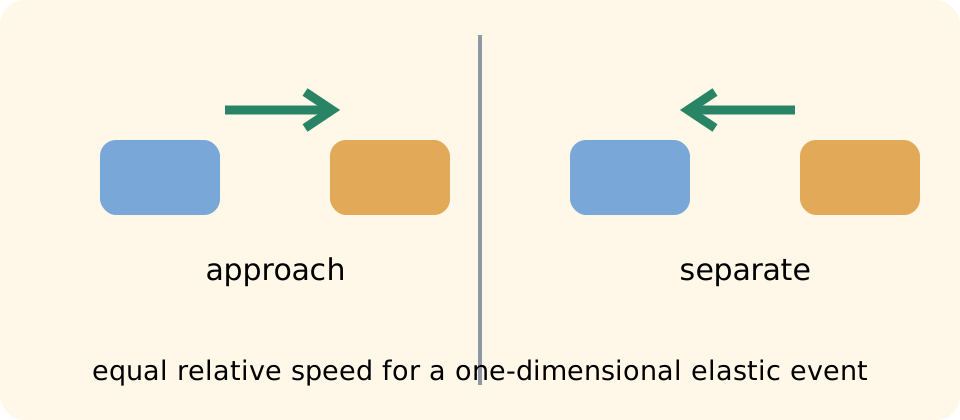
For a one-dimensional elastic collision, . The left side is the relative approach velocity before contact, and the negative sign says the relative separation velocity reverses afterward. In words, relative speed of approach equals relative speed of separation. This relation is not an extra universal law; it follows from momentum and kinetic-energy conservation for this special case. It should not be applied to inelastic collisions without qualification.
If a moving object of mass strikes a stationary object of mass , the elastic solutions are and . Equal masses exchange velocities, so the first stops and the second departs with the original velocity. If , the lighter object rebounds with nearly its original speed. If , the heavy object slows only slightly while the light target can leave at nearly twice the heavy object’s initial speed. Limiting cases turn complicated-looking expressions into understandable physical predictions.
Extend momentum to two dimensions
In two dimensions, momentum conservation must hold independently along perpendicular axes. The vector equation becomes and . A momentum component is or when angle is measured from the positive -axis. Signs follow from the quadrant of the vector. Drawing a momentum-vector diagram before writing equations reduces trigonometric and sign errors.
Suppose an object initially moves only along the positive direction and breaks into two pieces. The initial momentum is zero, so the final components must cancel. The final components must add to the original momentum. This does not require the fragments to have equal speeds or opposite directions because their masses may differ. Vector closure, not visual symmetry, is the controlling condition.
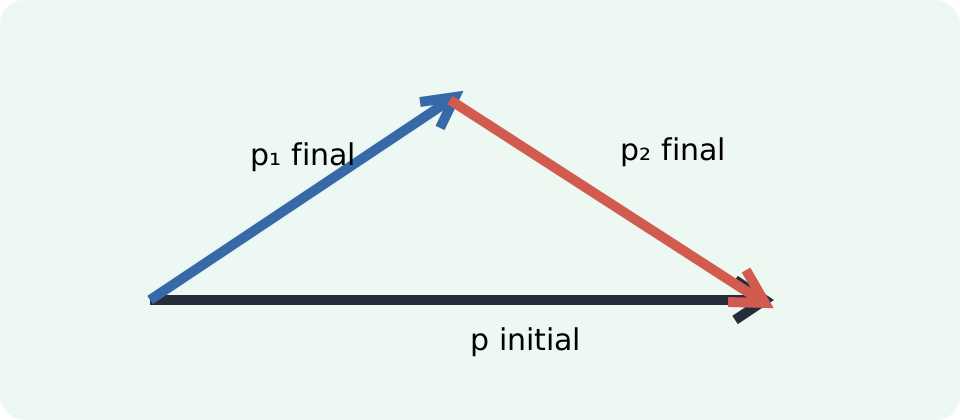
Two-dimensional elastic collisions also require kinetic-energy conservation, but the number of unknown speeds and angles may exceed the available equations. Measurements or geometric constraints then supply needed information. A glancing collision can transfer momentum sideways even when the system’s initial sideways momentum was zero, provided final sideways components cancel in total. Each object can change in both dimensions while the system vector remains fixed. Always count scalar unknowns and independent component equations before attempting numerical solution.
Use center-of-mass reasoning
The center-of-mass velocity is , where is total momentum and is total system mass. If net external impulse is zero, total momentum is constant, so center-of-mass velocity is constant. Internal collision forces can rearrange individual motions but cannot change the motion of the system center of mass. This statement remains true for elastic collisions, sticking collisions, explosions, and complex deformation. The center-of-mass frame often reveals symmetry hidden in a laboratory frame.
In the center-of-mass frame, total momentum is zero by definition. For a two-object elastic collision in one dimension, each object reverses its momentum while preserving its kinetic-energy contribution in that frame. Transforming back to the laboratory frame recovers the usual final velocities. This perspective explains why relative-speed reversal naturally accompanies elastic behavior. It also separates overall translation from motion internal to the system.
For a perfectly inelastic collision, both objects are at rest relative to one another after sticking. Their remaining laboratory kinetic energy is entirely the kinetic energy associated with center-of-mass translation. The kinetic energy associated with relative motion has been transformed into internal forms. Therefore perfectly inelastic sticking produces the greatest possible loss of translational kinetic energy consistent with the fixed total momentum. This conclusion follows from system structure rather than from an arbitrary collision label.
Evaluate data and uncertainty
Laboratory collisions are assessed by comparing measured total momentum before and after. A fractional momentum difference can be reported as when is not near zero. However, measurement uncertainty must be considered before declaring conservation successful or violated. Photogate timing, video scale, alignment, friction, and mass measurements all contribute uncertainty. Agreement within experimental uncertainty supports the model but does not prove an exact law from one trial.
Kinetic-energy ratio provides a useful classification measure when . A value near one is consistent with an approximately elastic event. A value below one indicates conversion out of the modeled translational kinetic energy, while a value above one suggests released internal energy, external work, or measurement error. The ratio is dimensionless because joules cancel. Its uncertainty should be estimated from the uncertainties in measured masses and velocities.
Momentum depends linearly on velocity, while kinetic energy depends on velocity squared. Consequently, the same velocity uncertainty generally has a larger relative effect on a kinetic-energy calculation. This sensitivity helps explain why momentum may appear well conserved while measured kinetic energy is noisier. Repeating trials and graphing distributions is more informative than selecting a single favorable run. Experimental reasoning includes judging the evidence, not merely inserting measured numbers into exact equations.
Repair common mistakes
A frequent mistake is conserving kinetic energy merely because momentum is conserved. First determine the collision type from physical information or data. Sticking immediately implies a perfectly inelastic model, so kinetic energy should be calculated afterward to find its transformation. Bouncing does not by itself prove elasticity because many inelastic objects separate. The energy condition requires evidence, not appearance alone.
Another mistake is discarding velocity signs. In one dimension, choose a positive direction and assign signs before substitution. A rebound must have a final velocity opposite in sign to its initial velocity. Kinetic-energy terms remain nonnegative because velocity is squared, but momentum terms retain sign. Writing units and signs beside the known values creates a reliable translation from the verbal situation.
A third mistake is placing external agents inside the collision system without recognizing the change. If Earth is excluded, gravity is external; if Earth is included, gravitational forces between Earth and the objects are internal. Either boundary can be valid, but the energy and momentum accounts must match it. A conservation law does not choose the system for you. State the boundary, time interval, and approximation so that another reader can audit the reasoning.
Practice with complete accounts
A cart moving at strikes and sticks to a stationary cart. Momentum conservation gives . Initial kinetic energy is , while final kinetic energy is . Therefore moves into other energy accounts. Explain why the final speed is not found by averaging and zero without mass weighting.
A ball travels right at and rebounds left at . Taking right positive, its momentum change is . If contact lasts , average force is . The negative sign means the impulse and average force point left. Identify the equal and opposite impulse delivered to the collision partner.
Two equal pucks collide elastically in one dimension, with the first moving right at and the second initially stationary. The equal-mass elastic result predicts that the first stops and the second moves right at . Verify both momentum and kinetic energy numerically rather than quoting the exchange rule. Then consider how the prediction changes if the second puck is fixed to an immovable wall. The wall introduces a different system boundary and an external impulse unless Earth and wall are included.
Consolidate the collision model
The central sequence is system external impulse momentum equation collision constraint energy interpretation. Momentum conservation follows when net external impulse is negligible for the chosen system and interval. It does not depend on whether objects bounce, deform, stick, or explode. The collision type supplies additional information when more unknowns remain. Energy accounting then explains what happened to organized translational motion.
Elastic collisions conserve kinetic energy, inelastic collisions transform some translational kinetic energy, and perfectly inelastic objects share one final velocity. Total energy remains conserved when every relevant form and interaction is included. Relative approach and separation speeds provide a useful one-dimensional elastic relation. Component equations extend momentum conservation into two dimensions. Center-of-mass reasoning explains what internal forces can and cannot change.
A rigorous solution includes a declared system, sign convention, before-and-after diagram, unit-bearing equations, and physical interpretation. It checks whether the number of independent equations matches the number of unknowns. It distinguishes a negative component from a negative magnitude and transformed kinetic energy from destroyed energy. It tests the result against limiting cases and the observed collision type. These habits make collisions an application of conservation reasoning rather than a collection of special-case formulas.