
Kinetic energy is energy associated with motion. A body can translate, rotate, vibrate internally, or exhibit several kinds of motion at once. The familiar expression describes only translational motion of a particle or center of mass. Rotating extended bodies carry additional kinetic energy that is often omitted only because a simpler model is adequate. This lesson develops the meaning, derivation, units, accounting rules, and limitations of each model.
Recognize kinetic energy as energy of motion
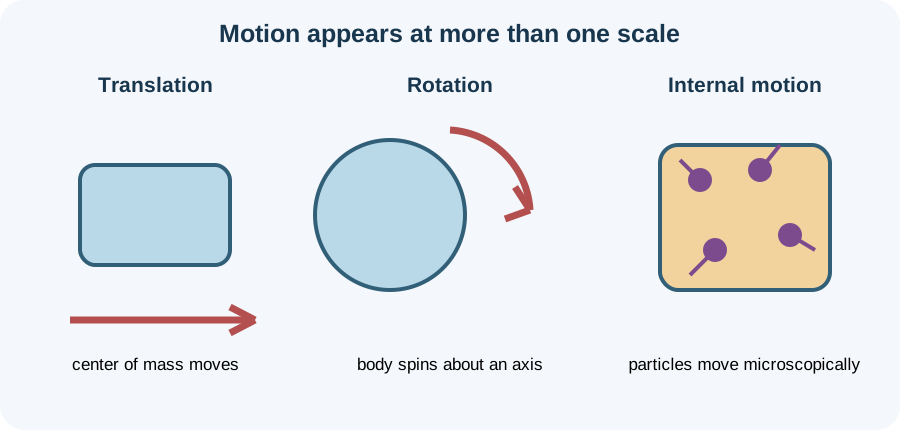
An object has translational kinetic energy when its center of mass moves relative to a chosen reference frame. The center of mass is the mass-weighted average position of the object. Its velocity is written , where bold type indicates a vector. Kinetic energy depends on the corresponding speed, which is the vector’s nonnegative magnitude. Direction influences momentum but does not make kinetic energy negative.
An extended body can also rotate while its center of mass remains fixed. A spinning flywheel, fan blade, or wheel therefore possesses kinetic energy even when it does not travel across the room. Molecules inside matter translate, rotate, and vibrate microscopically. Their disordered kinetic energies contribute to internal energy and temperature rather than appearing as visible bulk motion. The selected system boundary determines which motions are resolved explicitly.
The phrase “energy of motion” is more complete than “energy because an object moves forward.” Translation is only one possible motion. Rotation matters when angular speed and mass distribution are significant. Internal motion matters when heating, deformation, or molecular behavior is part of the question. A useful energy model states which forms are included and which are deliberately neglected. That statement turns omission into a visible approximation rather than a hidden mistake.
Define translational kinetic energy
For a particle of constant mass moving with speed , translational kinetic energy is . The symbol denotes kinetic energy. The subscript “trans” identifies translation rather than rotation. Mass is measured in kilograms, and speed is measured in metres per second. The square applies to the entire speed, not to the velocity unit alone.
The SI units follow directly from the expression. Multiplying kilograms by squared metres per squared seconds gives . This compound unit is called the joule, abbreviated . Therefore . Showing this reduction checks that a calculation truly produces energy.
Because speed is squared, doubling speed multiplies translational kinetic energy by four. Tripling speed multiplies it by nine. Doubling mass at fixed speed only doubles the energy. These scaling differences matter in braking, collision severity, and machine design. A verbal proportionality check can detect arithmetic that contradicts the formula.
Derive the expression from net work
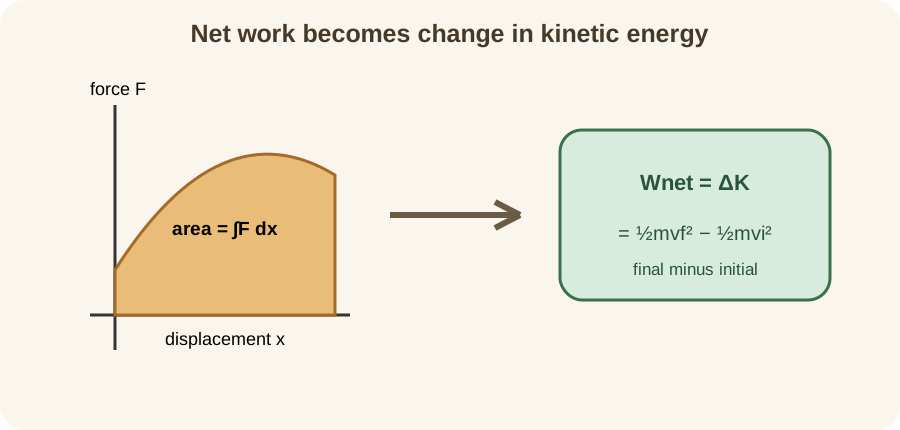
Begin with Newton’s second law in one dimension, . For velocity that depends on position, the chain rule gives . The symbol is acceleration, and is signed velocity during this derivation. Multiplying the net force by a small displacement gives differential work. Integration adds those contributions along the path.
The net work from position to is . Substituting changes the integration variable from position to velocity. The result is . Constant mass can be taken outside the integral. Evaluating gives .
The final expression is a difference of the same state quantity evaluated at two times. Defining that quantity as makes the result compact. Thus . The delta symbol means final value minus initial value. This derivation explains why the factor one-half and the square of speed appear together.
Apply the work–energy theorem
The work–energy theorem states that net work on a particle equals its change in kinetic energy. Positive net work increases kinetic energy, while negative net work decreases it. Zero net work leaves the kinetic energy unchanged. Individual forces can perform positive and negative work that cancel. The theorem concerns the sum of work by all forces included in the particle model.
Suppose a cart speeds up from to . Its initial energy is . Its final energy is . Therefore the net work is . Units appear on every measured value and calculated energy.
One can also solve backward for a speed. If a known net work changes the initial kinetic energy, first compute . Then rearrange to . The positive square root gives speed, while a velocity direction must come from separate motion information. An impossible negative signals inconsistent data or a force model that stops applying before the stated endpoint.
Interpret signs without assigning negative kinetic energy
Classical translational kinetic energy cannot be negative because mass is positive and is nonnegative. A negative velocity still produces positive kinetic energy. For example, velocities and give the same speed and energy. The sign of velocity identifies direction along an axis. Energy records capacity for transfer, not the orientation of motion.
The change can be negative even though cannot. A braking vehicle loses translational kinetic energy as its speed decreases. Friction may transfer that energy into internal energy of brakes, tires, road, and surrounding air. Saying that kinetic energy “disappears” would overlook those receiving stores. An energy account should identify transfer across the chosen system boundary.
Work can also be negative because it is a signed transfer. A force opposite displacement performs negative work on the modeled particle. A force perpendicular to displacement performs zero instantaneous work. Those signs describe how the force changes kinetic energy. They do not imply that the kinetic energy itself carries a direction or negative orientation.
Define rotational kinetic energy from moving particles
A rigid body rotating about a fixed axis can be modeled as many particles. Particle at perpendicular distance from the axis has speed . The symbol is angular speed, measured in radians per second. Its translational kinetic contribution is . Adding every particle gives the body’s total rotational kinetic energy.
The sum becomes . The quantity in parentheses is rotational inertia, defined as for discrete particles. Therefore . Rotational inertia measures how mass is distributed relative to the axis. The same total mass can produce different values when its distribution changes.
The SI unit of is . Angular speed has unit , and the radian is dimensionless in unit analysis. Thus has unit . This confirms that rotational kinetic energy and translational kinetic energy can be added. Their common unit does not mean they arise from identical motion.
Understand the role of rotational inertia
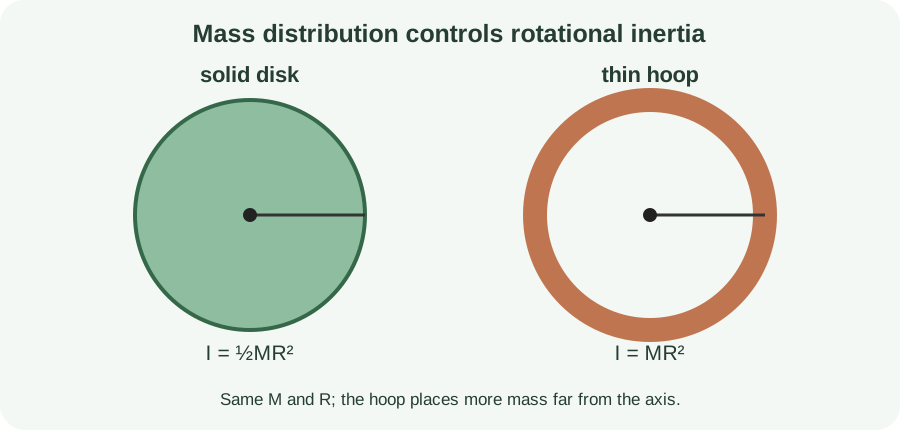
Rotational inertia plays a role analogous to mass in translational kinetic energy. Greater at fixed angular speed produces greater rotational kinetic energy. Moving mass farther from the axis increases because distance is squared. A hoop and solid disk of equal mass and radius therefore store different rotational energies at the same angular speed. Shape enters the energy model through rotational inertia.
For a solid cylinder about its central symmetry axis, . For a thin hoop about the same kind of axis, . Here is total mass and is radius. The hoop’s mass lies farther from the axis on average. Consequently, it has twice the rotational kinetic energy of the cylinder at equal , , and .
The axis must always be specified. Rotating the same object about a different axis generally changes . The parallel-axis theorem relates a center-of-mass axis to a parallel displaced axis. Tables of inertia formulas silently assume particular shapes and axes. Copying a formula without checking those assumptions can create a dimensionally correct but physically wrong result.
Combine translation and rotation for rolling motion
A rolling rigid body has center-of-mass translation and rotation about its center of mass. Its total mechanical kinetic energy is . The first term tracks bulk travel. The second tracks spinning around the center. Both forms exist simultaneously and must be included unless the model explicitly neglects one.
For rolling without slipping, the speeds satisfy . This constraint connects translation and rotation at the contact point. It does not say that the two energy terms are equal. Their ratio depends on and therefore on shape. Static friction can enforce the rolling constraint without necessarily dissipating mechanical energy.
Consider a solid cylinder of mass rolling without slipping at . Its translational energy is , and using gives rotational energy . The total is . Ignoring rotation would undercount the total by , which is one third of the correct value. Radius cancels only because the rolling constraint pairs in with in .
Explain when rotation is neglected
Introductory mechanics often treats an object as a point particle. A point particle has position and mass but no resolved size, orientation, or rotational inertia. Rotation is absent from that model by construction. This simplification can be appropriate when only center-of-mass motion affects the question. It is a modeling choice rather than evidence that physical objects cannot rotate.
Rotation may also be neglected when its energy is demonstrably small relative to other terms. A compact object translating rapidly while spinning slowly can have . The double inequality symbol here means “much less than,” not merely smaller. A numerical scale comparison should support the omission when precision matters. Stating the approximation lets readers judge whether it is reasonable.
Sometimes rotation is omitted because shape or angular-speed information is unavailable. In that case the simplified result is conditional on the particle approximation. A rolling wheel, turbine, flywheel, planet, or spinning projectile often makes rotation central rather than negligible. Problems involving energy conservation can be seriously wrong if a significant rotational term is silently dropped. The decision should follow the physics and desired accuracy, not habit.
Separate kinetic energy from momentum
Linear momentum is , while translational kinetic energy is . Momentum is a vector and retains velocity direction. Kinetic energy is a scalar and depends on speed squared. Momentum has unit , while energy has unit . Their distinct units and mathematical types prevent them from being interchangeable.
Two equal masses moving with equal speeds in opposite directions have total momentum zero. Their kinetic energies are both positive and therefore add. A system can consequently have zero net momentum while containing substantial kinetic energy. Center-of-mass motion and motion relative to the center of mass provide different decompositions. Collision analysis often needs both conservation of momentum and an energy-transfer account.
Momentum is conserved for an isolated system even in an inelastic collision. Mechanical kinetic energy need not be conserved because it can become deformation, thermal energy, sound, or other internal forms. Total energy remains conserved when all transfers and stores are included. The phrase “kinetic energy is lost” means it leaves the resolved mechanical kinetic category. It does not mean energy ceases to exist.
Track systems with multiple moving parts
For multiple particles, total kinetic energy is the sum . The sigma symbol instructs the reader to add one term for every indexed particle . Each velocity must be measured in the same reference frame. Squaring occurs before the terms are summed. Oppositely directed velocities therefore do not cancel in the energy sum.
The total can be decomposed into center-of-mass kinetic energy plus kinetic energy relative to that center. This decomposition separates bulk translation from internal motion. A gas container moving across a laboratory has bulk kinetic energy, while molecules also move randomly inside it. Stopping the container removes the bulk term without necessarily cooling the gas. System definitions decide which level of motion is visible in the account.
For a rigid body, the particle sum reduces to translation of the center of mass plus rotation about the center of mass. For a deformable object, vibration and relative motion may require further terms. No single formula automatically captures every physical scale. The model should be complex enough to answer the question and no more. Energy conservation becomes reliable only after all significant categories are identified.
Use reference frames carefully
Kinetic energy depends on the observer’s inertial reference frame. A passenger seated on a steadily moving train has zero translational kinetic energy relative to the train but nonzero energy relative to the ground. Neither value is intrinsically the one true kinetic energy. Each belongs to a stated frame. Energy changes and work calculations must use one consistent frame.
Suppose a passenger moves at relative to the ground with the train. The ground-frame kinetic energy is . In the train frame, the passenger’s translational speed is approximately . The corresponding translational kinetic energy is approximately . Both calculations are internally consistent with their frames.
Conservation laws remain valid when applied consistently in an inertial frame. Changing frames alters numerical kinetic energies and may alter work assigned to forces. It does not permit mixing initial values from one frame with final values from another. State the frame whenever ambiguity is plausible. This habit becomes especially important in collisions and relative-motion problems.
Diagnose common errors and practice
A common error is using velocity with an unexplained sign inside a scalar energy answer. Another is forgetting to square the speed or its unit. A third is adding translational energy while omitting important rotation. A fourth is treating negative work as negative kinetic energy. Dimensional analysis and an explicit energy-category list catch many of these mistakes.
Practice with a ball moving at . Its translational kinetic energy is . If its speed doubles to , the energy becomes . The speed doubles while the energy quadruples. Explain that result through the exponent before trusting the arithmetic.
Next compare a hoop and solid disk, each with mass and radius , spinning at . Compute each rotational inertia with its appropriate shape formula. Then compute both rotational energies in joules. Predict which is larger before calculating. Finally, explain why equal mass, radius, and angular speed do not guarantee equal energy.
Connect kinetic energy to the accounting framework
Kinetic energy is one store within a larger energy accounting system. Potential energy describes energy associated with configuration, such as gravitational position or spring compression. Internal energy includes microscopic motion and interactions not resolved as bulk mechanical motion. Work and heating describe transfers across a system boundary. Clear categories prevent the same energy from being counted twice.
When friction slows a sliding block, its translational kinetic energy decreases. If the system contains only the block, energy may cross the boundary as work and heating. If the system contains the block and surface, much of the decrease appears as increased internal energy within the system. The physical event is the same, but the bookkeeping changes with the boundary. A complete solution names both the system and energy forms.
You are ready to continue when you can derive and interpret , apply net work as , and attach units throughout. You should identify rotational energy and justify any decision to neglect it. You should distinguish energy from momentum and separate bulk from internal motion. These abilities turn a familiar formula into a defensible physical model. The conservation framework can then organize transfers among kinetic, potential, and internal stores.