
Rotational dynamics predicts how interactions change the angular motion of extended bodies. A force can accelerate a center of mass, produce rotation, or do both. Its rotational effect depends on where and in what direction it acts relative to a chosen axis. Mass alone does not determine the response because mass distribution matters. The central fixed-axis relationship is .
The symbol denotes net external torque about the chosen axis, is moment of inertia about that axis, and is angular acceleration. This equation resembles , but the analogy must be used carefully. Moment of inertia changes when the axis or mass distribution changes. Torque is not simply force with a different unit. The fixed-axis scalar equation is a special case of a broader vector law.
This lesson builds rotational dynamics from geometry and force. It derives torque for a particle, constructs moment of inertia, and applies the torque law to rigid bodies. It then connects rotational work, kinetic energy, angular momentum, and rolling without slipping. Every worked example carries units and states assumptions. The goal is to reason from a physical model rather than match formulas by vocabulary.
Learning objectives and opening comparison
After this lesson, you should calculate torque magnitude and sign. You should compute moment of inertia for point-mass systems and use standard rigid-body results. You should apply under its valid conditions. You should connect angular and tangential variables. You should analyze rolling with both translation and rotation.
Imagine pushing a door near its hinge and then near its outer edge with the same force. The push farther from the hinge produces greater angular acceleration. Now push at the outer edge directly toward the hinge. The door barely rotates because the line of action passes through the axis. Both distance and direction control rotational effect.
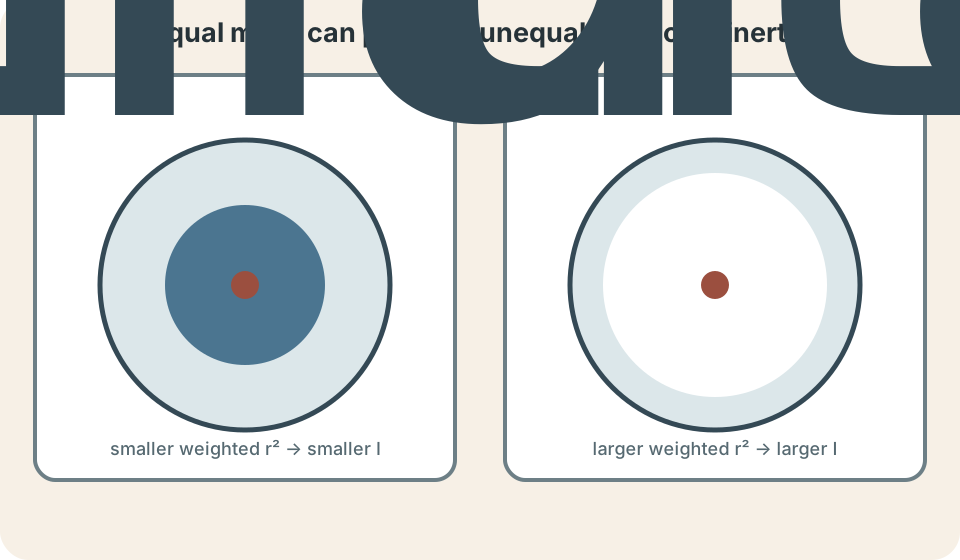
Compare two wheels with equal total mass and radius. One concentrates mass near its hub, while the other concentrates mass near its rim. The rim-heavy wheel is harder to angularly accelerate about the center. Its larger moment of inertia records that distribution. Equal mass does not imply equal rotational response.
Angular kinematics establishes the variables
Angular position is represented by , commonly measured in radians. Angular velocity is . Angular acceleration is . The derivative symbols describe rates with respect to time . Positive direction must be chosen before signs are assigned.
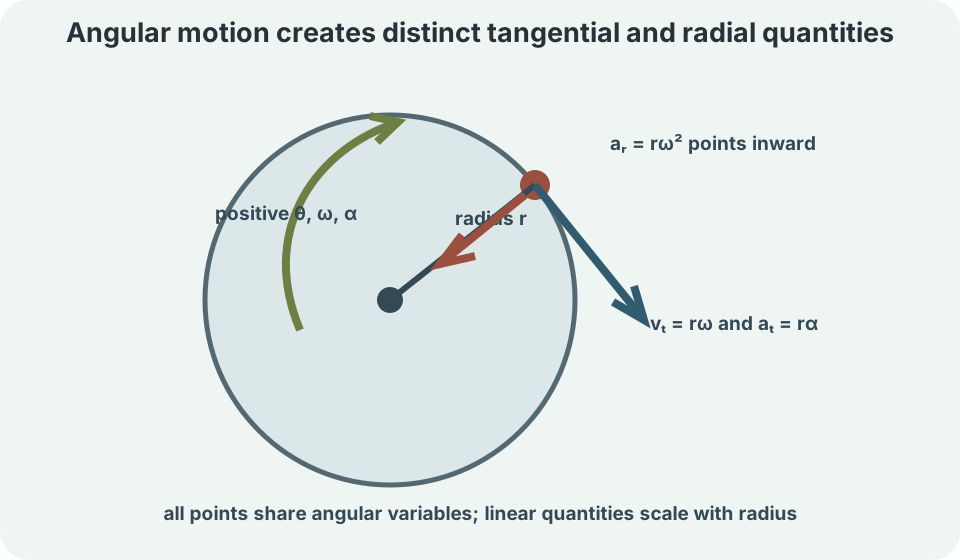
For a rigid body rotating around a fixed axis, every point sweeps the same angular displacement in the same time. Points farther from the axis travel greater arc length because . Differentiating gives tangential speed . Differentiating again gives tangential acceleration . The radius is perpendicular distance from the axis.
Radial acceleration also appears whenever angular velocity is nonzero. Its magnitude is and it points toward the axis. Tangential acceleration changes speed, while radial acceleration changes velocity direction. A point can have while still having inward acceleration. Rotational dynamics must not confuse these components.
Torque measures the rotational effect of force
Torque about an origin is the vector . The vector points from the axis or origin to the point where force acts. The cross product makes torque perpendicular to the plane containing and . Its magnitude is . The angle lies between the two vectors.
The same magnitude can be written , where is the perpendicular lever arm from the axis to the force’s line of action. It can also be written , where is the force component perpendicular to . These forms express the same geometry. Only the perpendicular component produces torque. A radial component changes no angular momentum about that axis.
Torque has SI unit . This unit is dimensionally equal to a joule, but torque and energy are different quantities. Torque is a vector or signed axial quantity connected to angular change. Energy is a scalar. Unit equality does not make physical meanings interchangeable.
Sign convention organizes multiple torques
In planar problems, choose counterclockwise torque as positive or negative and state the choice. A common convention makes counterclockwise positive. Clockwise torque is then negative. The net torque is the algebraic sum of signed contributions. Diagrams should show the chosen axis and force lines.
Suppose a perpendicular force acts from an axis and tends counterclockwise. Its torque is . A second perpendicular force at tending clockwise gives . The net is . Its sign predicts counterclockwise angular acceleration when the fixed-axis model applies.
A force whose line of action crosses the axis has zero lever arm. Its torque is zero even when its magnitude is large. A small force at a long lever arm can exceed a larger force near the axis. Comparing forces alone is insufficient. Compute or reason about torque for each force.
Moment of inertia describes mass distribution
For particles rotating about a fixed axis, moment of inertia is . The index labels each particle, is its mass, and is its perpendicular distance from the axis. The squared distance gives faraway mass strong influence. The SI unit is . Moment of inertia is always tied to a specified axis.
For a continuous body, the sum becomes . The small mass element is integrated through the body. Geometry and density determine how much mass occurs at each distance. A thin hoop about its symmetry axis has . A uniform solid disk about the same type of axis has .
The disk has smaller than the hoop because more of its mass lies inside the outer radius. Both objects can have equal mass and radius . Distribution creates the difference. Rotational inertia is not an additional force. It is the coefficient linking torque to angular acceleration for the specified rotational model.
Derive the fixed-axis torque law
Consider a particle of mass at radius from a fixed axis. Its tangential acceleration is . Newton’s second law along the tangent gives . Multiplying by lever arm gives . The quantity is the particle’s moment of inertia.
For a rigid collection of particles sharing angular acceleration , sum the torques. Internal force pairs cancel appropriately in the ideal rigid-body derivation, leaving net external torque. Then . The parenthesized sum is . Therefore .
This scalar equation assumes rotation about a fixed principal axis and constant mass distribution. General three-dimensional rotation uses . Moment of inertia becomes a tensor rather than one number. Introductory problems deliberately choose geometries where the scalar law is valid. State those restrictions rather than treating the equation as universal.
Worked example: a disk under net torque
A uniform solid disk has mass and radius . About its central symmetry axis, . Substitution gives . The result is . The squared radius supplies square metres.
Suppose the net external torque is . Solve the fixed-axis torque law for angular acceleration. Divide the signed net torque by the moment of inertia. A positive result follows the chosen positive rotation direction. Keep the compound units visible during division. The calculation is shown below.
Radians are dimensionless in SI, but retaining them clarifies angular meaning. The unit reduction follows . One metre cancels from torque against one of the two metres in inertia. Kilograms also cancel. The remaining unit is reciprocal seconds squared, labeled angularly as .
If the disk starts from rest and torque remains constant for , then . The angular displacement is . These kinematic equations require constant angular acceleration. The torque and inertia assumptions provide that condition. Verification should connect dynamics to kinematics.
Axis choice can change inertia and torque
The same object has different moment of inertia about different axes. A disk about its center differs from the same disk rotating about a tangent line. The parallel-axis theorem states . Here is inertia about a parallel axis through the center of mass, is total mass, and is distance between axes. The theorem requires parallel axes.
Moving the axis also changes lever arms of external forces. Both sides of must refer to the same axis. Combining torque about one point with inertia about another is invalid. Choose the axis before calculating either quantity. A good axis can eliminate unknown-force torques.
For a physical pendulum pivoted away from its center of mass, gravity creates torque about the pivot. The relevant inertia is about that pivot, not automatically about the center of mass. The parallel-axis theorem can provide it. The pivot force has zero torque about the pivot because its lever arm is zero. Strategic axis selection simplifies the equation.
Rotational work and kinetic energy
For a torque acting through angular displacement, differential work is for aligned signed quantities. Constant torque gives . The angle must be in radians for direct use. Work has unit joules. Torque’s unit gains scalar energy meaning only after multiplication by angular displacement.
Rotational kinetic energy is . The formula follows by summing with . Substitution produces . The sum is . Every point shares for a rigid body, though their speeds differ.
The rotational work–energy theorem is for fixed-axis rotation under the stated model. It can solve for speed without time. The torque law can solve for angular acceleration and then time evolution. Both descriptions are consistent. Choose the one aligned with known and requested quantities.
Angular momentum connects torque to change
For a rigid body rotating about a fixed symmetry axis, angular momentum is . The unit is . Net external torque satisfies . If is constant, this becomes . The fixed-axis torque law is therefore a special case.
If net external torque is zero, angular momentum remains constant. A person pulling mass inward while spinning decreases and increases . No external torque is required for that redistribution-driven change in angular speed. Rotational kinetic energy need not remain constant because internal work can change it. Conservation laws must be named separately.
Angular impulse is . A brief large torque and a longer small torque can produce the same angular-momentum change. The area under a torque–time graph equals angular impulse. This mirrors linear impulse . The analogy helps only when vector directions and axes remain clear.
Rolling without slipping combines two motions
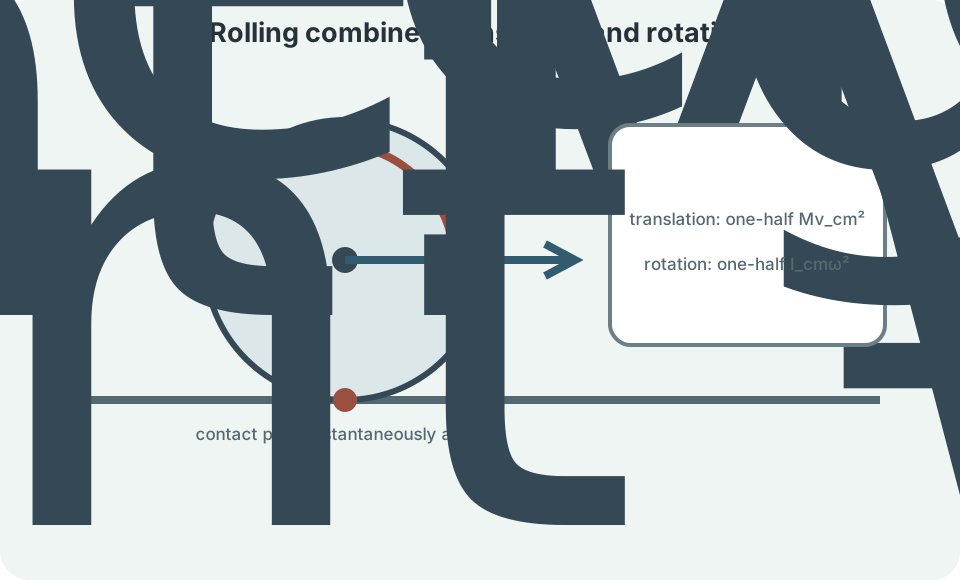
A rolling rigid body translates through center-of-mass motion and rotates about its center. Its total kinetic energy is . The first term is translational, and the second is rotational. Both must be included. Omitting either undercounts energy.
For rolling without slipping on a stationary surface, . Under suitable conditions, tangential accelerations satisfy . These are constraints, not additional force laws. They state that the instantaneous contact point has zero relative speed. They fail when sliding occurs.
Static friction often creates the torque needed to roll. Static friction does not necessarily dissipate mechanical energy because the contact point can be instantaneously at rest. Its direction depends on the tendency to slip, not simply on the direction of center-of-mass motion. Draw forces and infer impending relative motion. Do not memorize one friction direction for every rolling problem.
Worked example: rolling down an incline
Consider a rigid body of mass and radius rolling from rest through vertical drop . Assume no slipping and negligible dissipative losses. Conservation of mechanical energy gives . Use . The gravitational energy divides between translation and rotation.
Write , where dimensionless describes mass distribution. Substitution gives . Solving gives . Mass and radius cancel in this ideal model. Shape enters through .
For a hoop, , while for a solid disk, . The disk reaches greater speed because less energy is tied to rotation for the same . Both speeds remain below the sliding point-mass value . The comparison assumes equal starting height and no loss. It demonstrates how inertia affects motion even when total masses match.
Static equilibrium is the zero-acceleration case
An object in static equilibrium requires and . Zero net force prevents translational acceleration. Zero net torque prevents angular acceleration. Satisfying only one condition is insufficient for an extended body. The torque equation can be taken about any point when full equilibrium holds.
A ladder against a wall can have zero net force but nonzero net torque if forces are arranged incorrectly. Conversely, a force couple can produce zero net force and nonzero torque. Force balance and torque balance encode different conditions. Free-body diagrams should include application points. Geometry is essential.
Choosing a torque origin at an unknown reaction force can remove that force from the torque equation. After solving another unknown, return to force balance. This is a calculation strategy, not a claim that the omitted force vanishes. Its torque about the selected point vanishes. Clear language prevents strategic simplification from becoming physical confusion.
Common mistakes and repairs
One mistake is using full radius when the force is not perpendicular. Replace with or use the perpendicular lever arm. Draw the line of action. If it crosses the axis, torque is zero. Geometry comes before arithmetic.
Another mistake is selecting a moment-of-inertia formula without naming the axis. Write the body, axis, and mass distribution beside . Use the parallel-axis theorem only for parallel axes. Do not add when the quoted formula already uses the desired axis. Check unit .
A third mistake is writing for an arbitrary three-dimensional situation. Confirm a fixed axis and rigid body with suitable scalar dynamics. For changing inertia, start from . For rolling, include translation and the no-slip constraint. The model statement determines the equation.
A reliable rotational-dynamics workflow
First define the system, axis, and positive direction. Draw every external force at its point of application. Determine perpendicular lever arms and torque signs. Choose the correct moment of inertia about the same axis. State whether the body is rigid and whether the axis is fixed.
Second select the governing relationship. Use for fixed-axis angular acceleration. Use work–energy when angular displacement and speed matter more than time. Use angular impulse or conservation when torque history or isolation matters. Use translation plus rotation for rolling.
Third solve with units and verify. Check that torque units reduce with inertia to . Test limiting cases such as force through the axis or mass approaching the axis. Confirm signs against the diagram. Explain what the result predicts physically.
Retrieval practice and synthesis
Without looking back, explain why doubling every particle’s distance from an axis multiplies by four. Then explain why angular acceleration falls by a factor of four under the same net torque. State which assumptions keep constant. Give the correct SI units. Connect the algebra to the rim-heavy wheel comparison.
Calculate the angular acceleration of a body with under net torque . The result is . Explain how newton metres divided by kilogram metres squared produces reciprocal seconds squared. State the sign based on torque direction. Predict the change if the same torque acts about an axis with twice the inertia.
Compare a sliding point mass, rolling hoop, and rolling disk descending the same vertical height without dissipative loss. Use energy partitions rather than memorized finish order. Explain why the distribution coefficient changes speed. Identify the constraint required for rolling. State why static friction can matter without necessarily reducing total mechanical energy.