
Angular momentum measures rotational motion relative to a chosen point or axis. It belongs to a family of accounting ideas that connect a system’s state to the external interactions that can change it. Linear momentum changes through net external force, while angular momentum changes through net external torque. The analogy is powerful, but angular momentum includes geometry that linear momentum does not. Learning to choose the origin, system, and direction correctly is therefore more important than memorizing a single formula.
Learning objectives
By the end of this lesson, you should be able to calculate the angular momentum of a moving particle about a specified origin. You should be able to interpret the vector cross product rather than treating it as a mysterious multiplication symbol. You should also calculate angular momentum for a rigid body rotating about an appropriate fixed axis. In every calculation, you should identify the units, sign, reference point, and physical meaning of the result. These habits distinguish a defensible solution from an unsupported substitution.
You will connect net external torque with the rate of change of angular momentum. You will use angular impulse to analyze changes occurring over a time interval. You will apply conservation only after selecting a system and verifying that the relevant external torque is zero or negligible. You will also explain why angular momentum conservation does not automatically conserve rotational kinetic energy. Several examples will develop these ideas through prediction, calculation, and reflection.
Keep one question active throughout the lesson: angular momentum about what point? A particle can have nonzero angular momentum about one origin and zero angular momentum about another. The same dependence appears in torque, so both sides of the angular-momentum principle must use the same origin. In fixed-axis rigid-body problems, the axis often supplies that reference naturally. In orbital and collision problems, choosing the origin strategically can turn a difficult calculation into a transparent one.
Begin with linear momentum and geometry
Linear momentum is the vector . The bold symbol indicates that momentum has both magnitude and direction. Its magnitude is mass in kilograms multiplied by speed in meters per second. The resulting unit is kilogram-meters per second. Linear momentum describes translational motion without reference to an origin.
Angular momentum adds the position vector measured from a chosen origin to the particle. This vector encodes the particle’s location relative to that reference. Changing the origin changes even when the particle itself does not move. Geometry therefore enters before any rotational calculation begins. The position and momentum vectors must be drawn from a shared event. For a particle, the definition is
The bold symbol is angular momentum, and the cross indicates a vector cross product. The direction of is perpendicular to the plane containing and . Its magnitude depends on the angle between those vectors. Parallel vectors yield zero, while perpendicular vectors yield the largest magnitude for fixed and . These geometric facts will guide every later calculation.
The magnitude of the cross product is . Here is the distance from the origin to the particle, is linear-momentum magnitude, and is the smaller angle between their directions. The factor retains only the part of momentum perpendicular to the position vector. Consequently a particle moving directly toward or away from the origin has zero angular momentum about that origin. A particle moving across the observer’s line of sight can have substantial angular momentum even if it is not traveling on a circle.
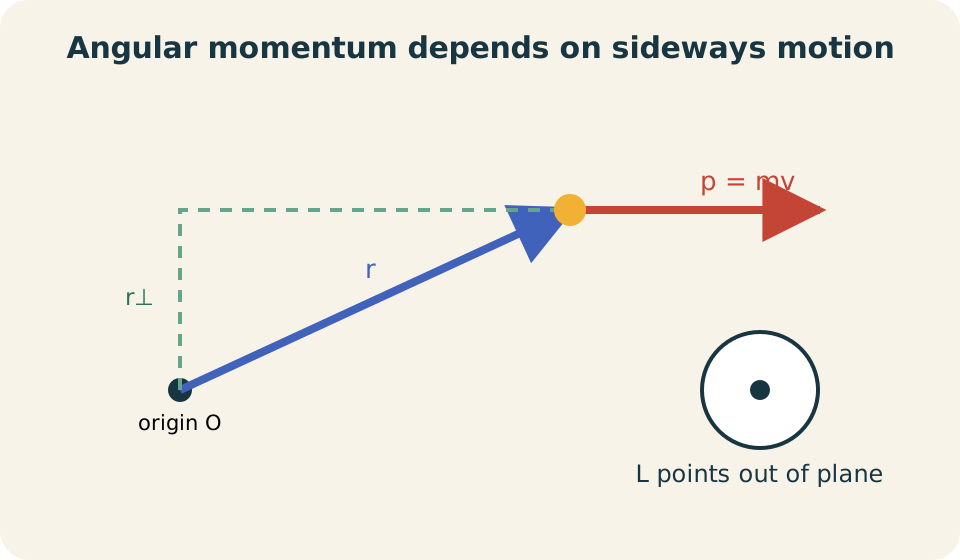
Three equivalent ways to read the magnitude
The formula can be reorganized as . The symbol is the component of momentum perpendicular to . This form emphasizes that radial motion contributes nothing to angular momentum. Only sideways motion relative to the origin contributes. It is especially useful when velocity components are already known.
The same magnitude can be written . The quantity is the perpendicular distance from the origin to the straight line along which the particle moves. This distance is often called the moment arm or impact parameter. It remains easy to identify for a particle passing an observer along a straight path. The formula shows that a more distant parallel path carries more angular momentum about the observer.
Substituting produces . Every version has units because one meter comes from position and another from velocity. The unit can also be written when discussing angular impulse. These equivalent forms are not separate laws to memorize. They are different geometric readings of the same cross product.
Direction and the right-hand rule
Angular momentum is an axial vector, so its direction represents an oriented plane of rotation. Point the fingers of your right hand along and curl them toward through the smaller angle. Your thumb points in the direction of . In a flat page, counterclockwise angular momentum points out of the page and clockwise angular momentum points into it. A consistent sign convention may represent those directions as positive and negative.
The order of the cross product matters. Reversing the factors changes the direction because . The magnitude remains the same, but the sign or vector direction reverses. This is why the definition must be written in its proper order. Cross products do not obey the ordinary commutative rule of scalar multiplication.
A useful two-dimensional shortcut computes . The subscripts identify Cartesian components, and names the direction perpendicular to the plane. A positive result points in the positive direction, usually out of the page. A negative result points into the page. This component formula is convenient, but the vector diagram should still guide the expected sign.
Origin choice changes particle angular momentum
Imagine a ball traveling east in a straight line. About a point located directly on its path, the moment arm is zero, so its angular momentum is zero. About a point north of the path, the moment arm is nonzero and the angular momentum points in one perpendicular direction. About a point south of the path, its magnitude can be the same while its direction reverses. The particle’s mass and velocity did not change, but the reference geometry did.
This dependence does not make angular momentum arbitrary or unphysical. It means that angular momentum answers a relational question about motion around a specified reference. Torque has the same origin dependence through . When applying , both quantities must be evaluated about the same origin. Switching origins midway invalidates the accounting equation.
Some origins are strategically better than others. A pivot eliminates the torque of an unknown pivot force because its moment arm about the pivot is zero. The center of mass can simplify a rigid body’s translation and rotation into separate contributions. The center of a central force makes that force’s torque vanish. A good solution states the origin before drawing position vectors or calculating torque.
Worked particle example
A puck moves east at along a line north of an origin. Its linear-momentum magnitude is . The perpendicular distance from the origin to the path is . Therefore . Units accompany each factor so the result can be checked directly.
Use the right-hand rule to determine direction. The position component from the origin to the path points north, while momentum points east. North crossed with east points into the page. If out of the page is defined as positive, the signed result is . The negative sign records direction rather than a negative amount of motion.
Suppose the same puck crosses directly over the origin while keeping its eastward velocity. At that instant, and are parallel, so . Its angular momentum about the origin is then zero. Its linear momentum remains , showing that linear and angular momentum answer different questions. The example also demonstrates why a drawing should precede arithmetic.
Rigid bodies about a fixed axis
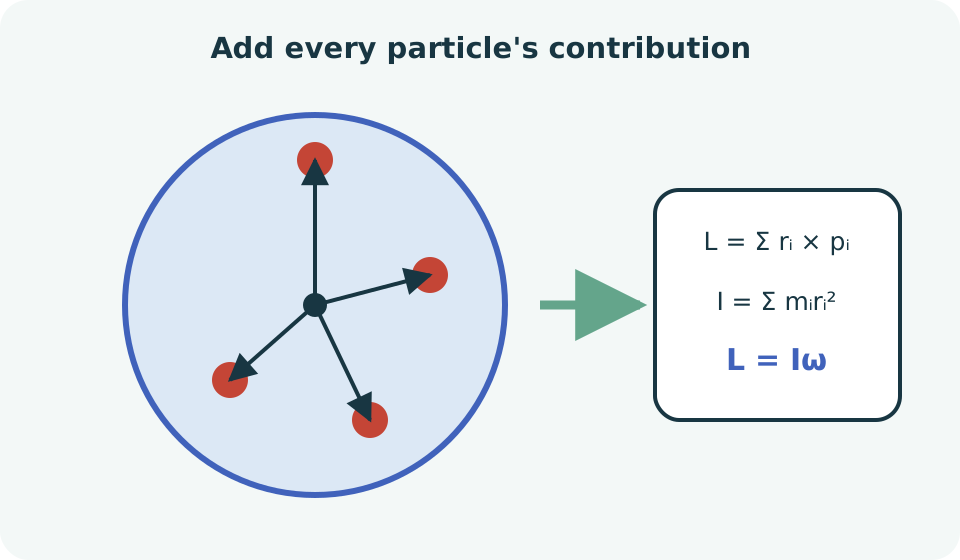
A rigid body contains many particles, and its total angular momentum is the vector sum . The subscript labels each particle in the model. For rotation about a fixed principal axis, this sum reduces to the scalar relation . The quantity is rotational inertia in kilogram-meters squared, and is angular velocity in radians per second. Their product has the required unit of kilogram-meters squared per second.
Rotational inertia depends on how mass is distributed relative to the axis. A small mass far from the axis can contribute more than a larger mass near it because each contribution contains the squared perpendicular distance. Moving mass inward decreases , while moving it outward increases . The axis must therefore be stated whenever a value of is quoted. Rotational inertia is not an intrinsic scalar independent of geometry.
The relation is safe for a rigid body rotating about a fixed principal axis. In general three-dimensional motion, angular momentum need not point in the same direction as angular velocity. The full relation involves the inertia tensor rather than a single number. Introductory problems often choose symmetry axes precisely so the simpler scalar relation applies. Recognizing the condition prevents the formula from being overgeneralized.
Torque changes angular momentum
Net external torque is the time rate of change of angular momentum. Torque is calculated about a selected origin or axis. Angular momentum must be calculated about that same reference. The word net means that individual torque vectors are added with their directions. Internal torques redistribute angular momentum without entering this external sum. The subscript external limits the sum to interactions crossing the chosen system boundary:
The summation symbol indicates vector addition of all torques exerted by objects outside the selected system. The derivative describes how both magnitude and direction of can change. A torque perpendicular to may turn the vector without greatly changing its magnitude. A torque parallel to changes its magnitude without turning it. The equation therefore contains more directional information than a scalar speed equation.
For fixed-axis rotation with constant , the principle becomes . The symbol is angular acceleration in radians per second squared. This familiar rotational form is therefore a special case of the more general momentum principle. If changes, differentiating gives . Ignoring the second term would miss changes caused by redistribution of mass.
Internal torques can change how angular momentum is distributed among parts of a system. They cannot change the total angular momentum of an isolated system because internal interaction pairs cancel in the total accounting under ordinary assumptions. External torque determines change in the system total. This distinction makes the system boundary essential. A torque can be internal for one chosen system and external for a smaller one.
Angular impulse
Integrating the torque principle over time connects accumulated torque with a finite change in angular momentum. The initial time is labeled , and the final time is labeled . Each short time interval contributes a small angular impulse. Contributions with opposite directions subtract when the integral is evaluated. The integral retains changes in torque throughout the interval. The resulting angular-impulse principle is
The left side is final angular momentum minus initial angular momentum. The integral on the right is angular impulse. Its unit is equivalent to . The two sides therefore describe the same physical change. Keeping vector signs allows impulses in opposite directions to cancel correctly.
If net torque is approximately constant, angular impulse becomes . A modest torque acting for a long time can produce the same angular-momentum change as a large torque acting briefly. A graph of torque versus time represents impulse as signed area under the curve. Positive and negative areas can partially cancel. Peak torque alone is not enough to determine the final angular momentum.
Angular impulse is especially useful in impacts where force and torque vary rapidly. A bat striking a ball away from its center can impart both linear and angular momentum. A door closer applies torque over time to reduce the door’s angular momentum. A figure skater pushing against the ice receives angular impulse from an external frictional force. Each example should be analyzed with a stated system and reference axis.
Conservation requires a system and torque test
If net external torque about the chosen origin is zero, then . The total angular momentum about that origin is constant. This statement is the angular-momentum conservation law. It does not say that every object within the system keeps its own angular momentum. Internal interactions may transfer angular momentum between system parts while preserving the total.
The phrase external torque cannot be omitted. A force can be external yet produce zero torque about the chosen origin if its line of action passes through that origin. Conversely, a small external force can produce meaningful torque if its moment arm is large. Zero net force does not automatically imply zero net torque. The conservation test must examine torque directly.
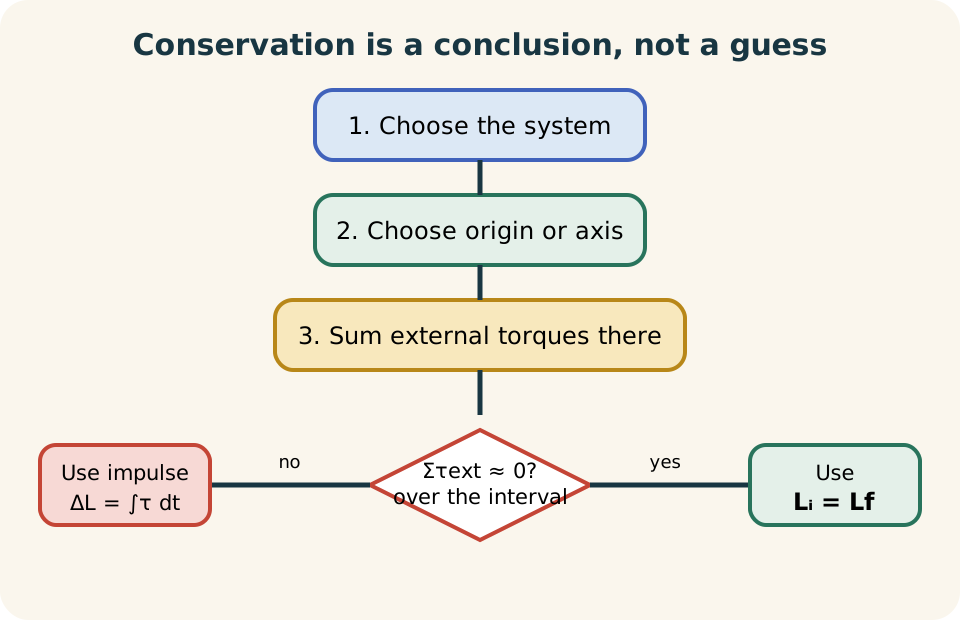
The diagram below organizes a reliable conservation decision. First choose the system, then choose the origin or axis. Next classify interactions and calculate or estimate their external torques about that same reference. Only if their vector sum is zero or negligible should initial and final angular momentum be equated. This sequence prevents conservation from becoming an unsupported slogan.
Pulling mass inward
Consider a rotating student who holds masses with an initial rotational inertia and angular speed . Pulling the masses inward reduces inertia to . If external torque about the vertical axis is negligible, . Solving gives . The increased angular speed compensates for the decreased rotational inertia.
The initial rotational kinetic energy is . The final rotational kinetic energy is . Angular momentum is conserved, yet kinetic energy increases by . The student does internal work while pulling the masses inward. Chemical energy is transferred into rotational kinetic energy.
This example separates two conservation laws that students often merge incorrectly. Angular momentum conservation follows from negligible external torque. Kinetic-energy conservation would require an additional condition that is not satisfied during the active pull. The student’s forces are internal to the selected student-plus-masses system, so they redistribute mass and energy without changing total angular momentum. Conserved angular momentum does not fix kinetic energy when rotational inertia changes.
Collisions and shared angular momentum
Suppose a small lump of clay strikes and sticks to the edge of a stationary turntable. During the short collision, the axle force may be large but its torque about the axle is zero because its moment arm is zero. External frictional torque may also be negligible over the brief time interval. Angular momentum about the axle can then be conserved through the collision. Linear momentum of the clay-turntable system need not be conserved because the axle exerts an external force.
If the clay approaches tangentially, its initial angular momentum magnitude is . After sticking, the combined rotational inertia is . Conservation gives . Every length must be measured from the same axle used for torque and angular momentum. The final angular speed follows only after the new inertia includes the attached clay.
The collision is inelastic, so rotational kinetic energy generally decreases. Some organized kinetic energy becomes internal energy, sound, and deformation. This loss does not contradict angular-momentum conservation because the two quantities obey different accounting conditions. The example also shows why choosing the axle as origin is strategic. About another point, the unknown axle force could exert a nonzero external torque during the impact.
Central forces and orbital motion
A central force points directly toward or away from a fixed center. For gravity around an ideal central body, is parallel or antiparallel to . The torque about the center is because the sine of the angle is zero. Angular momentum about the center is therefore conserved. This conclusion holds even though the gravitational force and acceleration are not zero.
For a planet or satellite treated as a particle, conserved magnitude can be written . When the object is nearer the center, the perpendicular component of velocity must generally be larger. When it is farther away, that component can be smaller. This relationship helps explain changing orbital speed in an elliptical orbit. It does not by itself determine the entire orbit because energy and geometry also matter.
Conservation also gives a geometric result. In a short time interval, the radius vector sweeps an approximate triangular area . Since is constant, the area-sweep rate is . Equal areas are swept in equal times. Kepler’s area law is thus an angular-momentum statement for central-force motion.
Common reasoning failures
The first common error is using for every moving object. A particle traveling along a line is more naturally analyzed with . The rigid-body formula requires an appropriate axis and rotational inertia. Treating a particle as if it were automatically a rigid rotor hides the origin dependence. Choose the form that matches the physical model.
The second error is announcing conservation without checking external torque. A frictionless surface may remove some forces, but it does not guarantee zero torque about every origin. A force through the chosen origin has zero moment arm, while the same force can have nonzero torque about another point. State the system, origin, interval, and torque estimate explicitly. Conservation is the conclusion of that argument, not its starting assumption.
The third error is dropping vector direction or units. Angular momentum into the page and out of the page can cancel, so unsigned magnitudes may give the wrong total. The unit must include two powers of length. A result in is linear momentum rather than angular momentum. Direction and dimensional analysis provide independent checks on arithmetic.
Practice and retrieval
A ball moves at along a line whose perpendicular distance from an origin is . Calculate the angular-momentum magnitude with units. Draw the position and momentum vectors at one point on the path. Use a right-hand rule to identify direction. Then explain what changes if the origin is moved onto the path.
A wheel has and initially rotates at . A constant opposing torque of magnitude acts for . Calculate the initial angular momentum and angular impulse. Determine the signed final angular momentum. Decide whether the wheel has stopped or reversed during the interval.
Finally, explain the rotating-student example without equations. Name the selected system and identify why external torque is negligible. Describe how changing mass distribution affects rotational inertia and angular speed. Identify the source of the increased kinetic energy. This verbal reconstruction tests whether the mathematics is connected to a causal model.
Solutions and reasoning
The ball has . Its direction depends on which side of the origin the path occupies and which way the ball moves. The right-hand rule determines the appropriate perpendicular direction. Moving the origin onto the line of travel makes . Angular momentum about that new origin becomes zero even though linear momentum is unchanged.
The wheel initially has . Taking its original rotation as positive, angular impulse is . The final value is . It remains positive, so the wheel has slowed but has not reversed. With constant inertia, its final angular speed is .
For the rotating student, the system includes the student and held masses. The support exerts negligible torque about the vertical rotation axis during the short motion. Pulling inward decreases rotational inertia, so angular speed rises to keep constant. Muscles do work while moving the masses inward. Chemical energy becomes additional rotational kinetic energy even as angular momentum remains fixed.
Connection forward
Angular momentum connects rotational dynamics, collisions, orbits, and wave-like rotational motion. In gravitation, a central force conserves orbital angular momentum and constrains how speed varies with distance. In rigid-body dynamics, torque redirects or changes angular momentum and can produce precession. In microscopic physics, angular momentum also appears in quantized forms that require new rules. The foundational system-and-origin reasoning developed here remains valuable across those settings.
The next step is to combine angular momentum with energy. Energy can determine allowable speeds and distances, while angular momentum constrains transverse motion. Together they provide a powerful description of orbital and collision problems. Neither law replaces the other because each responds to different external interactions. Choosing both accounts carefully often reveals information that either account alone cannot provide.
Carry forward a compact checklist. Name the system, choose the origin, draw , identify perpendicular components, and determine direction. Calculate external torque about the same origin before claiming conservation. Keep angular momentum distinct from angular speed and kinetic energy. When those habits become automatic, angular momentum becomes a coherent physical accounting tool rather than a collection of rotational formulas.