
Gravity is familiar as the downward pull that gives objects weight, yet that local experience is only one expression of a universal interaction. Newton’s model describes the attraction of falling objects, planets, moons, stars, and galaxies with the same mathematical structure. The model connects force, field, energy, and orbit while showing exactly when the near-Earth approximation is useful. Its inverse-square dependence also develops reasoning habits that recur throughout physics. This lesson emphasizes those connections so that orbital equations emerge from principles instead of becoming disconnected formulas.
Build the universal force law
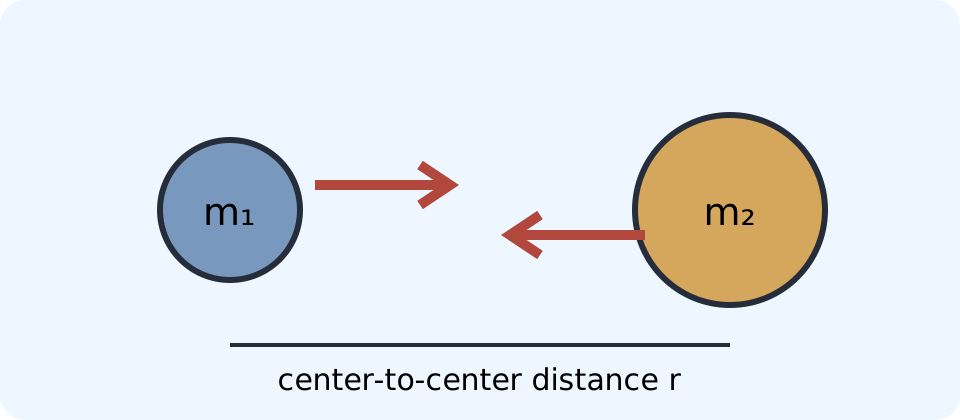
Every pair of masses attracts one another in Newtonian gravitation. For point masses and separated by center-to-center distance , the force magnitude is . The symbol denotes gravitational-force magnitude, and the subscript reminds us which interaction is being calculated. The universal gravitational constant is . The small numerical value helps explain why gravitational attraction between ordinary laboratory objects is difficult to notice.
The force is directed along the line joining the two centers. Each mass pulls the other, so the forces form a Newton’s-third-law pair with equal magnitude and opposite direction. The force on is exerted by , while the force on is exerted by . These forces do not cancel on either individual object because they act on different objects. They cancel only when considering the internal-force sum for the two-object system as a whole.
The point-mass equation also applies outside a spherically symmetric mass distribution as though all its mass were concentrated at its center. This shell-theorem result permits Earth, planets, and many stars to be modeled as point sources for exterior calculations. The distance must therefore be measured between centers, not between surfaces. For an object at altitude above a spherical planet of radius , the correct separation is . Confusing altitude with center-to-center distance is one of the most consequential errors in gravitation problems.
Reason with the inverse-square relationship
The factor means that gravitational force weakens with the square of separation. If distance doubles while masses remain fixed, force becomes of its original value. If distance triples, force becomes as large. If distance is halved, force becomes four times as large. Ratio reasoning reaches these conclusions without repeatedly inserting and the masses.
For two situations involving the same masses, division gives . The subscripts label the first and second configurations, not mathematical powers. This ratio form automatically cancels constants and shared masses. It is especially effective for altitude comparisons and uncertainty estimates. Before calculating a decimal, predict whether the new force should be greater or smaller so that an inverted ratio is easier to catch.
The inverse-square pattern has a geometric interpretation. The influence from a point source spreads over spherical surfaces whose area is . As radius grows, the same source is distributed over an area proportional to . This picture supports the distance dependence, although Newton’s equation remains the quantitative rule. Similar geometry later appears in electric fields and radiation intensity.
Distinguish gravitational field from force
A source mass changes the gravitational conditions in the space around it. Gravitational field at a point is defined as force per unit test mass, . Bold type marks both field and force as vectors. The test mass is imagined small enough not to alter the source configuration. Dividing the source-to-test force by gives the field of a spherical source as directed inward.
Field has units , which are equivalent to . The equivalence follows from , so dividing by kilograms leaves acceleration units. A test mass in a gravitational field experiences and therefore acceleration when gravity is the only force. This cancellation explains why objects of different mass share the same ideal free-fall acceleration. It does not mean their gravitational forces are equal, because the heavier object experiences proportionally greater force.
Fields from multiple sources obey vector superposition. The total field is , where the capital sigma means to add the field vector from every indexed source. Contributions can reinforce, oppose, or combine at angles. A point between two unequal masses can have zero net field when the opposing contributions have equal magnitude. That balance point lies closer to the smaller mass because one must approach the weaker source to make its field competitive.
Recover the near-Earth model
At Earth’s surface, the universal expression becomes . Here is Earth’s mass, is its mean radius, and the subscript zero labels the surface value. Inserting accepted values gives approximately . Over height changes that are tiny compared with , both distance and field strength change very little. The constant- model is therefore a local approximation rather than a separate law.
At altitude , field magnitude is . Dividing by the surface expression gives . At altitude , the center-to-center distance is , so when . Gravity is reduced but certainly not absent. The ratio calculation makes the origin of the one-fourth factor transparent.
The measured value of also varies slightly with latitude, altitude, rotation, and local geology. Introductory problems often neglect these variations to isolate the central model. A careful solution states the chosen approximation, such as uniform near Earth’s surface or spherical symmetry at larger distances. Model choice is not a weakness when its conditions are explicit. Physics progresses by selecting the simplest model that retains the effects relevant to the question.
Use gravitational potential energy
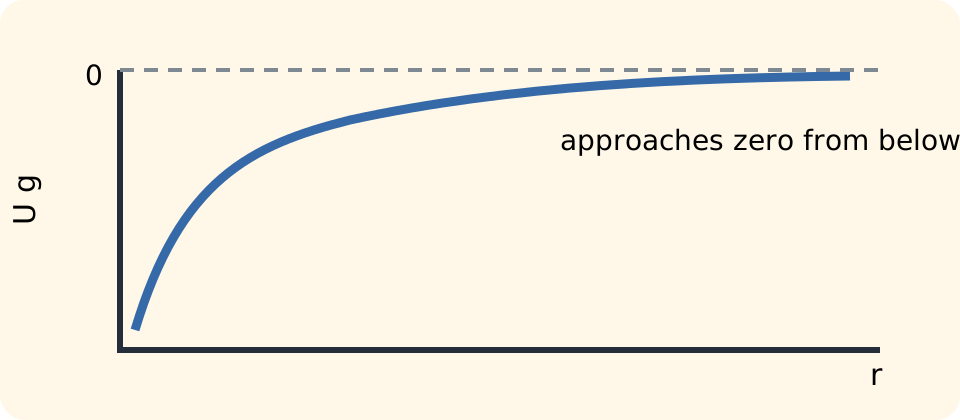
Gravitational force is conservative in the Newtonian model, so changes in potential energy do not depend on the path between endpoints. Choosing zero potential energy at infinite separation gives . The symbol denotes gravitational potential energy of the two-mass system, not energy stored in either mass alone. Its unit is the joule, where . The negative sign is a consequence of the chosen zero and the attractive nature of gravity.
At any finite separation, is negative because energy must be supplied to separate a bound pair completely. Moving masses farther apart raises toward zero, while bringing them closer lowers to a more negative value. A negative potential energy is not “less than no energy” in an absolute sense because potential-energy zeros are conventional. Only differences such as directly enter energy accounting. The infinity reference is valuable because it makes escape and binding questions especially clear.
Near Earth’s surface, the universal energy change reduces to . This approximation follows because the field is nearly constant over a small vertical displacement . The coordinate increases upward, so lifting an object gives positive . For distances comparable with Earth’s radius, one must instead use at both endpoints. The local and universal equations agree within the domain where the local approximation is valid.
Derive circular-orbit speed and period
For a small satellite in a circular orbit around a much larger spherical body, gravity supplies the entire inward net force. Equating gravitational force and the radial requirement gives . The mass belongs to the central body, belongs to the satellite, is orbital speed, and is orbital radius from the central center. Canceling and one factor of gives . The satellite’s mass does not affect ideal circular-orbit speed.
The equation predicts that circular-orbit speed decreases as orbital radius increases. This can feel surprising because higher objects possess more gravitational potential energy, yet the force needed for a broad slow circle is smaller. Combining speed with yields . Squaring produces , a Newtonian form of Kepler’s third law. For objects orbiting the same central mass, the ratio is constant.
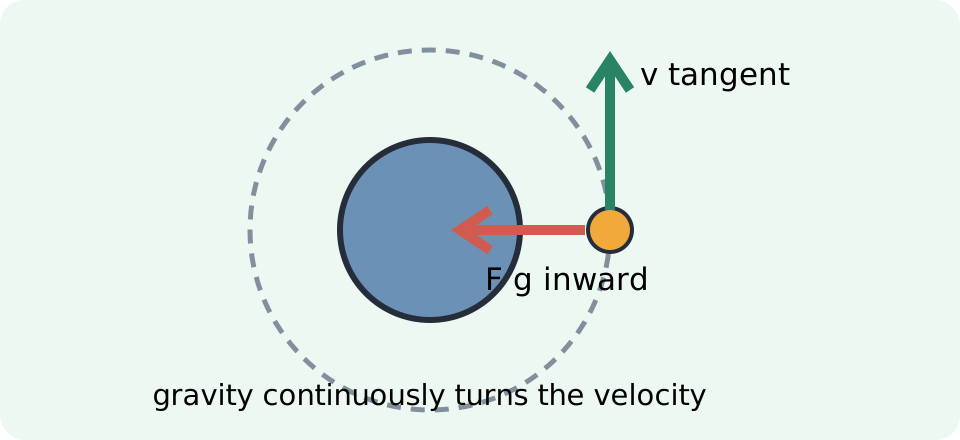
An orbiting satellite is continuously falling. Its tangent velocity carries it sideways while gravity bends its path inward by precisely the amount required for the surface of its circular path to curve away. Astronauts feel apparent weightlessness because astronaut and spacecraft share this free-fall acceleration, leaving little supporting normal force between them. Gravity at low orbit remains a substantial fraction of its surface strength. Small tidal differences and disturbances prevent the environment from being perfectly weightless. “Microgravity” describes the residual apparent-weight environment more accurately than “zero gravity.”
Connect orbital energy and escape
The kinetic energy of a circularly orbiting satellite is . Substituting gives . Its potential energy is . The total mechanical energy is therefore . A negative total indicates a gravitationally bound orbit under the infinity-zero convention.
Escape requires enough total energy for the object to reach infinite separation with nonnegative remaining kinetic energy. Setting the threshold total energy to zero gives . Solving yields . At the same starting radius, this is times circular-orbit speed. Satellite mass again cancels because both kinetic and gravitational potential energies are proportional to it.
Escape speed is not the speed required to keep an engine firing all the way outward. It is the ideal instantaneous launch speed for unpowered motion with no atmosphere, no rotation, and no other bodies. Real missions use propulsion over time and exploit orbital transfers, atmospheric considerations, and planetary motion. The ideal equation still provides an essential energy scale. Its assumptions should accompany any numerical interpretation.
Solve multi-stage gravitation problems
Begin by identifying the system and deciding whether the question concerns force, field, acceleration, energy, or orbital motion. Sketch centers and label center-to-center distances before choosing an equation. If several sources are present, establish a coordinate direction and add vectors rather than magnitudes. If the situation stays near one planetary surface, decide whether constant is accurate enough. This classification step prevents equations with similar symbols from being mixed indiscriminately.
Carry units through every numerical substitution. In , the units become . In , one kilogram cancels less, leaving . Energy expressions must reduce to joules. Unit cancellation will not prove that a physical model is appropriate, but it will expose many algebraic substitutions and missing powers.
Finish by testing proportionality and limiting behavior. Greater source mass should strengthen field and force, while greater distance should weaken them. Circular-orbit speed should fall with radius, whereas period should rise. Potential energy should approach zero from below as becomes very large. A result that violates these trends deserves investigation even if a calculator produced it cleanly.
Repair common misconceptions
The first misconception is that orbit occurs because gravity has become negligible. Gravity is actually the inward force sustaining orbital curvature. Without gravity, an orbiting body would move along a tangent line according to Newton’s first law. Apparent weightlessness reflects shared free fall and reduced support force, not absent gravitational field. Separating gravitational force from apparent weight resolves this language problem.
The second misconception is that heavier objects fall faster because gravity pulls harder on them. A heavier object does experience a larger force , but it also has proportionally greater inertia. Dividing by mass in gives the same gravitational acceleration when resistance and other effects are neglected. Air drag can create mass-dependent observed motions, but that is an additional interaction. The ideal gravitational prediction must be distinguished from the complete real-world situation.
The third misconception is that the negative sign in means gravitational potential energy is always decreasing. The sign gives the value relative to the chosen zero at infinity, while change depends on motion. Moving outward makes less negative and therefore increases it. Moving inward makes more negative and therefore decreases it. Words such as “increase” must refer to numerical change, not merely to visual distance from zero.
Practice with explanation
Two spheres have centers separated by . Their attraction is . If separation doubles to , the force becomes one fourth as large. Draw the two third-law force vectors and label the agent exerting each. Explain why the pair does not cancel when analyzing only one sphere.
At altitude equal to twice Earth’s radius, , the center-to-center distance is . The field ratio is . Using gives . State why using would be an altitude-versus-radius error. Predict the field before calculating so the numerical result has a conceptual check.
For a circular orbit, suppose the orbital radius becomes four times larger around the same central body. Because , speed becomes one half as large. Because , period becomes eight times as large. These conclusions require no values for or . Explain how a slower satellite can nevertheless take much longer by discussing both its reduced speed and enlarged path.
Consolidate the framework
Universal gravitation begins with a pairwise attractive force . Dividing by a test mass produces gravitational field . The near-surface value is a local approximation to that variable field. Gravitational potential energy provides a system-level energy description. Each equation answers a different question and should be chosen by meaning rather than symbol matching.
Circular-orbit formulas follow by combining gravitation with mechanics. Setting gravitational force equal to the radial net-force requirement yields , and geometry then yields the orbital period. Combining kinetic and potential energy reveals why bound orbital energy is negative and why escape has a threshold speed. None of these results requires inventing a new orbital force. Gravity remains the interaction throughout.
Strong solutions coordinate diagrams, directions, units, ratios, and assumptions. They measure distance from centers, distinguish field from force, and state when spherical symmetry or constant is being used. They interpret negative energy and apparent weightlessness rather than merely reporting numbers. These habits will transfer directly to electrostatics, where another inverse-square law produces closely related field and potential ideas. Gravitation is therefore both a model of the universe and a training ground for disciplined physical reasoning.