
An object moving around a circle can keep the same speed while its velocity changes every instant. That statement sounds contradictory only if speed and velocity are treated as synonyms. Speed describes how fast the object moves, while velocity also includes its direction. Circular motion therefore offers a particularly clear setting in which to connect vector change, acceleration, force, and physical mechanism. This lesson builds that connection from geometry and then uses it to analyze vehicles, rotating objects, and orbits.
Distinguish speed from velocity
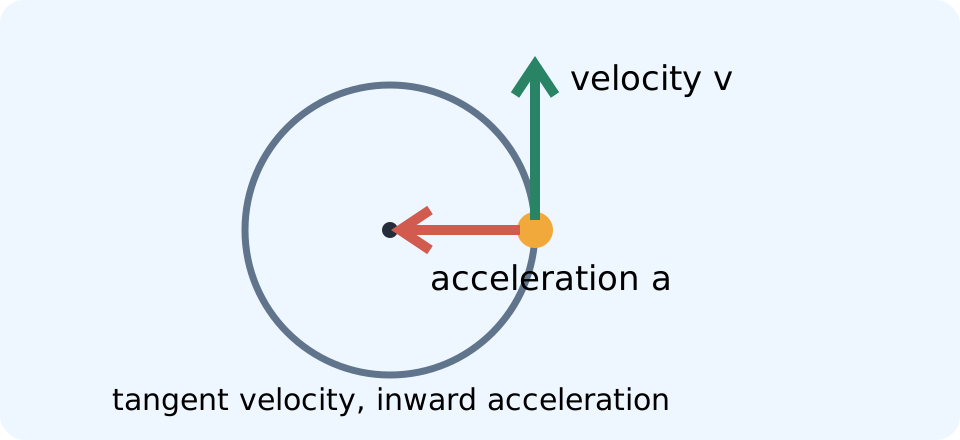
Uniform circular motion means motion at constant speed along a circular path of fixed radius. The word uniform refers to speed, not to the complete velocity vector. At every point, instantaneous velocity is tangent to the circle and perpendicular to the radial line from the center. As the object moves, that tangent direction rotates continuously. Because velocity changes whenever either magnitude or direction changes, the object is accelerating even though a speedometer would remain steady.
Picture a bead traveling counterclockwise around a circular track. At the rightmost point its velocity points upward, at the top it points left, and at the leftmost point it points downward. These vectors can have identical magnitudes while being different vectors. Subtracting an initial velocity vector from a later velocity vector gives a nonzero change . Acceleration is the rate of this change, in an average interval and its limiting value over an instant.
A useful prediction precedes every calculation: the acceleration points inward, toward the center of the circle. If acceleration vanished, Newton’s first law says the object would continue along the tangent rather than curve. The inward change does not mean the object is moving inward, because velocity is tangent while acceleration is radial. Perpendicular acceleration changes direction without changing speed at that instant. This geometric relationship is the signature of ideal uniform circular motion.
Derive centripetal acceleration geometrically
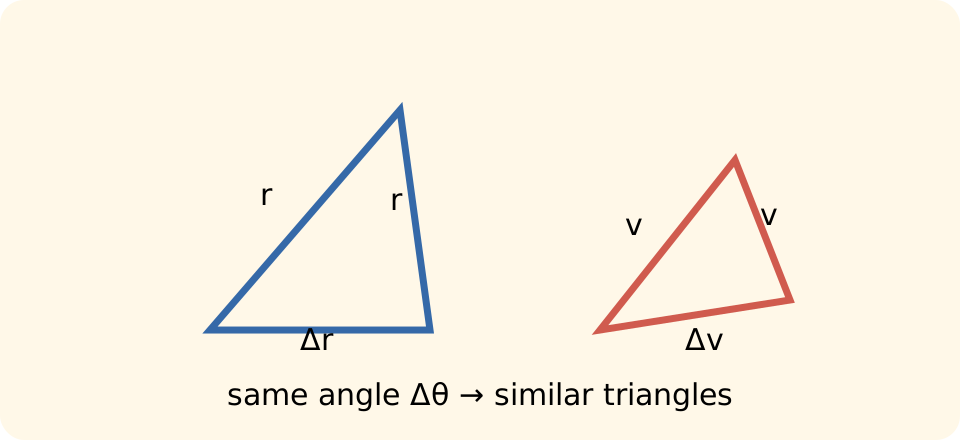
Take two nearby positions separated by a small angle . Their radius vectors have equal magnitude , and their velocity vectors have equal magnitude while differing by the same angle. The triangle formed by the two radii is similar to the triangle formed by the two velocity vectors. Similarity gives . For a very short interval, the traveled arc and chord become nearly equal, so .
Substitution gives . Dividing by and taking the limit as the interval shrinks produces . The subscript identifies the radial component, and the acceleration direction is inward. The word centripetal literally means “center seeking,” so is another common symbol for the same quantity. The equation predicts that acceleration grows with the square of speed and decreases as radius grows.
The square on speed has an important practical consequence. Doubling while holding fixed multiplies by four, and tripling multiplies it by nine. Doubling the radius while holding speed fixed cuts the acceleration in half. Unit analysis confirms the result because . These proportional relationships provide quick reasonableness checks before numerical work. They also explain why modest increases in vehicle speed greatly increase the demands of a turn.
Relate linear and angular descriptions
Circular motion can be described by distance traveled along the path or angle swept about the center. Angular position is commonly written and measured in radians. One radian is the angle that subtends an arc length equal to the radius, so the geometric relation is . Here is arc length, is radius, and must be expressed in radians for the equation to take this simple form. Dividing by elapsed time connects linear and angular rates.
Angular speed is for uniform motion. Using gives , where is tangential speed and is measured in . Radians are dimensionless ratios of lengths, but writing the radian unit helps communicate what is rotating. Substituting into yields . At fixed angular speed, points farther from the axis therefore have greater tangential speed and greater radial acceleration.
The period is the time required for one revolution, measured in seconds. Frequency is the number of revolutions per unit time, measured in hertz, where . Because one cycle takes seconds, . One revolution covers distance and angle , so and . These equations are translations among equivalent descriptions rather than unrelated formulas to memorize.
Interpret the radial force equation
Newton’s second law remains the governing force principle for circular motion. Choosing inward as the positive radial direction gives . The summation symbol means that every real force component along the radial axis must be added with its sign. The right side is not an additional force; it is mass times the required radial acceleration. Calling “the centripetal force” can be convenient only if one remembers that it represents the net inward force.
Tension may supply the inward force for a mass on a string, gravity for a satellite, static friction for a car on a flat curve, or a normal force for a roller-coaster car. In other situations several interactions combine to produce the radial net force. A free-body diagram should contain only actual interactions, not a separate arrow labeled “centripetal force.” Each force should be named by both its type and the agent that exerts it. After drawing the forces, choose a radial axis and write the signed component equation. This method reveals which mechanism bends the path and prevents double counting.
Suppose a car rounds a level curve of radius at . Vertical normal force and weight cancel, so static friction supplies the horizontal inward force. Its required magnitude is . The friction points toward the center, even though the velocity is tangent to the road. If available static friction is smaller than this requirement, the car cannot follow the intended radius at that speed.
Analyze flat and banked curves
On a flat road, static friction between tires and pavement is normally the horizontal force that turns the vehicle. The maximum possible static friction is , where is the dimensionless coefficient of static friction and is normal-force magnitude. With no vertical acceleration, , so the limiting condition is . Solving gives . Vehicle mass cancels in this ideal model because both available friction and required radial force scale with mass.
A banked curve tilts the normal force so that it has an inward component. At one design speed, the curve can be negotiated without relying on friction. Resolving into components gives vertically and inward. Dividing the second equation by the first eliminates both and , producing . The angle is measured between the road surface and horizontal, and carries units near Earth’s surface.
Real roads still use friction because vehicles travel at many speeds and conditions vary. At speeds above the no-friction design value, friction may need an inward component. At lower speeds, friction may point up the bank to prevent sliding inward and downward. The direction of static friction is determined by the direction slipping would occur without it, not by a rule that friction always opposes motion. Drawing the no-friction tendency first is therefore more reliable than assigning friction from habit.
Examine vertical circles
In a vertical circle, the direction toward the center changes relative to gravity as the object moves. Speed also generally changes because gravity can do positive or negative work. At the top of the circle, inward is downward, so weight points inward. At the bottom, inward is upward, so weight points opposite the inward radial direction. One equation cannot be copied unchanged between these locations without redefining signs carefully.
For a mass on a string at the top, choosing inward as positive gives . At the bottom, the corresponding equation is . Here denotes tension, denotes mass, and denotes gravitational-field magnitude. These equations show why the string tension is usually greater at the bottom than at the top. The radial equation determines force balance at an instant, while an energy equation is often needed to relate the speeds at different heights.
The limiting condition for a string to remain taut at the top is . Setting in the top equation gives the minimum top speed . A negative tension result is not physically possible because a flexible string cannot push. Such a result means the assumed circular path has already failed and the object would enter a different trajectory. Interpreting mathematical constraints physically is as important as solving the algebra.
Connect circular motion to orbital motion
A satellite in a circular orbit is continually falling toward the planet while moving sideways fast enough to keep missing the surface. Gravity is the real interaction that supplies its centripetal acceleration. For a planet of mass and satellite of mass , equating gravitational force to radial requirement gives . The orbital radius is measured from the planet’s center, not from its surface. The satellite mass cancels, showing that ideal circular orbital speed does not depend on the satellite’s mass.
Solving gives . Combining this with yields . A larger circular orbit has lower speed but a longer period because the path is larger and gravity is weaker. These results assume a dominant spherical central body and neglect drag and other gravitational sources. The equations are consequences of gravitation plus circular kinematics, not independent orbit rules.
Astronauts in orbit feel weightless even though gravity remains strong. They and their spacecraft share essentially the same inward gravitational acceleration, so no supporting normal force presses them against a floor. Apparent weight is associated with support force rather than the presence or absence of gravity. Calling orbit “zero gravity” therefore hides the very force producing the circular motion. Continuous free fall is the more accurate conceptual description.
Compare inertial and rotating frames
In an inertial reference frame, Newton’s laws apply directly without invented forces. An object following a circle has a real net inward force and no required real outward force. When a car turns left, a passenger’s body tends to continue tangent to the original path while the car pushes the passenger inward. Relative to the turning car, the passenger appears to shift outward. That observation does not imply that an external object has exerted an outward interaction in the ground frame.
In a rotating, noninertial frame, one may introduce an apparent centrifugal force to use a modified force balance. This apparent force points away from the axis and has magnitude for steady rotation. It is a frame-dependent bookkeeping device rather than an interaction with another physical object. A correct analysis can use either frame, but it must state the frame and remain consistent. Mixing a centrifugal term from the rotating frame with an unmodified inertial-frame equation produces false double counting.
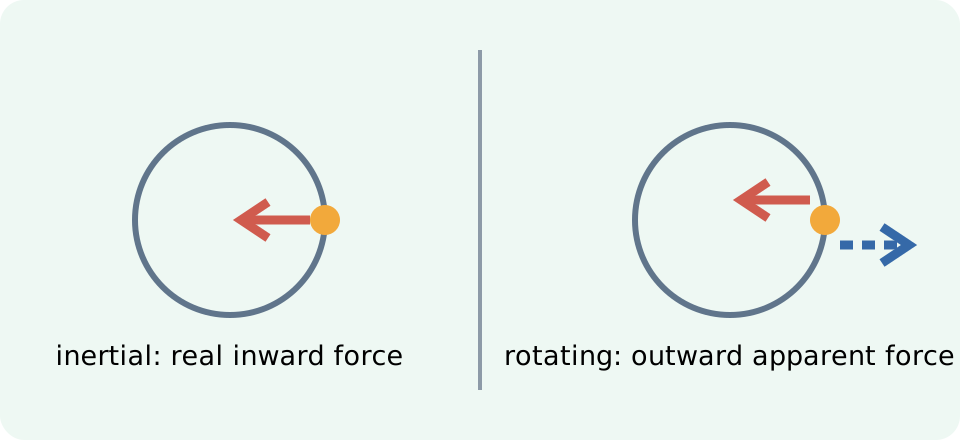
The sensation of being thrown outward is often the body resisting the inward acceleration imposed by a seat, door, or restraint. The contact surface must push inward to bend the person’s path with the vehicle. If that contact vanished on a frictionless surface, the person would travel tangent to the circle rather than radially outward. This tangent-line prediction can be tested by releasing a rotating object safely in a model or simulation. Frame language should clarify this observation rather than replace it with a slogan.
Solve problems with a repeatable strategy
Begin by identifying the object, the instant of interest, and the center of curvature. Draw the velocity tangent to the path and mark inward before drawing a free-body diagram. Include only forces exerted by identifiable agents such as Earth, a string, a road, or a track. Choose radial and tangential axes, because these often simplify the components. Then write with signed real-force components on the left.
Next determine whether the speed is given or must be found from period, frequency, angular speed, kinematics, or energy. Convert revolutions to radians or cycles to seconds deliberately rather than inserting numbers into a remembered formula. Preserve units through substitution, especially squared speed and radius. Solve symbolically when possible so that proportional relationships remain visible. Finally test direction, limiting cases, magnitude, and units against the original physical situation.
When a result is surprising, separate mathematical error from physical insight. A calculated negative normal force usually means contact would be lost, not that a surface pulls. A required friction greater than means the proposed motion exceeds the no-slip limit. An inward force requirement that grows fourfold when speed doubles is expected from the square-law dependence. Constraints define whether the assumed circular path is dynamically possible.
Practice and explain
A runner moves at around a curve of radius . The radial acceleration is inward. If speed doubles while radius stays fixed, the new acceleration is , not . State which interaction provides the inward force on the runner. Explain why the acceleration is nonzero even when the runner’s speed is steady.
A laboratory turntable rotates at , and a marker sits from the axis. Its angular speed is . Its tangential speed is . Its radial acceleration is . Identify the physical interaction that could keep the marker from sliding.
A car travels around a flat curve where . Using , the ideal maximum speed is . Explain explicitly why mass cancels from this result. Predict how rain that lowers changes the safe speed. Then describe why the velocity at the instant friction fails is tangent to the curve.
Consolidate the central idea
Uniform circular motion is not force-free motion. Constant speed coexists with changing velocity because an inward acceleration continually turns the velocity vector. Its magnitude is , and its direction is always toward the instantaneous center of curvature. Newton’s second law then requires a net inward real force . These statements connect geometry, kinematics, and dynamics in one model.
The phrase centripetal force describes a role, not a new category of interaction. Ask what agent supplies the inward force in each system, and place that force on the free-body diagram. Tension, friction, gravity, normal force, or combinations can occupy the role. Keep tangent velocity separate from inward acceleration, and keep inertial-frame forces separate from rotating-frame apparent forces. Those habits prevent most conceptual errors before algebra begins.
This framework prepares you for universal gravitation, rotational dynamics, and oscillations. Orbital relations emerge when gravity supplies the inward net force. Rotational dynamics expands from particles moving in circles to extended objects whose different points share angular motion. In every later setting, diagrams, units, signs, and limiting cases remain tools for understanding rather than mere presentation conventions. The circle is simple geometrically, but it reveals some of the deepest connections in mechanics.