
Mechanics describes quantities that possess direction as well as size. A force toward the east and an equal force toward the west do not produce the same effect as two forces toward the east. Vectors preserve this directional information and provide rules for combining it. Components translate vector geometry into signed algebra after a coordinate system is chosen. This lesson develops vector meaning, notation, operations, and physical interpretation from the ground up.
Distinguish scalars from vectors
A scalar quantity is described by a magnitude and physical unit. Mass, elapsed time, temperature, energy, and speed are common scalars. A scalar can be positive, zero, or in some cases negative without pointing in space. Temperature does not indicate a direction. Its sign locates a value relative to the Celsius reference.
A vector quantity includes both magnitude and direction. Displacement, velocity, acceleration, force, and momentum are vectors. A velocity of is incomplete as a vector description unless a direction or signed axis is understood. Saying east completes the one-dimensional description. In multiple dimensions, components or angles provide direction.
The distinction is determined by transformation and combination rules, not merely by whether a quantity has a sign. Electric charge is a signed scalar because charges add without spatial direction. Torque and angular momentum require additional directional structure. Classification follows the physical definition. Memorized lists are useful only when connected to those meanings.
Read vector notation precisely
A vector may be written in bold as or with an arrow as . Its magnitude is written or sometimes simply when context is clear. Magnitude is a nonnegative scalar. The vector and its magnitude are not interchangeable. Equations should preserve whether each symbol is scalar or vector.
A drawn vector is represented by an arrow. Its orientation shows direction, and its scaled length represents magnitude. The tail marks the starting point of the representation, while the head marks the arrow tip. Translating the entire arrow without rotating or resizing it represents the same free vector. Physical application points may still matter for torque and deformation.
Vector equality requires equal magnitude and equal direction. Two arrows can occupy different locations on a diagram and still represent equal free vectors. Opposite vectors have equal magnitudes and directions separated by . If , then . The minus sign reverses direction rather than creating negative magnitude.
Establish coordinates before assigning signs
A coordinate system defines an origin, axis directions, and units. In one dimension, right may be chosen positive and left negative. Another valid choice reverses those signs. Physical conclusions must remain unchanged under a consistent coordinate change. Signs belong to components relative to axes, not intrinsically to a vector.
In two dimensions, perpendicular horizontal and vertical axes are common. The positive horizontal axis is usually labeled , and the positive vertical axis is labeled . An angle is then measured from a declared reference direction. Counterclockwise-positive angles are conventional but must not be assumed silently in ambiguous diagrams. A small axis sketch prevents many sign errors.
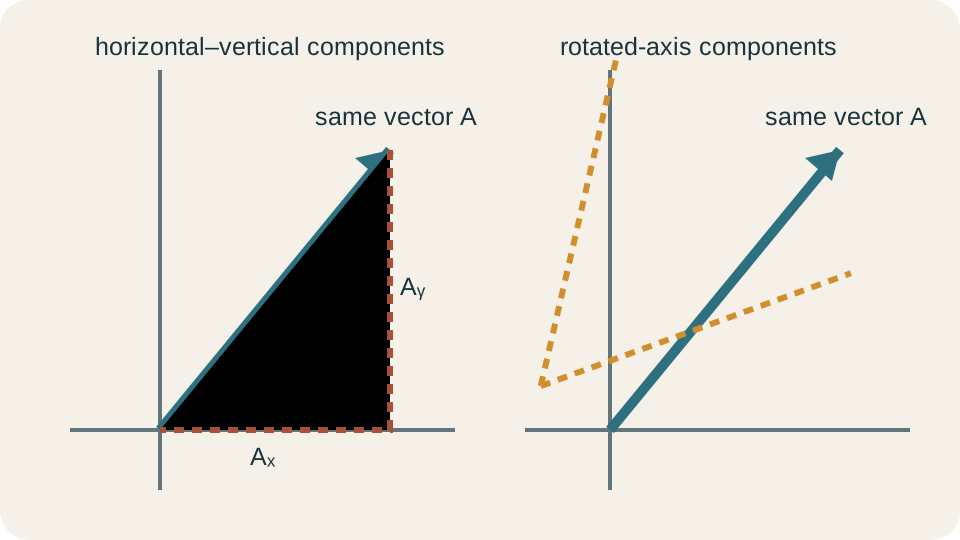
Coordinate choice should simplify the equations. On an incline, choosing one axis parallel to the surface and another perpendicular to it often reduces force components. In projectile motion, horizontal and vertical axes align naturally with gravitational acceleration. Changing axes changes component values but not the physical vector. Magnitude and relative direction remain invariant.
Define unit vectors
A unit vector has magnitude one and specifies direction. The Cartesian unit vectors , , and point along positive , , and directions. The hat distinguishes a unit direction from a general vector. Unit vectors are dimensionless. Physical magnitude and units appear in their scalar coefficients.
A vector can be written in two dimensions. The quantities and are signed scalar components. If is a force, both components have units of newtons. The unit vectors carry direction but no force units. Addition joins perpendicular directional contributions into one vector.
The unit vector in the direction of a nonzero vector is . Division by magnitude removes physical size and units. The original vector can then be reconstructed as . This factorization separates “how much” from “which way.” It is undefined for the zero vector because zero has no unique direction. Any direction multiplied by zero produces the same zero vector.
Resolve a vector into components
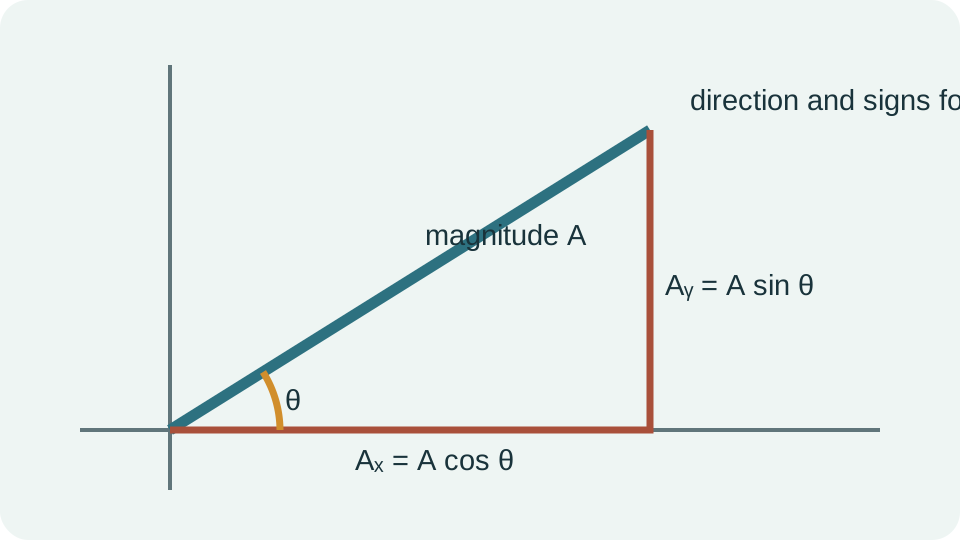
Suppose vector has magnitude and angle measured counterclockwise from the positive horizontal axis. Its components are and . Cosine multiplies the component adjacent to the reference angle. Sine multiplies the opposite component. Quadrant signs emerge from the trigonometric functions.
Let a force of magnitude act at above the positive horizontal axis. Its horizontal component is . Its vertical component is . The components inherit newtons because sine and cosine are dimensionless. Both signs are positive in Quadrant I.
If the same magnitude points above the negative horizontal axis, its standard angle is . Then and . Using the acute reference angle gives magnitudes, while the quadrant gives signs. Writing a negative magnitude would obscure the distinction. Components, not magnitude, carry coordinate signs.
Reconstruct magnitude and direction
For perpendicular components, magnitude follows from the Pythagorean theorem. The formula is . Squaring removes component signs before contributions are added. The square root returns to the original physical units. Magnitude is never negative.
Direction can be estimated from . A plain inverse tangent may return an angle in the wrong quadrant because the ratio loses information when both signs change. The two-argument function often called uses both component signs. It returns an angle in the correct quadrant under the software’s convention. A sketch remains a valuable check.
For and , magnitude is . The reference angle is . The vector lies in Quadrant II. Its standard direction is . Reporting only would describe a different quadrant under the standard convention.
Add vectors geometrically
To add and geometrically, place the tail of at the head of . The resultant runs from the first tail to the final head. This is the head-to-tail rule. Translating a free vector preserves it. Rotating or resizing it would not.
Vector addition is commutative, so . Drawing both vectors from a common tail creates a parallelogram. The diagonal from the common tail is the same resultant. Different addition orders create different intermediate paths but the same endpoint. This geometric fact matches component-wise arithmetic.
Only compatible physical quantities may be added. Two displacement vectors can be added to obtain total displacement. A displacement cannot be added to a velocity because their dimensions differ. Even two vectors with compatible units must represent quantities that belong in the same physical relation. Dimensional consistency is necessary but not always sufficient for meaning.
Subtract vectors as addition of an opposite
Vector subtraction is defined by . The vector has the same magnitude as and opposite direction. Geometrically, reverse and apply head-to-tail addition. Subtraction is therefore not a separate geometric operation. It uses addition after directional reversal.
The change in velocity is . Place after or draw the vector from the head of to the head of when both share a tail. A direction change can produce nonzero even if speed stays constant. Circular motion is the central example. Vector subtraction captures that directional change.
If and , then . Its magnitude is to two significant figures. Initial and final speeds are both . Velocity nevertheless changes substantially. The example demonstrates that direction is part of velocity, not an optional label.
Add vectors by components
Component addition treats each axis independently. If and , then . Horizontal components add only to horizontal components. Vertical components add only to vertical components. This rule extends to three dimensions.
Suppose and . Their sum is . The resultant magnitude is . Its direction lies in Quadrant I. The positive component signs agree with that quadrant assignment.
Component arithmetic is usually more precise than scale drawing. A geometric diagram still provides essential interpretation. The component signs should match the arrow’s quadrant. The resultant should fall between two vectors pointing into the same general region. Algebra and geometry should check one another.
Distinguish path length from displacement
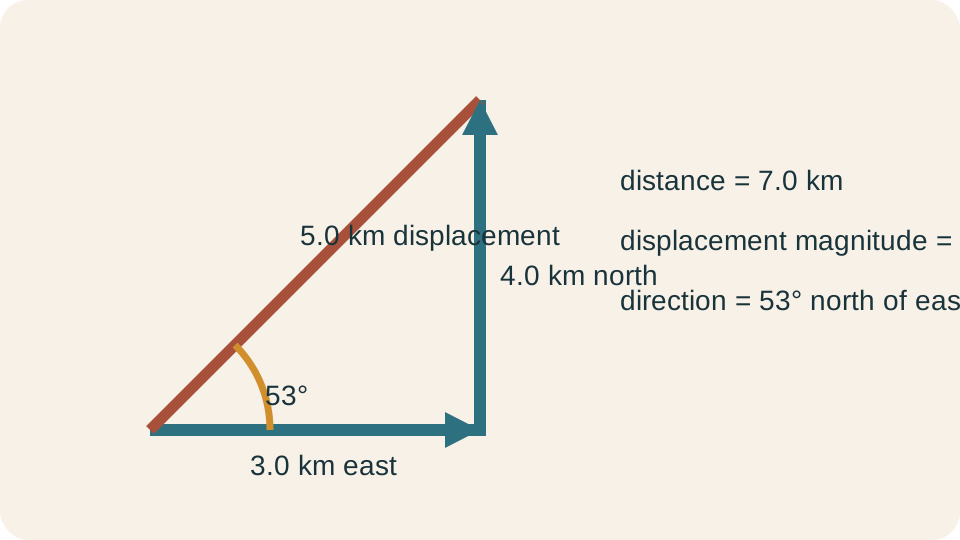
A hiker walks east and then north. The total distance traveled is . Distance is a scalar path length. The displacement vector is . Its magnitude is not the sum of perpendicular components.
The displacement magnitude is . Its reference direction is north of east. The phrase “north of east” means begin facing east and rotate toward north. Units cancel inside the tangent ratio. The final magnitude retains kilometers.
Distance and displacement coincide only for motion along one straight direction without reversal. The hiker’s path forms two legs, while displacement is the direct vector from start to finish. The triangle inequality guarantees that direct displacement magnitude cannot exceed path distance. Here . This inequality is a useful check.
Multiply vectors by scalars
Multiplying vector by scalar changes its magnitude by factor . If is positive, direction stays the same. If is negative, direction reverses. If , the result is the zero vector. Scalar multiplication can also change physical units.
Momentum is . Mass is a positive scalar measured in kilograms. Multiplying velocity by mass preserves the velocity direction. Units become kilogram meters per second. A negative momentum component comes from velocity direction, not negative mass.
Newton’s second law in constant-mass form is . The net force vector points in the same direction as acceleration when mass is positive. Doubling the net force with fixed mass doubles acceleration magnitude. Component equations follow as and . Vector structure becomes signed scalar equations along chosen axes.
Use the dot product for alignment
The dot product of vectors is . Its result is a scalar. Geometrically, , where is the angle between the vectors. The product measures directional alignment. Perpendicular vectors have zero dot product.
Work done by a constant force is . Work is scalar and measured in joules. Only the force component parallel to displacement contributes. A perpendicular force performs zero work in this ideal definition. An opposing force produces negative work.
Suppose a force acts from a displacement. Then . One joule equals one newton meter. The cosine selects the aligned fraction of force. The scalar sign describes whether energy transfers into or out of the chosen mechanical account.
Build vector equations from free-body diagrams
A free-body diagram isolates one object and draws external forces acting on it. Each force arrow begins on the object representation and points in the force direction. Arrow labels identify interactions such as weight, normal force, tension, or friction. The diagram should not include forces exerted by the object on something else. System choice determines which forces are external.
After choosing axes, resolve angled forces into components. Sum components separately to form and . The sigma symbol means add all force components in that direction. Component signs come from the axes. A force magnitude itself remains nonnegative.
On an incline, axes parallel and perpendicular to the surface often simplify the normal force and acceleration. Weight then resolves into along the surface and perpendicular to it under the usual angle convention. These are components of one weight vector, not additional forces. Drawing both the full weight and its components as separate forces would double count gravity. The diagram may show either the original vector or its resolved components for summation, but not treat both as independent interactions.
Change reference frames and axes carefully
Rotating coordinate axes changes component values. The physical vector remains the same. A vector with components in one basis has different components in a rotated basis. Magnitude calculated from an orthonormal basis remains invariant. Direction relative to physical landmarks also remains invariant.
Changing inertial reference frames can change velocity vectors, not merely components. If a train moves at east relative to ground and a passenger walks west relative to the train, classical relative velocity gives east relative to ground. Frame labels are essential. Adding unlabeled velocities invites conceptual error. The calculation is meaningful only after each velocity’s object and reference frame are named.
Force and acceleration transformations require attention to the frame’s acceleration. Newton’s laws take their simplest form in inertial frames. A rotating or accelerating coordinate system may require apparent forces. The vector tools remain useful, but the physical model changes. Coordinate choice and reference-frame choice are related but distinct decisions.
Diagnose common vector errors
One error is adding magnitudes instead of components. Magnitudes add directly only when vectors point in the same direction. Opposite vectors subtract in effect, and perpendicular vectors combine through the Pythagorean theorem. General vectors require component or geometric addition. Direction controls the result.
Another error is assigning a negative magnitude. Magnitude is nonnegative. A negative component indicates opposition to a selected positive axis. Writing as a magnitude confuses direction with size. Write a component, arrow direction, or unit-vector form instead.
A third error is using inverse tangent without checking the quadrant. Ratios alone can return an angle differing by . Sketch the component signs and use a two-argument arctangent when available. State the directional convention in words. A numerical angle without reference direction is incomplete.
Practice a complete vector routine
First identify whether each quantity is scalar or vector and attach units. Second choose and draw coordinate axes. Third resolve every relevant vector into signed components. Fourth combine compatible components algebraically. Fifth reconstruct magnitude and direction, then compare with the diagram.
Suppose two forces act on an object: east and north. The resultant is . Its magnitude is . Its direction is north of east. The result points between the original forces.
If a third force of acts exactly opposite that resultant, net force is zero. Opposite means equal magnitude and direction separated by . The object then has zero acceleration in an inertial frame. It may remain at rest or continue with constant velocity. Zero net force does not necessarily mean zero velocity.
Consolidate vector reasoning
Scalars carry magnitude and units, while vectors also carry direction. Coordinates express a vector through signed components. Unit vectors separate directional basis from physical magnitude. Magnitude and direction can be reconstructed from perpendicular components. Coordinate choices alter representation without altering the physical vector.
Vector addition follows head-to-tail geometry and component arithmetic. Subtraction adds an opposite vector. Scalar multiplication changes magnitude and possibly direction. The dot product converts directional alignment into a scalar. These operations support displacement, velocity, acceleration, force, momentum, and work.
A reliable mechanics solution draws axes, preserves units, labels frames, and checks signs against geometry. It never substitutes magnitude addition for vector addition without justification. It distinguishes physical vectors from their coordinate components. These habits make later free-body diagrams and motion equations far easier to interpret. Vectors are the grammar through which mechanics expresses direction-dependent relationships.