
A vector combines magnitude with direction. Displacement, velocity, acceleration, force, and momentum are vectors because direction changes their physical meaning. A component is the signed amount of a vector along a chosen axis. Components let one vector relationship become separate scalar relationships. This translation makes multidimensional problems manageable.
The same physical vector can have different numerical components in different coordinate systems. Rotating the axes changes the component values without changing the vector itself. A component is therefore not an independent fragment of reality. It is a projection created by a coordinate choice. Good choices simplify the mathematics while preserving the physics.
This lesson develops components from geometry instead of memorized slogans. You will resolve vectors, reconstruct them, add them, subtract them, and test signs and quadrants. Every numerical example will carry units. Diagrams will connect arrows to equations. The aim is a repeatable method that transfers into mechanics.
Learning goals and an opening model
You should represent a vector with component notation and unit vectors. You should calculate components from magnitude and direction. You should reconstruct magnitude and direction from components. You should add and subtract vectors component by component. You should also choose axes that make a problem simpler.
Imagine pulling a sled with a rope angled upward. The rope tension is one vector. Part of that vector points forward and contributes to horizontal motion. Another part points upward and changes the normal interaction with the ground. Components describe both effects without splitting the rope into two ropes.
Predict what happens as the rope angle rises while tension magnitude stays fixed. The upward component grows initially. The forward component shrinks. At a vertical angle, the entire vector is upward and no component remains forward. Geometry makes those trends visible before calculation.
Vectors differ from scalars
A scalar has magnitude but no spatial direction. Mass, temperature, elapsed time, and energy are common scalars. A vector needs both magnitude and direction. Writing is not enough to specify a force vector. Writing eastward completes the description.
Vector notation often uses a bold symbol such as or an arrow above a symbol. Its magnitude is written or and is nonnegative. A component such as can be positive, negative, or zero. The sign indicates direction along an axis. Magnitude and component should not be confused.
Two vectors are equal when they have equal magnitudes and directions. Their drawn locations do not matter for free-vector addition. A vector can be translated parallel to itself without changing it. Rotating or rescaling it does change it. Diagrams should preserve relative direction and approximate length.
Axes and unit vectors create a language
Cartesian axes are usually labeled , , and sometimes . Their positive directions must be shown. Unit vector points along positive , along positive , and along positive . A unit vector has magnitude one and no physical unit. It supplies direction while a component supplies signed size and units.
In two dimensions, write . The plus sign means vector addition rather than simple addition of unlike directions. The contribution and contribution are perpendicular. Together they reproduce the original vector. This equation is a decomposition in a selected basis.
Suppose east is and north is . A displacement has an east component of and a north component of . Parentheses keep the common metre unit clear. Negative values would point west or south. Stating the axis convention removes ambiguity.
Components are projections
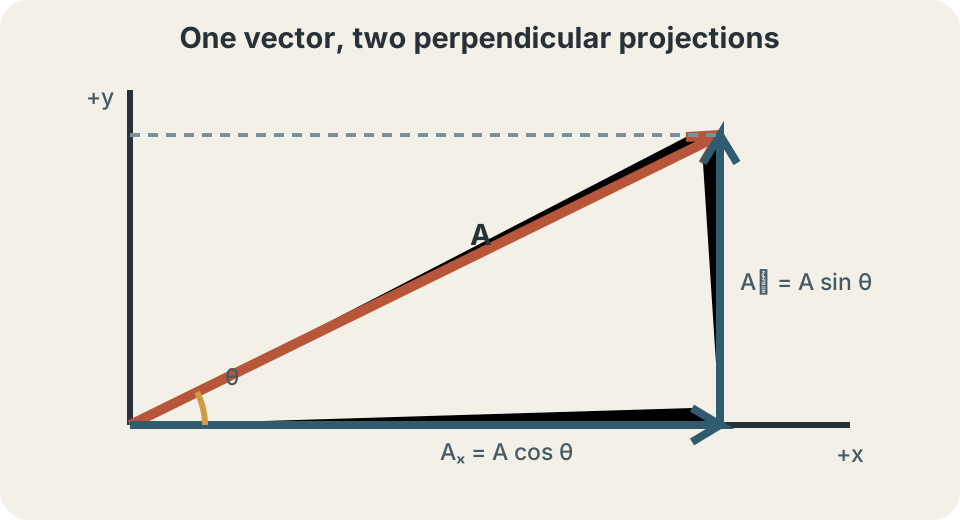
Projection asks how much of a vector lies along a specified direction. For perpendicular axes, dropping lines from the vector tip creates a right triangle. The vector is the hypotenuse. Its components form the legs. Right-triangle trigonometry then relates magnitude, angle, and components.
If angle is measured counterclockwise from positive , then and . The symbol is vector magnitude. Cosine supplies adjacent side divided by hypotenuse. Sine supplies opposite side divided by hypotenuse. Both trigonometric ratios are dimensionless.
These formulas depend on where the angle begins. If an angle is measured from the axis, the adjacent component is the component. The phrase “cosine is horizontal” is therefore unreliable. Draw the triangle and identify adjacent and opposite sides. Geometry decides which function belongs to which component.
Worked resolution example
A force has magnitude and points above positive . Its horizontal component is . Its vertical component is . Both are positive because the vector lies in the first quadrant. The components retain the force unit newton.
The values pass two geometric checks. The component along the nearer axis is larger because the angle from is only . Each component magnitude is at most the full magnitude. The identity ensures reconstruction. Rounding occurs only after the calculation.
Now describe the same vector as to the right of positive . The horizontal component is opposite that stated angle, so it uses sine. The vertical component is adjacent, so it uses cosine. Calculations still produce and . The physics does not depend on which complementary angle is reported.
Signs come from quadrants
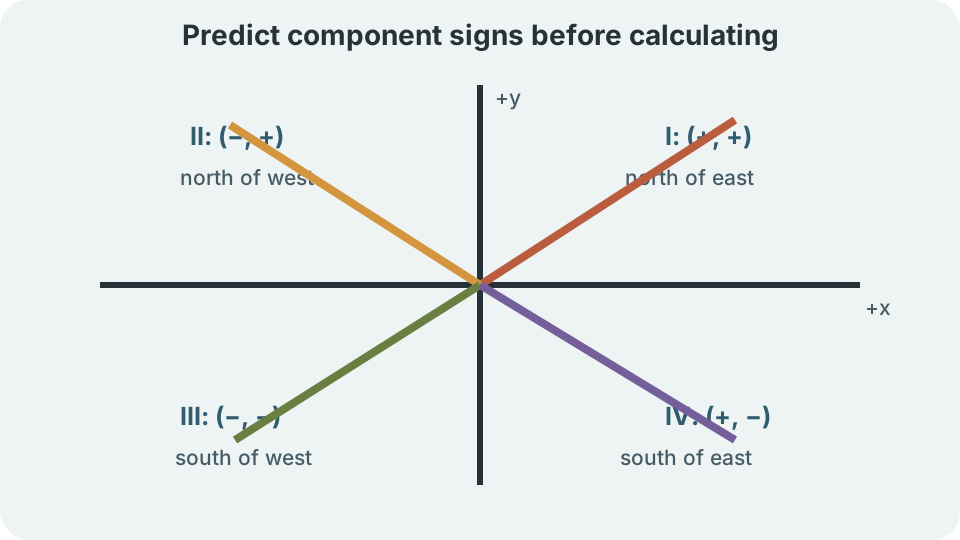
Trigonometric magnitudes alone do not replace direction reasoning. In quadrant I, both Cartesian components are positive. In quadrant II, is negative and is positive. In quadrant III, both are negative. In quadrant IV, is positive and is negative.
Consider a displacement at counterclockwise from . The formulas give and . The negative cosine correctly places the horizontal component toward . The positive sine places the vertical component toward . Those signs agree with quadrant II.
Some problems report a reference angle rather than a standard-position angle. “ north of west” begins at west and turns toward north. The expected signs are negative and positive . Assign those signs from words or a sketch before pressing calculator keys. This prediction catches angle-mode and quadrant mistakes.
Reconstructing magnitude
Perpendicular components form a right triangle. The Pythagorean theorem gives . Squaring makes each contribution nonnegative. The square root returns the original unit. The resulting magnitude cannot be negative.
For , the magnitude is . This becomes . The negative horizontal component still contributes positively to magnitude. Direction information is recovered separately. Squaring has removed the component signs only for this magnitude calculation.
The magnitude should be at least as large as either component magnitude. It should also be no greater than the sum of component magnitudes. For the example, lies between and . A result of would fail immediately. Bounds are useful before checking detailed arithmetic.
Reconstructing direction
A reference angle can be found from . The horizontal fraction compares the magnitudes of opposite and adjacent legs. Inverse tangent returns an acute reference angle. Component signs then determine the quadrant. This two-step approach prevents quadrant loss.
For , the reference angle is . The signs place the vector in quadrant II. Its standard angle is . An equivalent verbal direction is north of west. Both descriptions point to the same vector.
Many programming languages and calculators provide an function. It uses both signed components and returns a quadrant-aware angle. Its argument order must be checked because conventions vary. Degree and radian modes must also match the task. A sketch remains an independent validation even when software handles the quadrant.
Adding vectors by components
Vector addition combines corresponding components. If , then and . The method follows from collecting coefficients of the same unit vectors. Perpendicular directions are not added directly as ordinary scalars. Each axis keeps its own ledger.
Suppose and . The resultant is . Therefore . Its magnitude is . The resultant points into quadrant I.
The head-to-tail graphical method represents the same addition. Components are often more accurate and scalable. Ten vectors require only separate sums along each axis. Opposing components cancel through their signs. Units must match before any component addition is valid.
Subtraction and relative vectors
Vector subtraction means adding the opposite vector. If , then and . Geometrically, reversing changes its direction by . Then ordinary head-to-tail addition applies. Parentheses prevent sign errors.
Relative velocity provides a physical example. The velocity of object A relative to object B is . If both move east at and , A moves at east relative to B. If they move in opposite directions, subtraction increases the relative magnitude. Direction must remain encoded throughout.
Displacement differences work similarly. The vector from point B to point A is . Reversing the order reverses the direction. A label such as should be translated into words before calculation. “A relative to B” means A minus B.
Choosing axes strategically
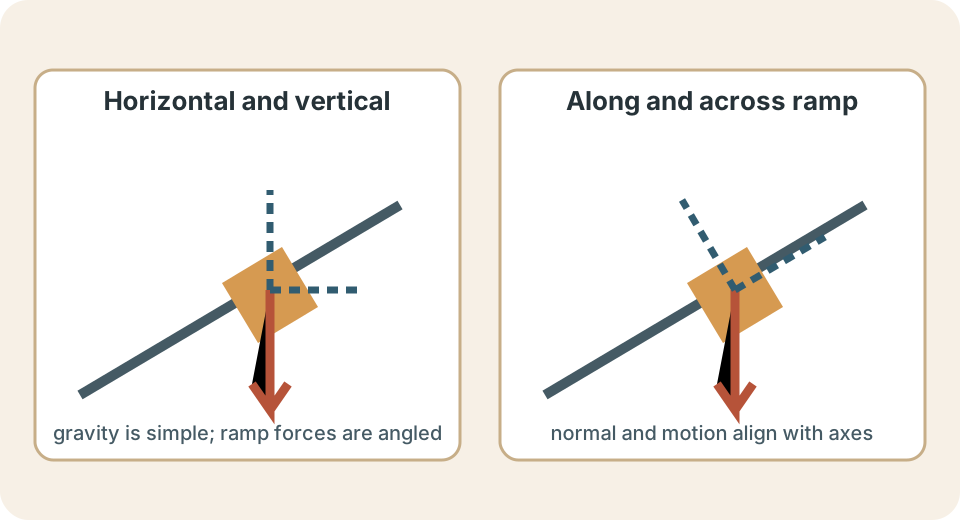
Coordinate axes are mathematical choices, not physical rails. Horizontal and vertical axes are convenient for projectile motion. Axes parallel and perpendicular to a ramp are often better for inclined-plane forces. One choice can remove unnecessary components. The vector remains unchanged when the axes rotate.
On an incline at angle , gravity can be resolved into down the plane and into the plane. These results follow from the geometry of the rotated axes. The normal force then lies along one axis. Motion often lies along the other. Newton’s equations become simpler.
Choose axes before resolving any vector. Draw positive arrows and label the origin if position matters. Use the same axes for every vector in one equation. Changing conventions midway changes signs and meanings. A strategic coordinate system reduces algebra without altering the situation.
Three dimensions and general projection
In three dimensions, write . Magnitude becomes . Every term must use the same physical unit. Three signs locate the vector among eight octants. Visualization is harder, but the component method remains unchanged.
A unit vector can define any desired direction. The scalar projection of along it is . The centered dot is the dot product. The projected vector is . Cartesian component formulas are special cases using axis unit vectors.
Projection can be positive, negative, or zero. A positive value points generally with . A negative value points against it. Zero means the vector is perpendicular to that direction. This general language extends components beyond standard axes.
Units and dimensional discipline
Every component has the same physical dimension as its parent vector. Force components use newtons, velocity components use , and displacement components use metres. Sine and cosine are dimensionless ratios. Multiplying by them does not change units. An angle itself must be interpreted in the calculator’s correct mode.
Only components of the same kind can be added. A force component cannot be added to a velocity component. Even two lengths require conversion to compatible units before addition. For example, should become . Unit consistency is part of vector consistency.
Significant figures should reflect input precision. Intermediate values can retain extra digits to avoid accumulated rounding. Final components, magnitude, and angle should then be reported reasonably. A diagram is qualitative evidence rather than a precision instrument. Do not infer extra digits by measuring a schematic arrow.
Uncertainty in components
Measured magnitude and angle both contribute to component uncertainty. For , uncertainty in scales the component while uncertainty in changes the projection. Near , a small angle error can be important for the small horizontal component. Relative uncertainty can become large when a component is near zero. Context determines which uncertainty matters most.
A simple sensitivity check recalculates components at plausible extreme inputs. More formal propagation uses partial derivatives and a stated statistical model. These methods answer different questions from worst-case bounds. Correlated magnitude and angle errors require special care. Reporting assumptions prevents false certainty.
Graphical addition also has scale and drawing uncertainty. Component calculation avoids ruler and protractor error but still depends on input quality. Software output is not automatically accurate. Measurement, model, and numerical uncertainty remain distinct. A complete result communicates all three when they are important.
Common misconceptions and repairs
One misconception says cosine always gives the horizontal component. Cosine actually gives the component adjacent to the stated angle in the relevant right triangle. If the angle begins at the vertical axis, cosine belongs to the vertical component. Draw the reference angle. Label adjacent and opposite legs before choosing functions.
Another misconception treats negative components as negative magnitudes. A component’s sign records direction. The magnitude reconstructed from squared components is nonnegative. A vector can have two negative components and still have positive magnitude. Preserve signs until direction is determined.
A third misconception adds magnitudes to find any resultant. Magnitudes add directly only for vectors pointing in the same direction. Opposing or angled vectors require geometry or components. Component sums can cancel. Estimate the direction before calculating to expose impossible results.
A reliable solution routine
Begin with a sketch and coordinate axes. Mark the vector direction and the exact angle reference. Predict component signs from the quadrant. Identify the hypotenuse, adjacent leg, and opposite leg. Write symbolic component relationships before substituting.
Carry the vector’s units through sine or cosine. Reconstruct with the Pythagorean theorem when possible. Determine direction using both a reference angle and signs. Check that each component is no larger than the magnitude. Check that the final quadrant matches the sketch.
For multiple vectors, resolve each one in the same coordinate system. Sum corresponding components in an organized table. Reconstruct the resultant only after the component ledgers are complete. Translate the result into magnitude and direction. Finish with units, precision, and a physical interpretation.
Practice and connection forward
A force points above . Its components are and . Both signs are positive. The horizontal component is larger because the vector lies closer to . Reconstruction returns approximately .
A displacement has components and . Its magnitude is . The reference angle is . Both signs place it in quadrant III. Its standard direction is counterclockwise from .
Without looking back, explain why components depend on axes while a vector does not. Derive the sine and cosine relationships from a labeled triangle. Explain how signs preserve direction during addition. Free-body diagrams will use these skills to resolve forces. Projectile motion will apply the same method to velocity and acceleration.