
Sine, cosine, and tangent are functions that connect angles with ratios and coordinates. Their familiar right-triangle definitions work because similar triangles preserve proportional shape. The unit circle extends those definitions beyond acute angles and reveals signs, periodicity, and symmetry. Inverse functions reverse the question by finding selected angles from ratios. This lesson builds all of these views into one coherent framework for measurement and modeling.
Begin with similarity rather than a mnemonic
Consider two right triangles that share the same acute angle . Each triangle also contains a right angle, so the remaining acute angles must match. The triangles are therefore similar by the angle-angle criterion. Similar triangles can differ in overall size while preserving corresponding side ratios. This fact makes trigonometric ratios depend only on the angle rather than on a particular drawing.
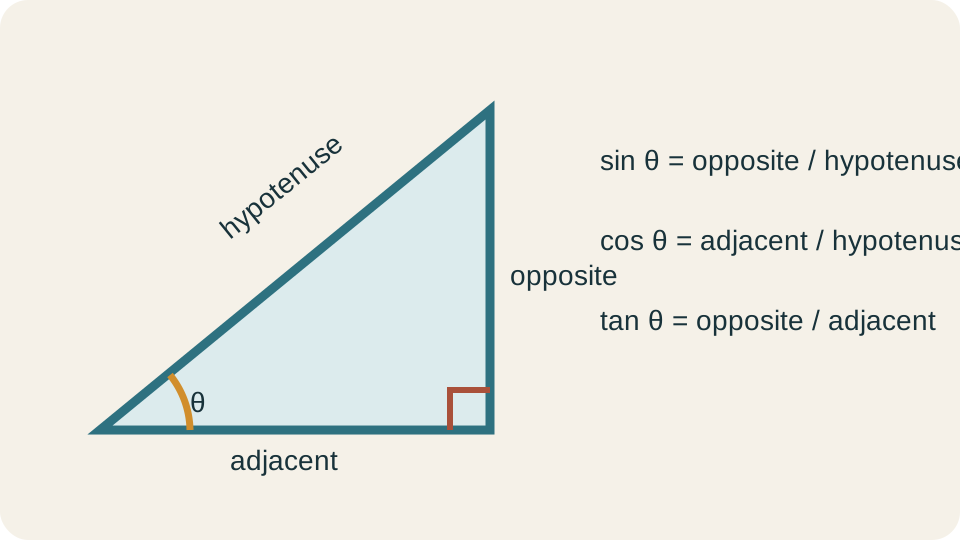
Relative to the chosen angle, the opposite side lies across from . The adjacent leg touches but is not the hypotenuse. The hypotenuse lies opposite the right angle and is always the longest side. These labels change if the chosen acute angle changes. Naming the reference angle before naming sides prevents a common conceptual error.
The ratio of opposite side to hypotenuse is sine, written . The ratio of adjacent side to hypotenuse is cosine, written . The ratio of opposite side to adjacent side is tangent, written . Horizontal fraction bars group numerator and denominator as complete quantities. These ratios are dimensionless when all side lengths use compatible units.
Understand why the ratios remain stable
Suppose one right triangle is a scaled copy of another by factor . Every corresponding length in the second triangle equals times the first length. The sine ratio then becomes . The common nonzero factor cancels. Cosine and tangent remain unchanged for the same reason.
This cancellation explains why a calculator can return one sine value for an angle without knowing a triangle’s size. The function records shape rather than scale. A -- triangle and a -- triangle have identical acute-angle ratios. Their lengths differ, but their corresponding angles do not. Trigonometry separates geometric form from physical magnitude.
The stable ratios also allow an unknown length to be found from one known length and an angle. Selecting a ratio is not guesswork when the relevant sides are named first. If opposite and hypotenuse are involved, sine connects them directly. If adjacent and hypotenuse are involved, cosine does. If the two legs are involved, tangent usually gives the shortest path.
Extend the definitions to the unit circle
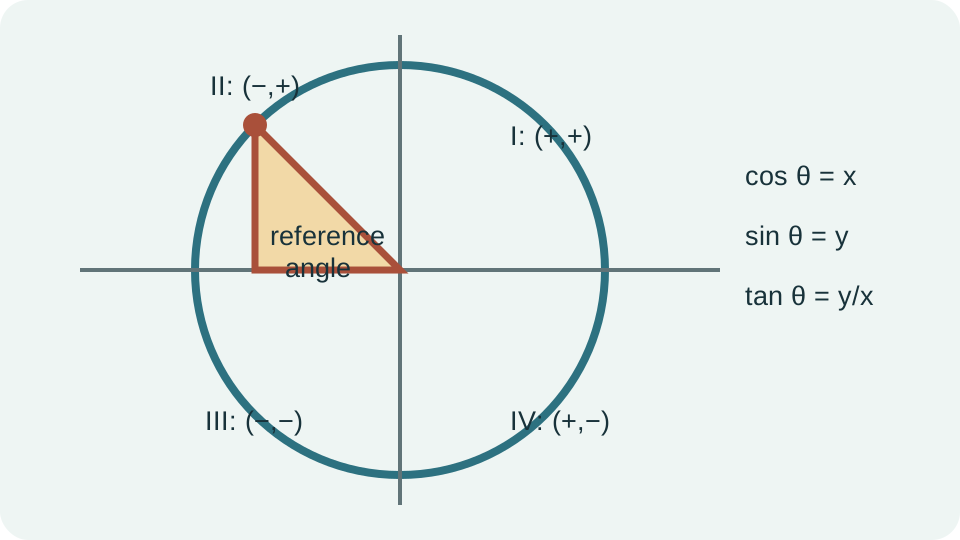
A unit circle has radius one and center at the origin. An angle determines a point on the circle. That point has coordinates . Cosine is the horizontal coordinate, while sine is the vertical coordinate. This coordinate definition works for any real angle, not only an acute angle in a right triangle.
Drop a perpendicular from to the horizontal axis when the point is not on an axis. The resulting reference triangle has hypotenuse one. Its horizontal leg has magnitude , and its vertical leg has magnitude . Coordinate signs indicate direction, which right-triangle side lengths alone cannot express. The unit circle therefore extends rather than contradicts the triangle definitions.
Tangent follows from the quotient wherever . The symbol means “is not equal to.” When cosine is zero, the quotient has zero in the denominator and tangent is undefined. The unit-circle definition makes this restriction visible. It also connects tangent to the slope of the ray from the origin to . The quotient therefore has simultaneous algebraic, geometric, and coordinate meanings.
Determine signs by quadrant
In Quadrant I, both coordinates are positive, so sine, cosine, and tangent are positive. In Quadrant II, the horizontal coordinate is negative while the vertical coordinate is positive. Therefore cosine is negative, sine is positive, and tangent is negative. In Quadrant III, both coordinates are negative, making tangent positive. In Quadrant IV, cosine is positive, sine is negative, and tangent is negative.
A reference angle is the acute angle between the terminal side and the horizontal axis. It determines the magnitudes of the trigonometric values. The quadrant determines their signs. For example, has reference angle and lies in Quadrant II. Thus while .
Sign reasoning is more durable than memorizing a quadrant slogan. Ask whether the point’s horizontal and vertical coordinates are positive or negative. Then form tangent as vertical divided by horizontal. This coordinate procedure works with degrees, radians, and angles beyond one rotation. It also exposes mistakes when a calculator result has an impossible sign.
Evaluate special angles exactly
A -- triangle can be built with legs of length one. The Pythagorean theorem gives hypotenuse . Therefore . Rationalizing the denominator produces the customary exact form. Tangent is one because the legs are equal.
A -- triangle has side-length ratio . Relative to , sine is , cosine is , and tangent is . Relative to , the opposite and adjacent legs exchange roles. Sine and cosine values therefore exchange. Tangent becomes .
Exact values preserve mathematical structure that decimals can hide. For example, immediately connects to an isosceles right triangle. The approximation is useful for measurement but less informative for symbolic work. Exact fractions and radicals also avoid accumulated rounding error. A final approximation should be clearly marked with , meaning “approximately equal to.” Keeping both forms distinguishes exact mathematical equality from measurement-oriented estimation.
Use reciprocal functions carefully
Secant is the reciprocal of cosine, so . Cosecant is the reciprocal of sine, so . Cotangent is the reciprocal of tangent, so . These definitions expand the trigonometric family from three functions to six. They do not create new geometric information independent of sine and cosine.
Each reciprocal inherits a domain restriction from its denominator. Secant is undefined where cosine is zero. Cosecant is undefined where sine is zero. Cotangent is undefined where tangent is zero, and it can also be written . Stating restrictions prevents an identity from being applied at an excluded input.
Reciprocal notation must not be confused with inverse-function notation. The expression conventionally means arcsine, not . The reciprocal of sine is written . A negative one written as a function superscript signals inverse notation in this context. Clear naming is safer than relying on a potentially ambiguous symbol alone.
Select a ratio to solve for a side
Begin by drawing and labeling a right triangle. Mark the known angle and identify the opposite, adjacent, and hypotenuse sides relative to that angle. Circle the known side and the desired side. Choose the ratio that contains both and excludes the unused side. This procedure turns formula selection into a controlled matching task.
Suppose a cable of length forms a angle above level ground. The vertical rise is opposite the angle, and the cable is the hypotenuse. Thus . Multiplication gives . The result is shorter than the hypotenuse, as geometry requires.
The horizontal run is adjacent to the same angle. Therefore and . The check confirms consistency within rounding. Both answers include meters because they represent lengths. Units and the Pythagorean relationship provide independent checks on calculator use.
Measure an inaccessible height
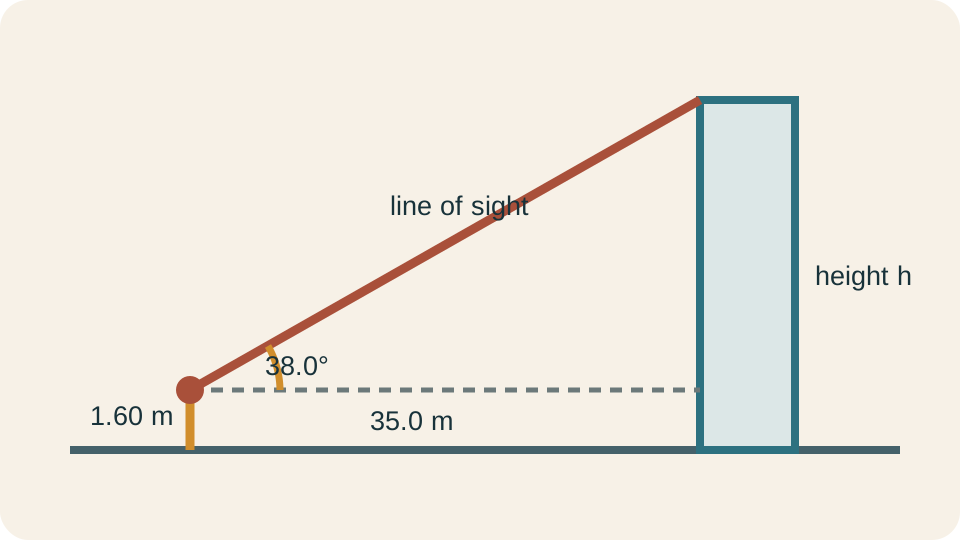
An observer stands horizontally from a tower. The angle of elevation from an instrument to the top is . The instrument is above the level ground. Let denote the tower’s total height. The triangle’s vertical leg is therefore rather than .
Tangent relates opposite and adjacent legs, so . Multiplying by gives . Adding the instrument height gives . Numerical evaluation produces . Every term being added has units of meters.
A sketch reveals why the instrument height must be restored. The trigonometric triangle begins at the instrument, not at ground level. Ignoring that offset would underestimate the tower. The result should also be compared with the viewing geometry: an angle below makes the rise from the instrument less than the horizontal distance. The calculated rise of about satisfies that expectation.
Use inverse trigonometric functions
Sometimes side lengths are known and the angle is unknown. If , then an inverse sine operation can return a selected angle, written . Similarly, reverses cosine on a restricted interval, and reverses tangent on a restricted interval. The prefix “arc” emphasizes that the output is an angle. These functions answer ratio-to-angle questions.
Trigonometric functions repeat, so they are not one-to-one over all real numbers. A function needs one output angle for each allowable input ratio to possess an inverse. Arcsine therefore uses the principal range . Arccosine uses , and arctangent uses . These choices make the inverse functions single-valued.
Suppose a right triangle has opposite leg and hypotenuse . Then . Applying arcsine gives . The centimeter units cancel inside the ratio. The angle unit must still be reported.
Distinguish principal values from all angles
An inverse function returns one principal angle, but a trigonometric equation may have many solutions. If , a calculator in degree mode returns . Sine is also one-half at in the same rotation. Adding any integer multiple of to either angle produces another solution. The equation’s full solution set is larger than the inverse function’s single output.
In radians, the solutions are or , where . The symbol denotes the set of integers. The parameter counts complete positive or negative rotations. Periodicity generates infinitely many coterminal solutions. A restricted interval can reduce the set to finitely many answers.
For right-triangle problems, the desired acute angle usually lies between and . Principal inverse outputs then often match the geometric context directly. For unit-circle equations, quadrant analysis must supplement the calculator. The sign of the ratio identifies possible quadrants, and the reference angle determines magnitude. Context decides whether one principal value or a full periodic family is required.
Keep angle units and calculator mode aligned
Degrees divide a full rotation into equal parts. Radians measure angle by the ratio of arc length to radius, so a full rotation is radians. The conversion is . Multiplying by an appropriate form of one converts between systems. The unit should remain visible during conversion.
A calculator interprets a bare number according to its current angle mode. In degree mode, means the sine of and equals one-half. In radian mode, means the sine of radians and has a different value. A correct key sequence in the wrong mode produces a wrong mathematical interpretation. Estimating sign and magnitude before calculation makes mode errors easier to notice.
Inverse outputs also follow the selected mode. If displays , the calculator is reporting degrees. If it displays approximately , it is reporting radians, which equals . Neither representation is inherently wrong. The answer must match the units requested by the problem and used elsewhere in the model.
Resolve vectors into components
A vector of magnitude at angle above the positive horizontal axis can be decomposed into perpendicular components. The horizontal component is . The vertical component is . Subscripts identify directions rather than exponents. The original vector is the hypotenuse of the component triangle.
Suppose a force has magnitude at above horizontal. Then . Similarly, . Both components retain newtons because trigonometric ratios are dimensionless. Their signs would change if the vector pointed into another quadrant.
The magnitude check is . Substituting the component formulas gives . Factoring and using recovers . This derivation connects component resolution to the Pythagorean identity. It also verifies that the two components preserve the original vector’s magnitude.
Diagnose common reasoning errors
Opposite and adjacent are not fixed sides of a triangle. They are defined relative to the chosen acute angle. Switching the reference angle swaps those two labels while leaving the hypotenuse unchanged. A diagram should therefore mark the angle before side labels are assigned. This habit prevents selecting the wrong ratio.
Another error is treating inverse and reciprocal notation as interchangeable. Arcsine returns an angle, whereas cosecant returns a reciprocal ratio. Their inputs and outputs have different meanings. Writing words alongside symbols can expose the distinction. If the question asks “which angle,” an inverse function is likely involved.
Rounding too early can also distort later calculations. Keep exact radicals or several guard digits through intermediate steps. Attach units to all physical lengths, forces, and angles. Check that the hypotenuse is longest and that an acute-triangle angle is actually acute. A numerical answer is complete only when it fits the geometry and context.
Practice a complete solution routine
First draw the geometry and mark known quantities with units. Second name sides relative to the chosen angle or locate coordinates by quadrant. Third write a trigonometric equation before entering calculator values. Fourth solve algebraically and then approximate if needed. Fifth check dimensions, sign, size, quadrant, and angle mode.
Consider a ramp rising over a horizontal run of . The incline angle satisfies . Therefore to three significant figures. The small rise compared with run makes a small angle reasonable. The ratio is dimensionless because meters cancel.
As a unit-circle exercise, evaluate . The angle lies in Quadrant II and has reference angle . Sine has magnitude and is positive, while cosine has the same magnitude and is negative. Their quotient is negative one. Sign reasoning and exact values agree without a decimal calculation.
Consolidate the function framework
Right-triangle trigonometry rests on similarity. Sine, cosine, and tangent compare sides in a scale-independent way. The unit circle turns those ratios into functions defined across all real angles where their formulas permit. Coordinates explain signs and periodic repetition. Inverse functions reverse selected ratio-to-angle relationships.
Reliable problem solving begins with definitions rather than button sequences. Name the reference angle, label sides or coordinates, choose a relation, preserve units, and check the result. Exact values convey structure, while approximations support measurement. Quadrants determine signs, and principal inverse ranges determine selected outputs. Each layer answers a different part of the reasoning.
These functions support graphs, identities, vectors, waves, surveying, and later calculus. Their notation is compact, but every symbol carries geometric meaning. The strongest understanding moves freely between triangle, circle, graph, and equation. When one representation becomes confusing, another can provide a check. Trigonometry becomes coherent when these views are treated as translations of the same relationships.