
A trigonometric identity states that two expressions represent the same quantity for every input on their shared domain. Identities are not arbitrary formulas to memorize; they are reusable consequences of circles, ratios, and rotations. They let us change an expression’s form without changing its value. That freedom becomes essential in equation solving, wave analysis, and calculus. This lesson develops a small connected system of identities and a disciplined method for using it.
Distinguish identities from conditional equations
An identity is an equation that is true for every input at which both sides are defined. The statement is an identity because every real angle satisfies it. By contrast, is true only at selected angles. That second statement is an equation to solve rather than an identity to verify. The distinction determines whether the goal is transformation or solution finding.
The phrase “where both sides are defined” is part of the definition. For example, is valid only when . At an excluded input, the ratio has no real value, so the equality makes no claim. Simplification can hide such exclusions without removing them from the original problem. A rigorous solution records the domain before canceling or dividing.
Numerical checking can disprove a proposed identity but cannot prove it. One counterexample is enough to show that an equation is not universally true. Even a thousand successful calculator checks leave infinitely many inputs untested. A proof instead transforms one expression through known equalities until it becomes the other. This logical chain explains why the agreement must persist throughout the domain.
Build reciprocal and quotient identities
The reciprocal functions are defined by , , and . The Greek letter theta, , represents an angle. The prefix “co” in cosine, cotangent, and cosecant reflects complementary-angle relationships, not reciprocal pairing. Secant is reciprocal to cosine, and cosecant is reciprocal to sine. Each reciprocal is undefined wherever its denominator equals zero.
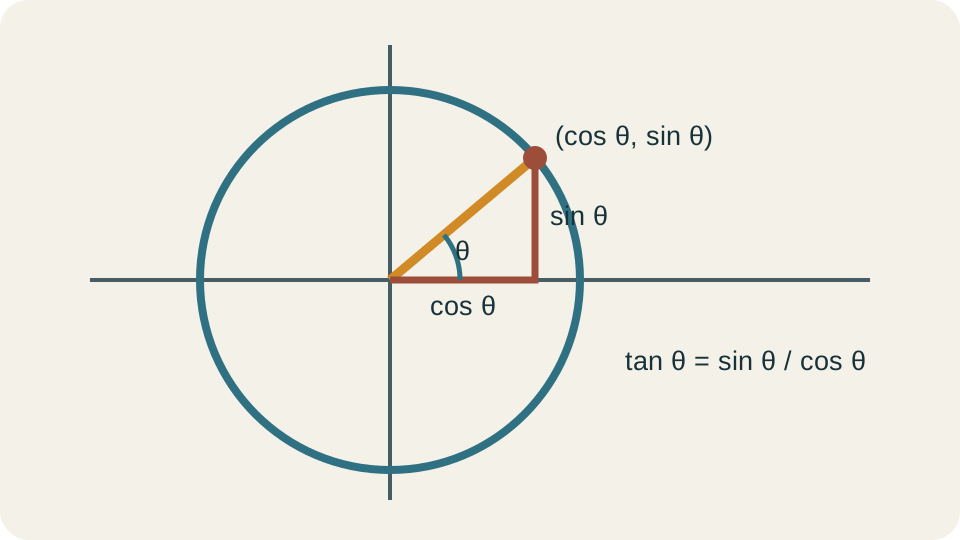
The quotient identities are and . On a unit circle, cosine is the horizontal coordinate and sine is the vertical coordinate. Tangent therefore compares vertical displacement with horizontal displacement. Cotangent reverses that comparison. These ratios connect all six trigonometric functions to sine and cosine.
Domain restrictions follow directly from denominators. Tangent and secant require , which excludes odd multiples of . Cotangent and cosecant require , which excludes integer multiples of . The symbol represents half a full rotation in radians, and an integer multiple is written for . Domain language turns a memorized identity into a precise mathematical statement.
Derive the Pythagorean family
Every point on the unit circle satisfies . For the point at angle , the coordinates are and . Substitution gives . The notation means , not . Geometry therefore produces the central Pythagorean identity.
Divide all terms by where cosine is nonzero. The result is . Quotient and reciprocal identities then give . Division creates the restriction . The derived identity is valid precisely where tangent and secant are defined.
Dividing instead by gives . This version requires . The three equations are not unrelated facts but transformations of one geometric relation. Remembering their family structure makes reconstruction possible when memory fails. It also helps a learner choose the version containing the functions present in a problem.
Rearrange without losing meaning
The central identity can be rearranged as or . These forms frequently replace a difference involving one function with a square of the other. Rearrangement uses addition or subtraction on both sides and does not add domain restrictions. The equality remains global because sine and cosine are defined for every real input. Equivalent forms are tools for matching a target expression.
Square roots require more care. From , one obtains , not automatically . The absolute-value bars mean nonnegative magnitude. Choosing a positive or negative sign requires knowing the angle’s quadrant. Squaring loses sign information, so reversing that operation must restore it.
For example, if and lies in Quadrant II, then . Thus . Cosine is negative in Quadrant II, so . The identity supplies magnitude while geometric location supplies sign. Both pieces of information are necessary for a complete conclusion.
Derive angle-addition formulas
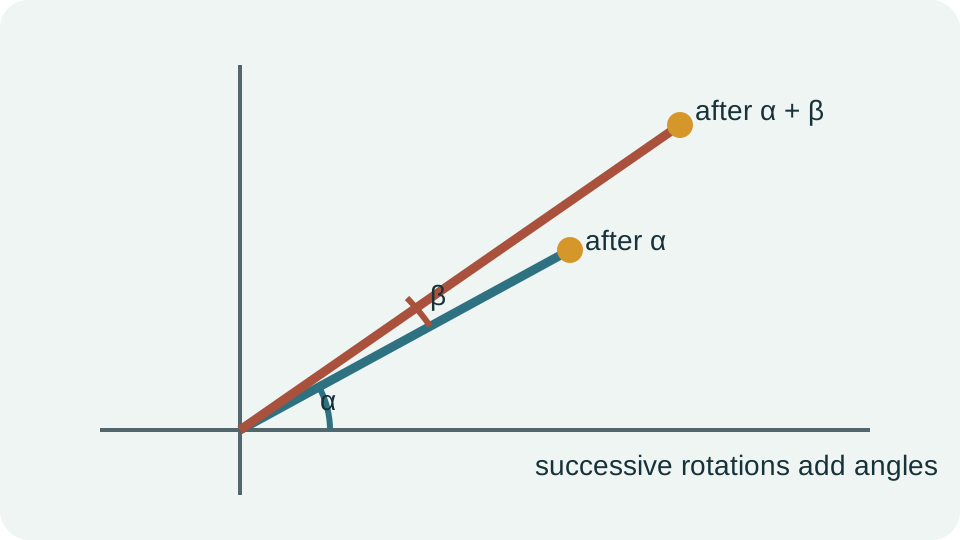
Angle-addition identities describe a rotation by a sum as two successive rotations. A rotation through angle sends a vector to . Start with the unit vector . Rotating it by must produce the unit vector at angle . Equating coordinates produces the sine and cosine sum formulas.
The cosine formula is . The sine formula is . The minus sign in the cosine formula arises from the horizontal coordinate of the rotation. The sine formula contains two positive cross terms. Seeing the rotation structure is more dependable than memorizing a string of symbols.
Replace with to obtain difference formulas. Since cosine is even, , and sine is odd, . Therefore . Similarly, . Parity explains why the signs change.
Compute exact values from known angles
The angle can be written as . The degree symbol indicates that one full rotation contains degrees. Apply the sine addition identity to get . Known special-angle values make every factor exact. No decimal approximation is required.
Substitution gives . Multiplying yields . Combining equal denominators gives . The radical symbol denotes the principal nonnegative square root. A calculator gives about , which is reasonable for a first-quadrant angle near .
For , use . The difference formula gives . The same values produce . Sine of equals cosine of because the angles are complementary. This agreement is a structural check rather than a coincidence.
Generate double-angle identities
Set in the addition formulas. For sine, . The argument means twice the angle, while the coefficient two multiplies the product. These operations must not be confused. Double-angle formulas relate function values at two different angular scales.
For cosine, . Substituting gives . Substituting instead gives . All three versions are identities. The best choice depends on which function a problem contains.
Solving the latter forms for the squares gives the power-reduction identities and . These equations replace squared functions with first powers at a doubled angle. They are especially useful when integrating trigonometric powers. The horizontal fraction bar groups the entire numerator over two. Reading grouping correctly is essential when substituting these formulas.
Verify identities through one-sided transformation
To verify , begin with the more complicated left side. Replace by . The expression becomes . Canceling a common factor gives wherever . This matches the right side on the original left side’s domain.
Transforming only one side preserves a visible chain of established equalities. If both sides are altered independently, accidentally reaching the same false expression may hide a nonreversible step. Every line should follow from an identity, factorization, common denominator, or other justified algebraic operation. An equals sign asserts that the adjacent expressions have the same value. It should never mean merely “the next thing I tried.” A reader should be able to justify every transition without guessing what happened between lines.
Cancellation applies to factors, not terms. In , the sine in the denominator cannot cancel only the sine term in the numerator because the numerator is a sum. Splitting correctly gives . Factoring can sometimes create a common factor, but addition alone does not. This algebraic discipline is as important as knowing the trigonometric identities.
Choose transformations strategically
Begin by comparing the functions and operations on both sides. If one side contains secant and tangent while the other contains cosine, rewriting everything in sine and cosine often reveals common structure. If a numerator contains , a Pythagorean replacement is likely useful. If angles are added or doubled, angle formulas should be considered. Strategy means matching visible features to a small catalog of structural moves.
Fractions often become manageable through a common denominator or multiplication by a conjugate. The conjugate of is . Their product is , which becomes . This move can turn a complicated reciprocal expression into a simple quotient. The reason it works is the difference-of-squares pattern .
For example, simplify by multiplying numerator and denominator by . The result is . Canceling one cosine factor gives . The original restrictions remain, including inputs where the original denominator vanishes. A successful simplification preserves values on the original domain.
Connect identities to graphs and waves
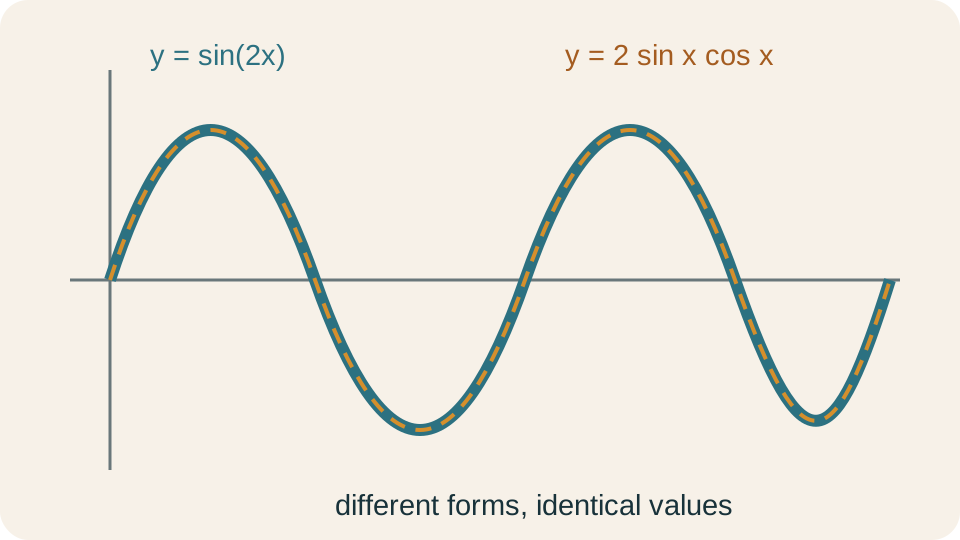
Identities explain why different-looking formulas can produce the same graph. For example, and agree at every real input. The doubled argument makes the second graph complete two cycles while completes one interval. The product form hides that frequency relationship. Switching forms can expose amplitude, frequency, symmetry, or zeros.
A linear combination can be rewritten as . Here is the resulting amplitude, and the Greek letter phi, , is a phase angle. Expanding the cosine difference gives . Matching coefficients requires and . The Pythagorean identity confirms that these conditions are compatible.
This amplitude-phase form models combined oscillations with the same frequency. Two perpendicular components can also be interpreted as coordinates of a vector with magnitude . Identities therefore connect algebraic manipulation with physical superposition. A graph provides a useful check because equivalent forms must coincide point for point on their shared domain. Visual agreement supports understanding, although algebraic proof establishes universality.
Solve equations without confusing identity steps
Consider on . The double-angle identity changes the equation to . This transformation is valid for every , but the resulting statement remains an equation true only at solutions. Since ranges from zero up to but not including , two full sine cycles must be considered. Restricting attention to one cycle would lose solutions.
Within , sine equals one-half at . Dividing each equation by two gives . The symbol means less than or equal to, while excludes the endpoint. Each candidate lies in the requested interval. Substitution into the original equation confirms the set.
Dividing an equation by a trigonometric expression can discard solutions where that expression is zero. Factoring and using the zero-product property is often safer. For example, becomes . Solutions come from either or . Dividing immediately by would erase the first branch.
Diagnose common errors
The expression is not equal to in general. Taking produces but . This counterexample disproves the false distribution rule. Trigonometric functions are nonlinear and do not distribute over addition. The correct sum formula contains products of sine and cosine values.
Another error is dropping domain restrictions after simplification. The expression simplifies to one only where . It is not defined at integer multiples of , even though the constant one is. Simplified expressions can extend a function to previously missing points, but that extension is not identical to the original domain. Recording exclusions preserves the exact statement being proved.
Calculator mode can also create misleading evidence. Angles measured in degrees and radians use different numerical inputs. For example, , while in radian mode is not one-half. A written degree symbol or a multiple of signals the intended unit. Exact work should preserve radicals and fractions until an approximation is explicitly useful.
Practice a repeatable verification routine
First state the shared domain and identify any denominators. Second choose the more complicated side and list candidate identities suggested by its structure. Third make one justified transformation per line. Fourth factor before canceling and record any restrictions created by division. Fifth stop when the target expression appears and state that the identity is verified on the shared domain.
Apply the routine to . Rewrite the numerator as . Dividing by means multiplying by its reciprocal . The product simplifies to . The derivation applies where the original secant and tangent expressions and the division are defined.
As a second exercise, derive . Begin with the sine sum divided by the cosine sum. Divide every numerator and denominator term by . Quotient identities then produce the desired tangent expression. Domain restrictions arise whenever the cosine factors or final denominator equal zero. Explaining those restrictions completes the derivation.
Consolidate the identity network
The reciprocal and quotient identities reduce all six functions to sine and cosine. The Pythagorean family encodes the unit circle, while angle-addition formulas encode rotation. Double-angle and power-reduction identities follow from those earlier relationships. This hierarchy means a small number of ideas can regenerate a large formula collection. Understanding dependencies is more durable than memorizing an unorganized table.
Rigorous identity work combines trigonometry with careful algebra. Fractions require common denominators, cancellation requires factors, and square roots require sign analysis. Every denominator introduces a domain question. Every equals sign needs a reversible or otherwise justified step. These habits prepare the learner for symbolic work in calculus and differential equations.
When an expression seems complicated, ask what structure is hidden rather than searching randomly. Rewrite functions, expose a Pythagorean pair, factor, use a conjugate, or change an angle form. Then check domains, special values, symmetry, and graphs. Identities are a language for recognizing that multiple representations carry the same mathematical content. Mastery means being able to explain why a transformation works and when it is valid.