
Integration is less algorithmic than differentiation because many different functions can hide the same derivative structure. A successful method transforms an unfamiliar integrand into one whose antiderivative is known. The important skill is therefore method selection, not merely carrying out a memorized procedure. This lesson organizes substitution, integration by parts, trigonometric rewriting, partial fractions, and improper integrals around the idea of reducing complexity. Every proposed antiderivative is verified by differentiation, and every definite result is checked against sign, bounds, units, and approximate size.
An integral that resists the first method is not evidence that integration has failed. It is evidence that the integrand should be read again from another structural viewpoint. One representation may emphasize a composition, while another exposes a product or rational decomposition. Experienced problem solvers test a promising transformation, measure whether complexity falls, and revise their choice when it does not. The reasoning used to abandon an unhelpful method is as valuable as the algebra used to finish a successful one. Careful notation preserves those decisions so another reader can audit the entire argument from beginning to end.
Learning objectives and strategic thinking
By the end of this lesson, you will choose an integration method from visible algebraic and derivative structure. You will use substitution as a reverse chain rule and integration by parts as a reverse product rule. You will rewrite trigonometric powers and decompose rational functions. You will define improper integrals through limits. You will also explain why a transformation makes the problem simpler.
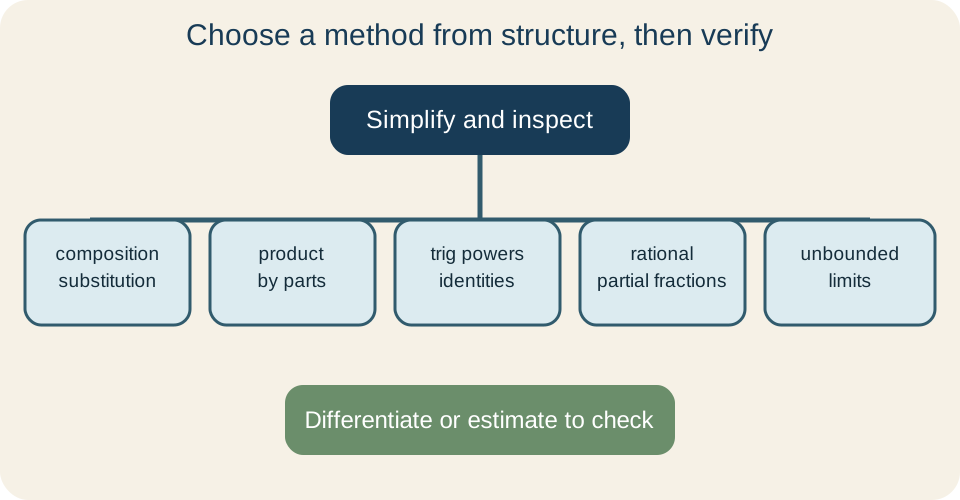
Method selection begins before formal integration. Simplify algebraically, factor or divide when helpful, and identify compositions, products, and rational structures. Compare pieces of the integrand with derivatives you know. Ask what change would reduce polynomial degree, remove a composition, separate denominator factors, or lower a trigonometric power. A technique is useful only when its result is genuinely easier.
No decision tree solves every integral, but structural signals are dependable. An inner expression accompanied by its derivative suggests substitution. A product involving a polynomial, logarithm, or inverse trigonometric function often suggests integration by parts. A rational function suggests division and partial fractions, while trigonometric powers suggest identities. The roadmap below makes these signals explicit without pretending they are automatic proofs.
Simplify before selecting a technique
Algebra can turn a complicated-looking integral into a direct one. Expand a product when it creates a sum of powers, split a numerator across a common denominator when valid, and rewrite roots as fractional exponents. Factor when it exposes cancellation or a substitution pattern. Preserve original domain restrictions after cancellation. The simplest correct form is the best starting point.
For , . Therefore on an interval excluding zero. The simplified expression extends through zero, but the original integrand does not. Differentiation verifies the result on the stated interval. Domain and antiderivative formula must be reported together.
Polynomial division precedes partial fractions when the numerator degree is at least the denominator degree. For example, divide by before decomposing the remainder. This gives . Each term now has an immediate antiderivative. Attempting partial fractions on an improper rational function hides this simple structure.
Use substitution as a reverse chain rule
Substitution targets the pattern . Set , so . The symbol records how the differential changes under the new variable. Rewrite the entire integrand in terms of and . Then integrate in and substitute back for an indefinite integral.
Evaluate . Choose , so . The integral becomes . Substituting back gives . Differentiation produces .
Constant mismatches can be corrected. For , the same substitution gives , so . The result is . Do not invent a substitution merely because an inner expression is visible; enough of its derivative must be present or created by algebra. The derivative check reveals missing compensation factors.
Transform definite bounds consistently
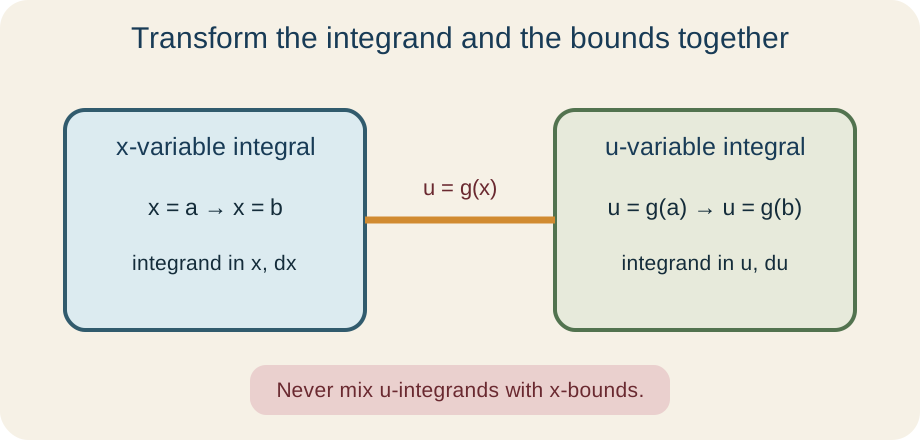
For a definite integral, one may substitute back to the original variable before applying original bounds. Alternatively, transform the bounds into the new variable and remain in that variable through evaluation. Both methods are valid. Mixing a transformed integrand with original-variable bounds is not valid. Label each bound with its variable during the substitution.
Evaluate . With , the lower bound becomes and the upper bound becomes . The transformed integral is . Endpoint evaluation gives . No back-substitution is necessary because the bounds are already in .
Orientation can change under substitution. If the inner function decreases, transformed lower and upper bounds may reverse numerical order. Preserve their mapped order rather than silently sorting them. A reversed definite integral naturally carries a negative sign. This behavior agrees with the chain-rule factor contained in .
Derive integration by parts
The product rule is . Integrating both sides gives . Rearranging yields . The notation and packages derivative factors. Integration by parts transfers a derivative from one factor to another.
Choose so differentiation simplifies it and choose so it can be integrated. For , take and . Then and . The formula gives . Differentiation returns .
The minus sign is structural and must not be dropped. A useful selection guide favors logarithms and inverse trigonometric functions for , followed by algebraic factors, but it is a heuristic rather than a theorem. The decisive question is whether the remaining integral becomes simpler. If a choice reproduces the same complexity without a solvable equation, choose again. Always compute and explicitly before substitution into the formula.
Repeat integration by parts when complexity falls
Some products require repeated use. For , choose and . This gives . The polynomial degree has dropped from two to one. That measurable reduction justifies repeating the method.
Apply integration by parts to . Choose and , giving . Substitution into the previous line yields . Differentiating the factored expression recovers . The check also confirms all alternating signs.
Tabular integration records repeated polynomial derivatives and repeated antiderivatives of the other factor. It is an efficient notation for cases such as a polynomial times , sine, or cosine. The table does not create a new theorem; it abbreviates repeated integration by parts. Signs alternate because the formula repeatedly subtracts the remaining integral. Stop when the differentiated polynomial becomes zero.
Rewrite trigonometric powers
Trigonometric identities can expose direct antiderivatives or substitutions. For even powers, power-reduction identities are often useful. The identity converts a squared function into a constant and a cosine. Therefore . Differentiation and the double-angle identity verify the result.
For products of sine and cosine, parity guides the rewrite. If one power is odd, save one factor and convert the remaining even power using . The saved factor supplies the derivative for substitution. If both powers are even, use power-reduction identities. This strategy follows derivative structure rather than surface memorization.
For powers of tangent and secant, the identities and organize choices. Saving a factor supports . Saving a factor supports . Domain intervals matter because trigonometric functions have discontinuities. Verify the final formula on an interval where the integrand is defined.
Use trigonometric substitution for radicals
Quadratic radicals can match Pythagorean identities. A radical suggests because . A radical suggests . A radical suggests . Each choice transforms the radical into a simpler trigonometric expression.
If , then . Also . Choosing an inverse-sine range where removes the absolute value correctly. This range choice is part of the method. Ignoring it can create sign errors when substituting back.
A reference triangle can translate trigonometric expressions back to . If , draw a right triangle with opposite side and hypotenuse . The adjacent side is . Then cosine and tangent follow from side ratios. An algebraic back-substitution is also possible, but every square root sign must agree with the chosen range.
Decompose rational functions with partial fractions
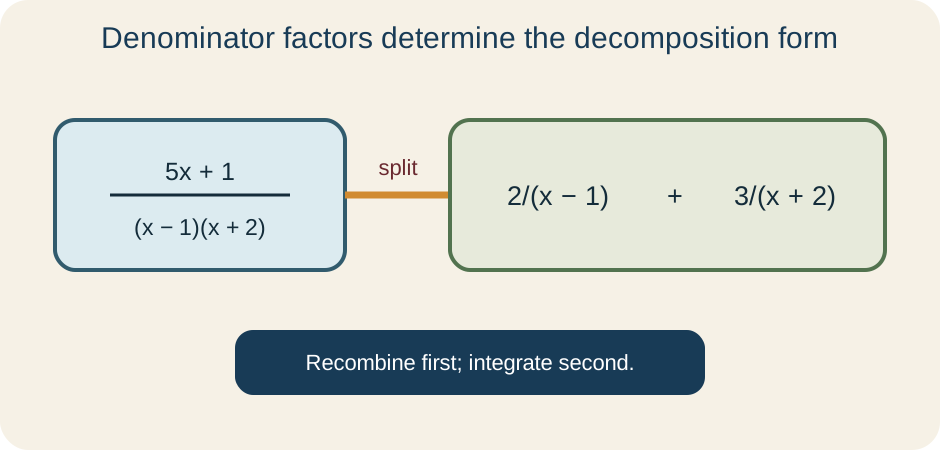
A rational function is a quotient of polynomials. After division makes it proper, factor the denominator over the intended number system. Each distinct linear factor receives a constant numerator. A repeated linear factor requires a term for every power up to its multiplicity. An irreducible quadratic factor receives a linear numerator.
Decompose . Write it as . Multiplying by the common denominator gives . Solving the coefficient equations gives and . Integration yields .
The absolute values belong in logarithmic antiderivatives of reciprocal linear factors. The original denominator excludes and , dividing the domain into intervals. Constants of integration may differ between disconnected intervals. Verify the decomposition before integrating by recombining the fractions. This algebra check separates coefficient errors from calculus errors.
Define and test improper integrals
An infinite bound or unbounded integrand makes an integral improper. Replace the problematic feature with a finite parameter and take a limit. For example, . The improper integral converges only when this limit exists and is finite. Antiderivative notation alone does not bypass the limit.
For , evaluate . The finite expression is . Its limit is one. Therefore the improper integral converges to one. The infinite symbol is never substituted as though it were an endpoint number.
If an integrand is unbounded at an interior point , split the integral into two independent limits. Both must converge. Opposite infinite behaviors do not cancel to produce an ordinary improper integral. A symmetric principal value is a different concept and must be named explicitly. Inspect the integrand’s domain before applying the Fundamental Theorem.
Combine techniques deliberately
Many integrals require more than one technique. Algebra may precede substitution, and substitution may create a rational function suited to partial fractions. Integration by parts may leave a trigonometric integral that needs identities. The order should produce consistent reductions. Write the goal of each transformation before performing it.
For , substitution is more direct than integration by parts. Set , so . The integral becomes . Integration by parts then gives . Substitute and differentiate to verify.
A failed approach can still reveal structure. If substitution leaves a more complicated integrand, reverse it and reassess. If integration by parts cycles back to the original integral with a usable coefficient, solve the resulting algebraic equation. If it cycles without progress, choose differently. Mathematical maturity includes abandoning a method for a stated reason.
Verify and estimate results
Differentiation is the decisive check for an indefinite integral. Apply product and chain rules fully, simplify, and compare with the original integrand. The arbitrary constant disappears as expected. State the interval on which the derivative agreement holds. A correct-looking table entry is not a substitute for this check.
For definite integrals, use sign and size. If a positive function never exceeds three on an interval of width two, its integral must lie between zero and six. Units should equal integrand units multiplied by input units. A numerical approximation can detect arithmetic mistakes. It does not replace the symbolic proof but provides independent evidence.
Common mistakes correspond to broken structure. Mixing transformed integrands with old bounds mixes variables. Omitting the minus sign in integration by parts contradicts the product-rule derivation. Skipping polynomial division invalidates a partial-fraction template. Evaluating an improper integral without a limit ignores its definition.
Guided practice and connection forward
Evaluate . Set , so . The result is . Differentiation gives . The factor one half compensates for the inner derivative.
Evaluate for . Choose and . Then and . Integration by parts gives . The domain supports the real logarithm.
For independent synthesis, evaluate for and justify your choice of method. Then determine whether converges, showing the required limit. Differentiate the antiderivative result and estimate the improper integral’s size before computing it. Explain how each check supports, but does not replace, the formal work. When elementary techniques fail, convergent series and numerical methods provide further representations and approximations.