
An angle is a directed rotation, not merely a corner cut from a triangle. This view allows angles to be positive, negative, larger than one revolution, and connected directly to motion. Radian measure then compares arc length with radius in a natural dimensionless ratio. The unit circle converts each terminal direction into coordinates that define sine and cosine. This lesson builds those ideas carefully so later trigonometry rests on geometry rather than memorization.
Treat an angle as a directed rotation
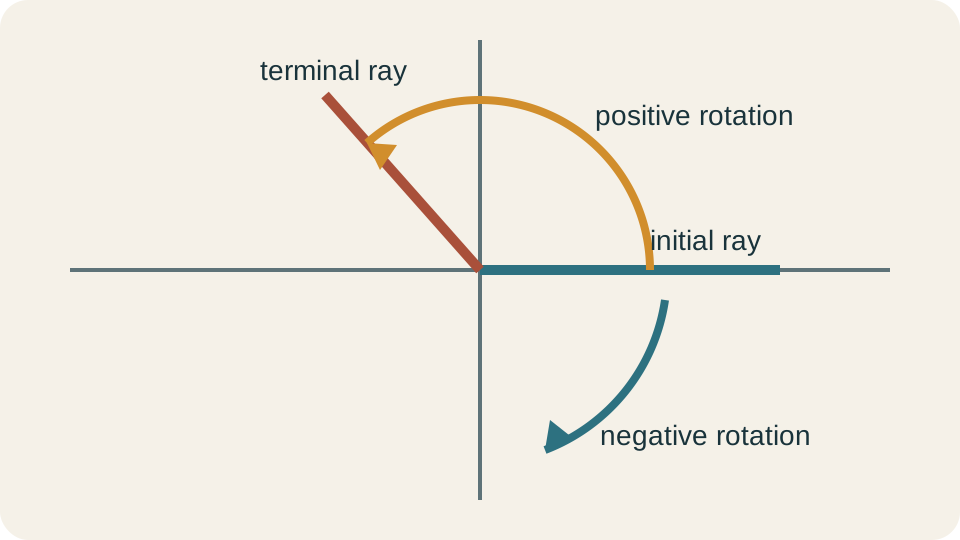
An angle begins with an initial ray and ends with a terminal ray. The vertex is the common endpoint of those rays. Rotation from the initial ray to the terminal ray determines both magnitude and direction. Counterclockwise rotation is conventionally positive. Clockwise rotation is conventionally negative.
This definition distinguishes an angle from the smallest corner between two lines. A rotation of ends in the same direction as but records one additional full revolution. A rotation of also ends there after turning clockwise. These angles share a terminal ray while representing different accumulated rotations. Motion, winding, and periodic behavior require that distinction.
Angle measure must always be accompanied by a unit or a clear convention. Degrees use the symbol , while radians may use during dimensional reasoning. A bare input inside a mathematical sine function is normally interpreted in radians. Calculator settings can change how typed numbers are interpreted. Clear notation prevents a correct calculation from answering the wrong angular question.
Place angles in standard position
An angle is in standard position when its vertex is at the coordinate origin and its initial ray lies on the positive horizontal axis. The terminal ray then determines a direction in the plane. This common placement makes different angles easy to compare. It also connects angular measure with coordinate geometry. The horizontal and vertical axes divide terminal directions into four quadrants.
Quadrant I contains directions with positive horizontal and vertical coordinates. Quadrant II has negative horizontal and positive vertical coordinates. Quadrant III has both coordinates negative. Quadrant IV has positive horizontal and negative vertical coordinates. Axis directions lie between quadrants and should not be assigned to either neighboring quadrant.
A terminal ray can be located by tracking complete rotations first and the remaining angle second. For example, . The first represents two full counterclockwise rotations. The remaining places the ray in Quadrant I. Decomposing large angles this way makes their geometry manageable.
Recognize coterminal angles
Coterminal angles have the same initial and terminal rays. In degrees, adding or subtracting produces a coterminal angle. In radians, adding or subtracting does the same. The general radian form is , where . The symbol denotes all integers, including zero and negative integers.
Coterminal angles are not equal as real numbers. They are equivalent with respect to terminal direction. For example, , , and end on the same ray. Their numerical values record different amounts and directions of rotation. Using the word “coterminal” preserves both their similarity and their difference.
To find a representative within a chosen interval, add or subtract full revolutions until the result fits. For , adding gives . This value lies between zero and . Both angles end in Quadrant II. The operation changes accumulated rotation without changing terminal direction.
Derive radian measure from arc length
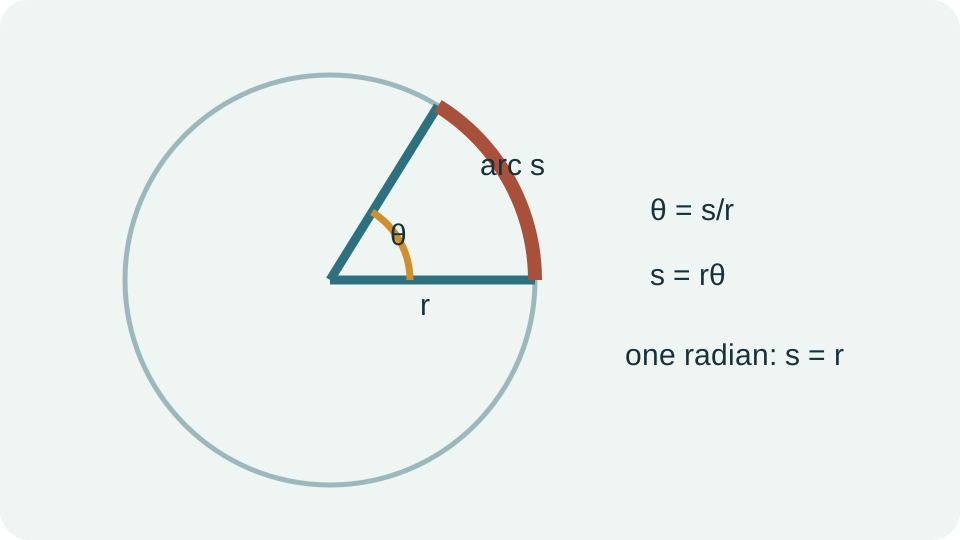
Consider a circle of radius and an arc of length cut off by a central angle. Radian measure is defined by . The numerator and denominator must use compatible length units. Their units cancel, so the radian measure is dimensionless. The angle records how many radius-lengths fit along the arc.
An angle of one radian cuts off an arc whose length equals the radius. This angle is about , but its definition does not depend on degrees. Doubling the circle while preserving the same direction doubles both and . Their ratio remains unchanged. Radians therefore measure angle independently of circle size.
Solving the definition for arc length gives . This compact formula is valid when is expressed in radians. The radius supplies length units, while the angular factor is dimensionless. Inserting a degree number directly would produce an incorrect scale. Conversion must occur before the formula is used.
Connect one revolution with two pi radians
A full circle has circumference . Substituting into gives . Thus one complete revolution measures radians. The same revolution measures . Equating them gives .
Dividing by two yields . This equality supplies conversion factors that equal one. To convert degrees to radians, multiply by . To convert radians to degrees, multiply by . Units show which orientation of the fraction performs the desired cancellation.
For example, . The degree units cancel, leaving radians. Conversely, . The factors and radian units cancel in the second calculation. Dimensional cancellation makes conversion systematic rather than mnemonic.
Compute arc length with units
A wheel of radius turns through . First convert the angle to radians. Then use . Substitution gives . The result is approximately .
The answer has length units because arc length is a distance along the circle. It is less than the full circumference . The angle is less than half a revolution, so an arc shorter than half the circumference is reasonable. Half the circumference is about . This magnitude comparison supports the numerical result.
If the wheel completes three full turns plus the stated , total rotation is radians. The total traveled arc would then be . Coterminal direction alone would not capture this additional travel. Arc length depends on accumulated rotation, not only the final orientation. Context determines which angle representative is physically meaningful.
Define the unit circle
The unit circle is the set of points one unit from the origin. Its equation is . This equation follows from the distance formula or Pythagorean theorem. The variables and represent horizontal and vertical coordinates. Squaring removes their signs while preserving their contributions to distance.
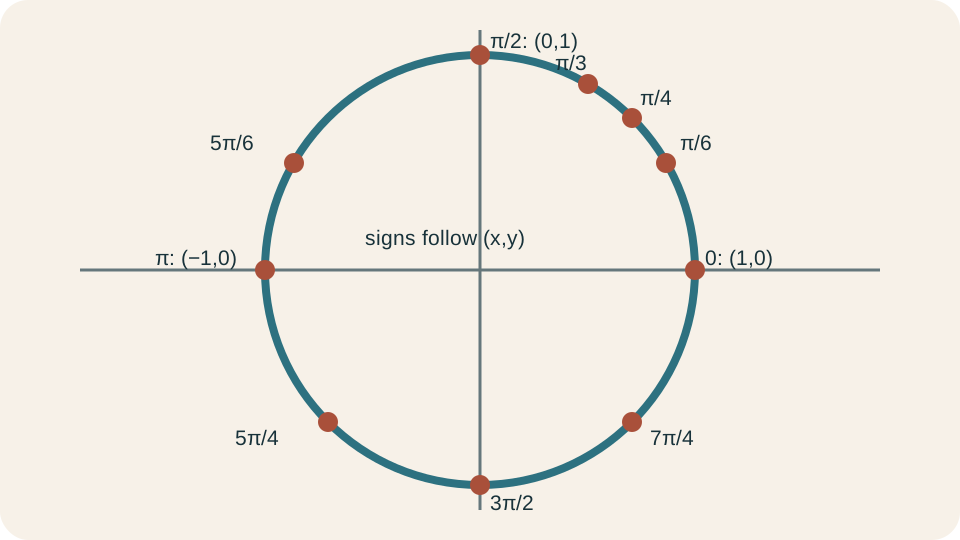
For each angle in standard position, the terminal ray meets the unit circle at one point . That point is defined as . Cosine is therefore the horizontal coordinate, and sine is the vertical coordinate. The order must not be reversed. This definition applies to all real angles.
Substituting these coordinates into the circle equation gives . The notation means . This Pythagorean identity is true for every real angle. It expresses the fixed unit distance of the terminal point from the origin. A fundamental trigonometric identity therefore comes directly from circle geometry.
Build exact values from special triangles
At angle , the reference triangle is a -- triangle. Its legs have equal magnitude. On a unit hypotenuse, each leg equals . The terminal point in Quadrant I is . Both coordinates are positive there.
At angle , a -- triangle supplies side proportions . Scaling the hypotenuse to one gives legs and . The horizontal coordinate is the longer leg for . Thus the point is . At , those coordinates exchange places.
Axis angles complete the first-quadrant framework. At zero, the point is . At , it is . These points do not form nondegenerate reference triangles, but their coordinates are immediate from the axes. Together, , , , , and generate the standard exact-value pattern.
Use reference angles across quadrants
A reference angle is the acute angle between a terminal ray and the horizontal axis. It always lies between zero and . Reference angles determine coordinate magnitudes because reflected unit-circle triangles are congruent. Quadrants determine coordinate signs. This separates a full-angle problem into magnitude and direction.
For , the reference angle is . The terminal point lies in Quadrant II. Its horizontal coordinate is negative, and its vertical coordinate is positive. Therefore . The exact magnitudes match the first-quadrant point.
For , the reference angle is . Quadrant IV has positive horizontal and negative vertical coordinates. The point is . A sketch makes the sign choice transparent. Memorizing unsigned values without quadrant reasoning is not enough.
Interpret coordinates and symmetry
Reflection across the horizontal axis changes to . On the unit circle, angles and have this relationship. Therefore and . Cosine is called even, while sine is called odd. These properties follow from coordinates rather than from an arbitrary rule.
Reflection across the vertical axis changes to . Angles and are related this way when interpreted appropriately. Thus their sine values agree while their cosine values have opposite signs. Half-turn rotation changes both coordinate signs. Circle symmetries generate many trigonometric relationships.
Periodicity follows because adding returns to the same unit-circle point. Hence and for integer . The functions repeat even though the real input has changed. Coordinates depend on terminal direction. Accumulated rotation matters in other contexts such as arc travel, so the input itself is not erased.
Relate angular and linear motion
If an object moves around a circle, its angular displacement and traveled arc length satisfy . If the angle changes over time, angular speed can be written . The Greek letter omega, , commonly represents angular speed. Its units may be radians per second. Radians are dimensionless, but retaining the label clarifies angular meaning.
For constant angular speed, when the initial angle is zero. Substitution into arc length gives . Dividing by time yields tangential speed . Here has units of meters per second when is in meters and is in radians per second. The relationship connects rotational description with ordinary linear speed.
A point from an axis rotating at has tangential speed . The radian label is dimensionless in the product. A point farther from the axis travels a longer arc during the same angular change. Equal angular speed does not imply equal linear speed at different radii. This distinction is foundational for circular motion.
Keep radians central in advanced formulas
Many calculus formulas take their simplest form only when angles are measured in radians. For example, the limit of as approaches zero equals one when is in radians. A degree-based input would introduce an additional conversion factor. The derivative of is without a coefficient only in radian measure. Radians align angular change directly with arc geometry.
The small-angle approximation also requires radians. It comes from comparing a short unit-circle arc with nearby vertical displacement. At , sine is approximately , close to the angle. At , the numerical comparison would be meaningless without conversion. Approximation formulas inherit the units used in their derivations.
Calling radians dimensionless does not make degree and radian numbers interchangeable. Dimensionless ratios can still encode different conventions. A percentage and a decimal fraction are both dimensionless but require a factor of one hundred between their numerical forms. Degrees and radians similarly require the factor . Preserving the radian label during learning makes that convention visible.
Diagnose common angle errors
One common mistake is switching the coordinate order. The unit-circle point is because horizontal coordinate comes first. Writing sine first incorrectly swaps horizontal and vertical information. Checking the zero-angle point exposes the error because must be . A correct ordering reproduces that obvious geometry.
Another mistake is treating coterminal angles as numerically equal. The equations and are false as statements about real numbers. The angles are instead coterminal. Their sine and cosine values agree because their terminal points agree. Precise vocabulary prevents equivalence of direction from becoming equality of measure.
A third mistake is placing a degree value directly into . If and the angle is , writing is incorrect. Conversion gives radians and . The result is one quarter of the circumference, as expected. Geometry and units jointly diagnose the bad substitution.
Practice a complete unit-circle routine
First reduce an angle to a convenient coterminal representative if terminal direction is the goal. Second identify its quadrant or axis. Third find the reference angle. Fourth use a special triangle or known first-quadrant coordinate magnitudes. Fifth assign signs from the actual coordinate location and state the ordered pair.
Apply the routine to . Adding gives the coterminal angle . Its reference angle is , and its terminal ray lies in Quadrant II. The coordinate magnitudes are both . Therefore the point is .
For an arc-length practice problem, let a disk of radius turn through radians. The traveled arc is to three significant figures. The angle is slightly less than one full revolution, so the answer should be slightly less than the circumference . This comparison verifies scale and units. It also confirms that accumulated rotation, rather than only terminal direction, was used in the distance calculation.
Consolidate angular reasoning
Angles record directed rotation. Standard position connects that rotation to coordinate axes, while coterminal angles distinguish final direction from accumulated travel. Radian measure compares arc length with radius. The unit circle turns a direction into the coordinates . These ideas form one connected geometric system.
Exact values arise from special triangles embedded in the unit circle. Reference angles preserve magnitudes across reflections, and quadrants determine signs. Symmetry explains even, odd, and periodic behavior. Arc formulas link angular displacement with linear distance and speed. Every later trigonometric function inherits this foundation.
A reliable learner moves between rotation, arc, coordinate, triangle, and algebraic representations. Units guide degree-radian conversion and physical interpretation. Sketches make quadrants and signs visible. Limiting and magnitude checks expose unreasonable answers. With these habits, the unit circle becomes a reasoning tool rather than a chart to memorize.