
The Pythagorean theorem is one of geometry’s most recognizable formulas, but its meaning is richer than a recipe for a missing side. It states an exact relationship among areas constructed on the sides of a right triangle. That area relationship supports distance measurement, coordinate geometry, vector magnitude, construction, and later trigonometry. It also has a converse that can determine whether a triangle is right. Understanding the conditions and proof makes the formula easier to apply correctly.
The theorem belongs specifically to Euclidean right triangles. It does not apply unchanged to an arbitrary triangle, and the letter is not automatically the longest side unless it has been assigned to the hypotenuse. Units must be squared before areas are added and restored through a square root when a length is recovered. This lesson develops two proofs and several applications while making those structural details explicit. The aim is to reconstruct the relationship from geometry rather than depend on a fragile memory of symbols.
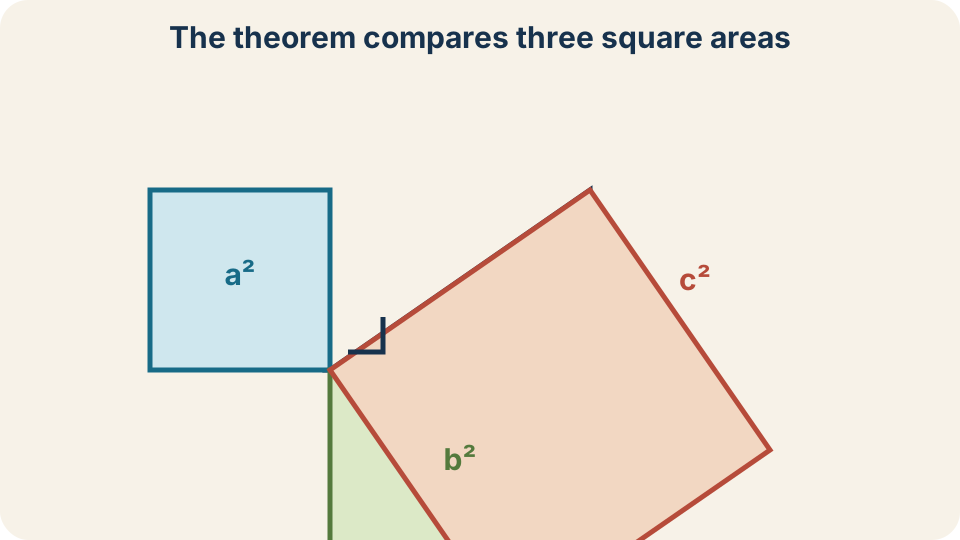
The two legs meet at the right angle. The hypotenuse lies opposite that angle and is the longest side. A square built on a side of length has area . The theorem says the two leg-square areas equal the hypotenuse-square area. It compares areas even though it is usually used to calculate lengths.
Identify the right triangle correctly
A right triangle contains one angle. The two sides that form this angle are called legs. The side opposite the right angle is the hypotenuse. Because it lies opposite the largest angle, the hypotenuse is the longest side. Correct identification must happen before any values are placed into a formula.
Let the leg lengths be and , and let the hypotenuse length be . The Pythagorean theorem states . The superscript means each length is multiplied by itself. The equation is symmetric in and , so the two legs can exchange names. The hypotenuse cannot exchange places with a leg without changing the equation’s meaning.
A right-angle box in a diagram is stronger evidence than the drawing’s appearance. Diagrams may not be drawn to scale. If no right angle is given or established, the theorem cannot simply be assumed. Sometimes perpendicular horizontal and vertical directions establish the right angle. Sometimes the converse of the theorem is used to prove it from side lengths.
Read the theorem as an area statement
Construct a square outward on each side of a right triangle. The square on leg has area , and the square on leg has area . The square on hypotenuse has area . The theorem says the first two areas add exactly to the third. This interpretation explains why the lengths appear squared.
Suppose the legs are and . Their attached squares have areas and . The sum is , so the hypotenuse square has area . Its side length is . The square root returns from area units to length units.
Dimensional consistency provides an immediate check. One may add square centimetres to square centimetres, but not centimetres to square centimetres. In , all three terms have length-squared dimensions. Solving restores a length. An answer such as for the hypotenuse in the preceding example confuses area with length.
Prove the theorem by rearranging areas
Begin with a large square whose side length is . Place four congruent right triangles inside so that their hypotenuses form a smaller central square. Each triangle has legs and and area . The central square has side and area . Both descriptions account for exactly the same large region.
The large-square area is . The pieces give total area . Equating descriptions yields . Expanding the left side gives . Subtracting from both sides leaves .
This proof uses congruence, area addition, distribution, and algebra. It does not assume the theorem inside its own reasoning. The four triangles fit because their acute angles are complementary, so they create right angles around the central figure. The central figure has four equal sides and four right angles, making it a square. Every algebraic term corresponds to a visible region.
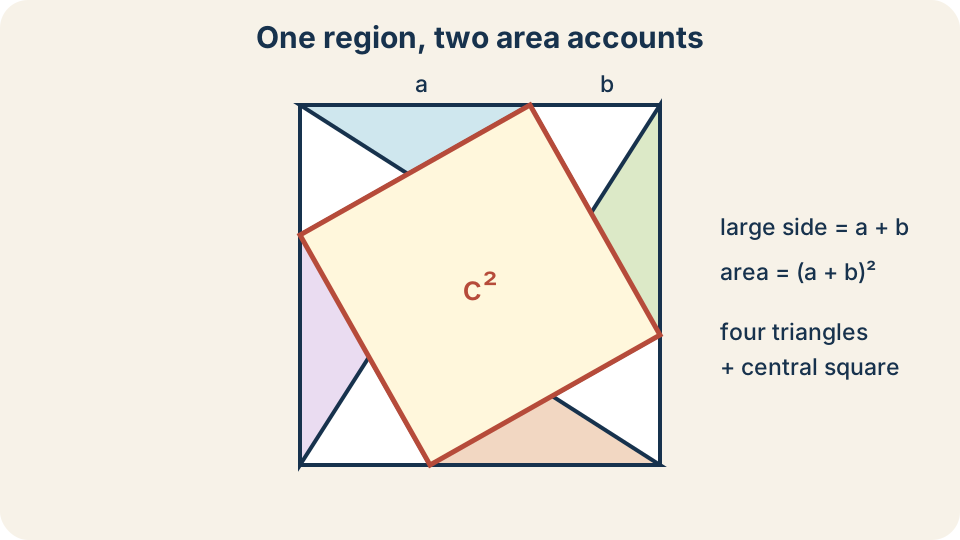
The large square has side . Four congruent triangles contribute total area . Their hypotenuses enclose a central square of area . Expanding the large-square area creates the same term. Canceling that shared area leaves . Every algebraic term corresponds to a visible region.
Prove the theorem through similarity
Drop an altitude from the right-angle vertex to the hypotenuse. The altitude is perpendicular to the hypotenuse and divides it into segments of lengths and . Therefore . The altitude creates two smaller right triangles. Each smaller triangle is similar to the original by angle–angle similarity.
Appropriate corresponding-side proportions give and . These equations can be interpreted as projection relationships. The square of each leg equals the hypotenuse times the adjacent segment of the hypotenuse. Adding gives . Factoring produces .
Since , substitution yields . This proof shows that the theorem is embedded in the proportional structure of similar right triangles. It also generates additional useful relationships involving the altitude. The rearrangement proof emphasizes area decomposition, while this proof emphasizes angle and ratio preservation. Multiple proofs deepen understanding by exposing different reasons the statement must hold.
Solve for a missing hypotenuse
When both legs are known, isolate the hypotenuse as . The negative square root is rejected because a geometric side length is nonnegative. Square each measured length with its unit, add the square quantities, and then take the square root. The result must exceed either individual leg. If it does not, the calculation or side assignment is wrong.
For legs and , . The squared contributions are and . Their sum is . Taking the square root gives . This is the familiar –– right triangle.
Keep the radical until the end when values are not perfect squares. Early rounding can distort the final answer. If legs are and , the exact form is . A decimal approximation is to three significant figures. Exact and approximate forms answer different reporting needs.
Solve for a missing leg
When the hypotenuse and one leg are known, subtract the known leg square before taking a square root. From , solving for gives . The hypotenuse square must be the larger quantity. Reversing the subtraction would create a negative radicand in a valid triangle. Side identification therefore controls the algebra.
A ladder reaches up a vertical wall. Level ground and the vertical wall form a right angle. If is the horizontal distance from wall to ladder foot, then . Solving gives with unrounded intermediate values. The positive root is selected because is a distance.
The result can be checked without recomputing every digit. A leg must be shorter than the hypotenuse, and is. Substitution gives . The ratio simplifies to . Pattern recognition reinforces the numerical verification.
Use the converse to establish a right angle
The converse states that if side lengths satisfy , with the largest side, then the triangle is right. A converse reverses the direction of an implication. The theorem begins with a right triangle and concludes a length relation. The converse begins with the length relation and concludes a right angle. Both statements are true, but they are logically distinct.
To test side lengths , , and , assign because it is largest. Then . Also . Equality proves the triangle is right. The angle opposite the side is therefore .
Builders can use this converse to establish perpendicular lines. A triangle marked with proportional lengths , , and will contain a right angle opposite its longest side. Scaling by any positive factor preserves the relation. Thus lengths , , and also create a right triangle. The method converts distance measurement into angle construction.
Classify acute and obtuse triangles
Let be the largest side of a triangle. If , the angle opposite is right. If , that largest angle is acute. If , that largest angle is obtuse. These comparisons extend the theorem through the law of cosines.
Consider side lengths , , and in the same length unit. The largest side is , so compare with . Since , the angle opposite the side of length is obtuse. A triangle’s largest angle lies opposite its largest side. Therefore the triangle is classified as obtuse.
First verify that the lengths can form a triangle. The sum of any two side lengths must exceed the third. Values , , and fail because . Applying the square comparison to them would classify a nonexistent Euclidean triangle. Conditions must be checked before a theorem is used.
Generate and recognize Pythagorean triples
A Pythagorean triple is a set of positive integers satisfying . Examples include , , , and . Multiplying every entry by the same positive number produces another right-triangle ratio. Thus is a scaled form of . Recognizing triples can speed exact calculations.
Primitive triples have no common integer factor greater than one. One generation formula uses positive integers : , , and . Substitution verifies the theorem because . The algebra expands both sides to . Additional parity and common-factor conditions identify primitive cases.
The generation formula shows that integer examples are structured rather than accidental. It is not necessary for routine missing-side calculations. Use it when exploring number patterns or constructing exact right triangles. Do not force a decimal measurement into the nearest familiar triple. Measured systems require calculation and uncertainty rather than pattern substitution.
Derive the coordinate distance formula
Take points and in a Cartesian plane. Their horizontal change is , and their vertical change is . Horizontal and vertical directions are perpendicular. These changes form the legs of a right triangle whose hypotenuse is the straight-line distance. Applying the theorem gives .
Taking the nonnegative square root yields . This is not an unrelated formula to memorize. It is the Pythagorean theorem expressed through coordinate differences. Reversing the subtraction order inside either squared difference gives the same result. Mixing the order inconsistently still works after squaring, but a consistent convention prepares later vector work.
For points and , coordinate units and coordinate units. Therefore coordinate units. The negative vertical change indicates direction, but squaring removes that sign for distance. Distance is a magnitude and must be nonnegative. The result is greater than either component magnitude and smaller than their sum.
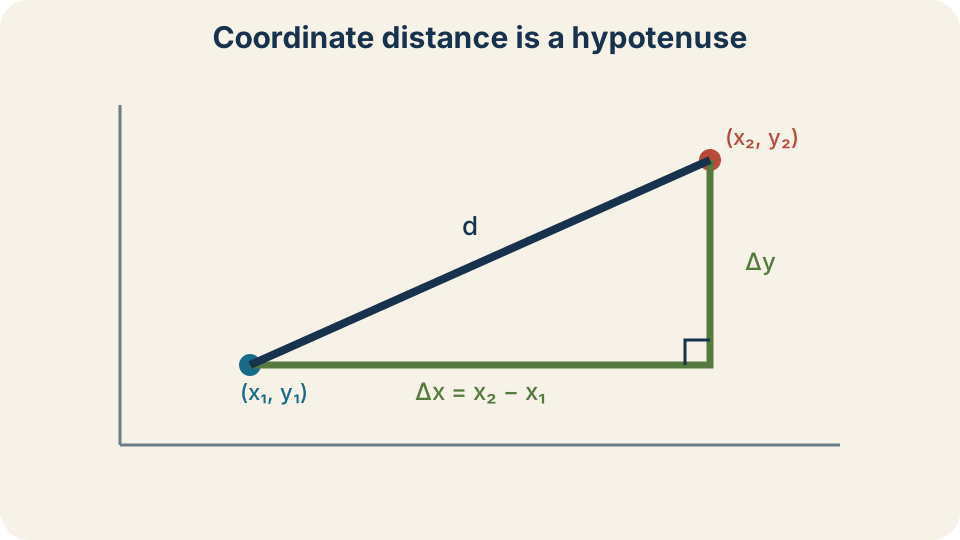
Horizontal change and vertical change form perpendicular legs. Their signs record direction, while their squares contribute positively to distance. The segment between the points is the hypotenuse. Applying the theorem produces the distance formula. The same construction later gives vector magnitude from components. Perpendicularity is what permits the contributions to be combined by squares.
Extend distance into three dimensions
In three-dimensional rectangular coordinates, perpendicular changes are , , and . First combine two directions to obtain a planar diagonal. Then combine that diagonal with the third perpendicular direction. The result is . This is repeated application of the same right-triangle relation.
For a box measuring by by , the space diagonal is . The squared sum is . Therefore . Each contribution is squared because the dimensions are mutually perpendicular. The final square root restores metre units.
The pattern generalizes algebraically to higher-dimensional Euclidean spaces. Orthogonal components contribute through a sum of squares. In physics, velocity magnitude is . In data analysis, Euclidean distance uses the same structure across feature coordinates. The geometric theorem becomes a general rule for magnitudes of perpendicular components.
Model measurement and uncertainty responsibly
Real side lengths are measured rather than known exactly. A ladder reported as may represent limited precision. Calculated results should not claim unjustified extra digits. Keep additional digits during intermediate calculations and round once at the end. Report units and a precision consistent with the inputs.
The theorem also assumes ideal right-angle geometry. A wall that leans or ground that slopes changes the included angle. The law of cosines would then replace the right-triangle specialization. Measurement uncertainty in the angle can affect the inferred distance. A model is reliable only when its geometric assumptions reasonably match the situation.
Estimate before calculating. A hypotenuse must exceed the longest leg but be less than the sum of the legs. A missing leg must be less than the hypotenuse. Coordinate distance cannot be smaller than the magnitude of either single coordinate change. These bounds catch misplaced squares, sign errors, and wrong side assignments.
Repair common mistakes
One mistake is to label the longest-looking drawn side as the hypotenuse without locating the right angle. The hypotenuse is defined by being opposite the right angle. Another mistake is to apply to every triangle. Establish perpendicularity first or use the converse after measuring all sides. An arbitrary triangle requires the law of cosines.
Another mistake is to write or . Squaring does not distribute across addition in that way. The square root must cover the complete sum of squares. When solving for a leg, subtract the known leg square from the hypotenuse square. Preserve parentheses around measured values and units.
A final mistake is to stop at a squared length when the question asks for a length. If , then , not . The negative algebraic root is excluded for an ordinary geometric length. In coordinate work, use coordinate differences rather than coordinate sums. Units and magnitude bounds provide final checks.
Retrieve and connect forward
A right triangle with legs and has hypotenuse . A triangle with sides , , and is obtuse because . Points and are coordinate units apart. Each answer follows from a right-angle structure or its converse. Naming that structure is part of the solution.
If a rectangle is wide and has diagonal , its height is . The diagonal is the hypotenuse because the rectangle corner is a right angle. The result is shorter than the diagonal and forms a –– scaled triple. Substitution confirms the equality. Units remain metres after the square root.
Trigonometry extends right-triangle reasoning from side lengths to angle ratios. Coordinate geometry turns perpendicular changes into distances and circle equations. Vectors use the same sum of squares to calculate magnitude. Physics repeatedly decomposes motion and force into orthogonal components. The Pythagorean theorem is therefore a reusable structure for combining independent perpendicular contributions.