
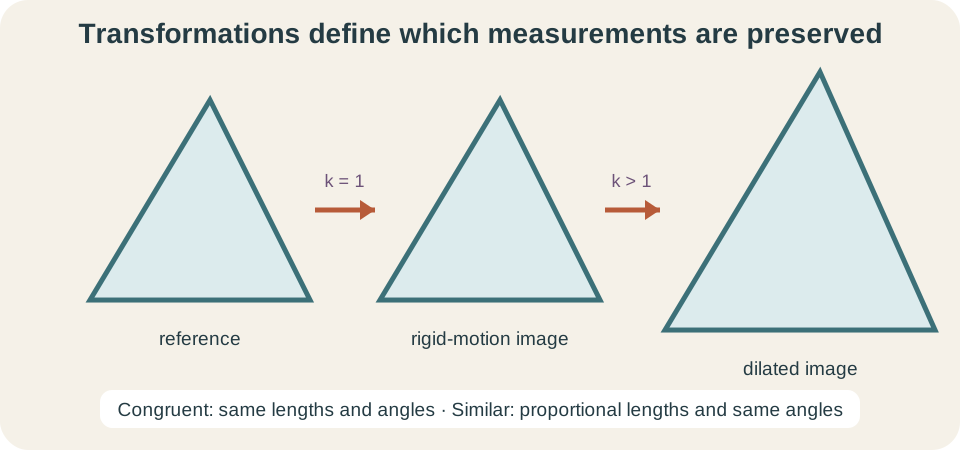
Congruent figures agree in size and shape, while similar figures agree in shape but may differ by a uniform scale. Those familiar descriptions become mathematically precise through transformations. Rigid motions preserve every distance and angle, whereas dilation changes every length by one common factor while preserving angle measure. The distinction determines which measurements stay equal and which remain proportional. This lesson develops the definitions, triangle criteria, proof habits, and scale consequences needed to use both relationships rigorously.
Establish the learning goals
By the end of this lesson, you should be able to define congruence using rigid motions and similarity using dilation followed by rigid motions. You will identify corresponding vertices, sides, and angles from a correctly ordered statement. You will justify triangle congruence using SSS, SAS, ASA, AAS, or right-triangle HL. You will justify triangle similarity using AA, SAS similarity, or SSS similarity. You will also predict how scale affects length, perimeter, area, and volume.
The emphasis is on reasons rather than diagram appearance. A drawing can suggest a relationship, but only stated or derived facts establish it. Tick marks, angle arcs, parallel marks, measurements, and transformation descriptions supply evidence. A proof organizes that evidence into a valid criterion. The conclusion then unlocks additional corresponding relationships.
Ask three questions whenever two figures are compared. Which vertices correspond, what transformation or criterion establishes the relationship, and which measurements are preserved? For similarity, add a fourth question: what is the direction and value of the scale factor? These questions prevent reversed ratios and unsupported conclusions. They also connect symbolic notation to geometric meaning.
Define rigid motions and congruence
A translation moves every point by the same directed displacement. A rotation turns every point through the same angle about a fixed center. A reflection maps points across a line so that the line is the perpendicular bisector of each point-image segment. Each transformation preserves distances and angle measures. Collectively, they are called rigid motions or isometries.
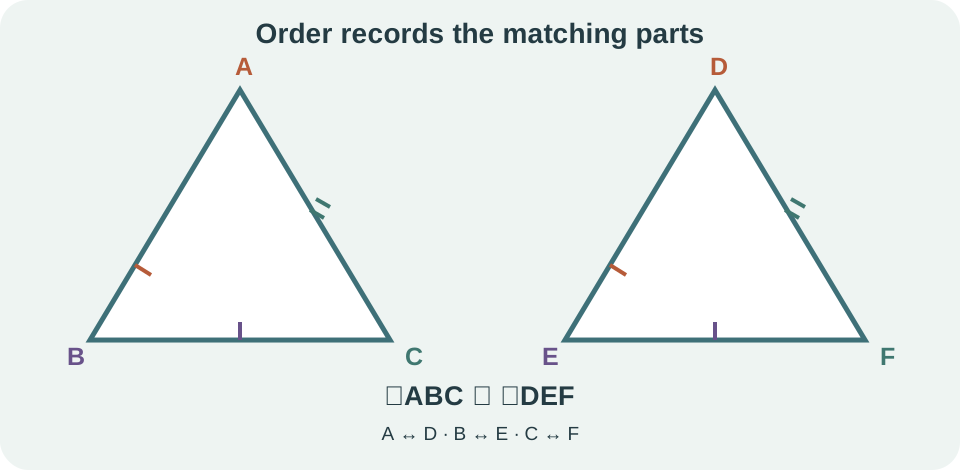
Two figures are congruent if a sequence of rigid motions maps one figure exactly onto the other. The symbol means “is congruent to.” Thus asserts more than a visual resemblance. It asserts that corresponds to , to , and to under a distance-preserving mapping. Every pair of corresponding sides and angles is equal. The ordered notation records those pairings compactly.
Orientation need not be preserved because a reflection reverses orientation while retaining congruence. Position also does not matter because translation and rotation relocate a figure without changing it. A traced shape can be moved, turned, or flipped to match any congruent copy. The definition captures the idea of exact geometric sameness independent of placement. Coordinates are optional rather than fundamental.
Define dilation and similarity
A dilation with center and positive scale factor sends a point to a point on ray so that . The scale factor is dimensionless because it is a ratio of two lengths. If , the image is enlarged. If , the image is reduced. A factor of one leaves all lengths unchanged.
Dilation preserves angle measure and multiplies every length by the same factor . Parallel lines remain parallel, and ratios of corresponding lengths remain constant. Distances are not generally preserved unless . Therefore dilation changes size without changing shape. This uniformity distinguishes geometric similarity from informal resemblance.
Two figures are similar if a dilation followed by rigid motions maps one exactly onto the other. The symbol means “is similar to.” If , corresponding angles are equal and corresponding side lengths share a common ratio. Congruence is the special case of similarity with scale factor one. Similarity therefore includes congruence but allows size to change. The transformation definition explains both the preserved angles and proportional lengths.
Read correspondence from notation
The order of vertex names communicates correspondence. In , the first listed vertices correspond, as do the second and third. Thus , , and . Consequently, side corresponds to , side to , and side to . Angle corresponds to .
An incorrectly ordered statement can make true triangles appear to have false corresponding relationships. Suppose side is the shortest side in the first triangle. Its partner in the congruence statement should be the shortest corresponding side in the second triangle. Angle markings and shared vertices help confirm the order. Write a correspondence table before building proportions. This small step prevents many errors.
Correspondence also controls scale-factor direction. If and the scale factor from to is , then . Reversing every ratio gives , which is valid for the reverse mapping. Mixing directions within one equation is invalid. State “image over preimage” or another consistent orientation.
Justify congruence with SSS
The Side-Side-Side criterion states that if three side lengths of one triangle equal the three corresponding side lengths of another, then the triangles are congruent. The reason is rigidity: three compatible lengths determine a triangle up to rigid motion and reflection. No angle measurement must be supplied separately. The included shape cannot flex while all three side lengths remain fixed. SSS converts complete side information into complete congruence.
Suppose , , and . These equalities establish the correspondence , , and . Therefore by SSS. Once congruence is known, corresponding angles are equal. The criterion is the reason, while the remaining equalities are consequences.
Three arbitrary positive numbers do not always form a triangle. The sum of any two side lengths must exceed the third, a condition called the triangle inequality. If the lengths fail that condition, there is no triangle to compare. Congruence criteria assume the named triangles exist. Conditions underlying a theorem should not be forgotten when applying it.
Justify congruence with SAS
The Side-Angle-Side criterion uses two corresponding side equalities and equality of the included angle between them. If , , and , then the angle lies between the two named sides in each triangle. These facts determine the third vertex’s position up to rigid motion or reflection. Therefore by SAS. The word “included” is essential.
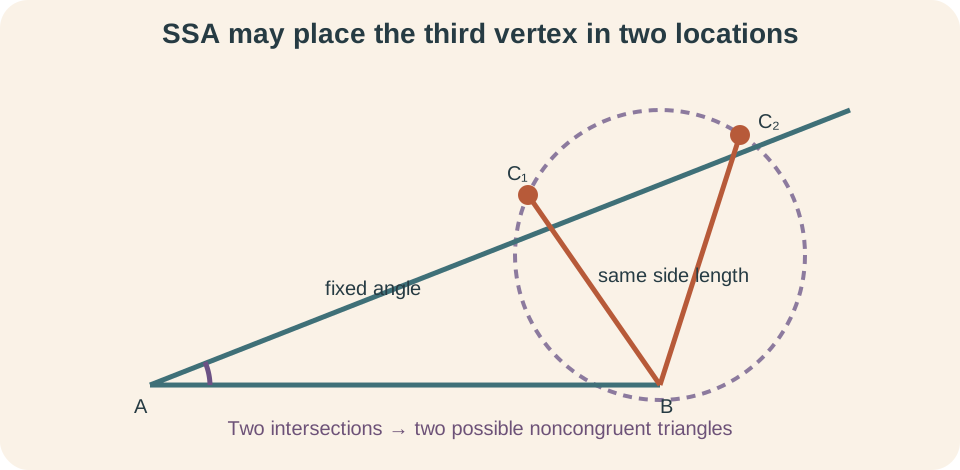
If the known angle is not between the two known sides, the information has Side-Side-Angle form. SSA does not generally determine one triangle. A fixed side can swing to meet a ray in zero, one, or two positions, producing the ambiguous case. Two noncongruent triangles can therefore share the same SSA measurements. A criterion must guarantee uniqueness, not merely provide three pieces of information.
Before claiming SAS, point to the vertex where the two known sides meet. Confirm that the known angle has that vertex. Then verify that the side correspondence agrees with the triangle order. A diagram can hide a nonincluded angle if markings are read too quickly. Naming the exact sides and angle makes the logic auditable.
Justify congruence with ASA, AAS, and HL
The Angle-Side-Angle criterion uses two corresponding angles and their included side. The Angle-Angle-Side criterion uses two angles and a nonincluded corresponding side. Two angles determine the third because triangle angle measures sum to . The supplied side fixes scale, preventing triangles of different sizes. Therefore either arrangement establishes congruence.
Angle-Angle-Angle information alone does not establish congruence. It fixes shape but leaves size free, so it establishes similarity. Adding one corresponding side equality fixes the scale factor at one. This explains why ASA and AAS prove congruence while AAA does not. The difference is not an arbitrary list rule.
For right triangles, Hypotenuse-Leg states that equality of the hypotenuses and one pair of corresponding legs establishes congruence. The right angles are already known, and the Pythagorean relationship fixes the remaining leg length. HL is a special right-triangle criterion, not a general SSA exception without conditions. Verify which side is opposite the right angle. That side, and only that side, is the hypotenuse.
Understand why SSA is ambiguous
Imagine a fixed base, a specified side length attached to one endpoint, and a specified angle at the other endpoint. The movable endpoint of the fixed side traces a circle. The ray defined by the angle may intersect that circle twice. Each intersection creates a triangle with the same two sides and nonincluded angle. The triangles can have different remaining angles and side lengths.
The ambiguity depends on the measurements. Sometimes the ray misses the circle and no triangle exists. Sometimes it is tangent and one triangle exists. Sometimes it crosses twice and two triangles exist. Because SSA does not guarantee exactly one triangle in all allowed cases, it is not a general congruence criterion. A theorem needs reliable sufficiency.
The ambiguous case later appears in trigonometry when the Law of Sines is used. A calculator may return one inverse-sine angle even though a supplementary angle produces another valid triangle. Geometry explains the numerical ambiguity in advance. Diagrams, triangle inequalities, and angle sums help classify the possibilities. Understanding the mechanism is safer than memorizing “SSA is bad.” It tells you exactly when a second configuration must be investigated.
Justify triangle similarity with AA
The Angle-Angle similarity criterion states that two pairs of equal corresponding angles are sufficient for triangle similarity. The third angles are automatically equal because both triangle angle sums are . Equal angles fix the shape while permitting a uniform change in size. Therefore corresponding sides are proportional. No side length equality is required.
Parallel lines often create AA evidence. Corresponding or alternate interior angles formed by a transversal are equal. If two triangles also share an angle, two angle pairs can be established. Marking the angle relationships before writing similarity keeps the proof organized. The similarity statement must follow the derived correspondence.
Every pair of right triangles shares one equal right angle, but that fact alone is insufficient. One additional pair of equal acute angles establishes AA. If one acute angle is equal, the remaining acute angles also match because each complements ninety degrees. Thus two right triangles with one corresponding acute angle equal are similar. Their sizes may still differ.
Use SAS and SSS similarity
SAS similarity requires equality of included angles and proportionality of the surrounding side pairs. For example, if and , then . The common ratio may be any positive value. If it equals one, SAS similarity also implies congruence. Otherwise the triangles have the same shape at different scales.
SSS similarity requires all three pairs of corresponding sides to have one common ratio. If side lengths correspond to , every second-triangle side is twice its partner. The scale factor from the first triangle to the second is two. The triangles are similar by SSS but not congruent. Their equal angle measures follow from similarity.
Ratios should be simplified and oriented consistently. Comparing , , and gives the reverse scale factor . That is equally valid if every ratio maps the second triangle back to the first. Problems arise only when one fraction is reversed relative to the others. Labeling source and image prevents mixed directions.
Solve proportions from similar figures
Once similarity is established, corresponding side ratios are equal. If , then . The horizontal fraction bars group each complete length. Select a proportion containing the unknown and enough known information. Preserve the same correspondence and direction in both ratios.
Suppose corresponds to , while corresponds to . Then . Multiplying by gives . The scale factor is , so the larger corresponding length is reasonable. Substitution confirms that both image-to-source ratios equal .
Do not assume similarity merely because a proportion can be written. The relationship must first be established by a valid criterion or transformation. After that, proportional sides are consequences. This logical order separates proof from calculation. A numerical answer without a similarity reason is incomplete.
Apply similarity to indirect measurement
Parallel sunlight creates equal angles of elevation for vertical objects at the same time and location. Each object and its horizontal shadow form a right triangle. Therefore a pole-shadow triangle and tree-shadow triangle are similar by AA. Suppose a pole casts a shadow while a tree casts a shadow. Let the tree height be meters.
Corresponding height-to-shadow ratios give . The pole ratio evaluates to the dimensionless scale factor . Multiplying by the tree shadow gives . Evaluating the product gives . Shadow-length units cancel within the original ratio, while the leading meter remains. The tree’s shadow is six times the pole’s, so its height is also six times the pole’s. The scale-factor reasoning and proportion calculation therefore agree.
The method depends on assumptions. The objects must be vertical relative to the level shadow surface, and the sunlight direction must be effectively parallel and unchanged between measurements. Uneven terrain or measurement at different times can break the angle correspondence. Similarity makes indirect measurement possible only when the geometric model is credible. State those conditions with the calculation.
Track scale through dimensions
If every length scales by , then every perimeter also scales by because perimeter is a sum of lengths. For a polygon with perimeter , its image has perimeter . The prime symbol identifies the image measurement. Both and have length units. Their ratio is dimensionless.
Area scales by because area combines two independent length factors. A rectangle with sides and has area . After dilation, its sides are and , so . Multiplication then gives . If , the area factor is . Scaling area only by ignores one dimension.
Volume scales by because three length factors are multiplied. A box with volume becomes . A scale model at one tenth of every length has one thousandth of the volume. This rapid dimensional change matters in engineering and biology. Similar shape does not imply proportional mass or capacity unless dimensional scaling is handled correctly.
Build a concise geometric proof
A proof begins by stating givens and the target relationship. Mark or list equal sides, equal angles, parallel lines, right angles, shared segments, and transformation facts. Derive any needed intermediate relationships with named reasons. Then invoke the exact congruence or similarity criterion. The triangle order in the conclusion must match the evidence.
After congruence is proved, corresponding parts of congruent triangles are congruent, often abbreviated CPCTC. This statement is a consequence, not a way to prove the original congruence. Likewise, after similarity is proved, corresponding angles are equal and side lengths are proportional. Do not use a consequence before establishing its premise. Logical sequencing distinguishes a proof from circular reasoning.
A diagram supports but does not replace the argument. Never assume a segment bisects an angle, lines are parallel, or angles are right merely because they look that way. Use only marked, stated, or derived facts. If the diagram is not drawn to scale, visual guesses may be deliberately misleading. Written reasons make the result independent of appearance.
Diagnose common misconceptions
AAA establishes similarity, not congruence, because it fixes shape without fixing size. SSA is generally ambiguous because two triangles can share the supplied information. SAS requires the angle included between the two supplied sides. HL applies only to right triangles and requires the hypotenuse plus a leg. Acronyms are safe only when their geometric meanings are checked.
Another common error pairs noncorresponding sides. Use vertex order, angle markings, and adjacency to build a correspondence map. Keep every ratio in the same source-to-image direction. If a scale factor is greater than one, image lengths should increase in that direction. A reasonableness check can reveal a reversed proportion.
Area and volume scaling are frequently treated as though they were lengths. A dilation by three multiplies perimeter by three, area by nine, and volume by twenty-seven. Units reveal why: length, square length, and cubic length contain one, two, and three factors. Diagrams can also tempt readers to trust appearance rather than evidence. Return to transformations, criteria, and dimensions whenever uncertainty arises.
Practice proof and scale reasoning
One triangle has side lengths , , and . A second has lengths , , and . Decide whether they are congruent, similar, both, or neither. Name the criterion and scale factor in both directions. Predict their area ratio. Explain why equal angle measures follow.
Similar triangles have scale factor from the first to the second. Find the perimeter, area, and volume factors that would apply to corresponding similar two- or three-dimensional figures. If the first triangle’s area is , calculate the second area. Keep the horizontal fraction form in the scale calculation. Include square units in the answer.
Explain why two right triangles with one equal acute angle are similar. Then explain why two arbitrary triangles with two sides and a nonincluded angle equal need not be congruent. Construct a correspondence statement from labeled vertices rather than saying only that “the triangles match.” Identify the criterion for each valid conclusion. Separate given facts from derived facts. Use complete reasons so that another reader can audit the proof order.
Solutions and reasoning
The second side lengths are twice the corresponding first side lengths, so the triangles are similar by SSS. They are not congruent because corresponding lengths differ. The scale factor from first to second is two, while the reverse factor is . Their area ratio from first to second is . Similarity guarantees equal corresponding angle measures.
Perimeter scales by . Area scales by , and volume scales by . The second-area calculation begins with . It evaluates to . The square unit remains because the scale factor is dimensionless. The exponent on the factor matches the measurement dimension.
Both right triangles contain a ninety-degree angle, and the stated acute angles form a second equal pair. Therefore AA establishes similarity. In an SSA arrangement, the endpoint of one side may meet the angle ray in two positions, producing noncongruent triangles. A correct correspondence statement must follow the equal-angle and side relationships supplied in a particular diagram. The criterion justifies the conclusion rather than the picture alone.
Carry transformation thinking forward
Congruence and similarity organize geometry around mappings rather than isolated measurement tricks. Rigid motions explain exact sameness. Dilation explains uniform scale. Triangle criteria provide efficient evidence that such mappings exist. Correspondence notation records which parts participate in the mapping.
These ideas lead directly to the Pythagorean theorem, trigonometry, coordinate proofs, and analytic geometry. Similar right triangles define the constant side ratios called sine, cosine, and tangent. Scale factors explain map models, image resizing, and indirect measurement. Dimensional scaling predicts how area and volume respond to size. The same structure crosses pure and applied mathematics.
Keep the reasoning sequence explicit. Establish correspondence, name a valid criterion or transformation, and only then use preserved or proportional measurements. Track the direction of scale and the dimension of each quantity. Test the result against the diagram without treating appearance as proof. That discipline turns visual intuition into rigorous geometry.