
Area and volume measure how much two-dimensional region or three-dimensional space an object occupies. Their formulas are not an unrelated list of facts; they are compressed consequences of unit comparison, decomposition, rearrangement, similarity, and accumulation. A rectangle can be tiled by unit squares, a prism by unit cubes, and many less familiar shapes can be cut into or compared with those basic forms. Units record the dimension being measured and provide one of the strongest error checks in geometry. Understanding the reasoning behind formulas makes them easier to reconstruct and safer to apply.
Learning objectives and the measurement viewpoint
By the end of this lesson, you will distinguish length, area, surface area, volume, and capacity by both meaning and units. You will derive and apply formulas for common polygons, circles, prisms, cylinders, pyramids, cones, and spheres. You will decompose composite figures, subtract holes, and choose dimensions that correspond to the formula’s geometry. You will predict how similarity and scale factors change area and volume. You will also estimate, convert units, and connect changing cross-sections to the later idea of integration.
Measurement compares an object with a chosen standard unit. Length asks how many unit segments fit along a path, area asks how many unit squares cover a region, and volume asks how many unit cubes fill a solid. The numerical answer depends on the unit selected, but the physical size does not. Smaller units produce larger numerical counts because more of them are needed. A complete measurement therefore includes both number and unit.
Formulas provide efficient counts when a shape has known structure. Each multiplication, fraction, or power in a formula has geometric meaning. Before substitution, identify the region or solid, label dimensions, and state which measure is requested. A correct formula for the wrong measure remains an incorrect solution. Meaning should precede arithmetic.
Distinguish one-, two-, and three-dimensional measures
Length has one dimension and uses units such as meters, centimeters, or feet. Area has two dimensions and uses square units such as . Volume has three dimensions and uses cubic units such as . The exponent on the unit records how many independent length directions are multiplied. It is structural rather than decorative.
If a rectangle has sides and , its area is . Multiplying the numerical values also multiplies the units. If a box adds height , its volume is . Reporting either result in plain meters would contradict the dimensional construction. Units reveal whether the calculation answers length, area, or volume.
Surface area and volume describe different features of a solid. Surface area measures the total two-dimensional boundary and uses square units. Volume measures the enclosed three-dimensional space and uses cubic units. Paint coverage depends on surface area, while storage capacity depends on volume. A problem’s context determines which quantity is relevant.
Derive rectangle and parallelogram area from tiling
A rectangle with whole-number side lengths and can be tiled with groups of unit squares, depending on orientation. The total number is the product . Fractional and irrational side lengths extend the formula through subdivision and limiting arguments. Thus rectangle area is . The letters and represent perpendicular side lengths.
A parallelogram has the same area formula even though one side may be slanted. Cut a triangular piece from one end and translate it to the other end. The rearranged figure is a rectangle with the same base and perpendicular height. Cutting and translating preserve area because no region is added, removed, stretched, or overlapped. Therefore for a parallelogram as well.
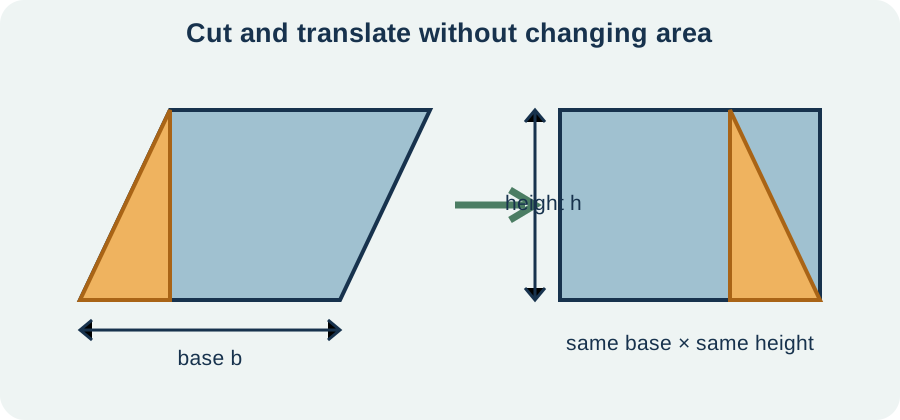
The height is the perpendicular distance between the parallel bases. A slanted side is not generally the height. Perpendicularity can be shown by a right-angle marker or inferred from coordinates. Using the wrong segment usually overestimates the area. Always label the base-height pair before multiplying.
Derive triangle and trapezoid formulas
A diagonal divides a rectangle or parallelogram into two congruent triangles. Because the two pieces have equal area, each triangle has half the area of the full parallelogram. Therefore . The horizontal fraction means the product is divided by two. As before, is perpendicular to the chosen base .
Any side of a triangle may serve as the base, but its matching height changes. For an obtuse triangle, the perpendicular height may fall outside the visible triangle on an extended base line. The formula still measures the same region. Different base-height pairs yield equal products because they describe the same area. Choose the pair that can be measured accurately.
A trapezoid with parallel bases and and perpendicular height has area . One derivation joins two congruent copies to form a parallelogram with base . Another views the formula as average base length times height. The parentheses require adding the parallel bases before multiplication. Only the parallel sides belong in that average.
Understand circle circumference and area
A circle is determined by its center and radius . Its diameter is , so confusing diameter with radius changes area by a factor of four. Circumference is . The constant is the ratio of circumference to diameter for every circle. Circumference is a length and therefore uses linear units.
Circle area is . One geometric argument cuts the circle into many narrow sectors and alternates their orientation. The rearranged sectors approach a parallelogram-like shape whose height is and whose base is half the circumference, . Multiplying gives . Finer sectors make the curved edges approach straight boundaries.
The square on is essential because area scales in two dimensions. If radius doubles, area becomes . Circumference doubles instead because it depends linearly on . Comparing the powers predicts scaling before numerical calculation. Unit exponents and variable exponents tell the same dimensional story.
Decompose composite planar figures
Composite figures combine familiar shapes through unions, subtractions, or overlaps. Begin by drawing boundaries and deciding which regions are included. Decompose the figure into nonoverlapping pieces whose areas can be computed. Add included pieces and subtract holes or cutouts. Avoid counting any region twice.
Suppose a by rectangle has a semicircle of radius attached along one short side. Rectangle area is . Semicircle area is . Total area is . The shared boundary is internal and does not subtract area.
For an irregular floor plan, more than one decomposition may work. Two correct partitions must give the same total when measurements are consistent. Comparing methods provides verification. Sketches should label which lengths are full dimensions and which are differences derived from others. A diagram is part of the reasoning, not ornamental work.
Define volume through layers and unit cubes
Volume measures three-dimensional space using unit cubes. A rectangular prism with side lengths , , and contains unit cubes in the whole-number case. Thus . The product can be read as base area multiplied by perpendicular height . This layer interpretation extends to every prism.
A prism has congruent parallel cross-sections along its height. If each perpendicular cross-section has area , then . The symbol conventionally denotes base area, not a base length. Therefore already carries square units. Multiplying by height produces cubic units.
An oblique prism has the same volume as a right prism with equal base area and perpendicular height. Sliding layers sideways does not change their areas or total amount of material. This principle is related to Cavalieri’s principle: solids with equal cross-sectional areas at every height have equal volumes. Slanted edge length does not replace perpendicular height. Geometry determines which dimension measures the stacking direction.
Apply prism and cylinder formulas
For any prism, compute the base area using the appropriate two-dimensional formula and then multiply by height. A triangular prism uses for its triangular base. Its prism height is a different dimension measuring distance between congruent triangular faces. Reusing the letter without labels can cause confusion. Name base dimensions and solid height distinctly.
A cylinder is a prism-like solid with circular cross-sections. Its base area is , so volume is . The radius and perpendicular height must use compatible units. If diameter is given, divide it by two before squaring. The result uses cubic units.
Consider a cylinder with radius and height . Volume is . Numerically, this is approximately to three significant figures. Keeping preserves the exact value. The approximation should be labeled as such.
Explain the one-third factor for pyramids and cones
A pyramid has a polygonal base and triangular faces meeting at an apex. A cone has a circular base and tapers to an apex. For either solid, volume is , where is base area and is perpendicular height. The one-third factor compares the tapered solid with a prism or cylinder having the same base and height. Tapering reduces the average cross-sectional area.
For a pyramid, three congruent pyramids can fill certain prisms, providing one geometric explanation in special configurations. A more general argument compares cross-sectional areas at each height. A cone’s cross-sectional radius decreases linearly toward the apex, so its area decreases quadratically. Accumulating those areas yields one third of the corresponding cylinder’s volume. Calculus makes this accumulation precise.
The slant height of a cone belongs to lateral surface-area formulas, not its volume formula. Volume uses the perpendicular distance from apex to base plane. A right triangle formed by radius, height, and slant height can be used to find a missing dimension. Label the requested measure before selecting values. Similar-looking lengths serve different geometric roles.
Understand sphere volume and surface area
A sphere of radius has volume . The cubic power agrees with three-dimensional scaling. A sphere’s surface area is , which uses square units. The shared factor four does not make the formulas interchangeable. One measures boundary and the other enclosed space.
Archimedean comparisons relate the sphere to a surrounding cylinder and cones. Calculus can also derive the volume by adding circular cross-sections whose radius changes with height. Either approach explains why the formula includes both and a cubic radius. The coefficient is not inferred from dimensions alone. Geometry determines the dimensionless numerical factor.
For radius , volume is . Surface area is . The numerical surface area happens to exceed the numerical volume in these units, but comparing their numbers alone has no direct meaning because their dimensions differ. Units prevent an invalid comparison. Each value must be interpreted as its own kind of measurement.
Predict scaling with similarity
If every length in a figure is multiplied by scale factor , corresponding lengths change by . Areas change by because two independent length factors are multiplied. Volumes change by because three length factors are multiplied. These rules apply to all similar figures and solids. They do not require the exact area or volume formula.
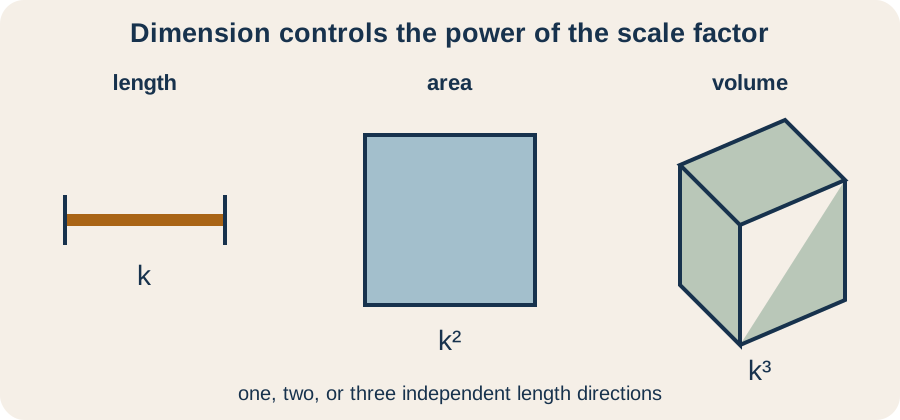
Doubling every dimension multiplies area by and volume by . A model built at scale has area and volume of the original. Reversing that comparison requires reciprocal factors. State which object is being scaled from which reference. Direction matters when a scale ratio is interpreted.
This nonlinear scaling explains why large organisms, structures, and containers do not behave as simple enlarged copies in every respect. Surface-dependent processes scale with length squared, while mass-like quantities often scale with length cubed. Their ratio changes with size. Geometry therefore influences heat transfer, structural strength, and biological exchange. Scale factors connect pure measurement to physical design.
Convert square and cubic units correctly
Linear conversion factors must be squared for area and cubed for volume. Since , it follows that . Similarly, . Multiplying by only one hundred would be correct for length but wrong for area or volume. The unit exponent controls the conversion exponent.
Dimensional-analysis fractions make conversions explicit. To convert to square centimeters, multiply by . Meter-squared units cancel, leaving . For volume, use the same linear fraction raised to the third power. Horizontal fractions show which units cancel.
Capacity units connect to volume units through definitions such as and . A liter is not a generic label for every volume without conversion. When density, flow, or material quantities are involved, consistent volume units are essential. Convert before combining values in a formula. A correct numerical factor with incompatible units is not a correct result.
Compute surface area from nets and boundaries
Surface area can be understood by unfolding a solid into a net. Each face becomes a planar region whose area can be computed. Adding all exposed faces gives total surface area. Shared internal faces are not part of the exterior boundary. Open containers omit the missing face.
For a closed rectangular prism, surface area is . Each product is the area of one face type, and the factor two counts its opposite congruent face. For a cylinder, total surface area is . The first term counts two circular bases, while the second is the lateral rectangle with circumference and height . Labeling each contribution prevents omitted or duplicated faces.
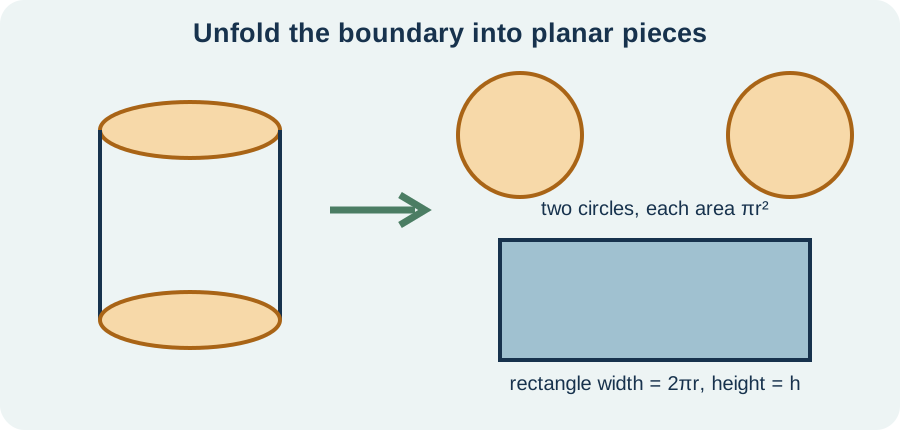
Surface area is sensitive to whether boundaries are joined, removed, or hidden. Two blocks glued together lose the shared face from the exterior surface. A hollow pipe has inner and outer surfaces plus end annuli when capped by material. Sketch a net or boundary inventory before adding formulas. Context determines which faces receive paint, insulation, or material.
Approximate irregular regions and solids
Not every shape has a convenient elementary formula. An irregular planar region can be covered by a grid, decomposed into simpler polygons, or bounded above and below by known shapes. Finer grids usually improve resolution. The difference between upper and lower estimates indicates remaining uncertainty. Approximation should be reported honestly rather than disguised as exactness.
For an irregular solid, measure cross-sectional areas at selected positions. Multiplying each representative area by a small thickness estimates the volume of one slice. Adding slice volumes gives a total approximation. Thinner slices capture changing geometry more accurately. This method anticipates the definite integral.
Measurement uncertainty also affects formula-based results. If a radius is uncertain, squaring or cubing it can amplify relative uncertainty. Rounding input measurements too early can distort the output. Keep sufficient working precision and round once at the end to a justified number of significant figures. A formula cannot produce more physical certainty than its measurements support.
Connect volume to changing cross-sections
A prism has constant cross-sectional area, so is area times total thickness. For a varying solid, imagine dividing the height interval into thin slices of thickness . A slice near position has approximate volume , where is cross-sectional area. Adding gives . The approximation improves as slices become thinner under suitable conditions.
The definite integral formalizes the limit of those sums. The limits and mark the beginning and end of the solid along the chosen axis. The differential indicates accumulation with respect to . Cross-sectional area has square units and contributes a length unit, producing cubic units. Dimensional reasoning remains valid inside calculus.
This viewpoint unifies elementary volume formulas. Constant gives . Cones, pyramids, and spheres use cross-sections that change with position. The one-third and four-thirds coefficients emerge from accumulation rather than memorization. Geometry supplies the slice formula, and calculus supplies the sum of infinitely refined slices.
Verify area and volume calculations
Begin by naming the requested measure and predicting its unit dimension. Draw or inspect a labeled diagram. Identify perpendicular heights, radii, diameters, included boundaries, and repeated faces. Decompose the figure or solid into nonoverlapping familiar pieces. Write a symbolic formula before inserting numbers.
Next, carry units through multiplication, powers, addition, and subtraction. Add only compatible quantities. Estimate magnitude using a surrounding rectangle, box, circle, or cylinder. A composite area must lie between plausible lower and upper bounds. A hole should reduce rather than increase the result.
Finally, check scaling and context. If a length doubles, verify that the formula predicts the correct area or volume factor. Compare alternative decompositions when possible. State whether the result is exact or approximate and round appropriately. A verified answer explains why the value and unit make sense.
Diagnose common mistakes
One mistake uses a slanted side where a perpendicular height is required. Add a right-angle marker and name the base-height pair. Another confuses radius with diameter. Write before using a circle formula. These errors alter the geometry before arithmetic begins.
Another mistake reports linear units for area or volume. Multiply units along with numerical factors to determine the exponent. Conversion errors often come from failing to square or cube a linear conversion factor. Write the conversion as a fraction raised to the required power. Unit cancellation makes the exponent unavoidable.
Composite-figure errors include overlap, missing pieces, and inclusion of internal boundaries. Shade pieces and mark whether they are added or subtracted. For surface area, use a net or face inventory. For volume, distinguish base area from a base length. Organized diagrams prevent formula hunting from replacing reasoning.
Practice derivation, calculation, and interpretation
Find the area of a triangle with base and perpendicular height . Explain the one-half factor using a parallelogram or duplicate triangle. Carry units through the multiplication. Predict how the area changes if both dimensions double. Verify the numerical result by comparing with the surrounding rectangle.
Find the volume and total surface area of a closed cylinder with radius and height . Keep exact answers in terms of and then approximate. Label the contributions from bases and lateral surface. State cubic and square units correctly. Explain how each result changes if every dimension is multiplied by .
A rectangular floor by contains a circular opening of diameter . Find the remaining floor area. Draw the decomposition and convert diameter to radius. Estimate the answer before calculation. If flooring costs 42\ \frac{\}{\mathrm{m^2}}$, find material cost before waste allowance.
Solutions and reasoning
Triangle area is . A duplicate congruent triangle forms a parallelogram of area , so one triangle has half. Doubling both dimensions multiplies area by four, giving . The surrounding by rectangle has area . The triangle is exactly half that bound.
Cylinder volume is . Total surface area is . Scaling by multiplies surface area by . It multiplies volume by . The different factors reflect dimensionality.
The rectangular floor area is . The opening radius is , so its area is . Remaining area is . Cost is approximately (44.9\ \mathrm{m^2})(42\ \frac{\}{\mathrm{m^2}})=$1{,}890$ to an appropriate practical rounding. The square-meter units cancel in the cost calculation.
Carry measurement into calculus and design
Area and volume formulas encode geometric reasoning about tiling, rearrangement, similarity, and layers. Unit powers identify dimensional structure. Composite shapes require decomposition, while irregular shapes require approximation. Scaling laws predict how measurements change before any detailed calculation. These ideas form a coherent measurement system rather than a memorization list.
Calculus generalizes the same logic to continuously changing boundaries and cross-sections. A definite integral accumulates thin contributions, just as a prism formula accumulates constant layers. Surface area, arc length, mass, work, and other quantities extend the pattern. The elementary formulas become benchmarks for checking integral setups. Familiar geometry remains useful in advanced analysis.
When solving a measurement problem, ask what is being measured, which dimensions are perpendicular, which pieces are included, and what unit power is required. Write the structure symbolically, then calculate with units. Estimate and check scaling afterward. This workflow turns formulas into explanations and makes the result useful beyond the page. A measurement is trustworthy when its geometry, arithmetic, and units tell the same story.