
Geometry begins by separating ideal objects from the marks used to represent them. A point is not a tiny disk, a line is not a pencil stroke, and a plane is not the edge of a sheet. These primitive ideas are understood through the relationships and axioms they satisfy. Measurement then assigns numbers to segments and angles without confusing an object with its measure. This lesson builds the precise language needed for congruence, similarity, coordinate geometry, trigonometry, and proof.
Establish the learning goals
By the end of this lesson, you should be able to distinguish points, lines, planes, segments, rays, and their measurements. You will read and write standard geometric notation with the correct endpoint order. You will apply segment and angle addition to recover unknown measures. You will derive relationships involving vertical, complementary, supplementary, and linear-pair angles. You will also use parallel-line theorems and converses without treating a diagram as proof.
The goal is not merely to memorize names for shapes. Geometry is a deductive system in which definitions, axioms, and previously proved results support new conclusions. Precise notation records which object is being discussed. A correct diagram organizes relationships but does not create unmarked facts. Every inference should identify its evidence.
As you work, ask three questions. What object does the notation name, which facts are given or marked, and what definition or theorem permits the next statement? Also track whether a symbol names an object or a numerical measure. These habits prevent assumptions based on appearance. They prepare you to write concise, auditable proofs.
Understand primitive terms and axioms
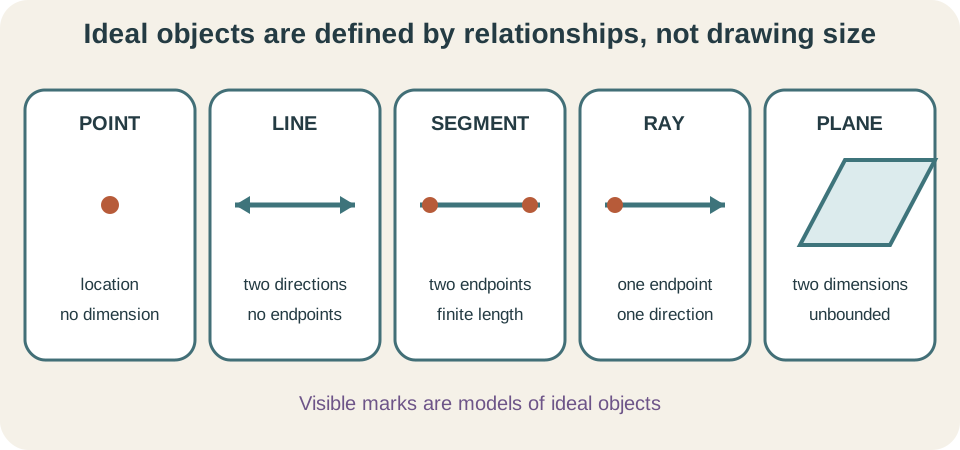
In Euclidean geometry, point, line, and plane are commonly treated as primitive terms. They are not reduced to simpler geometric definitions because any definition would need other undefined spatial ideas. Instead, axioms describe how they behave. A point names a location and has no length, width, or thickness. A drawn dot is only a visible representation of that ideal location.
A line extends without end in two opposite directions and has one-dimensional length but no thickness. A plane extends without end in two dimensions and has no thickness. Pencil marks and paper edges are finite physical models. Their imperfections do not alter the ideal properties used in reasoning. Geometry distinguishes the model from its drawing.
Axioms, also called postulates, are starting statements accepted within the system. One familiar incidence postulate says that through any two distinct points there is exactly one line. Another says that three noncollinear points determine exactly one plane. The word noncollinear means the points do not all lie on one line. These postulates make later constructions and proofs unambiguous.
Read line, segment, and ray notation
The line through distinct points and is written . The double-headed arrow indicates extension in both directions. Reversing the point order names the same line, so . A line can also be named by a lowercase script or italic letter when a diagram defines it. Two points suffice because exactly one line passes through them.
The segment with endpoints and is written . A bar without arrows indicates that only the points from through , including endpoints, belong to the object. Reversing endpoint order names the same segment. The symbol without a bar usually denotes the nonnegative length of that segment. Thus is a set of points, while is a number with a possible unit.
The ray beginning at and passing through is written . The first letter is the endpoint and cannot be reversed without generally changing the ray. The ray begins at and extends in the opposite named direction. More than one point can name the same ray if those points lie in the same direction from the endpoint. Endpoint order therefore carries structural information.
Describe incidence, collinearity, and coplanarity
An object is incident with another when it lies on or passes through it according to context. A point can be incident with a line, and a line can be incident with a plane. Points are collinear when one line contains all of them. Points or lines are coplanar when one plane contains them. These terms describe relationships rather than measurements.
Two distinct lines in one plane can intersect in exactly one point or remain parallel. Coincident lines are not distinct because they share every point. In three-dimensional space, two noncoplanar lines may be skew, meaning they neither intersect nor are parallel. The plane assumption therefore matters. Many high-school theorems silently operate within one Euclidean plane.
Three noncollinear points determine one plane, but three collinear points do not determine a unique plane. Infinitely many planes can rotate around their shared line. Likewise, two intersecting lines determine one plane. Two distinct parallel lines also determine one plane. Recognizing sufficient information prevents claims of uniqueness that the givens do not support.
Distinguish segment from segment length
A segment is a geometric object, while its length is a numerical measurement. If and are physical locations, names all points between them. The notation assigns a length to that segment. One cannot add a segment object directly to a number. Equations combine compatible measures.
Lengths are nonnegative. The distance between and equals the distance between and , so . In coordinates, directed displacement may be negative, but ordinary segment length is not. The distinction between distance and signed change will matter in analytic geometry. Here, records magnitude only.
Congruent segments have equal lengths. The notation names an object relationship. The equation states equality of their measures. These statements are closely connected but use different symbols because they have different grammatical roles. Precise notation prevents a proof from mixing objects with numbers.
Use betweenness and segment addition
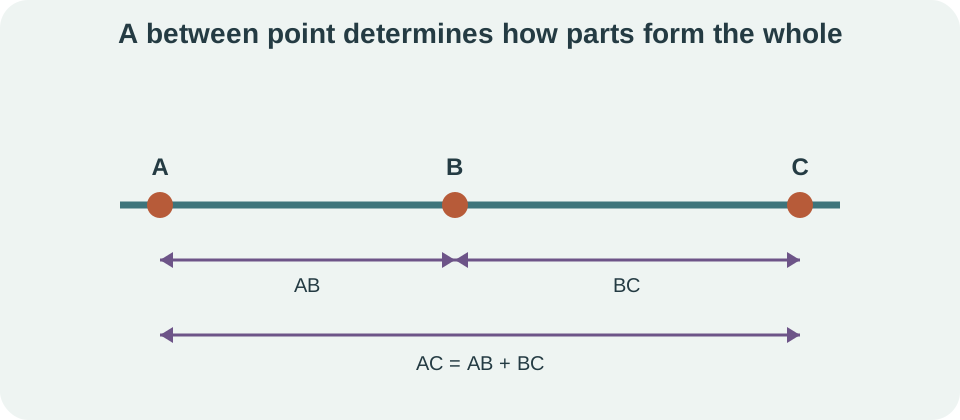
If point lies between distinct points and , then the three points are collinear and lies in the interior of . The Segment Addition Postulate states . Each symbol in the equation denotes a nonnegative length. The smaller adjacent pieces combine to make the whole segment. Betweenness determines the correct addition order.
Suppose and , with between and . Substitution gives . Subtracting from both sides gives . Centimeter units are retained because all terms measure length. The smaller result is reasonable because is only part of .
The same formula would be invalid if the stated betweenness changed. If lies between and , then . A drawing may suggest an order, but the order must be stated, marked, or established by coordinates. Segment addition is conditional on betweenness. Always identify the whole segment before writing the equation.
Define distance and midpoint
Distance measures the length of the shortest segment joining two points in Euclidean geometry. It satisfies nonnegativity, symmetry, and the triangle inequality. Distance is zero only when the two points coincide. Units depend on the measurement context. An unlabeled diagram cannot provide an exact distance by visual scale.
A midpoint of is a point on the segment such that . Segment addition also gives . Combining the two relationships yields , so . The midpoint divides a segment into two congruent subsegments. Both betweenness and equal length are part of the definition.
Suppose and is its midpoint. Then . The horizontal fraction bar groups the complete measured length above the divisor two. If a point merely appears centered in a sketch, midpoint cannot be assumed. A midpoint mark or statement supplies the needed evidence.
Define angles as two rays and a rotation
An angle consists of two rays sharing a common endpoint called the vertex. In , the middle letter is the vertex. The sides are rays and . When only one angle at a vertex is relevant, it may be named . With several angles at the same vertex, three-letter names remove ambiguity.
Angle measure describes the amount of rotation from one ray to another under a chosen convention. In elementary geometry, the smaller nonreflex angle is often intended unless directed angles are introduced. Degrees divide one full rotation into equal units. A right angle measures , and a straight angle measures . Ray length does not affect angle measure.
The angle object and its measure are distinct. The notation names the angle, while denotes its numerical measure. Congruent angles have equal measure. Some texts omit when context is clear, but explicit notation is safer during foundational work. Units such as degrees belong with numerical angle measures.
Classify angles by measure
An acute angle has measure greater than and less than . A right angle measures exactly . An obtuse angle is greater than and less than . A straight angle measures exactly . The inequalities define the categories without relying on appearance.
A reflex angle is greater than and less than . A full rotation measures . Some introductory diagrams focus only on angles at most . State the convention when directed or reflex angles may occur. Classification depends on measure, not ray length or page orientation.
Perpendicular lines intersect to form four right angles. The right-angle box in a diagram is evidence of perpendicularity. Conversely, if two intersecting lines form one right angle, adjacent linear-pair relationships force all four angles to be right. Thus one marked right angle establishes the complete perpendicular intersection. The symbol means “is perpendicular to.” This symbol records a relationship between the two named lines.
Apply the angle addition postulate
If ray lies in the interior of , then angle addition states . The interior ray divides the larger angle into adjacent smaller angles. Their interiors do not overlap, and they share a vertex and one side. The measures add because rotations occur consecutively. The ray’s interior position is an essential condition.
Suppose and . Then . Subtracting gives . Degree units remain attached throughout. The two parts recombine to check the whole.
An angle bisector is a ray that divides an angle into two congruent angles. If bisects , then . Combined with angle addition, each smaller angle has half the whole measure. The visual appearance of equal halves is not sufficient. A bisector mark, statement, or proof is required.
Distinguish complementary and supplementary angles
Two angles are complementary when their measures sum to . They need not be adjacent. Two angles are supplementary when their measures sum to . They also need not share a vertex or side. These are numerical relationships rather than position definitions.
A linear pair consists of adjacent angles whose noncommon sides are opposite rays. Because opposite rays form a straight angle, a linear pair is supplementary. The converse is not automatic: supplementary angles located far apart do not form a linear pair. Position plus measure distinguishes the concepts. Every linear pair is supplementary, but not every supplementary pair is linear.
If complementary angles measure and , then . Simplification gives , so . The angle measures are and . Their sum verifies the complementary condition. Both measures also fall within the expected acute-angle range for this example.
Derive the vertical-angle theorem
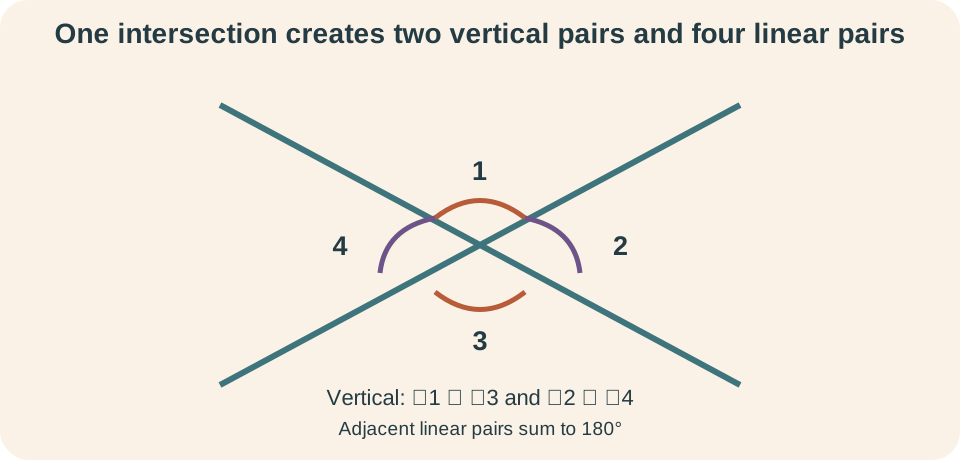
When two lines intersect, opposite nonadjacent angles are called vertical angles. Suppose angle is adjacent to angle , and angle is the vertical angle opposite angle . Angles and form a linear pair, so their measures sum to . Angles and also form a linear pair. Therefore both and equal .
It follows that , so vertical angles are congruent. The theorem is derived from linear-pair supplementation and equality properties. Vertical angles are not congruent merely because the diagram looks symmetric. Their equality follows under any intersection angle. This proof shows how definitions and prior facts create a theorem.
Adjacent angles at the same intersection are not generally congruent. They are supplementary linear pairs. They become congruent only when each measures , which means the lines are perpendicular. Distinguish “opposite” from “next to.” A vertex shared by four angles does not make every pair vertical. Position around the vertex determines which named relationship applies.
Analyze parallel lines cut by a transversal
Parallel coplanar lines do not intersect. A transversal intersects two or more coplanar lines at distinct points. The intersections create corresponding, alternate interior, alternate exterior, and same-side interior angle pairs. Position names identify where the angles lie relative to the two lines and transversal. A consistent diagram and vertex labels are essential.
When parallel lines are cut by a transversal, corresponding angles are congruent. Alternate interior angles are congruent, and alternate exterior angles are congruent. Same-side interior angles are supplementary. These results follow from the Euclidean parallel postulate and previously established angle relationships. They are conditional on the lines being parallel.
For example, if one corresponding angle measures , its corresponding partner also measures . An adjacent linear-pair angle measures . Vertical angles copy each of those measures across an intersection. Thus one known angle determines all eight angles in the standard configuration. The result alternates between two supplementary values unless the transversal is perpendicular.
Use converse angle theorems to prove parallelism
The parallel-line results also have converses. If two coplanar lines cut by a transversal have congruent corresponding angles, then the lines are parallel. Congruent alternate interior or alternate exterior angles also prove parallelism. Supplementary same-side interior angles provide another converse. A converse reverses the logical direction of a theorem and requires its own justification.
These converses allow measured or constructed angles to establish line relationships. Suppose two lines each form a corresponding angle with one transversal. The corresponding angles are congruent, so the two lines are parallel. This proves that two distinct coplanar lines perpendicular to the same line are parallel. The plane condition excludes skew lines in space.
Do not assume a converse exists for every true statement. “If lines are parallel, corresponding angles are congruent” and its standard converse are both theorems, but that symmetry is not automatic logic. A theorem and converse make different claims. State which direction your givens support. Proof vocabulary should match the logical direction used.
Build geometric constructions from definitions
Classical straightedge-and-compass constructions create objects using circles and lines rather than numerical measurement. A perpendicular bisector construction locates points equidistant from a segment’s endpoints. Equal-radius arcs centered at and intersect above and below . The line through those intersections is perpendicular to and passes through its midpoint. Congruent radii and triangle congruence justify the result.
An angle bisector construction uses an arc centered at the vertex to mark equal distances along both rays. Equal-radius arcs from those marks meet inside the angle. The ray from the vertex through their intersection divides the angle into congruent parts. The construction does not depend on visually guessing the center. Its correctness follows from congruent triangles.
Construction reasoning connects definitions with proof. A compass transfers equal lengths, while an unmarked straightedge draws the unique line through two points. The tools encode geometric postulates and circle properties. Dynamic geometry software can simulate the process but should preserve constraints. Dragging the original points provides a useful test that the construction remains valid.
Treat diagrams as models, not measurements
A diagram communicates incidence and helps organize a proof, but unmarked appearance is not evidence. Lines that look parallel may intersect outside the visible frame. An angle that looks right may not measure . Segments that look equal may have different lengths. Use only stated, marked, defined, or derived relationships.
Common markings have conventional meanings. Matching tick marks indicate congruent segments, matching arcs indicate congruent angles, arrow marks indicate parallel lines, and a small square indicates a right angle. Labels identify points and numerical measures. A diagram not drawn to scale may intentionally challenge visual assumptions. Read the symbolic evidence before estimating visually.
Measurements taken with a ruler or protractor can suggest a conjecture but do not prove an exact theorem. Physical tools have finite precision, and printed figures may distort. Deductive geometry establishes necessity from givens. Coordinate or algebraic calculations can serve as proof when their assumptions are explicit. Evidence strength depends on the question being asked.
Organize a short geometric proof
A proof begins with givens and a precise target. Translate diagram markings into statements. Identify relevant definitions, postulates, and theorems. Arrange statements so each follows from earlier evidence. A conclusion should not be used to justify itself.
Suppose two intersecting lines create vertical angles and . State that each forms a linear pair with . Use the Linear Pair Postulate to write two sums equal to . Subtract the common angle measure from both equations. Conclude that the vertical angles have equal measure and are congruent.
Proof formats can be paragraphs, two-column tables, flowcharts, or annotated diagrams. Format matters less than logical completeness. Definitions often supply the first and last links. Algebraic transformations should preserve equality and include units when measured quantities appear. Another reader should be able to audit every step without trusting the picture.
Diagnose common misconceptions
Putting the vertex anywhere except the middle of a three-letter angle name changes the angle. The segment is not the same kind of object as its length . Reversing a ray name generally changes its endpoint and direction. Reversing a segment or line name does not. Notation encodes geometry rather than merely decorating it.
Supplementary angles need not be adjacent, and complementary angles need not form a right-angle picture. Vertical angles are opposite, not adjacent. A linear pair is always supplementary because of its position. Two supplementary angles are not automatically a linear pair. Definitions prevent these category errors.
Parallelism, perpendicularity, congruence, midpoint, and bisector relationships cannot be inferred from appearance alone. A measured sketch does not prove an exact result. Units must accompany numerical lengths and angle measures. Theorems must be applied only when their hypotheses are satisfied. Geometry becomes reliable when every visual suggestion is translated into stated evidence.
Practice notation, measurement, and proof
Point lies between and , with and . Find and verify segment addition. Then suppose is the midpoint of . Find and . Distinguish every segment object from its numerical length.
Two supplementary angles measure and . Find and both angle measures. Then vertical angles measure and . Find and their common measure. Name the theorem supporting each equation.
Explain why two distinct coplanar lines perpendicular to the same line are parallel. Write the reasoning using corresponding angles and a converse theorem. Identify why the words “distinct” and “coplanar” matter. Then list three facts that cannot be assumed from an unmarked diagram. Use complete sentences rather than theorem names alone.
Solutions and reasoning
Segment addition gives , so . The check succeeds. A midpoint divides the segment into equal lengths. Therefore . Bars would name the segment objects, while these equations compare measures.
Supplementation gives , so and . The angle measures are and . Vertical-angle congruence gives , so . Each vertical angle then measures . The sums and equality verify the respective relationships.
Each line forms a right angle with the common transversal. Those corresponding angles both measure and are congruent. The converse corresponding-angle theorem therefore makes the two coplanar lines parallel. Distinct prevents the two names from describing the same line, while coplanar excludes skew geometry. Unmarked equal lengths, right angles, parallel lines, or midpoints are examples of facts that appearance cannot establish.
Carry precise geometry forward
Points, lines, planes, segments, rays, and angles form the vocabulary of Euclidean geometry. Incidence describes how objects meet. Measurement assigns numbers without replacing the objects themselves. Addition postulates connect parts with wholes. Angle theorems convert intersection and parallel structure into exact relationships.
Congruence and similarity will use these definitions to compare entire figures. Coordinate geometry will assign numerical coordinates and derive distance, slope, and midpoint formulas. Trigonometry will connect angle measure with side ratios and rotation. Vectors will add direction and magnitude to geometric displacement. The foundational notation remains active in every branch.
Keep the core discipline. Name objects correctly, attach units to measures, identify givens, and cite the relationship that permits each conclusion. Treat diagrams as organized models rather than measuring instruments. Check whether theorem hypotheses are actually present. Precise language turns geometric intuition into proof.