
Mechanical work measures energy transferred by a force through displacement. A large force does not necessarily perform large work, because direction and displacement both matter. A force perpendicular to motion performs zero work, while a force opposite motion performs negative work. The dot product packages magnitude, direction, and displacement into one scalar quantity. That scalar becomes the bridge between force descriptions and energy accounting.
Every work statement must identify the force, the object, the displacement, and the reference interval. “The work” can mean work by gravity, friction, a person, a spring, or the net force, and those values need not agree. Sign describes the direction of energy transfer relative to the chosen system. Units ensure that force times displacement becomes energy rather than another force. This lesson develops those habits before connecting work to kinetic-energy change and variable-force graphs.
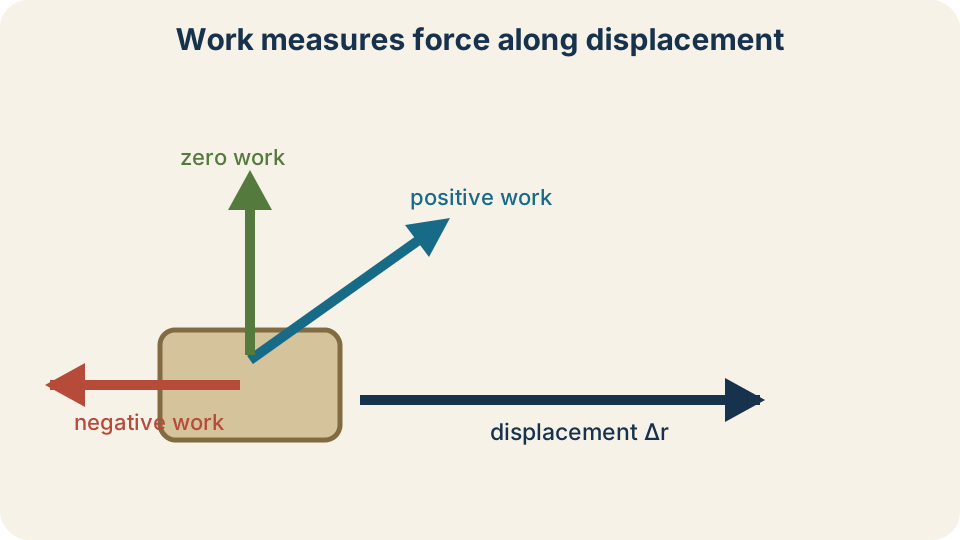
The displacement arrow defines the direction used in the dot product. A force with a forward component performs positive work. A perpendicular force performs zero work over that displacement. A backward component performs negative work. Only the component parallel or antiparallel to displacement contributes.
Identify system, force, and displacement
Work is associated with an interaction acting on a chosen system. If the system is a crate, a person’s pull and floor friction are separate external forces. Each can transfer energy differently over the same crate displacement. Gravity and the normal force may also act without performing work during horizontal motion. Naming the system prevents energy-transfer language from becoming ambiguous.
Displacement is the vector from initial to final position, written . The boldface indicates a vector with magnitude and direction. Work by a constant force depends on this net displacement, not on elapsed time by itself. If an object returns to its starting point under a constant force, its net displacement is zero and that force’s total work is zero. A curved path under a variable-direction force requires a more general integral.
The force used in a work calculation must be the force exerted on the system. Newton’s third-law partner acts on the other interacting body. If a person pulls a crate, the force of the person on the crate enters the crate’s work calculation. The force of the crate on the person belongs to the person’s force diagram. Careful force labels keep interaction pairs from being combined incorrectly.
Define constant-force work with a dot product
For constant force and displacement , work is . The centered dot denotes the vector dot product. Work is a scalar rather than a vector. It has magnitude and sign but no independent spatial direction. The sign comes from the relative direction of the two vectors.
In magnitude–angle form, . Here , , and is the smaller angle between force and displacement when their tails are aligned. The cosine selects the force component parallel to displacement. An angle copied from a surface or vertical line may need conversion before use. Draw both vectors from a common point to identify correctly.
The definition applies directly when the force vector is constant throughout the displacement. Constant means its magnitude and direction do not change over the interval. A spring force is generally not constant because it changes with position. Friction can sometimes be modeled as constant over a straight segment. Model conditions should be stated before the formula is selected.
Derive the component form
Resolve the force into a component parallel to displacement and a component perpendicular to it. The parallel component is . The perpendicular component is . Only the parallel component changes the speed along the displacement direction in the simplest setting. Therefore .
The same result follows from Cartesian components. If and , then . Each product pairs components along the same axis. Perpendicular component contributions vanish because their corresponding displacement component is zero. The sum is coordinate-independent even though components depend on chosen axes.
Suppose a crate moves only horizontally. Then and any vertical force component contributes . An upward pull can still alter the normal force and therefore change friction, but its vertical component does no direct work on the crate over a purely horizontal displacement. Distinguish direct work from an indirect effect on another force. Component reasoning makes that distinction visible.
Interpret positive, negative, and zero work
If , then and work is positive. The force has a component in the displacement direction. Energy is transferred into the system’s motion account through that interaction under the work–energy framework. A forward engine force on an accelerating car is a common example. Positive work does not require the force to be exactly parallel.
If , then and work is negative. The force has a component opposite displacement. Kinetic friction on a sliding block typically performs negative work on the block. A braking force also performs negative work while reducing speed. Negative work is not “less real” work; its sign records transfer direction.
At , the cosine is zero and the force performs zero work. A normal force on a horizontally sliding crate is perpendicular to displacement. An ideal centripetal force in uniform circular motion is perpendicular to instantaneous velocity and does no work. A nonzero force can therefore change direction without changing speed. Zero work does not mean zero force or zero acceleration.
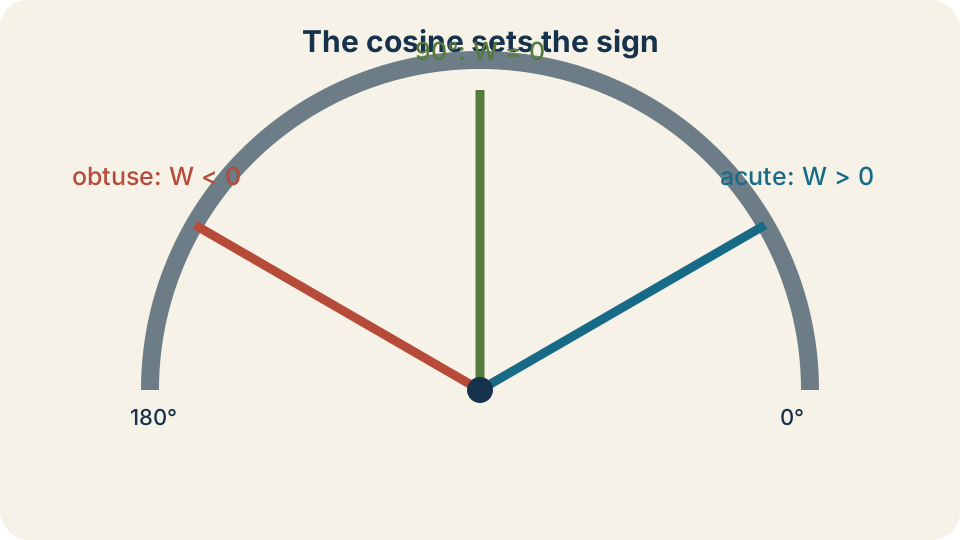
Work sign follows the cosine of the angle between force and displacement. Acute angles give positive work. A right angle gives zero work. Obtuse angles give negative work. Parallel and antiparallel cases produce the largest positive and negative magnitudes for fixed force and displacement. The angle prediction should be made before numerical calculation.
Track joules and base units
The SI unit of work is the joule, abbreviated . One joule equals one newton metre: . Because , a joule is . The unit confirms that force times displacement is energy. It does not make work a vector.
Torque also uses newton metres dimensionally, but it is not energy. Torque is an axial vector describing rotational effectiveness about an axis. Work is a scalar energy transfer. Convention writes torque as and work as joules to preserve the conceptual distinction. Identical base dimensions do not guarantee identical physical quantities.
Convert all distances to metres before calculating SI work. A force of acting through performs when parallel. Multiplying by without conversion would create a factor-of-one-hundred error. Units carried through the product expose the required conversion. A bare answer without joules is incomplete.
Work an angled-pull example
A person pulls a crate horizontally with a constant force directed above horizontal. The displacement is horizontal, so the angle between force and displacement is . Work by the pull is . Evaluating gives to three significant figures. The positive sign reflects a forward force component.
The horizontal force component is . Multiplying by gives the same . The upward component is . Since vertical displacement is zero, its direct work is . Both calculation routes agree.
The upward component can reduce the normal force from the floor. If kinetic friction depends on normal force, the angled pull can indirectly reduce negative work by friction. That effect requires a separate force analysis. It does not change the direct dot product for the person’s pull. Naming which force’s work is requested prevents the two effects from being confused.
Calculate work by multiple forces
Work adds over forces because the dot product distributes across a vector sum. Net work is for constant forces over a common displacement. The sigma symbol directs addition over all relevant forces. Individual works can be positive, negative, or zero. Net work is their signed sum.
Suppose the pull in the preceding example performs while kinetic friction of opposes the displacement. Friction work is . If weight and normal force are perpendicular to horizontal displacement, each performs . Net work is . The positive net sign predicts increasing kinetic energy.
The net value is not the work by the pull or friction individually. It describes the combined effect of all external forces included in the model. If a force is omitted, the sum changes. A work ledger listing interaction, magnitude, angle, and signed work reduces omissions. The net result should match the object’s kinetic-energy change.
Connect net work to kinetic energy
The work–energy theorem states . Kinetic energy for a particle of mass and speed is . Net positive work increases kinetic energy. Net negative work decreases kinetic energy. Zero net work preserves speed even when direction may change.
The theorem can be derived for one-dimensional constant net force. From and , multiply the kinematic relation by . The result is . Since , the right side is net work. Force-based dynamics and energy accounting describe the same motion from different perspectives.
Individual force work need not equal total kinetic-energy change. Only net work does. Work by gravity can be positive while friction is negative and an applied force is positive. Their sum sets . Separating interaction transfers from the net effect preserves the energy ledger.
Use the theorem in a speed calculation
A cart starts at and experiences of net work. Initial kinetic energy is . Final kinetic energy is . The positive net work increases the motion account. Units remain joules throughout the ledger.
Solve . Rearrangement gives . The negative square root is rejected because here denotes speed magnitude. Doubling speed required quadrupling kinetic energy. The result is consistent with the squared dependence.
If net work had been , the proposed final kinetic energy would be negative, which is impossible. That would indicate the cart stops before the assumed displacement ends or the model changes afterward. Energy constraints can reveal that a stated interval is not physically traversed under the assumed forces. Algebraic outputs require physical interpretation. Kinetic energy has a lower bound of zero.
Distinguish work from effort and fatigue
In everyday speech, holding a heavy object feels like work. In the mechanical definition, if the object’s displacement is zero, the force on that object performs zero mechanical work. The person’s body can still consume chemical energy through internal muscular processes. The mechanical system and physiological energy account are different. Everyday effort is not a direct measure of external mechanical work.
Carrying a bag horizontally at constant height provides another example. The upward supporting force on the bag is perpendicular to horizontal displacement, so it performs zero work on the bag ideally. The bag’s kinetic energy remains constant when speed is constant. The carrier still expends metabolic energy because muscles are not ideal static supports. System boundaries explain the apparent contradiction.
Work also does not equal force multiplied by time. Force times time is impulse, with units . Work uses displacement and has units . Power describes work per time and is measured in watts. Distinguishing these products prevents formulas with similar words from being interchanged.
Understand work over closed paths
For a constant force, total work depends only on net displacement. If an object travels around a closed path and returns to its starting point, . The work by that constant force is therefore zero. Positive contributions on part of the route cancel negative contributions elsewhere. The traveled distance can be large while displacement is zero.
Not every force has zero work around a closed path. Friction changes direction with motion and is not one constant vector around the loop. It typically performs negative work throughout, producing a nonzero total. Conservative forces such as ideal gravity have zero work around closed paths even though they vary with position. Path dependence becomes a criterion for classifying interactions.
The constant-force formula uses the overall displacement only because the same force vector applies everywhere. For a varying force, the path must be divided into differential displacements. Work is then . This line integral generalizes the dot-product idea. The constant formula is its simplest special case.
Read force–position graphs
For motion along , variable-force work is . The integrand is the force component along the displacement direction. On an versus graph, work is signed area between the curve and horizontal axis. Force above the axis contributes positive work for increasing . Force below contributes negative work.
A constant positive force appears as a horizontal line. From to , the area is a rectangle with height and width . Its area is , reproducing constant-force work. Graph axes have units and . Their product is .
Areas must be interpreted with sign. A triangle below the axis has negative signed area even though geometric area is positive. If positive and negative regions balance, net work is zero. Splitting the graph at sign changes makes the ledger explicit. The graph previews variable-force integration without abandoning units.
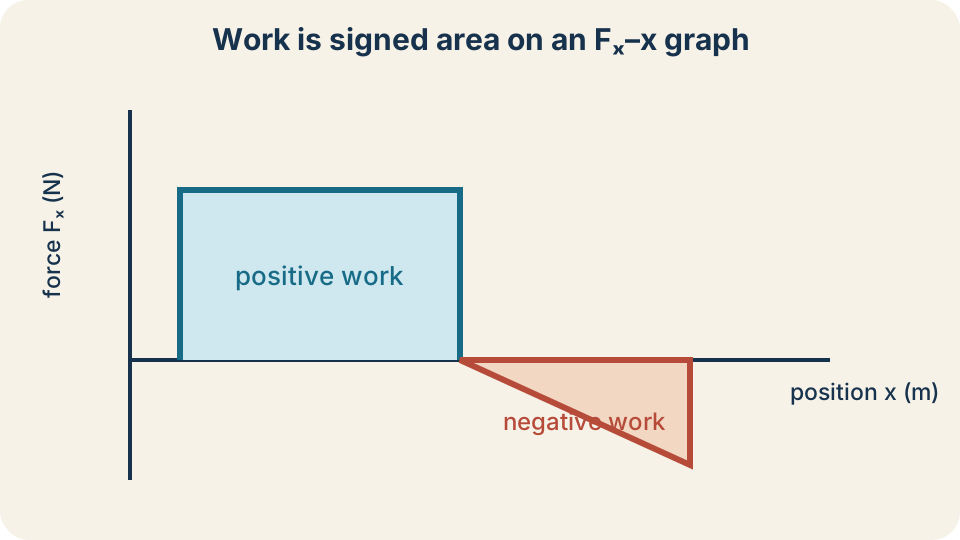
Work is signed area under a force-component versus position graph. A rectangle represents constant-force work. Regions above the axis contribute positively for motion toward increasing . Regions below contribute negatively. Force units times position units produce joules. Positive and negative areas must be added algebraically.
Treat gravity on straight displacements
Near Earth’s surface, weight can be modeled as constant downward. For vertical displacement with positive upward, gravity work is . Raising an object gives positive and negative gravity work. Lowering gives negative and positive gravity work. The sign follows relative direction.
Raise a object by at constant speed. Gravity work is . An external lifting force performs when ideal and quasi-static. Net work is zero, consistent with unchanged kinetic energy. Energy has been transferred into gravitational potential energy for an object–Earth system.
This example shows why system choice affects energy language. If the system is the object alone, gravity is an external interaction performing work. If the system includes object and Earth, gravitational potential energy can track internal configuration change. Both descriptions can be consistent. Do not count gravity work and potential-energy change redundantly in the same ledger.
Treat friction and thermal transfer carefully
Kinetic friction on a sliding object usually points opposite its local displacement. For a straight segment with constant magnitude , its work is , where is distance traveled along that segment. The negative sign indicates reduced mechanical energy of the object. The transferred energy often appears as thermal energy in the interacting surfaces. Energy is transformed or transferred rather than destroyed.
If the system includes both object and surface, friction can be treated as an internal process increasing thermal energy. If the system is the object alone, friction is external and its work changes the object’s kinetic energy. System boundaries change the bookkeeping categories. They do not change measurable motion. A clear ledger states the chosen boundary.
Static friction can perform positive, negative, or zero work depending on the situation and system. It should not automatically be assigned zero merely because there is no slipping at the contact. A rolling wheel, accelerating conveyor belt, or walking person requires careful contact-point and system analysis. Simple classroom cases must not be overgeneralized. Work is always force dot displacement of the relevant application point in the chosen model.
Follow an error-resistant workflow
First identify the system and the specific force whose work is requested. Draw force and displacement vectors from a common tail. Determine the angle between them or resolve the force along displacement. Convert force to newtons and displacement to metres. Predict the sign before multiplying.
Then calculate for a constant force. Keep the cosine dimensionless and carry into joules. For several forces, calculate each signed work separately before summing. Label net work distinctly from individual interaction work. Compare the net with expected kinetic-energy change.
Finally test limiting cases. Parallel force should give , perpendicular force should give zero, and antiparallel force should give . A result larger in magnitude than is impossible for a single constant force because . Confirm units and significant figures. Physical bounds can catch calculator angle-mode errors.
Repair common mistakes
One mistake is using the angle between force and the horizontal when displacement is not horizontal. The required angle is between the two vectors. Another is multiplying by the perpendicular force component. Work uses the parallel component. Drawing common tails and projecting onto displacement repairs both errors.
Another mistake is assuming every nonzero force performs work. Zero displacement or perpendicular geometry gives zero work. A force can change direction of velocity while doing no work. Conversely, negative work does not mean the force is absent. It means the force component opposes displacement.
A final mistake is calling individual work “net work.” Net work includes all modeled forces and equals . Individual force work identifies one energy-transfer channel. Do not use torque units or impulse units interchangeably with work. Name the force, preserve sign, and report joules. A complete statement also names the displacement interval.
Retrieve and connect forward
A force parallel to a displacement performs of positive work. A force perpendicular to a displacement performs . A force opposite displacement performs negative work. These results follow from cosine values , , and . Angle predicts sign before arithmetic.
If two forces perform and while all others do zero work, net work is . Kinetic energy increases by . The final speed still requires mass and initial kinetic energy. Energy transfer and motion state are related but not identical quantities. The work–energy theorem supplies the connection.
Work converts vector force information into scalar energy transfer. The dot product selects the parallel component, sign records transfer direction, and joules preserve physical meaning. Summing individual works gives net work and kinetic-energy change. Variable-force graphs generalize the same idea as signed area. Potential energy and power will reorganize or rate these transfers in later lessons.