
Two machines can transfer exactly the same energy and still perform very differently. A person walking upstairs and an elevator may produce the same gravitational potential-energy increase, but the elevator may do it in less time. Power measures this rate of energy transfer. Energy answers how much, while power answers how rapidly. Confusing those questions leads to mistaken comparisons of motors, batteries, athletes, and appliances.
The SI unit of power is the watt. One watt is one joule per second, written . A watt is not an amount of energy stored in a device. A device transfers during each second when operating at that power. Time must be included to determine total energy.
This lesson develops average and instantaneous power from energy accounting. It then derives the force–velocity and torque–angular-speed forms. Worked examples will carry units and signs explicitly. Efficiency will be treated as an energy or power ratio with a defined system boundary. Real ratings and variable operating conditions will show the model’s practical limits.
Learning objectives and an opening prediction
After this lesson, you should calculate average power from energy transfer and time. You should interpret instantaneous power as a derivative and area under a power–time graph as energy. You should use with correct vector meaning. You should analyze rotational power and efficiency. You should also distinguish rated power, peak power, average power, and energy consumption.
Imagine two identical boxes raised through the same height. Motor A completes the lift in , while motor B takes . Each produces the same increase in gravitational potential energy if losses are ignored. Motor A delivers three times the average useful power because it transfers that energy in one third the time. Neither motor necessarily uses less total input energy without efficiency information.
Now imagine holding a heavy box motionless for one minute. The upward force on the box is nonzero, but its displacement and velocity are zero. The mechanical work done on the box during the hold is zero, and mechanical power transferred to its motion is zero. A person’s body still consumes chemical energy through internal biological processes. The chosen system and energy pathway determine which power is being discussed.
Average power is energy per interval
Average power is . The numerator is energy transferred or an identified account change in joules. The denominator is elapsed time in seconds. The horizontal fraction bar groups the complete energy change over the complete interval. The result is measured in watts.
When work is the transfer mechanism, . Work can be positive, negative, or zero relative to the selected system and sign convention. Positive power means energy enters the chosen account by that mechanism, while negative power means energy leaves it. The magnitude alone does not communicate direction. A written system boundary makes the sign interpretable.
Suppose a motor transfers in . Convert to . Then . Prefix conversion should occur before division. The result describes the full interval, not every instant inside it.
Instantaneous power is a rate at one moment
If transfer rate changes during an interval, average power hides its time structure. Instantaneous power is or for work transfer. The derivative gives the limiting rate over an increasingly small time interval. Its value can change from moment to moment. A power rating may refer to a maximum, a steady value, or a time average, so labels matter.
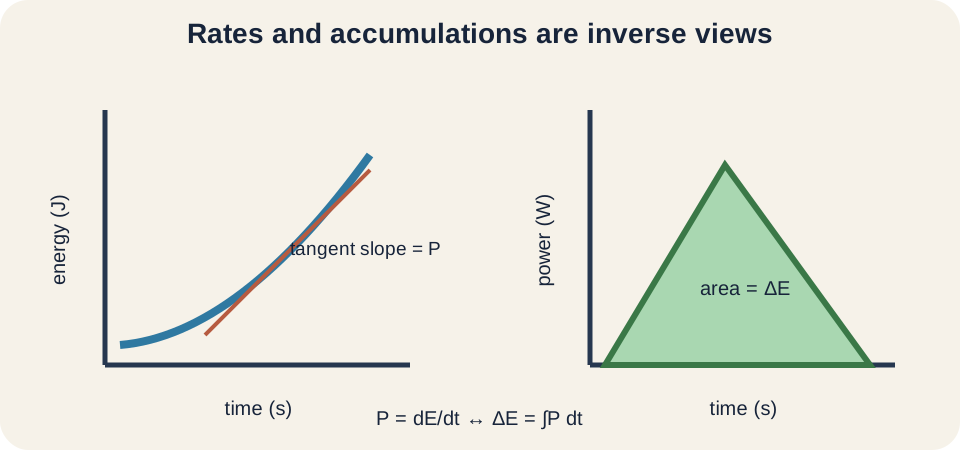
On an energy-versus-time graph, instantaneous power is the tangent slope. A steep positive slope means energy rises rapidly, a horizontal segment means no net transfer into that account, and a negative slope means energy decreases. Average power is the secant slope between two times. Curvature indicates changing power. Graph axes must include joules and seconds for slope units to become watts.
On a power-versus-time graph, signed area equals energy transfer: . A rectangular region has energy . A triangular pulse has energy . Negative regions subtract from positive regions. This relationship mirrors how impulse is area under force versus time.
Derive the force–velocity relation
An infinitesimal work transfer is . The bold is the force on the chosen object, and is an infinitesimal displacement. Divide by to obtain . Since velocity is , instantaneous power is . The dot product makes direction essential.
In magnitude-angle form, . Here and are nonnegative magnitudes, while is the angle between force and velocity. Only the force component parallel to velocity transfers energy instantaneously through mechanical work. A perpendicular force gives zero power because . It can change direction of velocity without changing kinetic energy.
If force and velocity point together, the dot product is positive and the force adds kinetic energy to the object. If they point oppositely, the dot product is negative and the force removes kinetic energy. Friction on a sliding object commonly has negative power for the object’s kinetic-energy account. A braking force also supplies negative mechanical power to the vehicle. The removed energy appears in other accounts such as thermal energy.
Worked example: climbing at steady speed
A climber rises in at steady speed. The gravitational potential-energy increase is . Use . Then . Kilogram-meter-squared per second-squared reduces to joules.
Average useful mechanical power is . Steady speed means kinetic energy does not change. It does not mean no energy is transferred. The useful output chosen here is the gravitational potential-energy increase. Internal biological losses are not included in that number.
The same result follows from because the lifting force magnitude equals at steady speed and average upward speed is . Thus . Agreement between energy-time and force-velocity methods checks the modeling. Both methods use the same steady-speed and negligible-loss assumptions. Acceleration phases would require more careful instantaneous analysis.
Vehicle power depends on force and speed
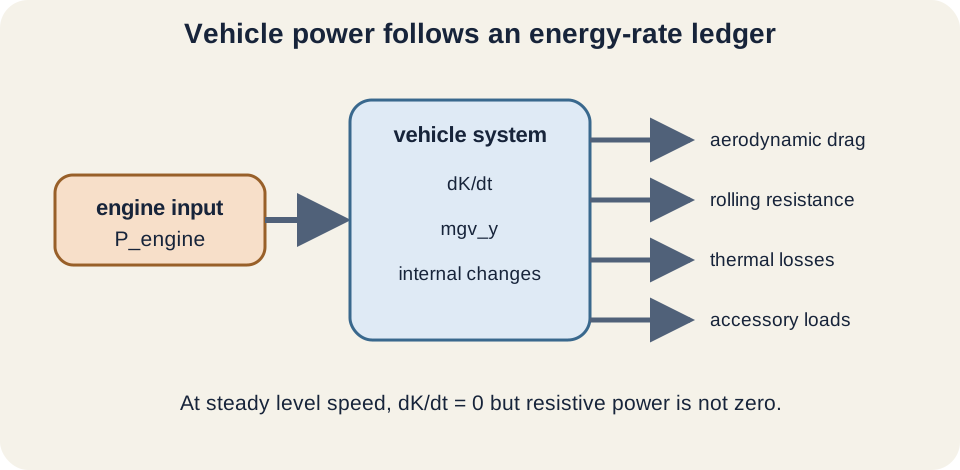
A vehicle moving at steady speed on level ground has zero net force, yet its engine may deliver substantial power. The forward traction force balances drag and rolling resistance. The net force does zero net work on kinetic energy, while the engine transfers energy that is dissipated by resistive interactions. Distinguishing one force’s power from net power resolves the apparent contradiction. System boundary and force identity must be named.
If a car’s traction force is while it moves at in the same direction, traction power is . The unit equals . At double speed with the same force, required power doubles. That comparison holds only if the force truly remains unchanged. Real aerodynamic drag force also grows strongly with speed, making power rise even faster.
During acceleration, some engine power increases kinetic energy while some counters resistance. An accounting form is under an appropriate boundary. Climbing adds a gravitational term , where is vertical velocity. Accessory loads and drivetrain losses add further terms. A single advertised power number cannot determine acceleration without mass, gearing, speed, and resistance.
Rotational power uses torque and angular speed
Rotational work for a torque through an angular displacement is . Dividing by time gives . The vector is torque in newton-meters and is angular velocity in radians per second. In fixed-axis scalar problems, with sign determined by direction. Torque and angular velocity play roles analogous to force and linear velocity.
Suppose a motor supplies at . Convert revolutions per minute to angular speed: . Power is . Radians and revolutions cancel as dimensionless angular measures. The result is about .
Gear systems trade torque against angular speed while approximately preserving power, minus losses. An ideal reduction gear increases output torque and decreases output angular speed by reciprocal factors. It does not create energy. Real gears transfer some input energy into thermal and sound accounts. Efficiency quantifies the useful fraction.
Efficiency is a boundary-dependent ratio
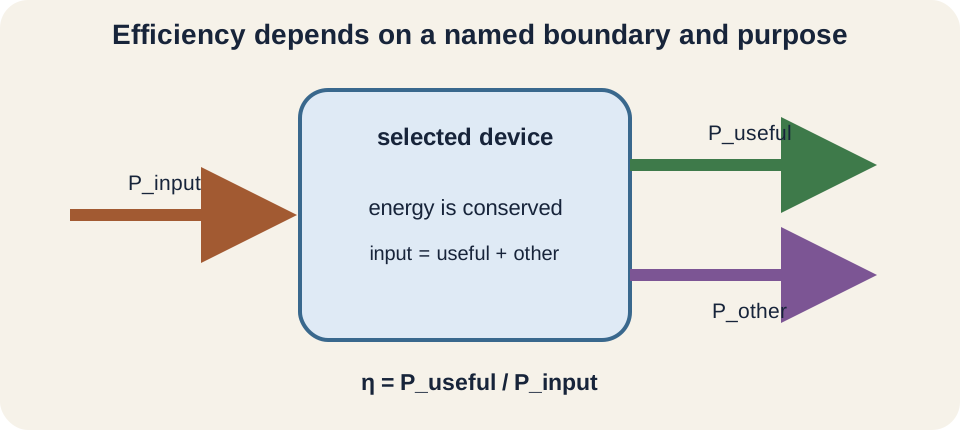
Efficiency is or, for matching intervals, . The Greek lowercase eta, , is dimensionless because like units cancel. Multiplying by expresses the fraction as a percentage. An ordinary passive device has efficiency between zero and one under a consistent accounting boundary. A value above one signals inconsistent definitions or measurement error.
Suppose a motor receives electrically and delivers of useful shaft power. Its efficiency is . The remaining is not destroyed. It transfers to thermal, sound, vibration, or other energy accounts. Conservation of energy constrains the complete ledger.
“Useful” depends on purpose. Heat from a motor is usually a loss, while heat from an electric heater is the intended output. Changing the system boundary can also move a transfer from input to internal conversion. Efficiency must therefore name device, interval, input, and useful output. Comparing percentages without matching definitions can mislead.
Power ratings and energy bills
A device’s rated power describes an operating value or limit specified by the manufacturer. It may identify nominal input power, useful output power, continuous maximum, or short-duration peak. The label and test standard decide its meaning. A motor can tolerate high peak power briefly but overheat if maintained there. Thermal time constants make duration relevant.
Energy consumption equals power integrated over time. For constant power, . A kilowatt-hour is an energy unit: . It is not kilowatts per hour. Utility bills charge energy, often with additional rate structures.
A heater operating for uses . In joules, this is . The hour unit is retained for billing units and converted to seconds for joules. A lower-power device running longer can consume more energy than a high-power device used briefly. Both rate and duration determine the total.
Human and biological power require careful accounting
Muscle converts chemical energy into mechanical work and thermal energy. Mechanical efficiency varies with activity, speed, posture, and definition. A climber’s useful mechanical output might require substantially greater metabolic power. The difference largely appears as thermal energy. Food-energy rate and external mechanical power are not identical.
Holding a load is a revealing example. External mechanical power on the stationary load is zero because its velocity is zero. Muscle fibers nevertheless cycle molecular interactions and consume chemical energy to maintain tension. Internal biological power is nonzero. A purely rigid-body mechanical model cannot describe the metabolic pathway.
Peak human power can be high for a short sprint, while sustainable average power is lower. Duration, muscle recruitment, and heat removal constrain performance. Comparing athletes requires standardized intervals and measurement methods. A one-second peak and a one-hour average are different quantities. Context belongs beside every power number.
Common misconceptions and repairs
One misconception treats power as stored energy. A battery stores chemical energy but has power limits governing how quickly it can deliver energy. Two batteries can store equal energy while supporting different maximum power. Conversely, equal-power devices can operate for different durations because their energy supplies differ. Watt-hours and watts answer different questions.
Another misconception says a force always supplies power. The dot product requires velocity along the force. A centripetal force perpendicular to circular velocity does zero work and zero power on kinetic energy. A force on a stationary contact point can likewise have zero instantaneous mechanical power. Force magnitude alone is insufficient.
A third misconception interprets efficiency below one as missing energy. Energy is conserved, but not all output is categorized as useful. Thermal, acoustic, and deformation accounts complete the ledger. Increasing efficiency reduces unwanted transfers for the chosen purpose. It does not change the conservation law.
Practice with guided feedback
First, a machine transfers in ; find average power. Second, a force acts at to a velocity; find instantaneous power. Third, a device receives and is efficient; find useful power. Fourth, explain why force perpendicular to velocity yields zero power. State the relevant system or account for every sign.
Average power is . Instantaneous power is . Useful power is . A perpendicular force has zero parallel component and therefore transfers no work at that instant. Each answer retains both a number and physical interpretation.
For a graph check, sketch power rising linearly from zero to over . The energy transferred is triangular area, . Average power is . Peak and average are not interchangeable. The graph makes their relationship visible.
Retrieval and connection forward
Without looking back, define average and instantaneous power with units. Derive from differential work. Explain what slope and area mean on energy-time and power-time graphs. Write the efficiency ratio and name its boundary-dependent terms. Finish by distinguishing watts from kilowatt-hours.
Energy-conservation lessons will incorporate power as the rate form of a ledger. Rotational dynamics will use . Circuits will use and resistor-specific substitutions. Thermodynamics will distinguish work and heat transfer rates. The same rate-versus-amount reasoning applies across every field.
Keep one organizing statement: power is the signed rate at which energy crosses a boundary or changes an identified account. Average power compresses an interval, while instantaneous power describes one moment. Force supplies mechanical power only through its velocity-parallel component. Efficiency compares useful output with input without violating conservation. A complete power claim includes system, pathway, interval, and units.