
Nonconservative interactions transfer and transform energy in ways that cannot be represented by one position-dependent potential-energy function. Friction, fluid drag, inelastic deformation, and many applied forces belong in this broader accounting. They do not violate energy conservation. Instead, they expose the difference between mechanical energy and total energy. A correct analysis begins by choosing a system boundary and identifying every significant energy store and transfer.
Separate total energy from mechanical energy
Mechanical energy is commonly defined as . The symbol denotes kinetic energy, and denotes potential energy associated with modeled conservative interactions. This sum is useful because kinetic and potential stores can exchange internally. It is not the complete energy of every real system. Internal, chemical, electrical, and other stores may also matter.
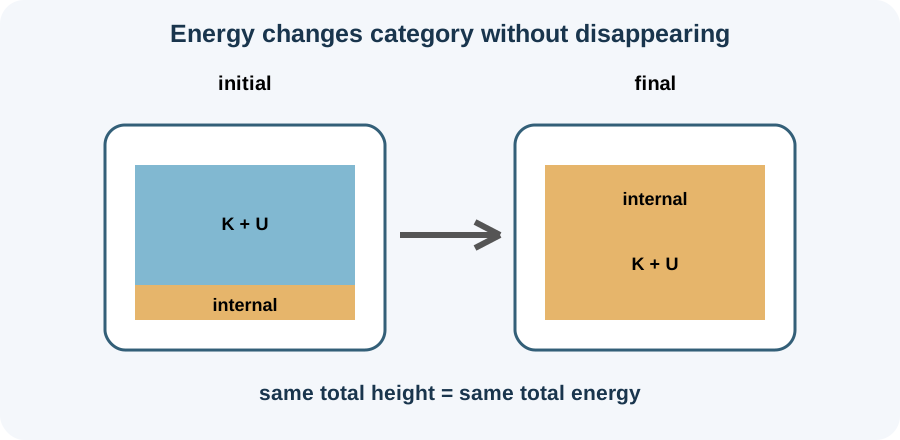
Mechanical energy can decrease while total energy remains constant. A sliding block slows as organized translational kinetic energy becomes microscopic motion and deformation. Those receiving forms are commonly grouped as internal energy . The block and surface may become slightly warmer. Energy changes category rather than ceasing to exist.
The phrase “mechanical energy is conserved” therefore requires conditions. It is appropriate when no significant transfer enters or leaves and no significant conversion occurs into excluded stores. If friction or deformation matters, alone generally changes. A wider account restores conservation by including internal energy and boundary transfers. Naming the level of account prevents an incomplete equation from being mistaken for a universal law.
Identify conservative interactions by path independence
A conservative interaction has work that depends only on initial and final configurations. Gravitational and ideal spring interactions are familiar examples within their modeling limits. Their work can be written . The negative sign means positive conservative work corresponds to decreasing potential energy. A potential-energy function stores the endpoint dependence compactly.
Path independence means two routes between the same configurations produce the same conservative work. Equivalently, the total conservative work around a closed path is zero. This property allows potential energy to depend on configuration rather than travel history. The chosen zero of is arbitrary, but changes in are physically meaningful. A constant shift in potential does not change forces or energy balances.
Conservative is not a synonym for weak, constant, or harmless. Gravity can do substantial work and still be conservative. An ideal spring force varies with position and is conservative. Classification depends on path behavior and potential representation. The nature of the interaction matters more than the numerical size of the force.
Recognize path-dependent interactions
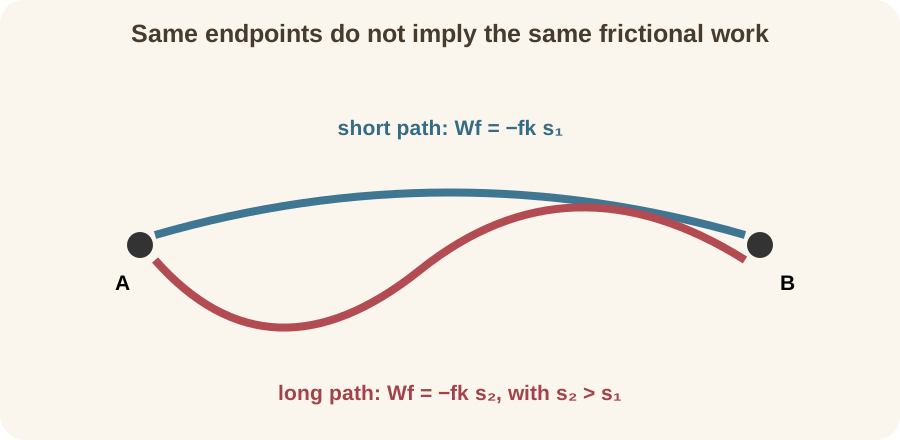
Kinetic friction generally performs work that depends on distance traveled. For constant friction magnitude opposing motion over path length , its work on the sliding object is . The minus sign comes from force opposite displacement. Taking a longer route between identical endpoints makes the work more negative. Endpoint coordinates alone cannot determine the result.
Fluid drag is also path and speed dependent. A common low-speed model is , where is a positive drag coefficient. The force depends on velocity rather than position alone. Work accumulated over a trajectory depends on the full motion history. A single scalar potential cannot reproduce that dependence.
Permanent deformation provides another example. Crushing, bending beyond elasticity, or internal friction converts organized motion into internal energy. Returning an object’s center of mass to its starting location does not automatically restore its original shape or temperature. The material retains history. That memory is incompatible with a simple position-only potential model.
Choose the system boundary before writing equations
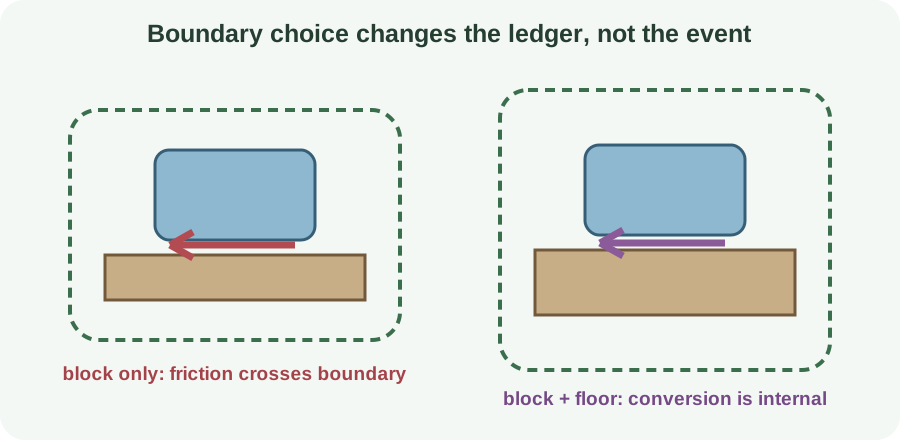
A system is the collection of objects or matter included in the energy account. The boundary separates that system from its surroundings. Interactions across the boundary transfer energy. Interactions between parts already inside redistribute or transform energy internally. The same physical event can be described with different valid boundaries.
If the system is a sliding block alone, friction from the floor is an external interaction. Its work transfers energy out of the block’s resolved mechanical store. Some transferred energy may remain as internal energy in the block, while some goes to the floor. A block-only model must not automatically assign all frictional work to one internal store. The boundary determines what can be tracked directly.
If the system includes both block and floor, friction is internal to the chosen system. Translational kinetic energy decreases while combined internal energy increases. No friction work crosses the outer boundary in an isolated block-floor model. Both boundary choices predict the same motion when used consistently. They differ in where transfers appear in the ledger.
Write a complete energy balance
For a closed system with no energy crossing its boundary, a simple balance is . Every delta means final value minus initial value. A positive change in one store must be balanced by negative changes elsewhere. The equation is an accounting identity after the relevant categories are chosen. It does not say that each category remains constant.
If external work transfers energy into the system, one convention is . Here represents energy transferred by heating under the adopted sign convention. More detailed accounts can include matter flow, radiation, or electrical transfer. Signs must be defined rather than assumed. The same convention must be used throughout one solution.
An alternative mechanical-energy form is when represents work by nonconservative external forces on the selected mechanical system. This compact formula is not automatically interchangeable with an internal-energy balance. Its meaning depends on which objects are inside the system. Writing a boundary sketch before the formula prevents double counting. A friction term should appear either as boundary work or internal conversion according to the chosen model, not both.
Analyze a block stopping on a level floor
A crate moves initially at and slides to rest. Its initial translational kinetic energy is . The final kinetic energy is . Gravitational potential energy does not change because height remains constant. The mechanical-energy change is therefore .
For a system containing crate and floor with no important external transfer, use . Substitution gives . Thus . The increase includes microscopic motion and deformation in both contacting materials. Total energy remains unchanged within the idealized isolated system.
For a crate-only mechanical account, friction does of net work to stop the crate. This result is consistent with . It does not specify how the is divided between crate, floor, and air. A broader thermal model would be required for that partition. The mechanical calculation and energy ledger answer related but distinct questions.
Connect kinetic friction with stopping distance
For kinetic friction magnitude , the coefficient is dimensionless and is normal force in newtons. On a horizontal surface with no other vertical forces, . The frictional work over distance is . The product has units newton-metres, equal to joules. The formula assumes constant coefficient and normal force.
If friction alone stops a sliding object, set . Mass cancels, giving . This ideal model predicts stopping distance proportional to speed squared. Doubling initial speed requires four times the distance. The cancellation does not mean friction force is independent of mass; both initial energy and friction scale with mass.
Let , , and . Then . Units reduce from divided by to metres. Real braking distances also include reaction time, tire behavior, and changing road conditions. The computed value is therefore a model prediction rather than a universal stopping distance.
Include gravitational change on an incline
An object sliding down an incline can lose gravitational potential energy while gaining kinetic and internal energy. For a block-Earth-incline system, an isolated balance is . The gravitational change is . A downward height change makes this term negative. Frictional conversion makes internal energy increase.
Suppose a block descends vertically from rest and reaches speed . The kinetic-energy increase is . The gravitational change is . The internal-energy increase is therefore . Each term has joule units and the three changes sum to zero.
Using vertical height for gravity avoids unnecessary incline geometry. Using path length for friction remains necessary because frictional work is path dependent. These two distances are generally different. Mixing them is a frequent error. Labeling as vertical displacement and as path length keeps their roles distinct.
Distinguish static and kinetic friction in energy accounts
Static friction does not automatically perform zero work in every frame and system. At a rolling contact point on a stationary surface, the instantaneous contact point may have zero velocity, so ideal static friction performs no power there. Yet static friction can redistribute energy between translation and rotation. In other setups, a moving surface can transfer energy through static friction. The interaction requires kinematic analysis rather than a memorized slogan.
Kinetic friction occurs when surfaces slide relative to each other. It usually increases internal energy through microscopic deformation and molecular motion. The mechanical work on each object can depend on its displacement in the chosen frame. The total internal conversion is related to relative sliding. Object-by-object work and system-level dissipation should not be conflated.
Rolling resistance, tire deformation, and bearing losses are not always described well by a simple kinetic-friction model. They may involve repeated deformation, hysteresis, and fluid drag. Effective resistance forces can still be useful approximations. Their limitations should be stated. A model name does not replace understanding of the actual transfer mechanism.
Treat applied forces and propulsion consistently
An external applied force can add or remove mechanical energy. Its work is . The dot product selects the component along displacement. A force aligned with motion performs positive work. A force opposite motion performs negative work.
A person pushing a crate transfers chemical energy from their body into the crate-floor system. Some becomes crate kinetic energy, and some becomes internal energy through friction. If speed remains constant, the crate’s kinetic energy does not change. Positive applied work is then balanced by frictional conversion. Zero kinetic-energy change does not imply zero energy transfer.
An engine similarly converts chemical or electrical energy into mechanical transfer. Treating propulsion merely as an unexplained force can predict motion but hide the energy source. A wider system includes fuel, battery, or motor stores. The appropriate detail depends on the question. Energy conservation remains meaningful only when the source category is present somewhere in the account.
Connect work with power and rate of dissipation
Power is the rate of energy transfer, . For a force acting at velocity , instantaneous power is . The unit is joules per second, called the watt. Positive power transfers energy into the selected mechanical store. Negative power removes it.
For kinetic friction of constant magnitude opposing speed , power on the sliding object is . Faster sliding produces a greater magnitude of mechanical-energy loss per unit time. If the force is and speed is , then . This says of mechanical energy is removed each second at that instant. The receiving internal-energy rate has corresponding positive magnitude in an appropriate closed system.
Power can vary even when total work over a path is fixed. A rapidly executed process may transfer the same energy in less time and therefore require larger average power. Internal heating rates can influence temperatures because thermal energy also leaves through the environment. Work, power, and temperature change are related but distinct quantities. Each requires its own units and model.
Understand drag and terminal behavior
For linear drag , drag power is . The coefficient has units so force has newtons. Power is always nonpositive because speed squared is nonnegative. Mechanical energy transfers into internal energy of the object-fluid system. The rate grows with speed squared under this force law.
Quadratic drag has form . Its magnitude scales as , and its power magnitude scales as . This model often fits higher-speed fluid motion better than linear drag. The coefficient depends on fluid density, shape, and area. Neither drag law is universally valid.
During a fall, gravity can supply energy at the same rate drag removes it. At terminal speed, kinetic energy remains constant because acceleration is zero. Gravitational potential energy continues decreasing. That decrease becomes internal energy of the object-air-Earth system. Constant speed therefore does not mean energy transfers have stopped.
Diagnose common accounting mistakes
The phrase “friction destroys energy” is incorrect. Friction changes how energy is organized and where it resides. Another error is declaring energy nonconservation because changes. The missing category is often internal energy. A complete total-energy account remains balanced.
Double counting occurs when frictional work and internal-energy increase are both added as separate losses within the same boundary convention. Choose either an external-work description or an internal-conversion description as appropriate. Draw the boundary and label transfers crossing it. Then write one equation consistent with that picture. A neat diagram can prevent a sophisticated algebraic mistake.
Distance errors also matter. Gravitational potential change uses vertical height. Kinetic-friction work uses sliding path length. Work by a general force uses its dot product with displacement along the actual path. Giving every distance the same symbol hides these distinctions. Use labeled variables and units from the start.
Practice complete energy accounts
Suppose an isolated system loses of mechanical energy. Its nonmechanical energy must increase by . State which internal categories are plausible rather than writing “lost.” Verify that the total change is zero. Explain why this conclusion depends on the system being isolated. A nonisolated system would also require boundary transfers in the balance.
A kinetic-friction force opposes motion over . Its work on the object is . If object and surface form an isolated system, the corresponding internal-energy increase is when no other mechanical changes occur. The signs refer to different ledger entries. Their magnitudes balance.
For a block descending a rough ramp, create two accounts. First choose the block alone and describe external work by gravity, normal force, and friction. Then choose block, ramp, and Earth and describe changes in kinetic, gravitational potential, and internal energy. Confirm that both predict the same final speed. This comparison develops control over boundaries rather than dependence on one memorized formula.
Connect forward to thermodynamics
Nonconservative work introduces energy categories central to thermodynamics. Internal energy is a state quantity representing microscopic energy within a system. Work and heating are transfer processes across a boundary. They are not substances stored inside an object. Clear nouns and verbs improve the accounting.
The first law of thermodynamics formalizes these ideas for broader processes. Its signs depend on the adopted convention, but total accounting remains consistent. Frictional heating, compression, electrical work, and chemical change can all appear. Mechanical examples provide a concrete bridge to that general law. System choice remains the first decision.
You are ready to continue when you can distinguish total from mechanical energy, conservative from path-dependent work, and internal conversion from boundary transfer. You should include units, path lengths, height changes, and signs explicitly. You should justify the system boundary before choosing an equation. These habits prevent the language of “lost energy” from replacing actual physics. Thermodynamic accounting can then extend the same discipline to heat and internal-energy processes.