
Internal energy belongs to a system state, while heat names energy crossing a boundary because of a temperature difference. This distinction sounds linguistic, but it determines which equations are valid and prevents energy from being counted twice. A cup of water can store internal energy, receive energy by heating, and deliver energy by heating without ever “containing heat” as a substance. Temperature, internal energy, and heat transfer are related but not interchangeable. This lesson develops their relationship through microscopic models, heat capacities, phase changes, calorimetry, transfer mechanisms, and complete energy accounting.
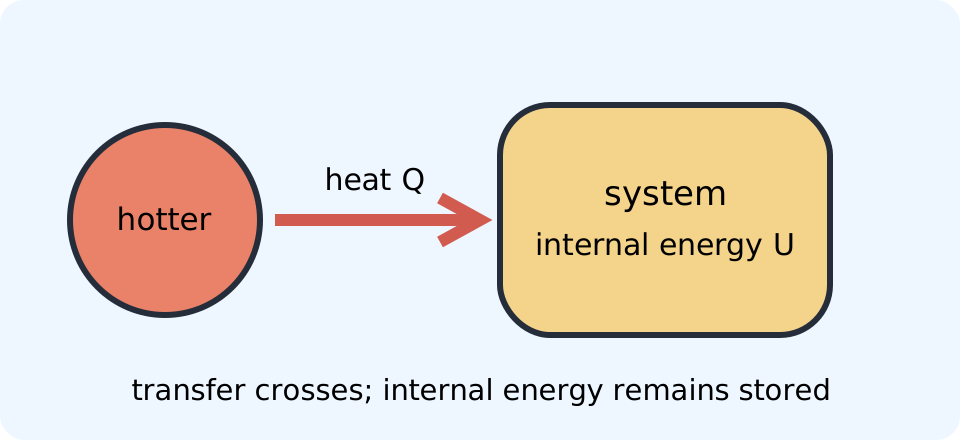
Define the system before naming heat
A system is the matter or region selected for analysis. Draw a boundary around it and identify the surroundings. Energy transfer can then be described as entering or leaving that boundary. Without a boundary, a sign such as has no defined recipient. System choice is the first step in thermal accounting.
Heat is energy transferred because a temperature difference exists across the boundary. Under the usual sign convention, means heating transfers energy into the selected system, while means energy leaves it by heating. Heat is measured in joules. The word heat describes a process during an interval rather than a property at one instant. One can report for a process but not the “heat content” of an equilibrium state.
The same transfer can have opposite signs for two systems. If a hot metal block transfers to cooler water, then and under an isolated-pair model. The energy amount is shared across one interaction. Adding the signed transfers gives zero. This cancellation is the basis of calorimetry.
Describe internal energy microscopically
Internal energy includes microscopic kinetic and potential contributions within the system. Molecular translation, rotation, vibration, intermolecular attraction, chemical bonding, electronic states, and nuclear structure can contribute. Which terms are active depends on material, temperature range, phase, and model. The total does not ordinarily include center-of-mass kinetic energy or macroscopic gravitational potential energy when those are tracked separately. Internal energy is measured in joules.
Internal energy is a state function. Its change is , so it depends on final and initial states rather than the path between them. Heat and work transfers can vary across paths that connect the same states. Energy conservation requires their net effect to produce the same . This distinction prepares the first-law relation .
Absolute internal energy often depends on an arbitrary reference, while changes are physically useful. Chemical tables, phase models, and ideal-gas formulas select convenient zeros. A negative value relative to one reference does not imply an impossible amount of energy. Consistency of the reference across states is what matters. Thermal problems typically calculate or transferred energy rather than an absolute microscopic total.
Separate temperature from internal energy
Temperature is an intensive state variable that orders systems by the direction of spontaneous heating transfer. Internal energy is extensive and generally increases with amount of matter. Two equal samples at the same temperature have approximately twice the combined internal energy of either sample alone. Their combined temperature remains unchanged when no other process occurs. Temperature therefore cannot be added like energy.
A small object can have high temperature but little internal energy. A large cooler object can contain far more internal energy because it has more particles and different microscopic storage modes. Material properties and phase also matter. Equal temperatures do not imply equal internal energies. Equal internal energies do not necessarily imply equal temperatures.
For a monatomic ideal gas, internal energy is . This model links directly to absolute temperature and amount . Real materials can change internal energy through phase or structural rearrangement without changing temperature. The ideal-gas link is valuable but not universal. Every microscopic interpretation should name its model.
Define heat capacity and specific heat capacity
Heat capacity describes the energy transfer required per unit temperature change under specified conditions. For an approximately constant capacity, . Its SI unit is . The quantity belongs to a particular object or system. A larger object of the same material generally has greater heat capacity.
Specific heat capacity is heat capacity per unit mass. The relation is , where is mass. Its unit is . For a temperature change without phase change and negligible work, . Unit cancellation gives .
The value of can depend on temperature, pressure, phase, and process constraint. Values listed in tables are approximations over stated ranges. Solids and liquids often use one value across modest temperature intervals. Gases distinguish constant-volume and constant-pressure heat capacities because expansion work differs. Treating as constant is a model assumption rather than a definition.
Apply sensible-heating calculations
Sensible heating refers to energy transfer that changes temperature without changing phase. Suppose of water has and warms by . The required transfer is . Mass and kelvin units cancel as expected. The positive sign indicates energy enters the water by heating.
Temperature differences have the same numerical size in kelvins and Celsius degrees. A rise from to has . Absolute temperatures differ by , but interval sizes do not. Use kelvins for absolute ratios and thermodynamic equations requiring absolute temperature. Use either compatible interval unit in .
If specific heat varies significantly, replace the constant approximation with . The integral adds the energy required across small temperature intervals. Its signed limits handle warming or cooling. A tabulated or fitted function supplies the integrand. Numerical integration may be needed when no simple antiderivative exists.
Explain latent energy and phase change
During a phase change, energy can alter microscopic arrangement without changing temperature appreciably. The simple model is , where is specific latent energy in . Fusion refers to melting or freezing, while vaporization refers to boiling or condensation. The same magnitude applies in opposite directions under an ideal reversible phase transition. The sign follows whether energy enters or leaves the selected system.
Melting requires positive heat transfer because the less-ordered liquid phase has greater internal energy than the solid at the same transition temperature under ordinary conditions. Freezing releases the same latent-energy magnitude. Vaporization usually requires substantially more energy because molecules separate more completely. Condensation releases that energy. Temperature remains near the phase-transition value while both phases coexist at fixed pressure.
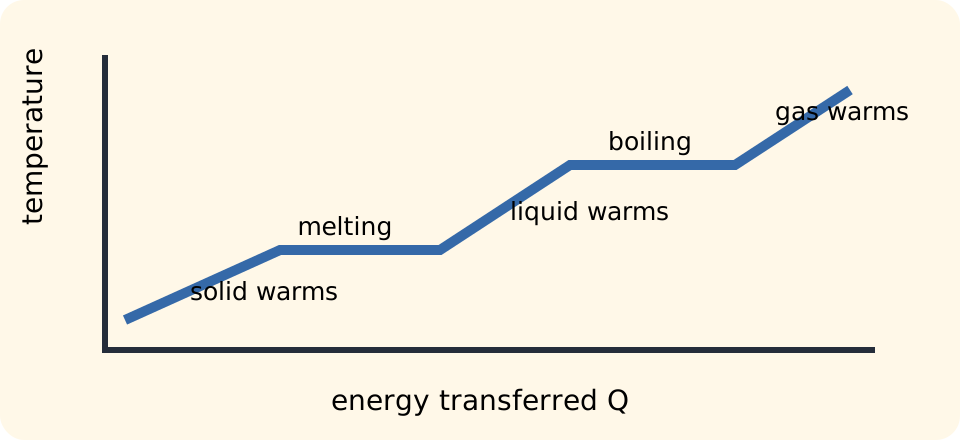
A plateau on a heating curve does not mean energy transfer has stopped. It means the incoming energy is changing phase proportions rather than average thermal state in a way that raises temperature. The phase-transition temperature depends on pressure. Impurities and nonequilibrium effects can broaden or shift the transition. The horizontal ideal plateau is a useful model, not every measured curve’s exact shape.
Solve a multistage heating problem
Suppose of ice warms from to and then melts. Using , the warming stage requires . Using , melting requires . Each stage uses a different physical model. Their units both reduce to joules.
Total input is . Most of the energy changes phase rather than temperature. Using one expression across the entire process would miss the latent stage. A heating-curve sketch should be drawn before calculating. Breakpoints identify where material properties and equations change.
If the resulting liquid water then warms to , add . With , that stage requires . The complete process needs to three significant figures. Sequential energy accounting preserves each phase and interval. It also makes the chosen material property and the units for every stage visible for inspection.
Build an isolated calorimetry balance
Calorimetry infers energy transfer from temperature and phase changes. For an isolated collection with negligible work, the signed heat transfers satisfy . The sigma means add every included component’s transfer. Energy leaving warmer components equals energy entering cooler components. The system boundary must include all bodies whose transfers are represented.
For two substances without phase change, the balance is . A body that cools has negative and therefore negative . A body that warms has positive . The shared final temperature expresses thermal equilibrium. Solving symbolically shows that is a thermal-capacity-weighted average.
The predicted final temperature should usually lie between the two initial temperatures in this isolated no-phase-change model. A result above both or below both signals a sign, algebra, or missing-process error. Phase changes can pin the result at a transition temperature while one phase remains. Chemical reaction or electrical work can also drive final temperature outside a simple mixing bound. Physical checks depend on the complete process.
Include the calorimeter and surroundings
A real calorimeter absorbs energy. If its heat capacity is , include . Omitting this term assigns too much or too little transfer to the sample. The container, thermometer, stirrer, and lid can all contribute. A calibration experiment can estimate their combined effective heat capacity.
Energy exchange with the room violates the ideal isolated assumption. Insulation reduces but does not eliminate transfer. Rapid measurements can limit exposure time, while extrapolation methods can estimate the temperature that would have occurred without leakage. Evaporation can remove energy and mass. A rigorous report states which effects are neglected and why.
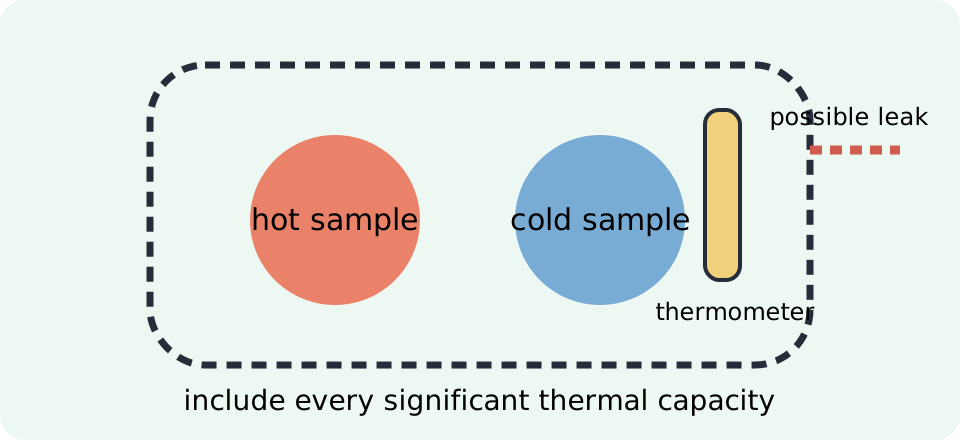
Uncertainty in mass, temperature, and material properties propagates into the inferred heat or specific heat. Temperature differences formed from two readings share instrument calibration errors in structured ways. Repeating trials reveals random variation but not every systematic bias. Significant figures should reflect the least precise evidence. Calorimetry is measurement plus a conservation model.
Distinguish conduction, convection, and radiation
Conduction transfers energy through microscopic interactions within or between materials. A simple steady one-dimensional model is . The dot denotes energy per unit time, is thermal conductivity in , is cross-sectional area, and is thickness. Greater conductivity or area increases transfer rate, while greater thickness reduces it. The model assumes a stable gradient and appropriate boundary conditions.
Convection transfers energy through bulk fluid motion combined with conduction near a surface. A common empirical form is , where is a convective heat-transfer coefficient. Natural convection arises from buoyancy-driven flow, while forced convection uses fans, pumps, or motion. The coefficient depends on geometry, fluid properties, speed, and flow regime. Convection is not merely “hot air rising,” although buoyancy is one mechanism.
Radiation transfers energy through electromagnetic fields and does not require matter. A simplified net model is . Emissivity is dimensionless, is the Stefan–Boltzmann constant, and temperatures must be in kelvins. The fourth power makes absolute-scale use essential. Real situations often involve all three mechanisms simultaneously.
Connect transfer rates with transferred energy
Heat is an energy amount, while is a transfer rate. A rate of means crosses the boundary each second. For constant rate over time interval , . If rate varies, integrate . Watts and joules must not be interchanged.
Suppose a heater delivers for . The energy delivered is . Not all of this must increase the target’s internal energy. Some may leave through the environment or perform work. Efficiency and system boundaries determine the useful fraction.
Transient heating couples transfer rate to changing temperature. A lumped model can use . The left side is the rate of internal-energy change under constant . The right side balances heater input and convective loss. Differential equations extend static calorimetry to time-dependent behavior.
Explain why material properties matter
Water’s relatively high specific heat capacity allows it to absorb substantial energy with modest temperature change. This property moderates climate near large bodies of water and makes water useful as a coolant. Metals often have lower specific heat but high thermal conductivity. They can change temperature with less energy per kilogram and transfer energy rapidly. “Feels cold” and “has low temperature” remain distinct.
Thermal diffusivity combines conductivity, density, and specific heat to describe how quickly temperature disturbances spread. A high-conductivity material can still have substantial heat capacity. Effusivity influences how strongly a material exchanges energy with skin during contact. Different properties answer storage-rate and transfer-rate questions. One label such as “good conductor” does not determine every thermal behavior.
Phase-change materials exploit latent energy to store or release large energy amounts within a narrow temperature range. Building materials, cooling packs, and thermal-control systems can use this behavior. Choice of phase-transition temperature matters for the application. Cycling stability and containment also matter. Thermodynamic models guide design but material performance requires measurement.
Relate heat to work and the first law
Heating is not the only way to change internal energy. Compression, stirring, electrical resistance, friction, and chemical reactions can transfer or transform energy. Rubbing hands warms them through work and internal dissipation, not because heat is a substance produced inside them. An insulated gas can warm during compression with . Internal-energy change must be connected to every boundary mechanism.
For a closed system using work done by the system, the first law is . If volume is fixed and no other work occurs, and . That special case underlies simple calorimetry. If expansion work occurs, and are not generally equal. The simpler equation must be justified by the boundary and constraints.
Mechanical energy transformed by friction can increase internal energy of surfaces and surroundings. Whether that increase appears as , work, or internal conversion depends on the system boundary and interaction classification. The total energy account remains consistent when boundaries and mechanisms are explicit. Labels describe how energy crosses a chosen boundary. They are not intrinsic tags permanently attached to energy packets.
Repair common misconceptions
A common mistake is saying that an object contains heat. It contains internal energy and can exchange energy by heating. Another mistake is treating temperature as energy amount. Mass, material, phase, and microscopic modes also matter. Precise language keeps state variables and processes separate.
A second mistake is using across a phase change. During the phase transition, use and add separate sensible-heating stages before or after. Draw a heating curve and mark every breakpoint. Use the specific heat for the correct phase. Sum energy transfers only after each stage is calculated.
A third mistake is mixing grams with or kilojoules with joules. Convert quantities before multiplication and retain units through every step. Another mistake is omitting calorimeter heat capacity without declaring an idealization. A numerical answer is only as valid as its system model. Unit and boundary checks should precede reporting.
Practice with complete reasoning
Find the energy required to warm of material with by . The result is . Mass and temperature units cancel. The positive sign means energy enters the material. State the assumptions about phase, work, and constant specific heat.
Find the energy required to melt of ice at using . The transfer is . Temperature remains near the melting point while solid and liquid coexist. Internal energy increases through changed molecular arrangement. Explain why would give zero and miss the process.
A metal sample with at is placed in water with at . The ideal balance is in consistent units. Solving gives . The value is closer to the water’s initial temperature because the water has greater thermal capacity. Identify how including the container would change the equation.
Consolidate the thermal-energy framework
Internal energy is microscopic energy stored in a system state. Heat is energy transferred across a system boundary because of temperature difference. Temperature orders thermal states but does not measure total stored energy. Heat capacity connects transfer with temperature change under stated constraints. Latent energy connects transfer with phase change.
Calorimetry applies energy conservation to an isolated or corrected collection. Signed transfers sum to zero when work and environmental exchange are negligible. Containers, thermometers, phase changes, and leakage must be included when significant. Conduction, convection, and radiation describe transfer mechanisms and rates. They do not define new stored substances.
The reliable method is boundary first, process second, equation third. Identify the system, transfer direction, phase, temperature interval, material properties, and possible work. Carry units and signs through each stage, then test the result against physical bounds. The first law will place these heat transfers beside work in a general energy balance. Clear distinctions now make that law an understandable accounting statement rather than a sign puzzle.