
The first law of thermodynamics is energy conservation applied to a carefully chosen system. It connects changes in stored internal energy with energy transferred across the system boundary by heating, work, and, in open systems, flowing matter. The equation is short, but its signs cannot be used responsibly until the system and work convention are declared. A good analysis therefore begins with a boundary diagram and a qualitative prediction before any arithmetic. This lesson develops that complete accounting method and shows how familiar thermodynamic processes emerge as constrained cases of one conservation principle.
Begin with the system boundary
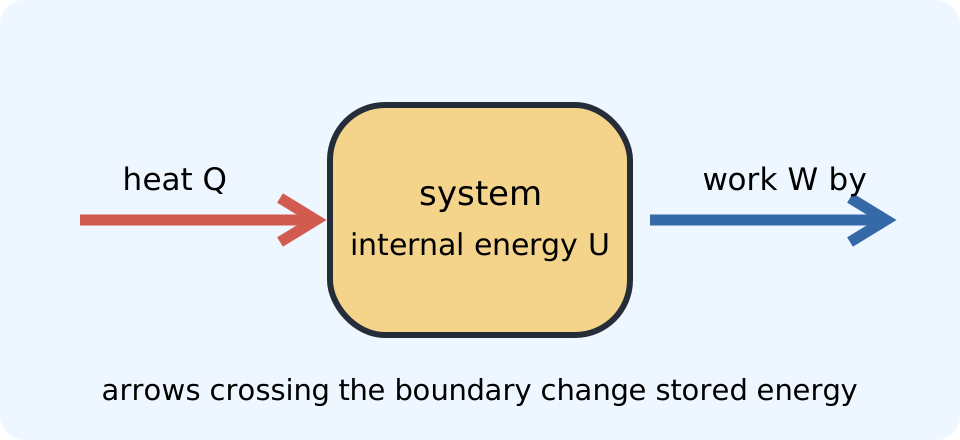
A thermodynamic system is the matter or region selected for analysis. Everything outside that boundary is called the surroundings. A sealed gas in a piston, a cup of water, a battery, an engine cylinder, or an entire power plant can be selected as a system. The choice is not merely verbal because it determines which energy transfers cross the boundary and which interactions are internal. State the system before assigning signs.
A closed system contains a fixed amount of matter, although energy can still cross its boundary. An open system, also called a control volume, permits matter to enter or leave and therefore requires an additional matter-carried energy account. An isolated system exchanges neither matter nor energy with its surroundings under the ideal model. These categories describe the chosen boundary over the selected time interval. The same physical device can be analyzed with different boundaries for different questions.
Draw the boundary as a closed curve around the selected contents. Add arrows for every identified transfer and label each arrow with both mechanism and direction. Heating, shaft work, electrical work, pressure–volume work, radiation, and matter flow must not be combined prematurely into a vague “energy” arrow. This diagram makes the signs consequences of physical direction rather than guesses made after calculation. It also exposes transfers that an equation-only solution may omit.
Separate stored energy from transferred energy
Internal energy is energy stored in microscopic degrees of freedom within the system. It can include translational, rotational, and vibrational molecular kinetic energy, intermolecular potential energy, chemical energy, electronic energy, and nuclear energy. The relevant contributions depend on the model and process. Internal energy does not include the macroscopic kinetic or gravitational potential energy of the system as a whole when those are tracked separately. Its SI unit is the joule.
Heat is energy transferred because of a temperature difference. Work is energy transferred through an organized macroscopic interaction such as a force through displacement, shaft rotation, electrical current through potential difference, or boundary motion against pressure. A system does not contain a quantity of heat or work after the process ends. It contains energy, while heat and work name ways energy crossed the boundary during the process. This language distinction protects the bookkeeping model.
The phrase “heat flows” is common shorthand, but rigorous interpretation remains energy transfer by heating. Temperature is not energy, and a temperature change is not identical to a heat transfer. A gas can change temperature during adiabatic compression even though . It can receive heat during isothermal expansion while its temperature remains constant. Process constraints determine how transfer and storage changes relate.
Declare the work sign convention
Theory Commons uses for work done by the system on its surroundings. The closed-system first law is . The change is final internal energy minus initial internal energy. Positive means energy enters the system by heating. Positive means energy leaves the system because the system does work.
Under this convention, compression work performed by the surroundings has . Subtracting a negative work transfer increases the calculated internal-energy change. Heat released by the system has . The algebra therefore mirrors boundary-arrow directions. Write the sign convention beside every first-law solution rather than assuming all readers use the same one.
Many chemistry texts define as work done on the system and write . This form is equally correct because . A problem arises only when a work value defined under one convention is inserted into the other equation without conversion. Compare the words accompanying the symbols before comparing signs. Conservation is invariant even when bookkeeping conventions differ.
Interpret the first law as a balance
The first law can be rearranged as . In this form, heat entering the system can be divided between increased internal energy and work delivered to the surroundings. The equation does not require all three terms to be positive. It is an algebraic balance in which signs carry transfer direction. A qualitative arrow diagram should predict those signs before substitution.
Suppose a gas absorbs by heating and does of work while expanding. The first law gives . Energy stored internally increases because inflow by heating exceeds outflow by work. The joule units match on every term. No energy has disappeared during the process.
Suppose instead that a compressor does of work on a sealed gas while the gas releases by heating its surroundings. Under the work-by convention, and . Thus . Compression transfers more energy inward than heating transfers outward. The positive result agrees with that qualitative prediction.
Treat internal energy as a state function
Internal energy is a state function, meaning its value is determined by the equilibrium state rather than by the path taken to reach that state. If a system begins at state and ends at state , then has one value. Different paths between those states can involve different heat and work transfers. The first law requires their combination to remain equal to the same . This is the distinction between a state quantity and path quantities.
Temperature, pressure, volume, density, entropy, and internal energy can serve as state variables under appropriate models. Heat and work cannot be assigned as properties of one isolated equilibrium state. Notation such as is meaningful, while “ stored in the state” is not. One may report heat transferred during process A or work during process B. The process label supplies the path information those quantities require.
Imagine two paths connecting the same initial and final gas states. Path A may involve large work output and correspondingly large heat input, while path B may involve smaller work output and smaller heat input. Their and values differ, but subtracting them yields the same internal-energy change. A pressure–volume diagram can display this difference geometrically. Endpoint equality does not imply path-transfer equality.
Connect ideal-gas internal energy to temperature
For an ideal gas, internal energy depends only on temperature. For a monatomic ideal gas, . The symbol is amount of substance in moles, is the ideal-gas constant, and is absolute temperature in kelvins. The dimensionless factor reflects three translational degrees of freedom in this model. Multiplying moles, joules per mole-kelvin, and kelvins produces joules.
For a fixed amount of monatomic ideal gas, . A positive temperature change gives positive internal-energy change, and a negative temperature change gives negative internal-energy change. This relationship does not by itself say whether the change came from heat, work, or both. The first law identifies the boundary transfers. Temperature provides the state link.
Real substances can change internal energy without a temperature change. During melting or boiling, intermolecular potential-energy contributions change while temperature can remain constant. Polyatomic ideal gases have rotational and sometimes vibrational contributions, producing different heat capacities. The statement that depends only on is an ideal-gas result, while the coefficient connecting them depends on the active degrees of freedom. Model assumptions belong beside the formula.
Derive pressure–volume boundary work
Consider a gas pushing a piston of area through a small displacement . An external pressure corresponds to resisting force . The volume change is . Therefore the infinitesimal work done by the system is . Integrating over the process gives .
Expansion has and therefore positive boundary work when pressure is positive. Compression has and therefore negative work by the system. The relevant pressure is the pressure resisting boundary motion. During a quasistatic process, internal and external pressures differ only infinitesimally and the system passes through near-equilibrium states. During rapid irreversible change, the gas may not possess one uniform equilibrium pressure, so careless substitution of an equation of state can fail.
Pressure times volume has energy units. One pascal is , so . This cancellation should appear in numerical work. It confirms that the area under a pressure-versus-volume curve represents energy. It does not determine the sign, which comes from the oriented volume change.
Read work from a pressure–volume diagram
On a – diagram, pressure is plotted vertically and volume horizontally. The signed area under a quasistatic process curve is . An expansion path proceeds toward greater volume and gives positive oriented area. A compression path proceeds toward smaller volume and gives negative work by the system. The endpoints alone do not determine the area.
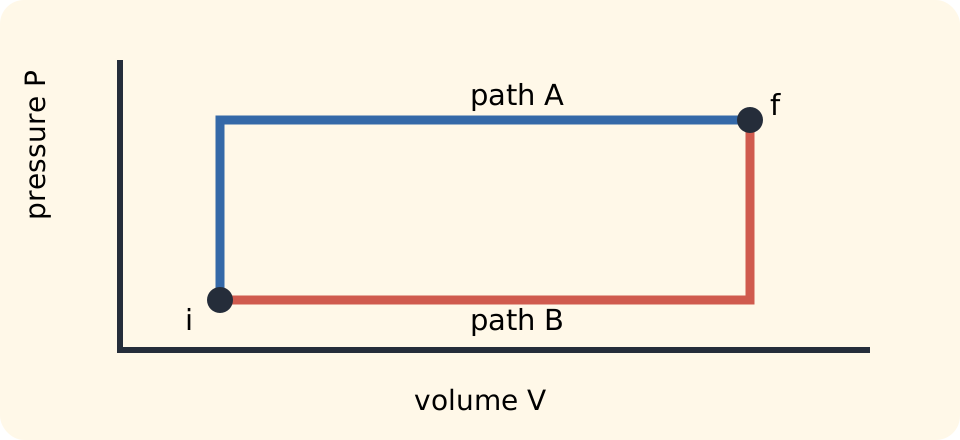
Suppose a gas expands from to against constant pressure . Its work is . At constant pressure over the same volume change, path B gives . Both paths have the same horizontal width on the diagram. Rectangle height differs, so the areas and work transfers differ.
If the two paths connect the same equilibrium states, their internal-energy changes are equal. The first law then requires and . Path A needs more heat input because it sends more work outward. A diagram makes the path dependence concrete. Heat compensates differently while the state change remains fixed.
Analyze isochoric and isobaric processes
An isochoric process occurs at constant volume. Because , pressure–volume boundary work is zero. The closed-system first law reduces to when no other work mode occurs. Heating a gas in a rigid sealed vessel therefore changes internal energy without moving a boundary. Pressure may change even though volume does not.
An isobaric process occurs at constant pressure. Boundary work becomes . In expansion, some incoming heat can raise internal energy while some leaves as work. In compression, and the surroundings do work on the system. The word isobaric provides one constraint but does not imply constant temperature or zero heat transfer.
Consider a gas absorbing while expanding by against . It does . The internal-energy change is . If the same heat entered a rigid vessel, the full would increase internal energy under the simplified model. The process constraint changes the allocation.
Analyze isothermal and adiabatic processes
An isothermal process occurs at constant temperature. For an ideal gas, internal energy depends only on temperature, so . The first law then gives . During isothermal expansion, heat enters while the gas does equal work. Isothermal does not mean no energy crosses the boundary.
For reversible isothermal expansion of an ideal gas, . The natural logarithm acts on the dimensionless ratio . If , the logarithm and work are positive. For compression, the ratio is below one and work by the gas is negative. The formula follows from integrating at constant .
An adiabatic process has . The first law becomes . Ideal-gas adiabatic expansion produces positive work and negative internal-energy change, so temperature falls. Adiabatic compression gives negative work by the gas and positive internal-energy change, so temperature rises. Adiabatic and isothermal describe different constraints.
Distinguish heat capacity and latent energy
For a temperature change without phase change, a common model is . The mass is measured in kilograms, specific heat capacity in , and temperature change in kelvins or Celsius degrees. The product has joule units. This equation calculates a heat transfer under stated conditions, not the complete first-law balance by itself. Work may also occur.
At constant volume for an ideal gas, and , so . At constant pressure, while expansion work also occurs. Consequently for an ideal gas. The difference reflects energy leaving through boundary work during constant-pressure heating. Heat capacity depends on the process constraint.
During a phase change at approximately constant temperature, heat transfer can be modeled as , where is specific latent energy in . Internal energy changes through molecular rearrangement even when . Temperature alone is therefore not a complete measure of stored energy. The phase must be included among the state descriptors. The first law accommodates sensible heating, latent processes, and work within one balance.
Analyze cycles and heat engines
A thermodynamic cycle returns a system to its initial state. Because internal energy is a state function, . The first law gives . Net heat entering over the cycle equals net work delivered. Individual legs can have nonzero internal-energy changes that cancel around the full path.
On a – diagram, net cyclic work is the signed area enclosed by the loop. A clockwise loop ordinarily represents positive net work by the gas. A counterclockwise loop represents net work input under the same axis orientation. Shape and direction both matter. The system returns to its original internal energy even though energy has crossed its boundary throughout the cycle.
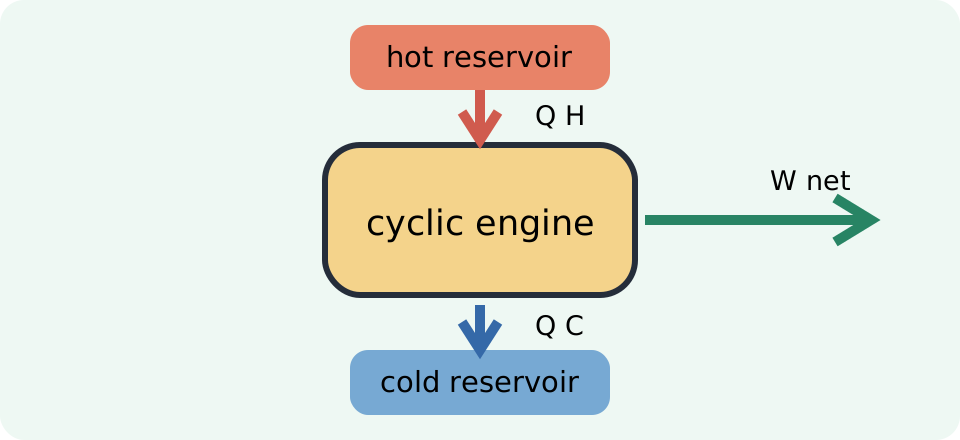
A heat engine absorbs from a hot reservoir, performs net work , and rejects to a colder reservoir. Magnitudes satisfy . The first law requires this accounting but does not determine the maximum possible work fraction. The second law supplies directionality and efficiency limits. Energy conservation alone cannot distinguish a physically reversible engine from an impossible perfect converter.
Analyze refrigerators and heat pumps
A refrigerator uses work input to move energy from a colder region to a warmer environment. For one cycle, energy accounting in magnitudes is . The device removes from the cold space and rejects the larger amount to the warm surroundings. The first law explains why the rear coils release more energy than was removed from the compartment. Work input supplies the difference.
A heat pump uses the same physical cycle but is evaluated for heating the warm space. Its desired transfer is , whereas a refrigerator’s desired transfer is . Coefficients of performance compare desired heat transfer with work input. They can exceed one because they are not thermal efficiencies and because the device moves existing energy in addition to converting work. No conservation law is violated.
Opening a refrigerator door cannot cool a closed room overall. The device removes energy from air near its interior but releases that energy plus electrical work into the same room. Net room internal energy rises. Drawing the room boundary makes this conclusion immediate. System choice prevents a locally cold region from being mistaken for global cooling.
Extend the balance to open systems
When matter crosses a boundary, it carries energy with it. A control-volume balance must include mass-flow contributions in addition to heat and work. In steady-flow devices, incoming and outgoing rates can be compared rather than total amounts over an arbitrary interval. Enthalpy packages internal energy and the flow work required to push matter across a boundary. Here lowercase symbols denote specific energy per unit mass.
A simplified steady-flow balance for one inlet and one outlet is . A dot denotes a rate per unit time, is mass-flow rate, is shaft-work output, is flow speed, and is elevation. Subscripts and label inlet and outlet states. Every bracketed term has units . Multiplying by gives watts.
Turbines, compressors, nozzles, pumps, and heat exchangers are naturally treated as open systems. Different devices permit different terms to be neglected after scale analysis. A nozzle often converts enthalpy change into kinetic energy, while a turbine produces shaft work from a flowing fluid’s energy decrease. The full balance should be written before terms are crossed out. Approximation follows physical reasoning rather than device-name memorization.
Use a systematic accounting workflow
First name the system and interval. Decide whether matter crosses the boundary, draw the boundary, and label every heat, work, and flow arrow. State the work convention beside the governing equation. Identify initial and final states and any process constraints. Predict the signs of transfers and storage changes in words.
Next write the most general relevant balance before applying constraints. Set a term to zero only because a stated condition justifies it, such as for adiabatic behavior or for rigid volume. Solve symbolically so sign structure remains visible. Substitute values with units and keep pressure, volume, energy, and temperature units compatible. Distinguish a transfer magnitude from an algebraic signed value.
Finally test the result. Confirm units, boundary-arrow directions, and energy balance. For an ideal gas, compare the sign of with the sign of . For a cycle, confirm total state-function change is zero. A physically contradictory sign should trigger review before the answer is reported.
Repair common misconceptions
A common mistake is saying that a system “contains heat.” The system stores internal energy, while heat describes a temperature-difference-driven transfer. Another mistake is assuming a temperature increase proves . Adiabatic compression raises temperature with zero heat transfer. Isothermal expansion can receive heat without a temperature increase. Mechanism and state change must remain distinct.
A second mistake is switching work conventions midcalculation. Write either or , define the work symbol, and use it consistently. A negative result is often meaningful rather than an error. Retain the algebraic sign rather than replacing it with an absolute value. Translate signs back into boundary directions after solving.
A third mistake is using for every process. That shortcut requires constant resisting pressure. Variable-pressure quasistatic work requires an integral, and rapid irreversible processes require careful boundary-pressure modeling. Process names do not erase path dependence. The pressure–volume diagram should agree with the chosen calculation.
Practice with units and interpretation
A system absorbs by heating and does of work. Under the work-by convention, . Internal energy increases because net transfer is inward. State which arrow enters and which leaves the system. Explain why both heat and work can be positive in the same process.
A gas releases while of work is done on it. Thus and . The first law gives . The gas loses energy through heating but gains more through compression work. Predict the likely ideal-gas temperature-change sign.
A gas expands at from to while internal energy rises by . Work is . Rearrangement gives . Explain why heat input must exceed the internal-energy increase. Verify that reduces to joules.
Consolidate the first-law framework
The first law is an accounting identity grounded in energy conservation. For a closed system using work done by the system, . Internal energy is stored and state-dependent, while heat and work are path-dependent transfers. The system boundary and sign convention give every term meaning. Without them, a correct-looking equation can represent the wrong physical story.
Process constraints simplify the balance. Isochoric means zero pressure–volume boundary work, isobaric permits , isothermal ideal-gas motion gives zero internal-energy change, and adiabatic means zero heat transfer. Cycles give zero net state-function change while permitting net heat and work. Open systems add energy carried by matter. These are branches of one framework rather than unrelated formulas.
Strong thermodynamic reasoning moves among boundary diagrams, words, equations, units, and process graphs. It predicts signs before arithmetic and checks that energy entering, leaving, and remaining is fully accounted for. The first law states what energy amounts must balance, while the second law will add direction and quality constraints. Conservation is necessary, but it is not the entire thermodynamic story. Mastering the accounting framework makes that later distinction much clearer.