
Energy conservation is most useful when treated as an accounting discipline. A falling object, a compressed spring, a rolling wheel, and a braking car look different, yet each can be analyzed by naming a system, identifying its energy stores, and recording energy transfer across the boundary. The formulas are entries in that account rather than isolated recipes. A correct solution must preserve energy, units, signs, and physical interpretation at the same time. This lesson develops a repeatable framework and asks you to justify every term you include.
The same discipline scales from classroom mechanics to engineering analysis. Keep a three-column ledger while you work. Label the columns initial state, transfer across the boundary, and final state. Before calculating, predict which stores should increase and which should decrease. After calculating, compare the sign and magnitude of every change with that prediction. This routine creates feedback at each step and makes an implausible answer easier to locate.
Define the system before writing an equation
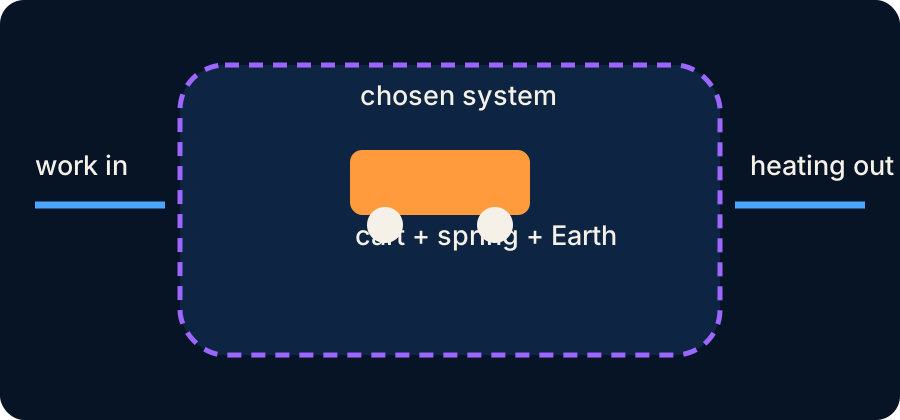
A system is the collection of objects whose energy you choose to track. Everything not included belongs to the surroundings, and the conceptual boundary separates the two. Energy stored inside the boundary appears as a system energy term, while energy crossing the boundary appears as a transfer term. Changing the system does not change the physical event, but it changes the bookkeeping language used to describe that event. Therefore, the first written line of an energy solution should name the system rather than display a formula.
Imagine a ball falling near Earth. If the system contains the ball and Earth, their gravitational interaction is internal and gravitational potential energy belongs in the account. If the system contains only the ball, gravity is an external interaction that transfers energy by work. Both choices can produce the same speed when used consistently. Mixing the two descriptions by including gravitational potential energy and external gravitational work in the same account counts one interaction twice.
Initial and final states complete the accounting frame. A state is a snapshot described by relevant positions, speeds, temperatures, deformations, and rotations. The interval between states may contain a complicated path, but an energy balance often requires only the state information and total transfers. Marking the states prevents a learner from combining a height from one instant with a speed from another. It also clarifies whether a store is unchanged and can be canceled before arithmetic begins.
Identify energy stores by physical mechanism
Kinetic energy is energy associated with motion. Translational kinetic energy is , where is mass and is the speed of the center of mass. The factor is dimensionless, so the units are . The joule, abbreviated , is equivalent to . Because speed is squared, reversing the direction of motion does not make kinetic energy negative.
Potential energy is stored in an interaction because of configuration. Near Earth, gravitational potential energy may be written , where is the gravitational field magnitude and is vertical position relative to a chosen zero. For an ideal spring, elastic potential energy is , where has units and is displacement from equilibrium. The mass alone does not “contain height energy,” and the spring alone does not contain all elastic energy independently of its interacting supports. Potential energy belongs to the chosen interacting system and changes when its configuration changes.
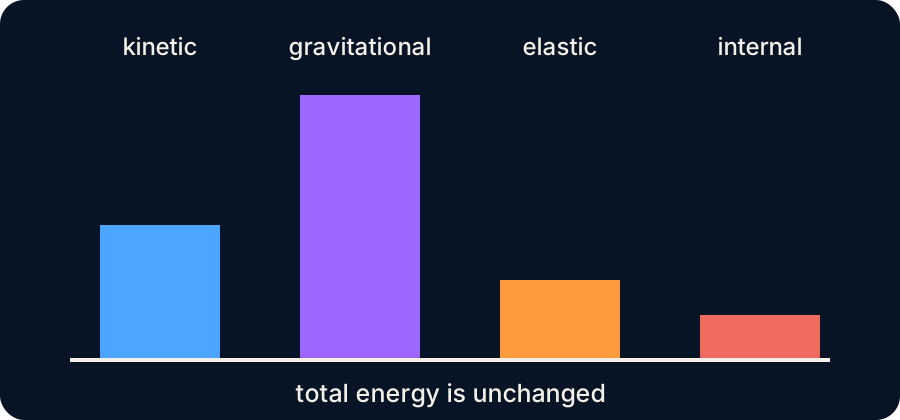
Internal energy collects microscopic kinetic and interaction energies that are not resolved as organized mechanical motion. Friction can increase internal energy by producing disordered molecular motion and deformation in contacting objects. Chemical energy is also an internal interaction store associated with molecular and electronic configuration, and a battery or fuel can decrease that store while transferring energy elsewhere. Thermal language should therefore describe a mechanism or state change rather than imply that energy disappeared. Naming the receiving store preserves the complete account when mechanical energy decreases.
Include rotational kinetic energy when the model requires it
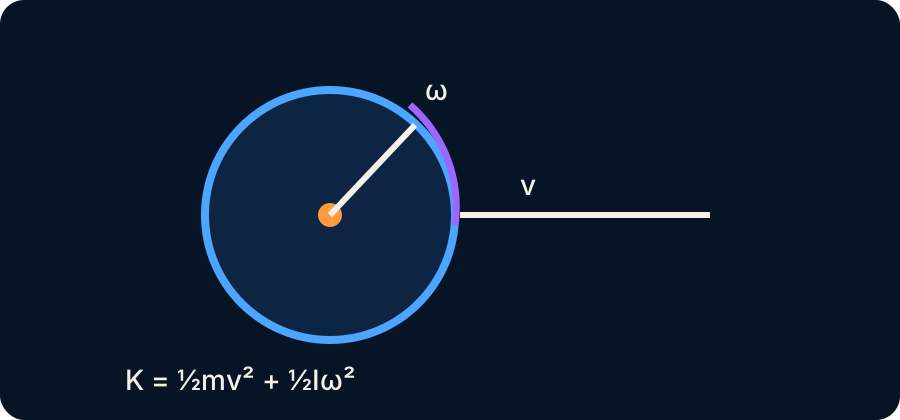
A rigid body can translate and rotate at the same time. Its rotational kinetic energy is , where is the moment of inertia about the rotation axis and is angular speed. Moment of inertia has units , while angular speed has units . Because the radian is dimensionless, the product again has joule units. The total kinetic energy can be , with the subscript “cm” identifying the center of mass.
Introductory problems often ignore rotation because the moving object is modeled as a particle. A particle model represents all mass at one point, so it has no spatial mass distribution and no moment of inertia to track. Rotation may also be irrelevant when an object slides without appreciable spinning or when rotational energy is negligibly small compared with other terms. This omission is an assumption, not a universal property of kinetic energy. A careful solution should say when the particle approximation is being used.
For rolling without slipping, translation and rotation are linked by , where is the rolling radius. A solid cylinder has , so its total kinetic energy becomes . Ignoring rotation would assign only and would therefore predict too much speed for a given energy decrease. The missing energy has not vanished; it resides in rotational motion. Comparing a sliding block with a rolling cylinder is a useful contrast because it isolates the effect of mass distribution.
Build the general energy balance
For a closed bookkeeping interval, a useful balance is . The Greek letter delta, , means final value minus initial value, so . The terms and describe transfer across the boundary by work, heating, radiation, electrical processes, or matter flow when relevant. In many mechanics problems the same idea is written . Here is external work on the system and is energy transferred into the system by heating under the stated sign convention.
The expanded system energy might be . This expression is a menu of possible stores, not a demand to use every term. Include a term only when the chosen system possesses that store and its value changes or matters to the comparison. Terms equal in the initial and final states cancel, and stores excluded by an explicit model assumption never enter. Writing the expanded account before simplifying makes those decisions visible to a reviewer.
Sign conventions must be declared and then applied consistently. One convention treats work done on the system as positive and work done by the system as negative. Another writes all transfers with explicit directional labels rather than signed symbols. Either method is valid if each term’s meaning is clear and the final balance is dimensionally consistent. A common error is to memorize “friction is negative” even though friction internal to a larger system may instead appear as a positive change in internal energy.
Work a falling-object example with units
Consider a ball released from rest above the chosen zero, with air resistance neglected. Choose the ball–Earth system, so gravity is internal and appears in the account. The initial kinetic energy is zero because , and the final gravitational potential energy is zero by the reference choice. The balance is . The symbol denotes the final speed, and mass cancels because both remaining terms are proportional to .
Using gives . Substitution yields . Inside the square root, the units are , so the positive root has units . Speed is reported as positive because it is a magnitude, although a velocity component would need a sign based on the coordinate axis. The result is smaller if air resistance transfers energy into internal energy of the air and ball.
Several checks reinforce the reasoning. Doubling the drop height multiplies speed by , not by , because kinetic energy depends on speed squared. Setting the height to zero produces zero speed for release from rest, which matches the limiting physical case. The canceled mass predicts the same ideal fall speed for different masses under the model assumptions. A force-and-kinematics solution gives the same result, providing an independent representation check.
Analyze springs, friction, and internal energy
Take a cart released from rest by a spring with compressed on a level frictionless track. Choose the cart and spring as the system, and compare the compressed state with the instant the spring reaches equilibrium. The energy balance is . Substituting the measured values gives . The square-root factor has units , so multiplying by metres produces speed units.
Now suppose kinetic friction of magnitude acts over . If the cart, track, and spring are all inside the system, friction transfers organized mechanical energy into internal energy within the boundary. The account becomes , with . The initial spring store is , leaving as translational kinetic energy. Solving gives , which is sensibly lower than the frictionless value.
If the system includes only the cart, the spring and track are external. Spring work adds energy to the cart, while frictional work removes energy from the cart’s organized motion. The resulting numerical speed agrees with the larger-system account when signs and boundaries are consistent. Comparing the two accounts shows that “negative work” and “increased internal energy” can describe the same physical interaction from different system choices. The comparison also explains why total energy remains conserved even when mechanical energy does not.
Extend the framework to rolling and coupled stores
Consider a solid cylinder of mass and radius rolling without slipping down a vertical drop of . Choose the cylinder–Earth system and neglect rolling resistance. The balance is . Substituting and reduces the final side to . Solving gives when .
A particle sliding frictionlessly through the same vertical drop would reach . The rolling cylinder is slower because part of the gravitational energy decrease appears as rotational kinetic energy. Static friction can enforce the rolling constraint without necessarily transferring energy as thermal energy at the contact point. The result depends on the moment of inertia, so a hoop and solid sphere reach different speeds despite equal mass and radius. This example demonstrates why rotational motion must not be omitted merely because the center of mass is translating.
Coupled-store problems become manageable when the ledger is built before numbers are inserted. A mass attached to a vertical spring may change gravitational potential, spring potential, translational kinetic, and internal energy during one interval. Write every plausible store, mark whether each rises or falls, and eliminate only terms justified by the chosen states. Solve symbolically long enough to expose cancellations and parameter dependence. Numerical substitution should be the final stage, not the method used to discover the physics.
Validate the account and consolidate learning
Every completed solution deserves four checks. First, dimensional consistency requires every additive term to have joule units. Second, sign consistency requires predicted increases and decreases to agree with the calculated changes. Third, limiting cases should behave sensibly when friction, compression, height, or rotation is set to zero. Fourth, the answer’s magnitude should fit the available energy, because no modeled store can supply more energy than it initially contains without an external transfer.
Common errors can be diagnosed by asking which accounting decision failed. Double-counting gravity usually means the system boundary was not respected. A negative value for often signals an impossible proposed final state or an incorrect sign. Missing rotational energy usually reflects an unjustified particle approximation. Calling frictional energy “lost” usually means the receiving internal store or surroundings were omitted from the verbal explanation.
Use retrieval and comparison to make the framework durable. Without notes, sketch the system boundaries for a falling ball, a spring-launched cart, and a rolling cylinder. For each, list the initial stores, transfers, and final stores before writing equations. Then explain why two different boundary choices can yield different-looking equations but the same observable prediction. If you can defend every term, unit, sign, and omission, you are using conservation of energy as an accounting framework rather than as a formula-selection trick.
A further consistency test is to reconstruct the account from measured data rather than from a requested unknown. Suppose a cart slows from to while remaining at the same height. Its translational kinetic-energy change is . If the cart and braking mechanism form the system and no appreciable energy crosses the boundary, the internal-energy store must increase by approximately . This reverse accounting checks whether the named stores can explain the observed motion without inventing a loss term.
The framework also reveals the limits of an idealized answer. Real measurements have uncertainty, air drag may transfer energy outside the selected system, springs may not obey Hooke’s law at large deformation, and rolling bodies can deform or slip. A numerical equality should therefore be read as a consequence of the declared model rather than proof that every physical interaction was represented. When observations disagree beyond measurement uncertainty, revisit the boundary, the chosen stores, and the neglected transfers before rejecting conservation itself. Conservation of energy is the invariant principle, while the particular ledger is a model whose completeness must be defended.