
Impulse answers a practical question: how does a force acting through time change an object’s motion? A force by itself is not the whole story because a brief force and a sustained force can have very different effects. The duration by itself is also incomplete because time must be paired with the net force acting during it. Impulse combines those ideas and equals the resulting change in momentum. That connection makes it useful for catching a ball, analyzing a crash, launching a rocket, and interpreting a force sensor.
This lesson develops impulse rather than presenting it as an isolated formula. You will begin with momentum and Newton’s second law, preserve vector directions, and then interpret area on a force–time graph. Worked examples will include units at every numerical step so that dimensions help check the reasoning. You will also distinguish average force from peak force, an essential distinction in safety analysis. By the end, you should be able to tell a complete physical story before pressing calculator buttons.
Learning is strongest when a new relationship connects to an existing mental model. Here, the familiar idea is that net force changes motion, while the new idea is that the change accumulates over time. Pause at each prediction prompt and commit to an answer before reading onward. Sketching direction arrows and rough graphs will reveal more than memorizing symbolic patterns. Treat every example as a model of a system with explicit boundaries, assumptions, and signs.
Learning objectives and a diagnostic prediction
After this lesson, you should be able to derive the impulse–momentum theorem from Newton’s second law. You should calculate impulse for constant, piecewise, and continuously varying net forces. You should interpret signed area beneath a force–time graph and explain why an area below the time axis is negative. You should use average force without confusing it with the largest instantaneous force. You should also explain how increasing collision time can reduce force even when momentum change stays fixed.
Imagine two identical carts initially at rest. Cart A experiences to the right for , while cart B experiences to the right for . Predict which cart finishes with more momentum before doing arithmetic. Both products equal , so the carts receive equal impulse. If their masses are equal, they also finish with equal velocity because equal momentum divided by equal mass gives equal velocity.
Now alter cart B so its force acts left instead of right. The force magnitude and duration remain unchanged, but its impulse points left. This change shows why impulse is a vector rather than merely a positive product. A sign convention converts direction into algebra, but the physical arrow must be chosen first. Write the positive direction on the page before substituting any values.
Begin with momentum as a state quantity
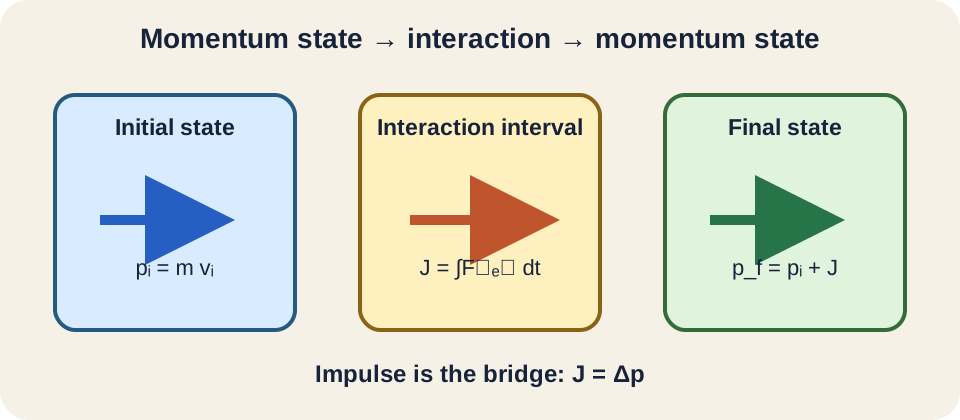
Linear momentum is defined by . The bold symbol denotes momentum as a vector, denotes mass in kilograms, and denotes velocity in meters per second. For constant mass, momentum points in the same direction as velocity. Its SI unit is . Momentum describes the object’s motion at an instant, so it is a state quantity rather than an interaction occurring over an interval.
A momentum change is . The Greek capital delta, , means final value minus initial value. Subscripts and label final and initial states rather than multiplication factors. A negative component of does not mean the object has “negative momentum” in an absolute sense. It means the momentum change points opposite the direction chosen as positive.
Suppose a cart changes from to . Its momentum change is . The negative result says the change points left under this convention. Notice that reversal produces a larger change than merely stopping at zero. The signed subtraction captures both the speed change and the direction change.
Derive the impulse–momentum theorem
Newton’s second law in momentum form is . The numerator represents an infinitesimal change in momentum, while the denominator represents an infinitesimal time interval. Their ratio is the instantaneous rate at which momentum changes. The subscript “net” matters because individual forces must be vector-added before predicting the momentum change. An applied force alone is insufficient if friction, tension, gravity, or another force also acts.
Multiply both sides by and accumulate from initial time to final time . The result is . The integral sign means continuous accumulation, and its lower and upper limits identify the interval. The right integral evaluates to . This produces the impulse–momentum theorem without adding a separate law.
Define impulse by . The symbol announces a definition, and is the conventional symbol for impulse. Combining the definition with the derivation gives . Impulse describes the accumulated effect of the net force during an interval, whereas momentum describes the state before or after it. Equal units confirm the relationship: .
Constant force is a special case
If net force remains constant in magnitude and direction, it can be taken outside the integral. Then . Here is elapsed time in seconds and cannot be negative for the ordinary forward interval. The vector direction comes from . This compact product is a special case of the integral definition, not the definition for every situation.
Consider a constant eastward net force acting for . Choose east as positive, so . The positive sign indicates east and the unit is newton-second. The momentum therefore changes by . If the object began at , it would finish at .
Do not substitute a changing force into the constant-force product without justification. A collision force commonly rises from zero, reaches a peak, and falls back toward zero. Multiplying the peak by the full duration would generally overestimate impulse. One may instead integrate the curve or use a correctly defined average force. The shape of the force history determines which method is valid.
Force–time area represents impulse
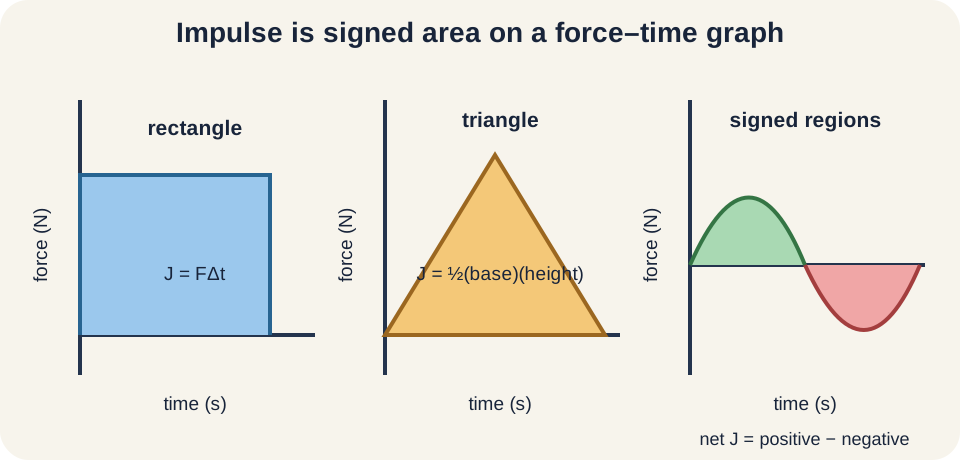
On a graph of force versus time, a narrow strip has approximate area . Adding all strips and shrinking their widths produces . Therefore the signed area between the net-force curve and the time axis equals impulse. The horizontal axis carries seconds and the vertical axis carries newtons, so area carries newton-seconds. Dimensional analysis makes the graphical meaning visible.
Area above the time axis is positive when upward force values represent the chosen positive direction. Area below the axis is negative because the force component points in the opposite direction. Positive and negative regions must be combined algebraically rather than adding their magnitudes. A force pulse can produce zero net impulse if its positive and negative areas cancel. Zero net impulse means unchanged momentum, not necessarily zero force at every instant.
For a rectangular pulse, area is base times height. For a triangular pulse, area is . A trapezoid can be divided into a rectangle and triangle or evaluated by average parallel sides times width. Curved data may be approximated with small trapezoids from measured samples. Increasing the sampling rate can improve the numerical approximation when the sensor resolves the changing force accurately.
Average force preserves total impulse
Average net force over an interval is defined by . Substituting the impulse definition gives . The horizontal fraction bar means the accumulated impulse is divided by the elapsed time. This average is chosen so that a constant force of that value would create the same impulse during the same interval. It is not automatically the arithmetic mean of the initial and final force values.
Average and peak force answer different questions. Average force summarizes the entire interaction, while peak force is the largest instantaneous magnitude recorded. A narrow sharp peak can be much larger than the average without contributing most of the area. Biological injury and material failure may depend strongly on the peak, loading rate, location, and stress distribution. Consequently, an impulse calculation alone does not fully predict safety.
Suppose a triangular force pulse lasts and peaks at . Its impulse magnitude is . Its average force is . The average is half the peak because the ideal triangular curve spends most of its time below the peak. A rectangular pulse with the same duration and peak would instead deliver .
Worked example: catching and reversing a ball
A ball initially travels right at . A player catches it and leaves it at rest in . Choose right as positive. The initial momentum is . The final momentum is .
Impulse is the final momentum minus the initial momentum. Thus . Average net force is . The negative sign says the force on the ball points left, opposite its initial motion. The player’s hands experience an oppositely directed force from the ball by Newton’s third law.
Now suppose the player throws the same ball back left at during the same contact time. Final momentum becomes . Impulse becomes . The average net force becomes . Reversing the ball requires more impulse than merely stopping it because the final and initial momenta lie on opposite sides of zero.
Worked example: a piecewise force history
A cart experiences from to , then from to . The first rectangular area is . The second is . Net impulse is . The force changes direction, but the positive portion has greater signed area.
If the cart’s initial momentum is , its final momentum is . This equation is obtained by rearranging . The cart must pass through zero momentum at some time during the positive-force interval. Its direction reverses even though the net impulse calculation alone does not identify the exact reversal time. Finding that time requires examining accumulated area up to intermediate moments.
Across the full interval, average net force is . Neither actual force segment equals . The average is an equivalent constant force for total impulse only. It should not be described as the force the cart “usually” experiences. Equivalent summaries preserve selected quantities while discarding time detail.
Collision time and safety engineering
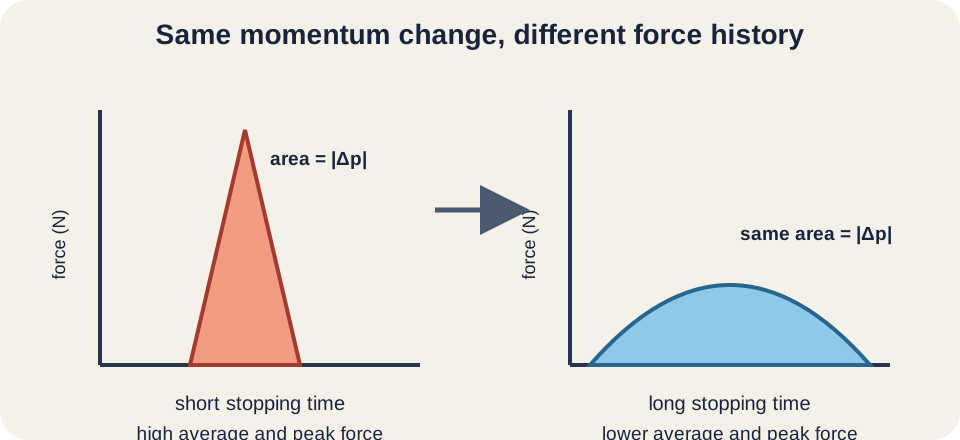
For a fixed momentum change, shows that increasing stopping time decreases average force magnitude. Airbags, crumple zones, padded mats, and bent knees extend the interval over which momentum changes. They do not generally eliminate the required impulse because the person or object must still change from its initial momentum to its final momentum. Instead, they reshape the force history. The same signed area is spread across a wider time interval. That distinction prevents the misleading statement that safety devices “absorb momentum.”
Consider a passenger moving at who comes to rest. The momentum-change magnitude is . If stopping occurs in , the average-force magnitude is . If a restraint system extends stopping to , the magnitude falls to . The impulse remains in both simplified cases.
Real injury risk is more complex than this one-dimensional model. Force distribution across the body, belt geometry, head acceleration, rotation, tissue response, and peak timing all matter. A longer stopping distance often accompanies a longer stopping time, but those quantities are not interchangeable. Energy methods also matter because structures deform and transform kinetic energy. Impulse reasoning supplies one essential layer of a larger engineering analysis.
System boundaries and internal impulses
Impulse–momentum reasoning always refers to a selected system. For a single ball, the hand’s contact force is external and changes the ball’s momentum. For the combined hand–ball system, their mutual contact forces are internal and cancel in the system momentum balance. External forces such as support forces and gravity may still contribute impulse. Changing the boundary changes which interactions appear explicitly, but it does not change the underlying event.
For a system of several particles, . The capital denotes total system momentum, the vector sum of individual momenta. Internal force pairs can exchange momentum among members without changing total momentum when their impulses cancel. If external impulse is negligible during a short collision, total system momentum is approximately conserved. This is the bridge from impulse to collision analysis.
“Negligible” is a comparison rather than a synonym for exactly zero. During a brief cart collision, gravity and track normal force may cancel vertically, while horizontal friction supplies only a tiny impulse compared with contact impulse. The system’s horizontal momentum can then be treated as conserved to experimental precision. Over a long interval, the same small friction force may accumulate a significant impulse. Timescale is therefore part of the modeling decision.
Common misconceptions and diagnostic repairs
One misconception is that impulse is force. Their units expose the error: force uses newtons, while impulse uses newton-seconds. Another misconception is that a large force always creates a large momentum change. A large force acting for an extremely short time may provide less impulse than a modest force sustained longer. Compare force–time areas before judging the outcome.
A second misconception is that impulse equals . Impulse equals a change in momentum, , for constant mass. Omitting the initial momentum works only when the object begins from rest. Reversal problems are especially vulnerable because the two signed momenta must be subtracted correctly. Draw initial and final velocity arrows before writing the algebra.
A third misconception is that the area under any force graph gives the desired object’s impulse. The graph must represent the net force on that chosen object or system. A sensor may measure one contact force while other forces also act. Determine whether those other impulses are negligible, cancel, or must be included. Labeling the graph with both the force source and the object receiving the force removes ambiguity.
Practice with feedback
First, a westward net force acts for . Choose east as positive and determine the impulse. Second, a triangular positive force pulse lasts and reaches ; determine impulse and average force. Third, a ball changes from to in ; determine average net force. Predict every sign before calculating.
For the first problem, west is negative, so . For the second, triangular area gives , and . For the third, . Dividing by gives . The negative signs in the first and third answers encode direction rather than an invalid magnitude.
Check each solution three ways. First, the sign must agree with the force or momentum-change direction. Second, impulse units must reduce to or . Third, the numerical scale should fit the graph or physical story. These checks catch reversed subtraction, missing triangular factors, and unconverted time units.
Retrieval, synthesis, and connection forward
Without looking back, state the impulse–momentum theorem in words and symbols. Explain every symbol in . Sketch a force pulse containing positive and negative regions, then identify the signed net impulse. Compare your graphical area with the momentum difference it predicts. Finally, explain why extending stopping time lowers average force for fixed momentum change without claiming that impulse disappears.
Use a two-column comparison to distinguish state from process. Momentum belongs to an instant and uses , while impulse belongs to an interval and uses the equivalent . The theorem connects them because accumulated external force changes momentum. Average force compresses the interval into one equivalent value, while the original force curve preserves timing and peaks. Keeping these roles separate supports durable understanding.
The next lessons extend this framework to conservation of momentum and collisions. When external impulse on a chosen system is negligible, the system’s total momentum changes negligibly. Collision models then combine momentum conservation with additional information about energy or restitution. Impulse also connects to rotational mechanics through angular impulse and angular momentum. The same accumulation idea will reappear whenever a rate acts across an interval.